

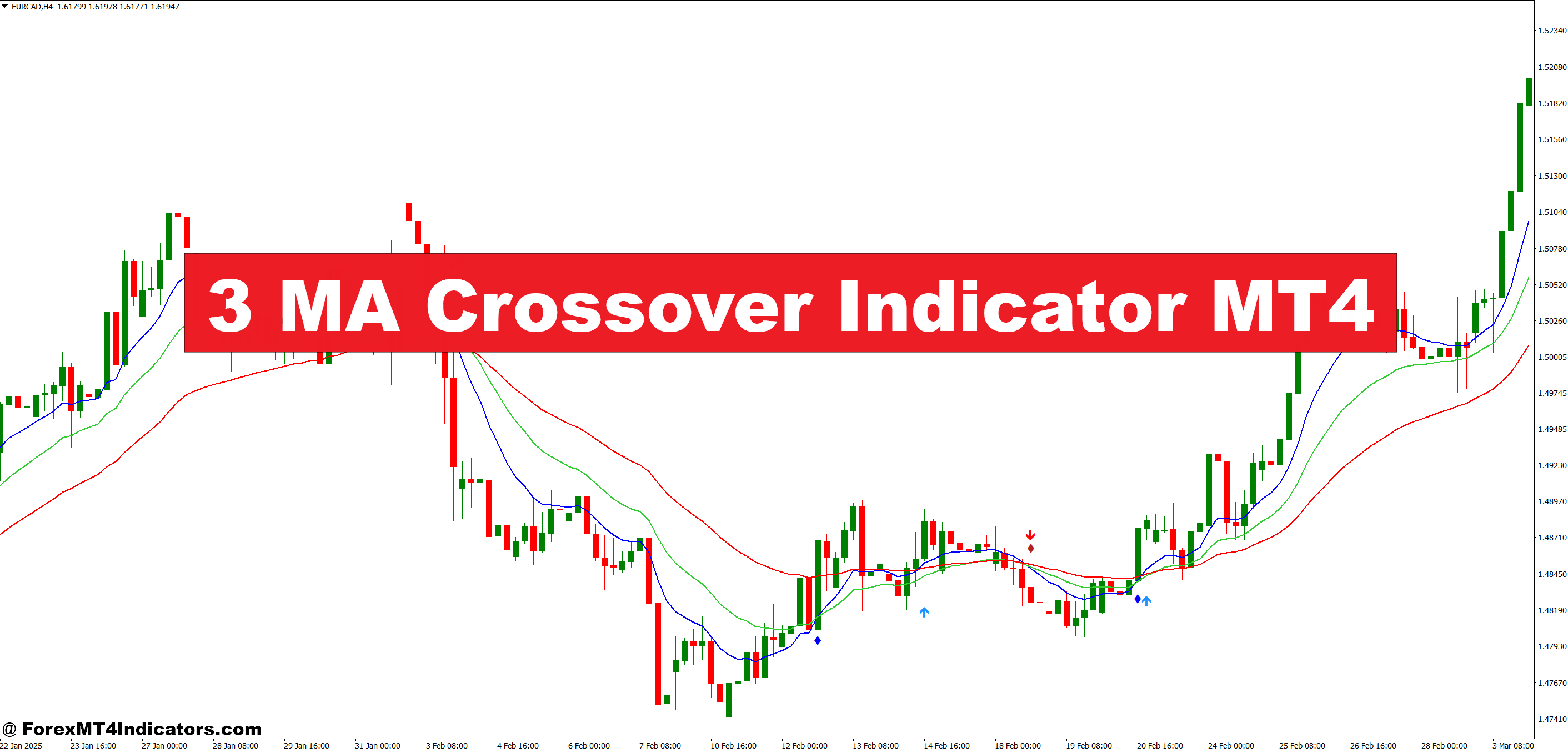
The 3 MA crossover indicator MT4 tackles this by layering three moving averages—fast, medium, and slow—to filter out noise and confirm trend direction. When all three align in a specific order, it signals stronger conviction than any single moving average could provide. This setup helps traders catch meaningful moves while avoiding the fake-outs that plague simpler systems.
What the 3 MA Crossover Indicator Actually Does
This indicator plots three exponential or simple moving averages on a chart simultaneously. Typical configurations use periods like 5, 10, and 20 (fast scalping), 10, 20, and 50 (swing trading), or 20, 50, and 200 (position trading). The magic happens when these lines stack in proper order.
For bullish alignment, the fastest MA sits above the medium MA, which sits above the slowest MA. Think of it as a staircase pattern where each step confirms the uptrend. When price trades above this entire structure, the trend bias is clearly up. Bearish alignment flips this—fast below medium, medium below slow—signaling downtrend conditions.
The crossover signals occur when these MAs change their relative positions. A fast MA crossing above the medium MA while both sit above the slow MA provides a strong buy signal. The reverse generates sell signals. This triple-layer confirmation reduces the false signals that plague dual MA systems.
Technical Mechanics Behind the Signals

Each moving average responds to price at different speeds. The 5-period MA hugs price closely, reacting to every minor wiggle. The 20-period MA smooths out short-term noise, showing the intermediate trend. The 50-period MA reveals the dominant directional bias.
When testing this on GBP/JPY 4-hour charts during trending weeks, the alignment held remarkably well. Price would pull back to the fast MA, bounce, then continue the primary trend. Those bounces offered lower-risk entries compared to chasing price away from the MA cluster.
The calculation uses standard MA formulas—either simple (arithmetic average of closing prices) or exponential (weighted toward recent prices). Most traders prefer exponential MAs for forex since they respond faster to changing conditions. The MT4 platform calculates these automatically; traders just need to apply the indicator three times with different period settings.
Here’s the thing: The indicator doesn’t predict where price will go. It confirms where price has been and identifies when momentum shifts. That distinction matters for risk management and expectation setting.
Real-World Trading Applications
Let’s get specific. On USD/CAD daily charts, a trader might use the 10/20/50 configuration. When crude oil prices dropped in late 2024, USD/CAD rallied hard. The 10 MA crossed above the 20 MA around the 1.3500 level. Three days later, the 20 MA crossed above the 50 MA, confirming the uptrend.
A trader entering when full alignment confirmed could have ridden that move from 1.3550 to 1.3850—a 300-pip gain. The exit signal came when the 10 MA crossed back below the 20 MA, suggesting momentum was fading. Not every trade works this cleanly, but the structure provides a framework.
For shorter timeframes, the 5/10/20 setup on EUR/USD 15-minute charts works during London session volatility. These tighter MAs generate more signals—probably 8-12 per session. The tradeoff? More false signals during ranging periods, especially during Asian session chop.
That said, combining the 3 MA crossover with support and resistance zones improves accuracy. When a bullish crossover happens at a tested support level, the probability of follow-through increases. Same concept applies bearish at resistance.
3 MA Crossover Indicator MT4 Customization
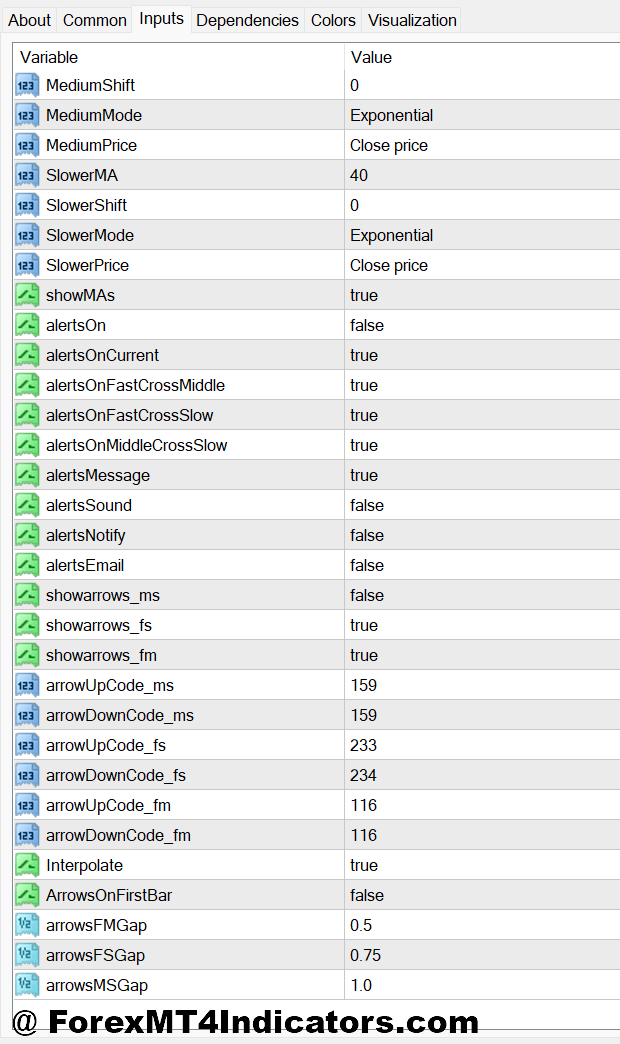
Scalpers typically tighten the MA periods. A 3/8/15 configuration on 5-minute charts generates quick signals for rapid entries and exits. The risk is getting chopped up during low-volatility periods when these MAs bunch together without clear direction.
Swing traders find the 20/50/100 setup on daily charts more reliable. These slower MAs filter out intraday noise, focusing on multi-day trends. A position might stay open for weeks when all three MAs maintain proper alignment. The patience required tests most traders, but the reward-to-risk ratio improves significantly.
Position traders go even slower with 50/100/200 on weekly charts. These ultra-slow MAs help identify major trend changes that last months. But the signals are rare—maybe 2-3 quality setups per year on any given pair. The commitment and capital requirements suit only certain trading personalities.
The MA type matters too. Exponential MAs (EMA) react faster, generating earlier signals but more false positives. Simple MAs (SMA) lag more, providing later but potentially more reliable signals. Some traders mix them—using EMA for fast and medium, SMA for the slow baseline.
Honest Assessment: Strengths and Weaknesses
The biggest advantage is trend confirmation through multiple layers. When all three MAs align, it indicates genuine momentum rather than random price fluctuation. This filtering keeps traders on the right side of strong moves.
The system also provides clear visual guidance. Even newer traders can look at the chart and immediately recognize trend conditions. No complex calculations required during trading hours—the alignment speaks for itself.
But here are the limitations nobody likes to mention. During sideways markets, the MAs tangle together, generating conflicting signals. A trader might enter long on a fast MA crossover, only to see the medium MA reject that signal hours later. These whipsaw losses eat into profits earned during trending periods.
The indicator lags by design. Moving averages calculate based on past prices, so they’ll never catch the absolute top or bottom. Traders accepting this enter after trends establish and exit after momentum fades. The middle portion of the move is the target, not the extremes.
Another issue: Fast-moving news events can blow through MA levels without respecting them. A surprise central bank decision might send price 100 pips in minutes, crossing all three MAs instantly. The indicator provides no protection against these volatile spikes.
How It Compares to Other Trend Tools
The MACD histogram shows momentum changes but doesn’t provide price levels for entries and exits. The 3 MA crossover plots actual price zones where traders can place orders, making execution more straightforward.
The Ichimoku Cloud offers similar multi-layered trend confirmation but with more complexity. Five lines instead of three, plus cloud projections. Traders preferring simplicity often choose the 3 MA system over Ichimoku’s visual density.
Bollinger Bands measure volatility rather than trend direction directly. They help identify overbought/oversold conditions but don’t confirm trend the way stacked MAs do. Many traders combine both—using MAs for direction and Bollinger Bands for entry timing.
The RSI indicator works differently too, oscillating between 0-100 to show momentum extremes. It provides countertrend signals when price is extended, while the 3 MA crossover confirms the prevailing trend. These tools complement rather than compete with each other.
How to Trade with 3 MA Crossover Indicator MT4
Buy Entry

- Fast MA crosses above medium MA – Enter long when the 10 MA crosses above the 20 MA while both sit above the 50 MA on EUR/USD 4-hour charts, confirming bullish momentum alignment.
- Price bounces off fast MA – Take entries when price pulls back to touch the 10 MA during uptrends and bounces with a bullish candle close, targeting 30-50 pip moves on GBP/USD.
- All three MAs show separation – Only enter when at least 15-20 pips separate each MA from the next, indicating strong trend rather than choppy consolidation on daily charts.
- Wait for medium MA to flatten or turn up – Skip signals if the 20 MA still slopes downward even after a fast MA crossover, as this suggests weak momentum that often fails.
- Place stop loss below slow MA – Set your stop 5-10 pips below the 50 MA to protect against false breakouts while giving the trade room to breathe on 1-hour timeframes.
- Avoid trading during MA compression – Don’t take buy signals when all three MAs bunch within 10 pips of each other, especially during Asian session on major pairs like EUR/USD.
- Confirm with price structure – Enter only when the crossover happens near support zones or previous swing lows, not in the middle of nowhere with no technical confluence.
- Risk 1-2% maximum per trade – Never risk more than 2% of your account on a single 3 MA crossover signal, regardless of how perfect the alignment looks.
Sell Entry

- Fast MA crosses below medium MA – Enter short when the 10 MA drops below the 20 MA while both trade beneath the 50 MA on USD/JPY 4-hour charts, confirming bearish structure.
- Price rejects from fast MA – Take shorts when price rallies to test the 10 MA during downtrends and forms a bearish rejection candle, targeting 40-60 pip drops on GBP/USD.
- MAs stack in bearish order – Confirm the fast MA sits below medium, and medium sits below slow with visible separation of 20+ pips on daily charts before entering.
- Watch for medium MA turning down – Wait for the 20 MA to curve downward after the crossover rather than entering immediately, as this confirms declining momentum on 1-hour timeframes.
- Set stop above slow MA – Place stops 5-10 pips above the 50 MA to avoid getting stopped by normal price fluctuations while protecting capital on EUR/USD trades.
- Skip signals during low volatility – Avoid sell entries during compressed MA conditions or when average true range drops below 60 pips on daily EUR/USD charts.
- Look for resistance confluence – Only take short signals when the crossover occurs near resistance levels, trend lines, or previous swing highs for higher probability setups.
- Don’t trade news events – Exit positions or avoid new entries 30 minutes before and after major economic releases like NFP, central bank decisions, or GDP data regardless of MA alignment.
Making It Work in Your Trading
Trading forex carries substantial risk. No indicator guarantees profits, and past performance doesn’t predict future results. The 3 MA crossover indicator provides structure and confirmation, not certainty.
Start by testing different MA periods on demo accounts. What works on GBP/USD might fail on AUD/JPY due to different volatility characteristics. Each pair has its own personality, and MA settings should reflect that. Keep detailed notes on what configurations produce the best results for your preferred pairs and timeframes.
Watch for MA convergence as a warning sign. When all three MAs bunch together with minimal separation, it indicates indecision. The next signal from this compressed state often carries more weight than signals during wide separation. Some traders avoid entries entirely during MA convergence, waiting for clear separation before risking capital.
The key takeaway: This indicator works best for trend-following traders who accept that most markets don’t trend most of the time. During the 30-40% of time when clear trends develop, the 3 MA crossover shines. During ranging conditions that dominate the remaining 60-70% of market time, it struggles like all trend-following tools.
Consider using the alignment as a filter rather than a standalone system. When the MAs show bullish alignment, only take long setups from other strategies. When bearish alignment forms, only take short setups. This framework prevents fighting the dominant trend, which is where most trading accounts die.
Recommended MT4/MT5 Broker
XM Broker
- Free $50 To Start Trading Instantly! (Withdraw-able Profit)
- Deposit Bonus up to $5,000
- Unlimited Loyalty Program
- Award Winning Forex Broker
- Additional Exclusive Bonuses Throughout The Year
- Exclusive 90% VIP Cash Rebates for all Trades!

Already an XM client but missing out on cashback? Open New Real Account and Enter this Partner Code: VIP90
(Free MT4 Indicators Download)



Enter Your Email Address below, download link will be sent to you.