


Last updated:
Forex scalping is a fast style where you take many small trades on the M1 or M5 chart, holding seconds to minutes for a few pips each. A scalping setup works when three things line up: a fast timeframe, a tight spread on a liquid pair, and one clear trigger to enter and exit — nothing more.
Key takeaways
- Scalping means opening and closing trades in seconds to minutes on the M1–M5 charts, targeting a small number of pips per trade rather than one big move.
- Three things make a scalp setup work: a fast timeframe (M1 or M5), a tight spread on a liquid pair, and one clean trigger — not five indicators arguing with each other.
- Spread is the whole game. A 2-pip spread on a trade aiming for 5 pips means the market must move 7 pips before you break even. On tight-spread pairs and sessions, the same setup works; on wide-spread ones, it does not.
- Typical scalp targets sit in the 3–12 pip range as a guide, not a promise — the right number depends on the pair’s spread and the session’s volatility.
- The best window is the London and London/New York overlap (13:00–17:00 GMT) — the most liquid, tightest-spread hours. Scalping the dead late-Asian session fights wide spreads and thin movement.
- This is a hub. Each of the five setups below links to a full, standalone guide covering the indicators, settings, and template — start with the one that fits your screen time.
What is forex scalping?
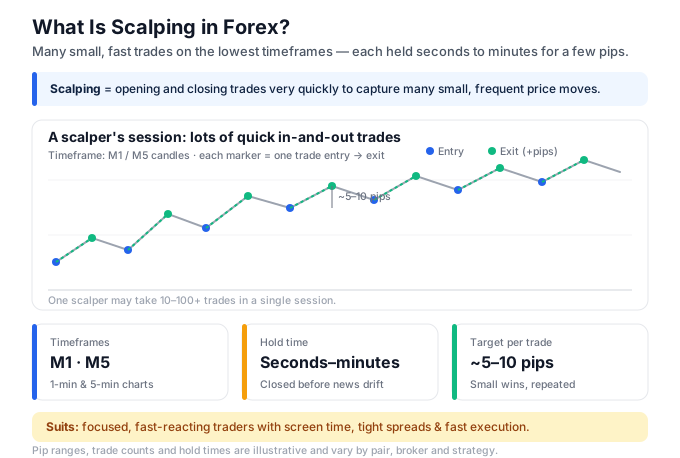
Forex scalping is a trading style built on speed and frequency. You open and close positions within seconds to a few minutes, take a small profit — often a handful of pips — and repeat many times through a session. You are not waiting for a trend to play out; you are harvesting small, repeatable moves.
Scalping sits at the fast end of the spectrum. Day traders hold for minutes to hours; swing traders hold for days. Scalpers hold for seconds to minutes and may take dozens of trades in one session — so spread cost dominates everything they do.
Scalping suits a specific kind of trader: focused screen time during a liquid session, fast decisions without hesitation, and the discipline to take a small loss instantly when a trade is wrong. If you can only glance at charts once a day, scalping is the wrong style — day trading strategies for the forex market or swing trading will fit your life better.
It is also spread-sensitive to a degree beginners underestimate. If you aim for 5 pips and pay a 2-pip spread, price must move 7 pips in your favour before you break even. That single fact — not the indicator you choose — decides whether a scalping approach can work on your pair and your broker.
The 5 forex scalping strategies
The five setups below are all genuine scalping systems, but they differ in timeframe, pairs, and trigger. You do not need all five. Pick the one that matches your screen time and the session you can trade, master it, then add another only when you understand why it works.
Each setup is a complete standalone system on its own page. This page is the map; the linked pages carry the indicators, settings, and templates for each system.
1. Free Scalp (M1/M5 signal system)
Setup: Free Scalp. A no-cost signal-based scalping system built for the fastest charts, where a set of indicators combine to flag a buy or sell so you can act quickly without second-guessing every candle.
- Timeframe: M1 and M5 — the classic scalping charts.
- Pairs: stick to tight-spread majors such as EUR/USD and GBP/USD, where the spread does not eat the small target.
- Trigger: enter in the direction the signal indicators agree on; exit at a small fixed target or when the signal flips.
- Stop and target: keep the stop tight, placed beyond the recent swing, and take a small target in the scalper’s typical range — treat the exact pip count as guidance tied to the pair’s spread, not a fixed rule.
Free Scalp is a good first system because the signals are explicit — you react rather than interpret. See the full build in our Free Scalp forex trading strategy guide.
2. Bykov Signal (arrow-signal scalping)
Setup: Bykov Signal. An arrow-signal system that plots buy and sell markers on the chart, aimed at traders who want a clear visual cue rather than a discretionary read of price action.
- Timeframe: M5 works cleanest; the signals are steadier than on M1 noise.
- Pairs: liquid majors during an active session, where the arrows are less likely to be whipsaw noise.
- Trigger: take the trade in the direction of the arrow, ideally only when it agrees with the immediate trend.
- Stop and target: stop beyond the last swing point; target a small, session-appropriate move, and do not hold past the next opposing signal.
Arrow systems are only as good as the filter you add — taking every arrow in a flat market is the fast way to bleed spread. Our Bykov Signal forex scalping strategy guide covers the settings and the filter that keeps it honest.
3. 5-Minute Scalping (M5 core system)
Setup: 5-minute scalping. The M5 chart is the most popular scalping timeframe because it balances speed against noise — fast enough for many trades, slow enough that the signals are not pure randomness.
- Timeframe: M5.
- Pairs: EUR/USD and GBP/USD during the London and New York sessions, where M5 candles carry real movement.
- Trigger: enter on the system’s confirmation in the trend direction; the M5 gives you a moment to confirm before the candle closes.
- Stop and target: a tight stop beyond structure, and a small target — the M5 often supports slightly larger scalps than M1 because each candle covers more range.
M5 is the timeframe most beginners should start on — it punishes hesitation less than M1 and pays less spread per unit of movement. The complete method is in our 5-minute forex scalping strategy guide.
4. 15-Minute Scalping (M15 slow-scalp)
Setup: 15-minute scalping. The slowest of the five, this setup uses the M15 chart to catch slightly larger intraday moves while keeping the fast, in-and-out scalping mindset. It suits traders who find M1 and M5 too frantic.
- Timeframe: M15.
- Pairs: majors, and it tolerates slightly wider-spread pairs better than M1 because the target is larger relative to the spread.
- Trigger: enter on the system’s signal in the direction of the higher-timeframe bias; the M15 gives you more time to decide.
- Stop and target: a wider stop than the faster setups, and a proportionally larger target — the spread is a smaller fraction of a bigger move.
The M15 setup is the bridge between scalping and day trading. Because the target is larger, the spread hurts less, which makes it the most forgiving of the five for a newer trader. See the full system in our 15-minute forex scalping strategy guide.
5. Bollinger Band + Keltner (squeeze scalp)
Setup: Bollinger Band and Keltner. This pairs two volatility tools — Bollinger Bands and Keltner Channels — to scalp the moment volatility expands out of a quiet squeeze, a cleaner entry than trading a single band alone.
- Timeframe: M5 to M15.
- Pairs: liquid majors, where the squeeze-and-expand pattern is reliable rather than erratic.
- Trigger: watch for the Bollinger Bands contracting inside the Keltner Channel (the squeeze), then enter in the direction price breaks as volatility expands.
- Stop and target: stop back inside the squeeze on the opposite side; target the expansion move, exiting as momentum fades.
The Bollinger-plus-Keltner combination filters out the flat conditions where band-only scalps get chopped up — you only trade when volatility is expanding. The full logic and settings are in our Bollinger Band and Keltner forex scalping strategy guide. For the fastest, discretionary version, our 1-minute dynamic forex scalping strategy covers the M1 approach in full.
Why broker choice and spreads matter for scalping
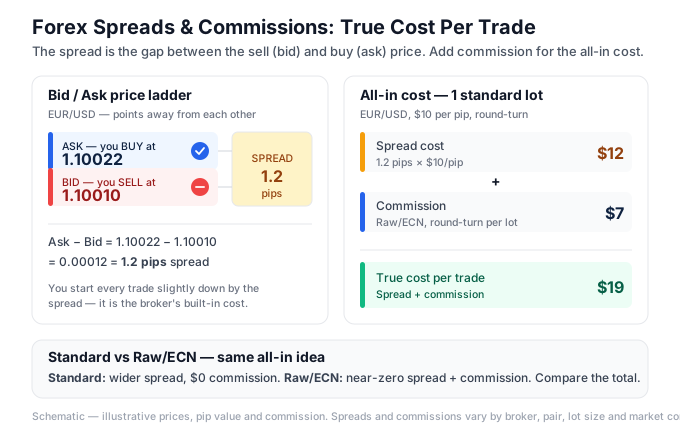
Scalping is the one style where the broker and the spread matter as much as the strategy. Because you aim for a few pips and pay the spread on every single trade, the spread is a fixed tax on your edge. A setup that is profitable on a 0.2-pip spread can be a loser on a 2-pip spread with nothing else changed.
Do the arithmetic. If you scalp for a 5-pip target and pay a 1.5-pip spread, you keep 3.5 pips when you win but lose 6.5 pips when your 5-pip stop hits — the spread widens your loss and shrinks your win. That asymmetry is why scalpers hunt for the tightest spreads and trade only when spreads are naturally tight.
Spread is not fixed through the day. It is tightest during the deep-liquidity hours — the London session (08:00–17:00 GMT) and especially the London/New York overlap (13:00–17:00 GMT) — and it widens during the quiet late-Asian hours and around high-impact news. Scalping the right session is half the battle.
Two more mechanics matter for scalpers: fast execution reduces slippage, which eats scalp profits when fills come late, and fractional lot sizing lets you size precisely to your risk on small stops. Before checking a spread on any pair, confirm the pip value of your position with our pip value calculator, and size the trade with the lot size calculator so a tight stop still maps to a controlled risk.
Risk management for high-frequency trading
Scalping takes more trades than any other style, which means more chances to lose and more spread paid. Risk management is not the boring part of scalping — it is the part that decides whether the frequency compounds in your favour or against you.
Size every trade to a fixed fraction of your account, commonly 1% or less, with the stop set first and the position sized to it. On tight scalping stops this matters more, not less: a 5-pip stop needs a larger lot to reach 1% risk than a 50-pip stop does, so precise sizing is essential. Set the stop where the chart invalidates the trade, then size to it — never the reverse.
Cap your session. Because a scalper can take dozens of trades, a bad run accumulates quickly. A daily loss limit — for example, stop after losing 2–3% of the account, or after a set number of losing trades — keeps one bad morning from becoming a blown account. Revenge-scalping after a loss, doubling size to win it back, is the fastest way beginners destroy a scalping account.
On XAU/USD (gold), scalping is harder and needs adjustment. Gold’s spread is wider than EUR/USD and its wicks are larger, so a forex-sized scalp stop gets swept before the move. If you scalp gold, use wider stops — roughly 1.5 times what you would use on EUR/USD — and avoid scalping through the New York open and news spikes, when gold’s spread balloons and slippage is worst. For the underlying tools behind any of these systems, our guide to using indicators for forex trading analysis explains how to combine them without cluttering the chart, and the what is forex trading primer covers the basics if you are new.
Frequently asked questions
What is the best forex scalping strategy?
There is no single best one — it depends on your screen time and the session you can trade. For most beginners the 5-minute setup is the best start: fast enough for many trades, slow enough that the signals are not pure noise, and it pays less spread per move than M1. Master one setup before adding a second.
Is forex scalping profitable?
Scalping can be profitable, but it depends far more on spread and execution than on the setup. Because you pay the spread on every trade and aim for a few pips, a wide spread can turn a winning system into a losing one. The edge comes from tight spreads, a liquid session, and strict risk control — not from the indicator.
What is the best timeframe for scalping, M1 or M5?
M5 is the better default. M1 gives more trades but fires more false signals, demands faster decisions than most traders make well, and pays spread on each tiny move. M5 balances speed against noise. Start on M5; drop to M1 only once you are consistent.
What are the best indicators for scalping?
Scalpers keep it minimal — one trend or momentum tool plus one trigger, not five overlapping indicators. Moving averages for direction, Bollinger Bands and Keltner Channels for volatility, and simple signal or arrow systems are common. The goal is one clean trigger you can act on in seconds. Two tools with rules beat ten that contradict each other.
What are the best pairs for scalping?
Stick to the tight-spread majors — EUR/USD and GBP/USD are the most-scalped because their spreads are narrow and their liquidity is deep. Avoid exotic pairs while scalping; their wide spreads eat a small target alive. Trade the majors during the London and New York sessions when their spreads are tightest.
How many pips do scalpers target per trade?
Typical scalp targets fall in a 3–12 pip range, but treat that as guidance, not a rule. The right target depends on the pair’s spread and the session’s volatility — a 5-pip target makes no sense on a pair with a 2-pip spread. Set the target relative to the spread you pay and the move the timeframe realistically offers.
Do you need a special broker to scalp forex?
You do not need a special account type, but scalping rewards tight spreads, fast execution, and fractional lot sizing more than any other style. Confirm your broker allows scalping (some restrict it), and favour the tightest spreads you can find, since the spread is a fixed cost on every trade.
Is scalping good for beginners?
Scalping is one of the harder styles for beginners — it demands fast decisions, strict discipline, and constant spread awareness. If you are new, start on the M5 or M15 setups rather than M1, trade a demo account first, and risk no more than 1% per trade. Many beginners are better served learning day trading or swing trading first.
Forex scalping comes down to three things done well: a fast timeframe, a tight spread on a liquid pair, and one clear trigger — repeated with discipline. Start with the setup that fits your screen time, the 5-minute or 15-minute system if you are newer, then study its full standalone build from the links above. Whatever you pick, the spread and your risk math decide the outcome more than the indicator ever will.
Forex and CFD trading carries a high level of risk and may not be suitable for all traders. The strategies and indicators described in this article are educational. Past performance does not guarantee future results. Always test on a demo account before risking real capital.
Ready to put this into practice?
Open an account with a regulated broker and apply what you have learned. These are the three brokers we recommend:
Trading forex and CFDs carries a significant risk of loss and is not suitable for everyone. Broker links are affiliate links — we may earn a commission at no cost to you.