

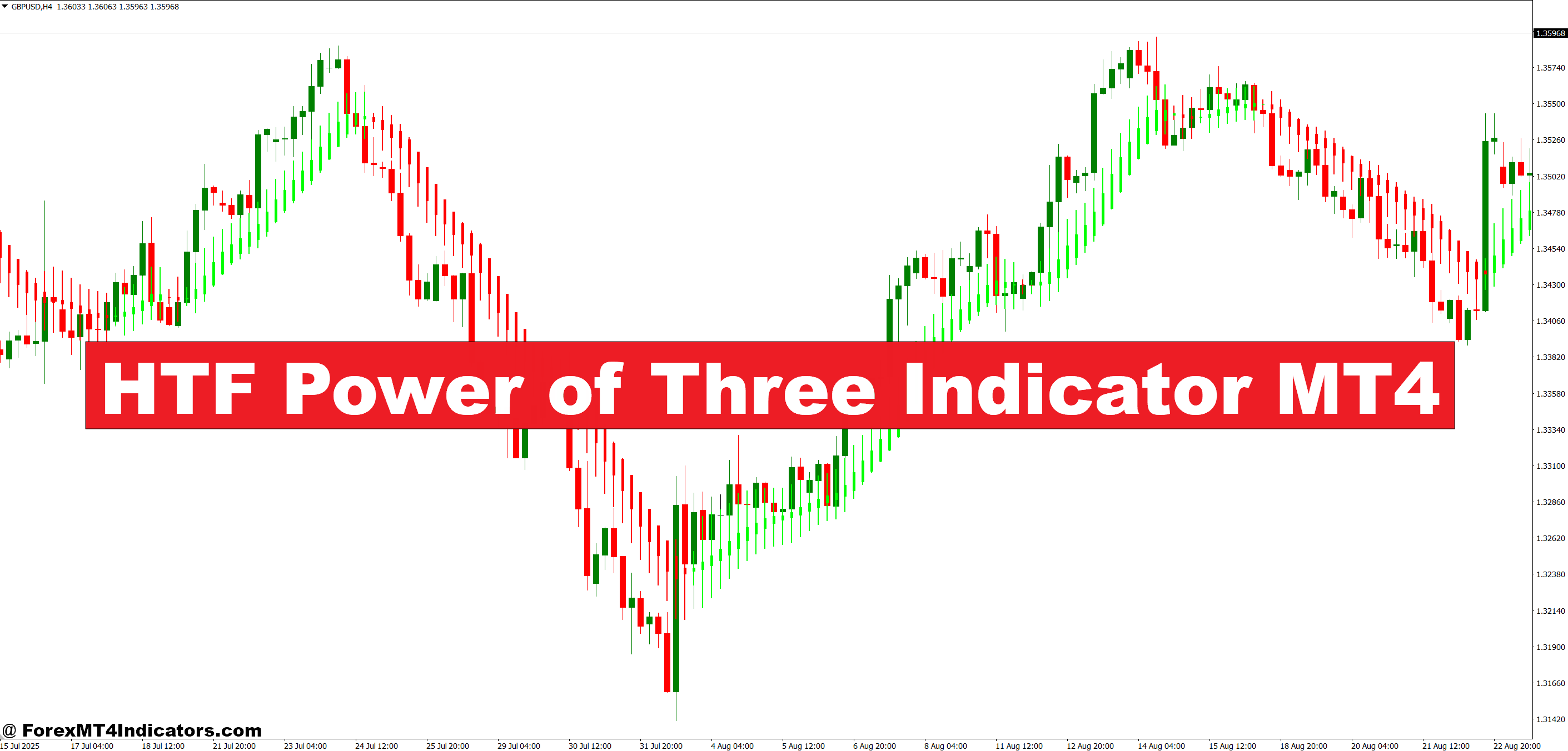
The HTF Power of Three indicator is an MT4 tool built around the Inner Circle Trader’s (ICT) Power of Three concept, originally inspired by Larry Williams. The core idea is straightforward: every candle on every timeframe goes through three distinct phases before it closes.
First comes accumulation – price consolidates near the opening level as smart money quietly builds positions. Next is manipulation – liquidity gets engineered above or below the range, sweeping stops and trapping breakout traders. Finally, there’s distribution – the real directional move happens as institutions pair their exits with fresh retail orders chasing the wrong side.
What makes the HTF version different from standard Power of Three indicators is the “higher timeframe” overlay. Rather than analyzing PO3 structure on the chart you’re already looking at, this indicator maps a 4-hour, daily, or weekly candle directly onto your 5-minute or 15-minute chart. You see the HTF candle’s open, current high, current low, and estimated close time – all without switching timeframes.
That distinction matters. A lot of traders understand the concept of accumulation-manipulation-distribution in theory, but they struggle to apply it because they can’t maintain context across timeframes while executing trades. The HTF PO3 indicator eliminates that gap.
How the Indicator Works Under the Hood
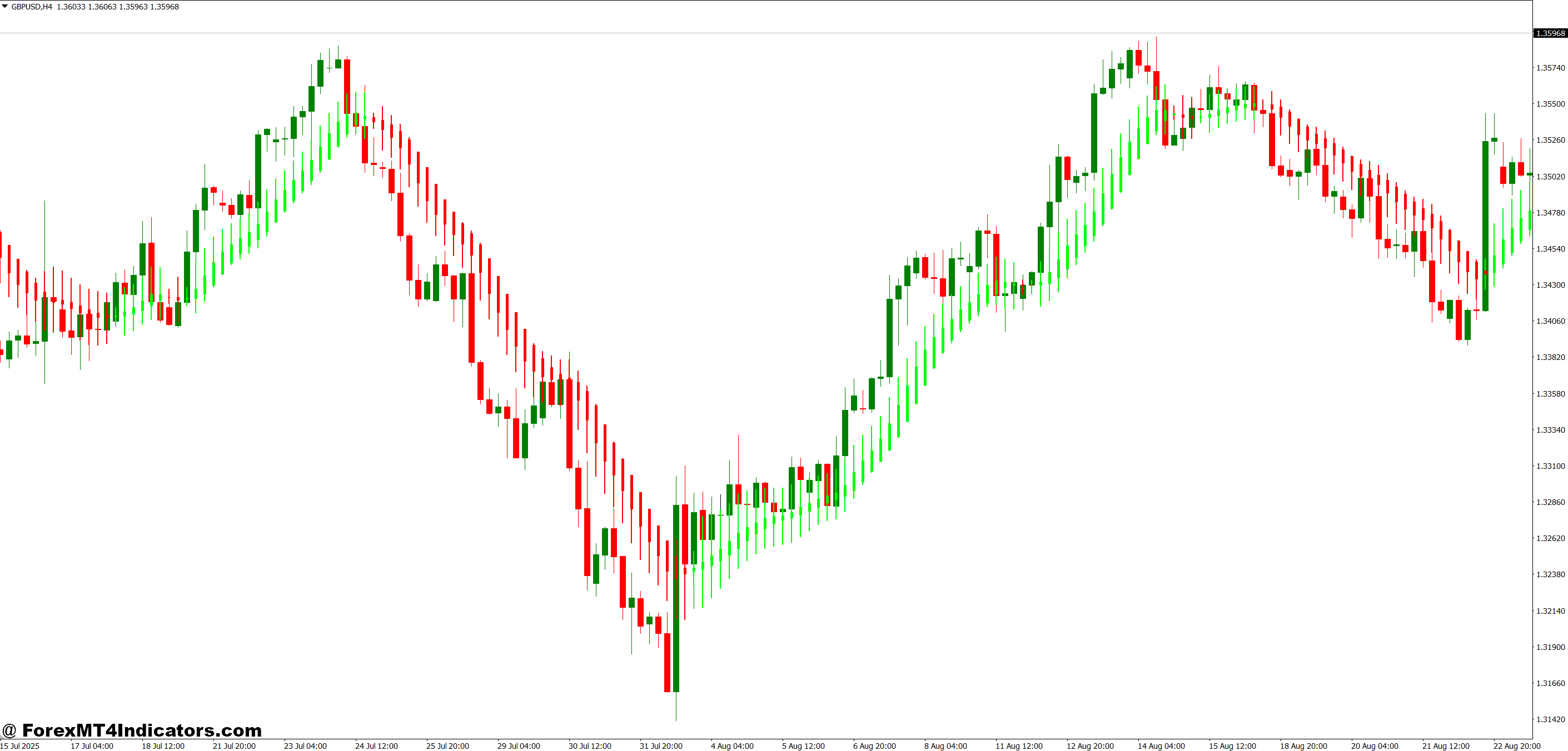
The logic behind this indicator isn’t based on lagging moving averages or oscillators. It tracks raw OHLC data from a selected higher timeframe and renders that candle’s development live on your current chart.
Here’s what happens step by step. When a new HTF candle opens – say, the daily candle at New York midnight – the indicator plots the opening price as a horizontal reference line on your lower timeframe chart. As price moves, it dynamically updates the high and low boundaries of that HTF candle in real time. Some versions also include a countdown timer showing how much time remains before the HTF candle closes.
The indicator typically uses ATR (Average True Range) over a 14-period lookback to gauge whether the accumulation phase range is unusually tight relative to normal volatility. When the distance between the HTF candle’s high and low is smaller than the current ATR reading, that signals a compression – an accumulation zone that hasn’t expanded yet. Once price breaks out of that range, the indicator marks the shift into the manipulation or distribution phase.
No repainting, no recalculation after the fact. The levels are drawn from the HTF candle’s actual open and developing range. That’s a big deal, because many MT4 indicators look perfect in hindsight but shift their signals on live charts.
Practical Application: Real Trading Scenarios
Here’s where this gets useful. Let’s say you’re trading GBP/USD during the London session on a 15-minute chart. You’ve set the HTF Power of Three to display the 4-hour candle.
The 4H candle opened at 1.2650. Price drifts down to 1.2635 during the Asian session – that’s accumulation. The range is tight, well below the 14-period ATR of 45 pips. Then London opens, and price spikes down to 1.2620, sweeping the Asian low. The indicator now shows the manipulation phase extending below the accumulation box. You spot a bullish order block at 1.2618 on your 15-minute chart. Price taps it, leaves a wick, and starts climbing.
That’s your entry zone. The HTF PO3 indicator didn’t “give” you a signal in the traditional sense – it gave you context. It framed the entire session’s price action within a structure you can read and trade around.
Another example: EUR/USD on a 5-minute chart with the daily PO3 overlay during NFP week. The daily candle opens, price chops around the open for the first few hours. The accumulation zone stays compressed. When the NFP number drops and price violently spikes one direction, you can see whether it’s a genuine expansion or just the manipulation sweep. If price quickly reverses back through the daily open, that’s classic manipulation – and the real move is likely coming the other way.
HTF Power of Three Indicator MT4 Settings, Customization
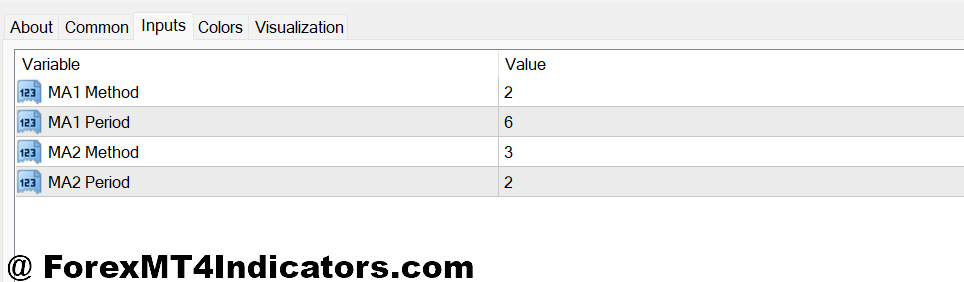
Most MT4 versions of this indicator let you adjust a few key parameters. The primary one is the HTF timeframe selection – daily, 4-hour, and weekly are the most common choices. Running the daily PO3 on a 5-minute or 15-minute execution chart is probably the most popular combination among ICT-style traders.
Some versions allow you to stack multiple instances. You might run both a daily and a 4-hour PO3 on the same 15-minute chart to see how intraday structure nests inside the larger daily framework. When both timeframes align – say the daily is in accumulation and the 4H just completed manipulation – the trade setup carries more weight.
A few practical tips worth noting:
- Use New York midnight as your daily open. The ICT methodology treats the true daily candle open at midnight EST, not the broker’s server time. Some indicator versions include this setting; if yours doesn’t, make sure your broker’s server time aligns or adjust accordingly.
- Pair it with liquidity concepts. The PO3 indicator tells you where price is within the HTF candle structure, but it won’t show you order blocks, fair value gaps, or liquidity pools. Combining it with a separate order block or FVG indicator gives you both the macro framework and the micro entry triggers.
- Avoid using it on timeframes that are too close together. Running a 1-hour PO3 on a 30-minute chart doesn’t give you enough separation for meaningful structure. A good rule of thumb: the HTF should be at least 4x your execution timeframe.
Strengths, Limitations, and Honest Assessment
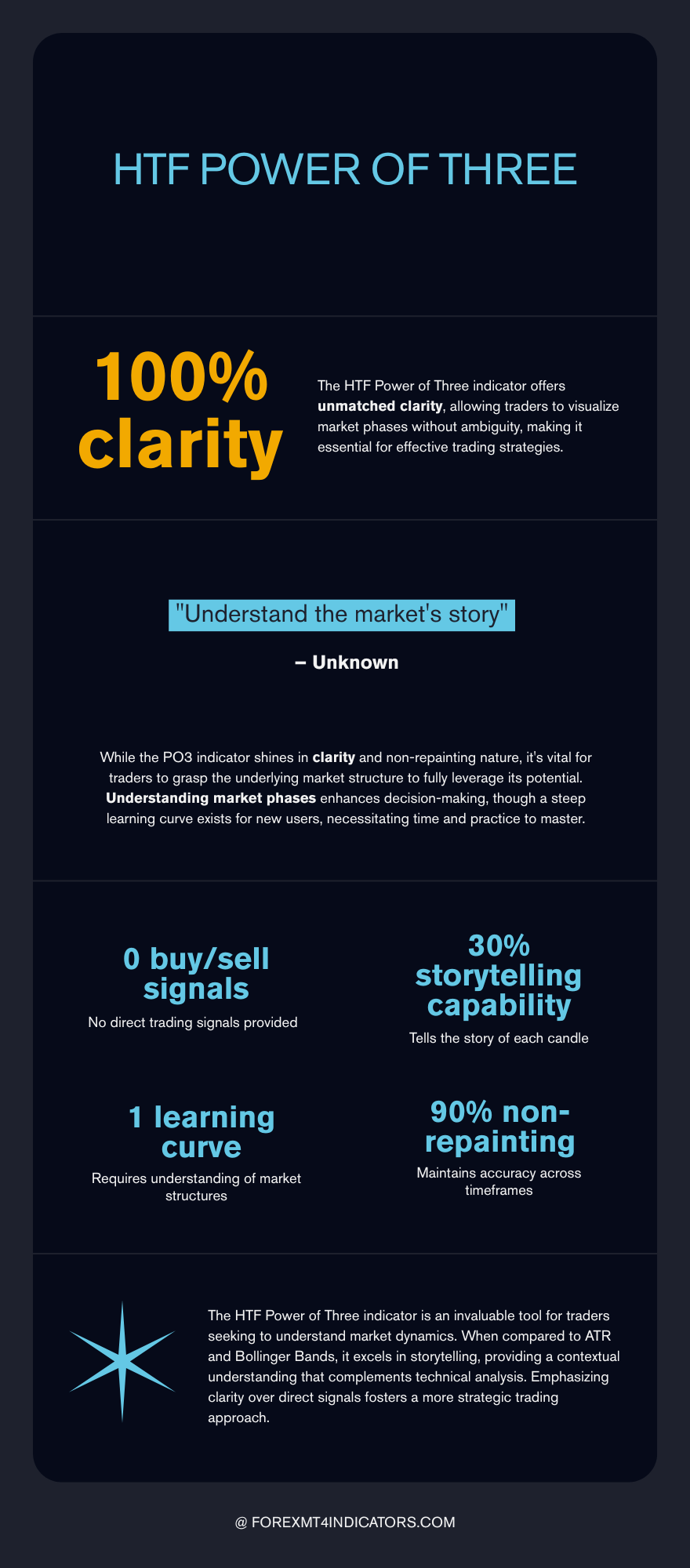
The biggest advantage of the HTF Power of Three indicator is clarity. It takes a concept that many traders understand intellectually but fail to execute on, and it makes it visual. Seeing the daily open, the developing range, and the phase transitions directly on your scalping chart changes how you interpret intraday price action.
It also doesn’t repaint, which puts it ahead of many signal-based MT4 indicators that look great on historical charts but perform differently live.
That said, this tool has real limitations. It doesn’t generate buy or sell signals on its own. Traders who want a green arrow telling them to buy and a red arrow telling them to sell will find it frustrating. The PO3 overlay requires you to understand market structure, liquidity, and session timing to extract value from it. It’s a framework tool, not an autopilot.
There’s also the learning curve. If you’re not familiar with ICT concepts – accumulation, manipulation, distribution, order flow – the colored boxes on your chart won’t mean much. This indicator rewards traders who’ve invested time studying how institutional price delivery works.
Compared to something like the standard ATR indicator or Bollinger Bands, the HTF PO3 takes a completely different approach. ATR tells you how much price is moving. Bollinger Bands tell you when price is stretched relative to its mean. The PO3 tells you where you are in the story of a developing candle – whether smart money is still loading, whether the trap has been set, or whether the real move is underway. They answer different questions, and combining them can work well.
Risk disclaimer: Trading forex carries substantial risk, and no indicator guarantees profits. The HTF Power of Three indicator is a visual analysis tool, not a trade signal generator. Always use proper risk management, and don’t risk capital you can’t afford to lose.
How to Trade with HTF Power of Three Indicator MT4
Buy Entry
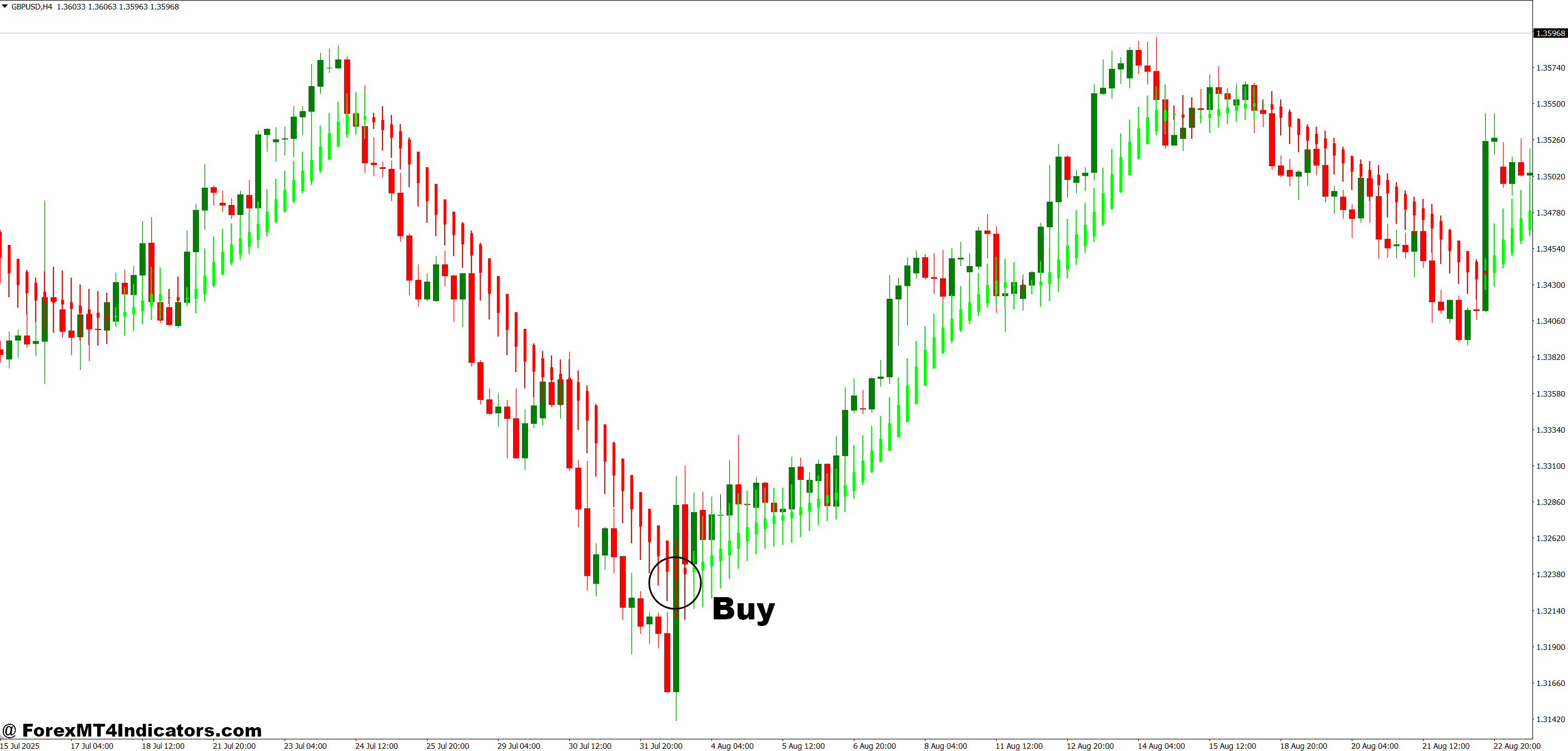
- Wait for the manipulation sweep below the HTF open – Price must dip below the accumulation zone and grab sell-side liquidity before you consider a long. On EUR/USD 15-minute charts, this sweep typically runs 15–25 pips below the daily open during the London session.
- Confirm a bullish rejection wick on the lower timeframe – After the sweep, look for a 5-minute or 15-minute candle that wicks sharply below the HTF low and closes back inside the range. That wick is your sign smart money absorbed the sell orders.
- Enter on the first candle that reclaims the HTF open price – Once price crosses back above the daily or 4H open line, place your buy within 3–5 pips above it. On GBP/USD, this reclaim often happens within 30–60 minutes of the manipulation low.
- Set your stop-loss 5–10 pips below the manipulation wick – Don’t place it at the exact low. Give it breathing room. If the 4H manipulation low on EUR/USD was 1.0835, your stop goes at 1.0825 or lower.
- Target the opposite side of the HTF range – If the daily open sits at 1.2700 and price swept down to 1.2670, aim for 1.2740–1.2760 as your first take-profit. That’s the buy-side liquidity above the accumulation zone where distribution typically kicks in.
- Stack confluences with a fair value gap or order block – A buy signal gains weight when the manipulation sweep lands directly into a 1-hour or 4-hour bullish order block. Naked PO3 entries without structural support have a noticeably lower hit rate.
- Avoid buying during low-volume sessions – If the manipulation sweep happens during the Asian session on a major pair like GBP/USD, skip it. Real institutional moves need London or New York volume behind them. Asian fakeouts trap early longs regularly.
- Risk no more than 1–2% of your account per trade – Even a textbook PO3 setup fails sometimes. Size your position so the distance from entry to stop-loss costs you 1% max. On a $10,000 account, that means risking $100–$200 per setup, not more.
Sell Entry
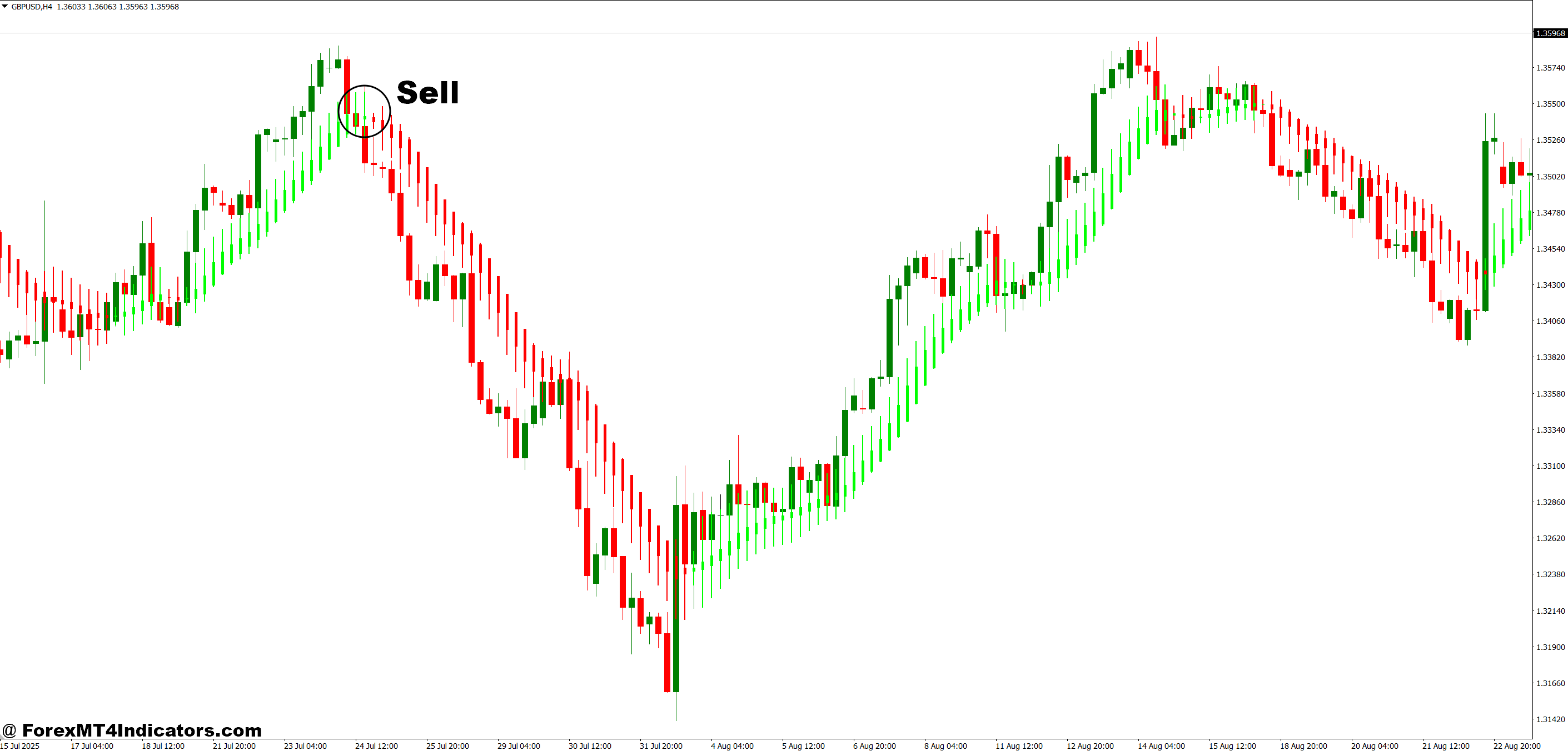
- Wait for the manipulation spike above the HTF open – Price needs to sweep above the accumulation zone and raid buy-side liquidity first. On a 4H PO3 overlay, this spike often overshoots the range high by 10–20 pips on EUR/USD before reversing.
- Spot a bearish engulfing or strong rejection candle – After the sweep above the HTF high, watch for a 15-minute candle that engulfs the prior candle’s body and closes red. That’s institutional selling stepping in after trapping breakout buyers.
- Enter short when price breaks back below the HTF open – Place your sell 3–5 pips below the daily or 4H open line once price drops through it. On GBP/USD during New York AM, this breakdown is usually sharp and gives little pullback.
- Place your stop-loss 5–10 pips above the manipulation high – If the 4H manipulation spike topped at 1.2780 on GBP/USD, set your stop at 1.2790–1.2795. Tight enough to keep risk controlled, wide enough to avoid a second wick.
- Aim for the sell-side liquidity below the accumulation zone – Your first target is the low of the accumulation range. If the daily open was 1.0910 and the manipulation spiked to 1.0940, target 1.0875–1.0860 where resting sell stops sit.
- Add conviction when the daily PO3 and 4H PO3 both show manipulation – When the 4H candle completes its manipulation phase upward while the daily candle is also in its manipulation phase, that’s a multi-timeframe alignment. These setups on EUR/USD and GBP/USD tend to produce 40–70 pip moves during London-to-New York overlap.
- Don’t sell into a strong trending day – If the daily candle has already expanded 80+ pips in one direction with no manipulation sweep, the PO3 structure has shifted to pure distribution. Fading that move is fighting momentum. Sit it out and wait for the next session’s setup.
- Lock in partials at 1:1 risk-to-reward – Close 50% of your position when profit equals your stop distance. Move your stop to breakeven on the remaining half. This protects you on the trades where distribution stalls midway and price chops back to the open.
Final Thoughts
The HTF Power of Three indicator for MT4 does one thing well – it maps higher timeframe candle structure onto your execution chart so you can track accumulation, manipulation, and distribution phases without juggling multiple windows. It’s particularly useful for traders who follow ICT methodology or any smart money approach that emphasizes session timing and liquidity engineering. The indicator won’t replace skill, experience, or a solid trading plan. But for those who already understand how institutional order flow shapes price, it removes a real friction point in the execution process. If you’ve been manually tracking the daily open and HTF ranges with horizontal lines, this tool automates that workflow and keeps it updating tick by tick. That alone can sharpen your timing and reduce the mental load during fast-moving sessions.
Level up your trading Learn to read the chart — not just the indicator eBook · Instant PDF Video Course · 12 modules Trading forex and CFDs carries a significant risk of loss and is not suitable for everyone. Broker links are affiliate links — we may earn a commission at no cost to you.Recommended MT4/MT5 Brokers
Free MT4 Indicator Download
Enter Your Email Address below, download link will be sent to you.