

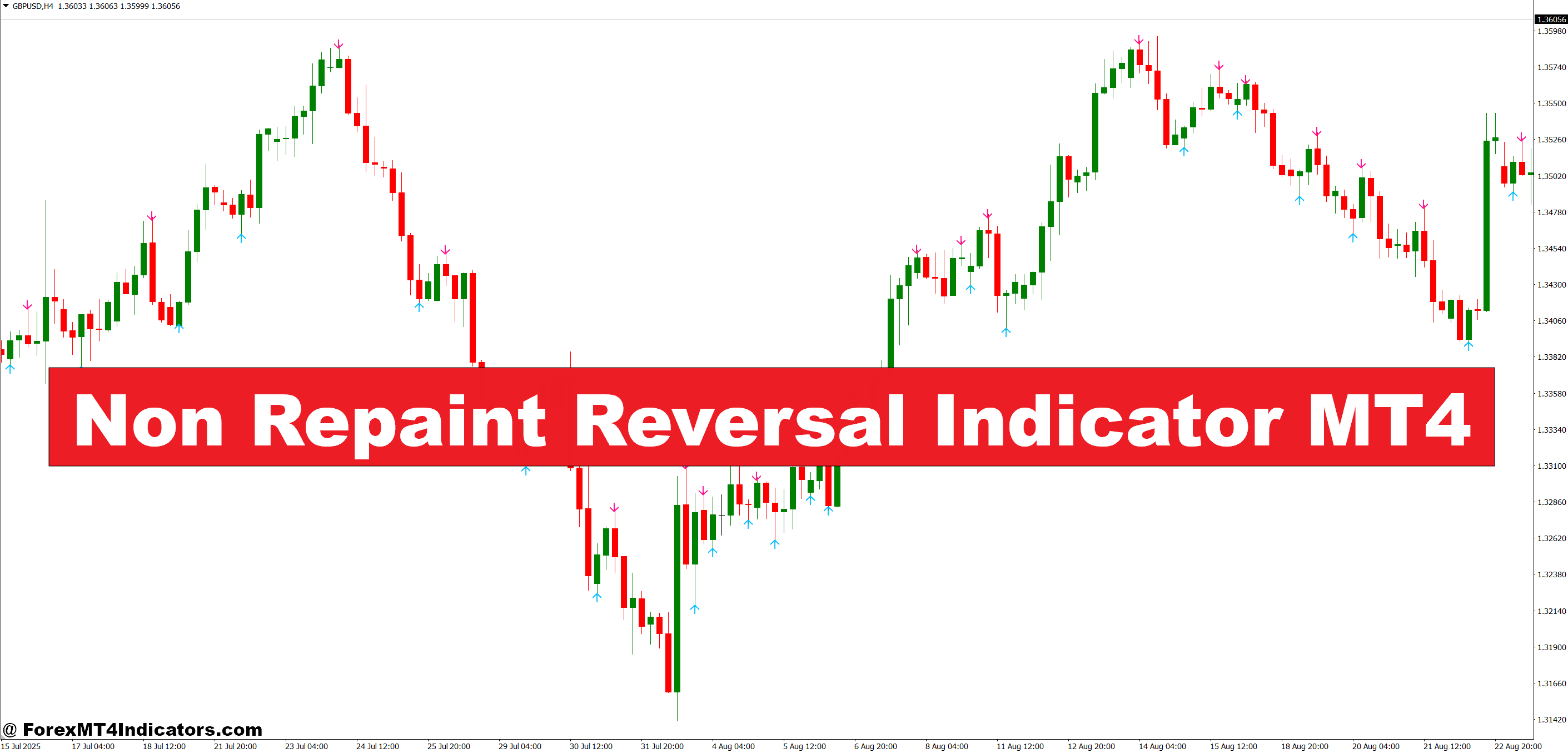
Most reversal indicators on MT4 rely on some variation of oscillator divergence, overbought/oversold zones, or candlestick pattern recognition. The “non repaint” label means one specific thing: once a signal prints on a closed candle, it stays there permanently. It won’t shift, recalculate, or vanish when new price data arrives.
Here’s how that differs from repainting tools. A repainting indicator recalculates its output with every incoming tick. So during a live session, it might show a buy arrow at a swing low — but if price drops further, the arrow moves down to the new low. On a historical chart, everything looks perfect because the indicator has already adjusted to show ideal entries. It’s backtesting fiction.
A non repaint reversal indicator waits for candle confirmation before plotting. The typical logic works like this: the indicator monitors price action relative to a set of internal conditions — often a combination of moving average crossovers, RSI extremes (commonly the 14-period RSI crossing above 30 or below 70), and swing high/low detection. Once the candle closes and all conditions are met, the signal locks in. Period.
That confirmation delay is the trade-off. Traders won’t catch the exact top or bottom tick. But they get something more valuable: a signal that existed in real time, not one manufactured after the fact.
Practical Application: What It Looks Like on a Live Chart
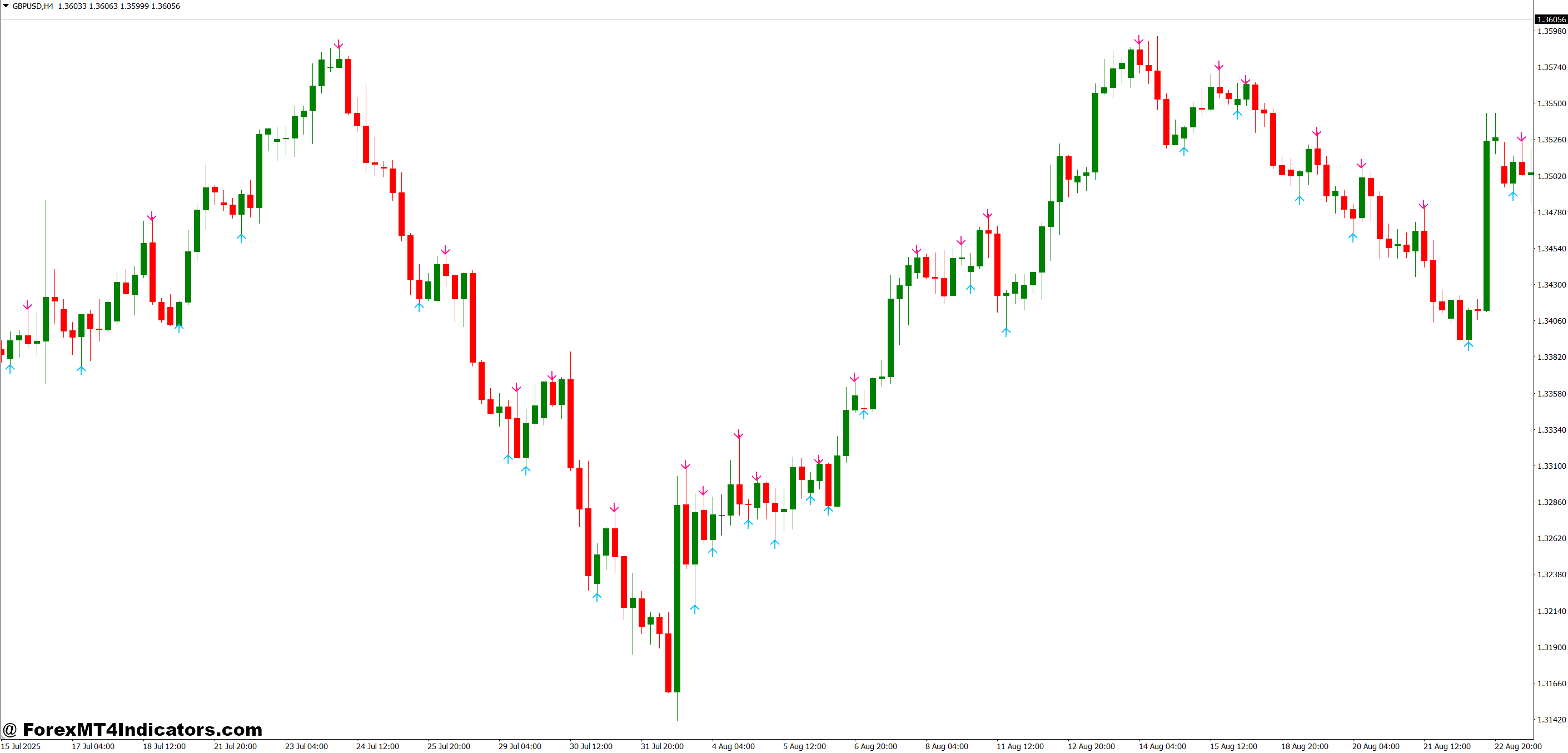
Let’s get specific. Say a trader is watching GBP/USD on the 15-minute chart during the London session. Price has been trending down for two hours and reaches a zone near 1.2640 — a level that acted as support twice the previous week. The non repaint reversal indicator prints a blue up-arrow below the candle at 10:15 AM after that candle closes.
The trader now has a concrete decision point. The arrow won’t move. They can evaluate the setup alongside other factors — is the signal near a known support level? Does the RSI show oversold conditions? Is there a bullish engulfing pattern forming?
On higher timeframes, these signals tend to carry more weight. A reversal arrow on the 4-hour chart of USD/JPY, especially near a round number like 150.00, often aligns with institutional order flow zones. Scalpers on the 5-minute chart will see more frequent signals, but also more noise. That’s not a flaw in the indicator — it’s the nature of lower timeframe trading.
One thing experienced traders learn quickly: the indicator works best as a confirmation tool, not a standalone trigger. A reversal signal at a random price level in the middle of a range is far less meaningful than one appearing at a tested support or resistance zone.
Non Repaint Reversal Indicator MT4 Settings and Customization
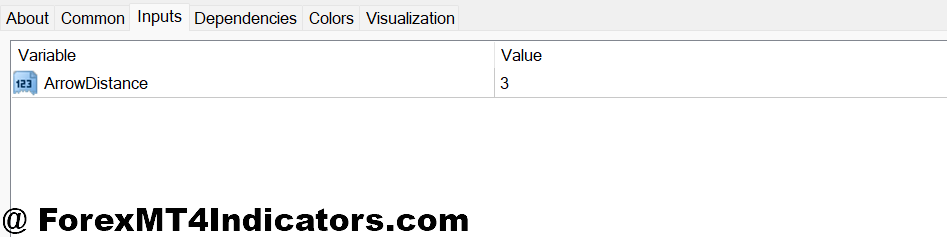
Most versions of this indicator on MT4 come with adjustable parameters, and understanding them matters more than most traders realize.
- Sensitivity period is the big one. A shorter lookback period (say, 8–10) generates more signals but increases the chance of catching minor pullbacks rather than true reversals. A longer period (20–30) filters out noise but may cause late entries on fast-moving pairs like GBP/JPY.
- Alert settings are straightforward — pop-up alerts, sound notifications, or push notifications to a mobile device. For traders who monitor multiple pairs, enabling push alerts on the 1-hour chart across six or seven pairs can flag setups without screen time.
- Arrow placement can typically be adjusted for distance from the candle. This is purely visual, but keeping arrows close to price action helps avoid cluttered charts, especially when combining this tool with other indicators like Bollinger Bands or Fibonacci retracement levels.
A practical starting configuration for swing traders: 14-period sensitivity on the 4-hour chart, alerts enabled, applied to major pairs (EUR/USD, GBP/USD, USD/JPY, AUD/USD). From there, adjust based on how many signals hit during a two-week forward test.
Strengths, Weaknesses, and an Honest Comparison
What it does well. The fixed-signal approach removes a major source of confusion. Traders can journal their entries knowing the signal they acted on was real. For those building rule-based strategies, non-repainting signals allow legitimate backtesting — what shows on the chart now is what showed up in real time.
Where it struggles. No reversal indicator handles ranging, choppy markets gracefully. During consolidation phases — think EUR/CHF grinding sideways for three days — these tools can fire multiple conflicting signals. A buy arrow followed by a sell arrow two candles later, then another buy. That’s not a bug; it’s a reflection of indecisive price action. The indicator doesn’t know the market is ranging. The trader needs to recognize that context.
And here’s something worth saying plainly: the “non repaint” label has become a marketing term. Some indicators sold under this name do still repaint on the current (unclosed) candle. That’s technically not repainting once the candle closes, but it can confuse traders who see a signal appear and disappear on the live bar. Always test any indicator on a demo account and watch it tick-by-tick on a live candle before trusting it with real money.
Compared to the Zigzag indicator — another popular reversal tool on MT4 — the non repaint reversal indicator offers a cleaner entry signal. Zigzag is notorious for repainting its swing points. The MACD histogram reversal approach is more stable but lags significantly on entries. And pure candlestick pattern indicators (like pin bar detectors) don’t repaint but lack the multi-factor confirmation that a well-built reversal indicator provides.
How to Trade with Non Repaint Reversal Indicator MT4
Buy Entry
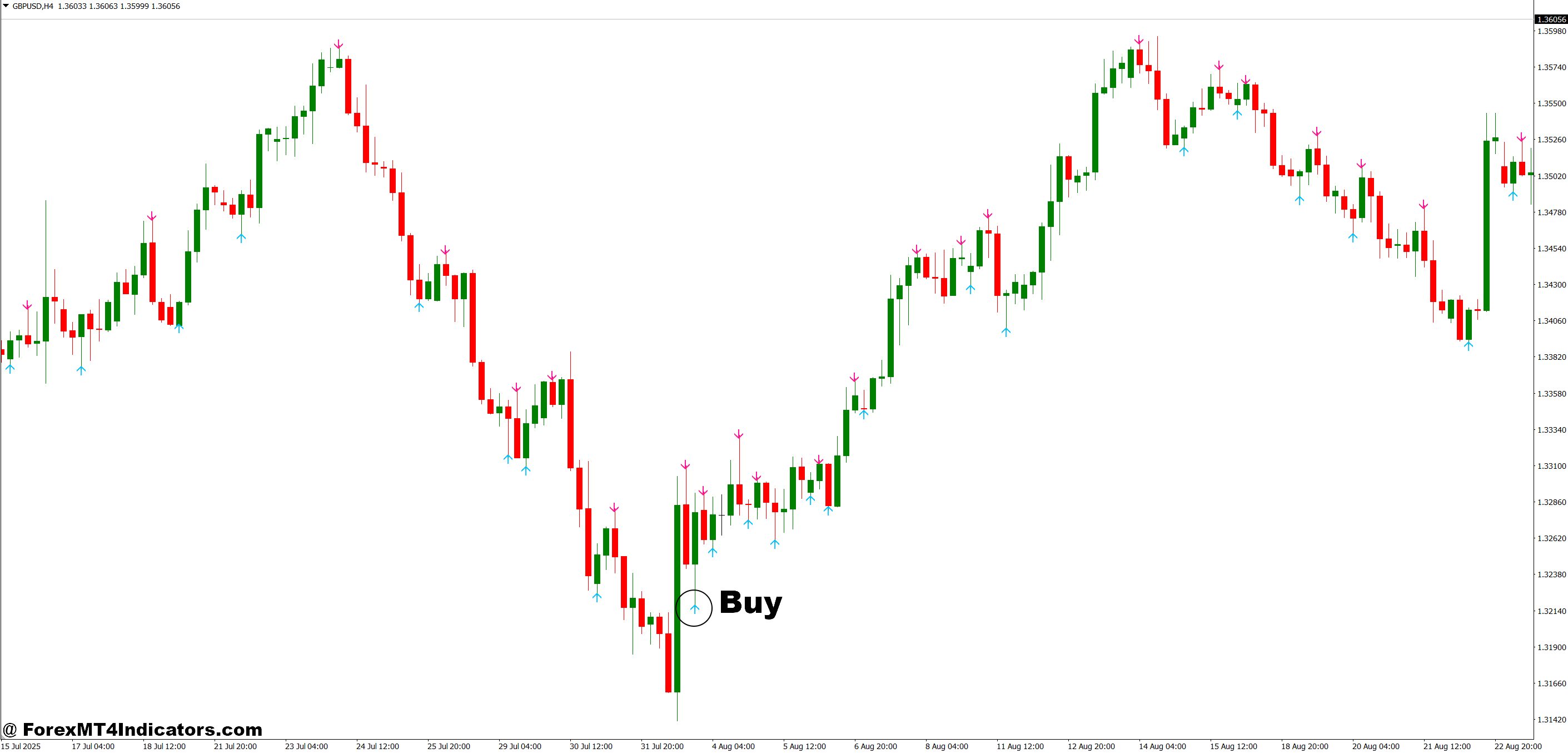
- Wait for the candle to close before acting – A buy arrow on a live candle means nothing until it locks in. Enter only after the signal candle fully closes on your chosen timeframe (1-hour or 4-hour works best for EUR/USD and GBP/USD).
- Confirm the signal sits near a known support zone – A buy arrow printed at a tested support level like 1.0725 on EUR/USD carries far more weight than one floating in open space. Check the daily chart for key horizontal levels before placing the trade.
- Set your stop loss 5–15 pips below the signal candle’s low – Tight stops get clipped by spread noise. On the 1-hour chart, aim for 10–15 pips below the low; on the 4-hour, give it 15–25 pips depending on the pair’s average volatility.
- Target a minimum 1:1.5 risk-to-reward ratio – If your stop is 20 pips, your take profit should sit at least 30 pips away. On GBP/USD, which moves 80–120 pips daily, a 1:2 ratio is realistic on 4-hour signals.
- Check RSI is below 35 when the buy arrow prints – A reversal signal paired with an oversold RSI (14-period) on the same timeframe adds genuine confirmation. Without it, you’re trusting a single data point.
- Avoid buy signals during high-impact news within 30 minutes – NFP, CPI, and rate decisions create erratic spikes that invalidate technical setups. Check your economic calendar before every entry.
- Skip the signal if price is below the 200 EMA on the daily chart – Buying against a strong downtrend catches falling knives. Use buy arrows only when the broader trend supports them, or at minimum, when price is testing a major weekly support level.
- Scale in with 50% position size if the signal appears during London–New York overlap – This 12:00–16:00 GMT window has peak liquidity on major pairs. Enter half at the signal and add the rest if price moves 10 pips in your favor within two candles.
Sell Entry
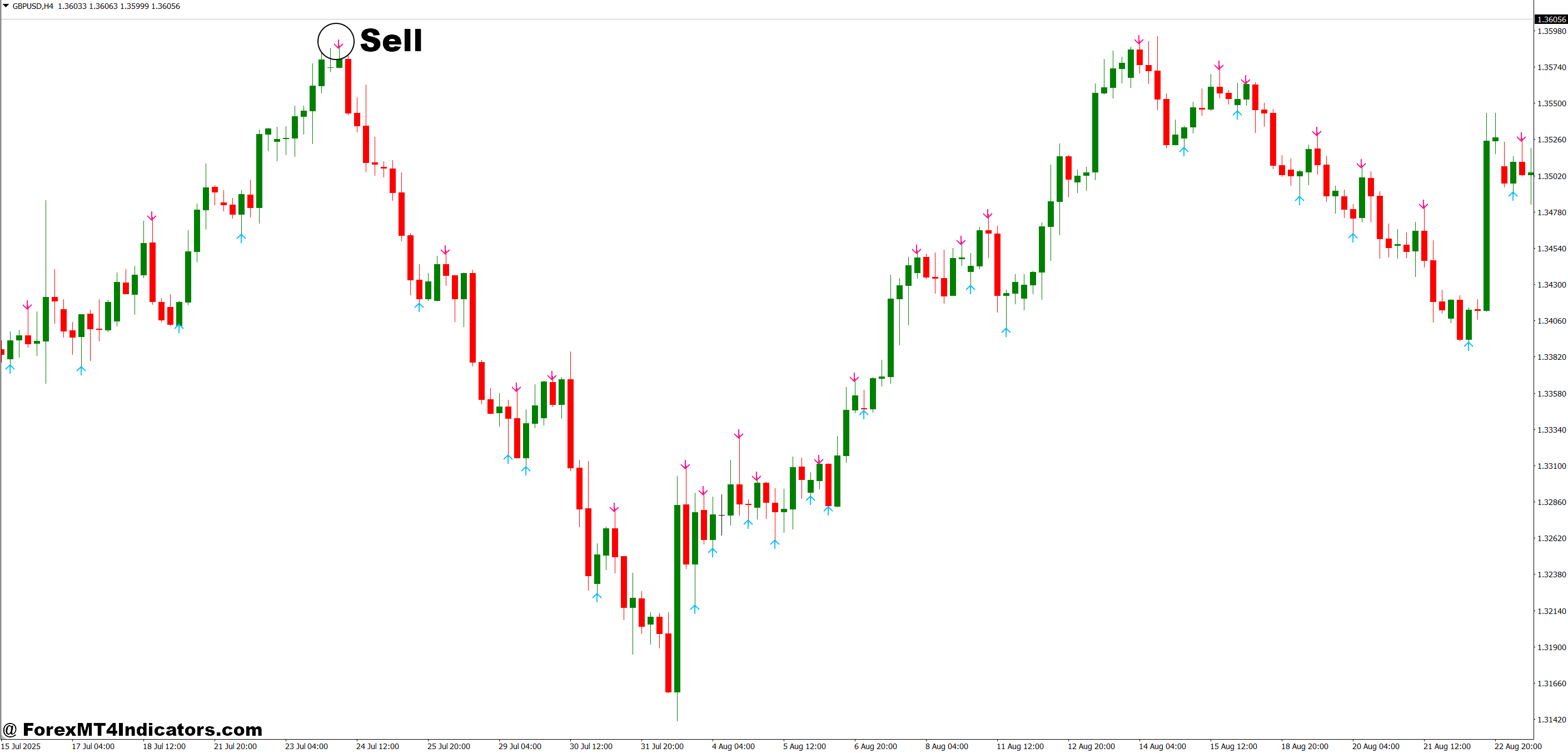
- Enter short only after the signal candle closes with a confirmed sell arrow – Same rule as buys. A sell arrow that vanishes on the live bar was never a real signal. Wait for the close on the 1-hour or 4-hour chart before committing capital.
- Look for sell signals at tested resistance zones – A sell arrow near 1.2750 on GBP/USD where price rejected three times last week is a high-probability setup. Random sell arrows mid-trend are low-quality and best ignored.
- Place your stop loss 5–15 pips above the signal candle’s high – On volatile pairs like GBP/JPY, widen to 20–30 pips on the 4-hour chart. Getting stopped out by a wick before the move starts is a fixable problem — just give it room.
- Confirm RSI reads above 65 when the sell arrow appears – Overbought conditions on the 14-period RSI make sell signals significantly more reliable. If RSI is sitting at 50, the “reversal” might just be a pullback in a bull trend.
- Don’t sell into a strong uptrend on the daily chart – If price is above the 200 EMA and making higher highs on the daily, a sell arrow on the 1-hour chart is likely a minor retracement, not a reversal. Trade the bigger picture.
- Use the previous swing low as your first take-profit target – On EUR/USD 4-hour chart, measure the distance to the last swing low. That’s your realistic TP1. Move your stop to breakeven once price covers 50% of that distance.
- Avoid sell entries during the Asian session on major pairs – EUR/USD and GBP/USD barely move between 00:00–06:00 GMT. Sell signals during this window tend to stall out and chop sideways, eating into your time and patience.
- Risk no more than 1–2% of your account per trade – Even the best sell setup can fail. On a $5,000 account, that’s $50–$100 max risk per position. Adjust your lot size to match your stop distance, not the other way around.
Making It Work in a Real Trading Plan
The traders who get consistent value from a non repaint reversal indicator MT4 tend to share a few habits. They don’t use it alone. They pair reversal signals with at least one confirming factor — a key price level, a trendline touch, or volume divergence. They test it forward, not just backward. And they accept that some signals will fail, because no indicator predicts the future.
Trading forex carries substantial risk. No indicator guarantees profits. Past performance on historical charts does not ensure future results, and traders should only risk capital they can afford to lose.
The real value here isn’t magic accuracy — it’s signal integrity. When a trader sees an arrow on the chart, knowing it was there in real time changes everything about how they evaluate their strategy. That alone makes the non repaint reversal indicator a tool worth testing seriously, with proper risk management and realistic expectations.
Level up your trading Learn to read the chart — not just the indicator eBook · Instant PDF Video Course · 12 modules Trading forex and CFDs carries a significant risk of loss and is not suitable for everyone. Broker links are affiliate links — we may earn a commission at no cost to you.Recommended MT4/MT5 Brokers
Free MT4 Indicator Download

Enter Your Email Address below, download link will be sent to you.