


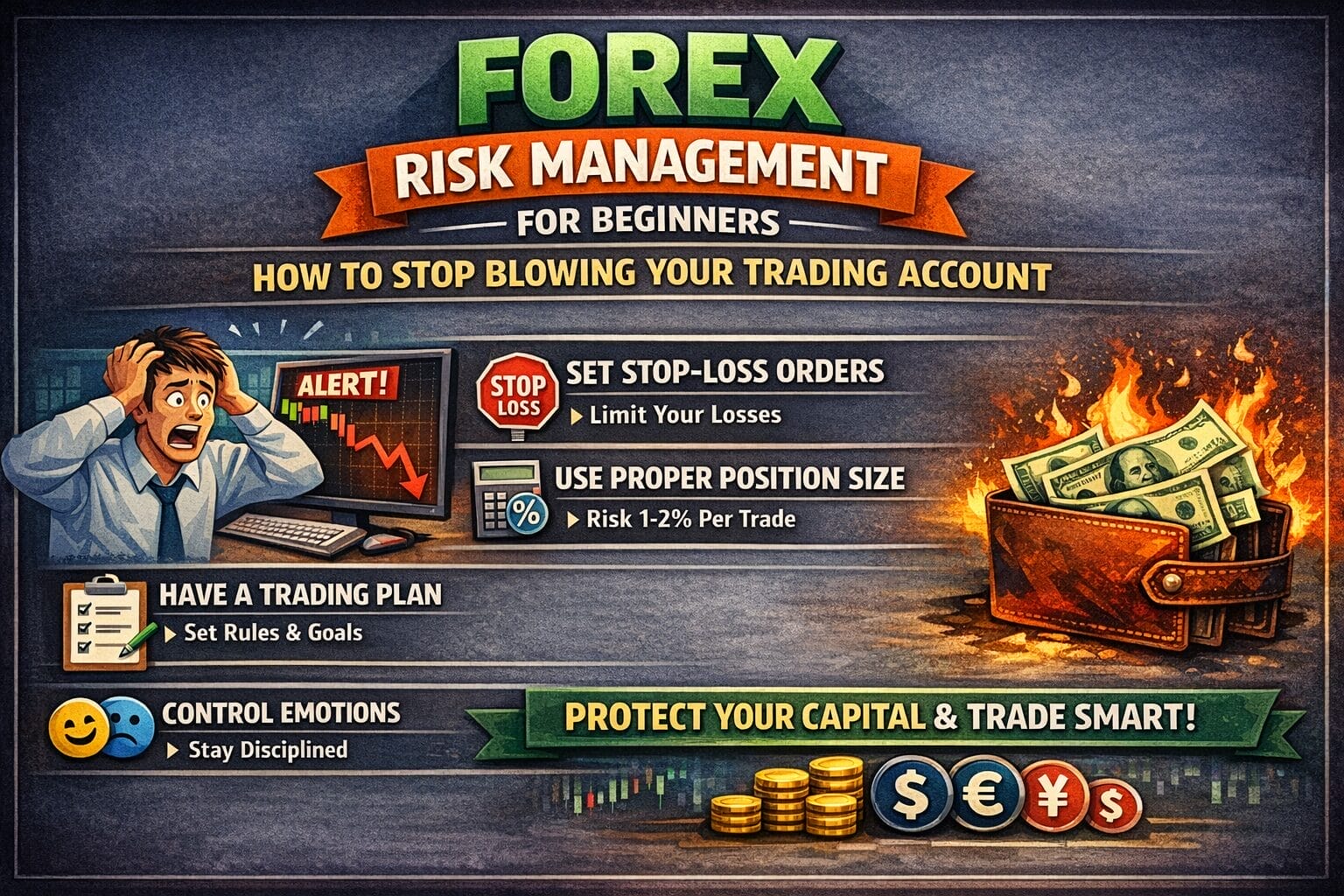
1. “I Lost My First $1,000 in 3 Days” (And What I Learned)
I still remember the hollow feeling in my stomach.
Three days. That’s all it took. One thousand dollars—gone. Not because I picked the wrong direction. Not because the market was “rigged.” But because I had no idea what I was doing when it came to forex risk management for beginners.
I’d spent weeks learning chart patterns. I could spot a head and shoulders formation from across the room. I understood support and resistance. On paper, I was ready.
But here’s what nobody told me: Your strategy is worthless if your risk management is broken.
Most beginners fail at forex trading—not because they can’t read charts, but because they can’t control their position sizes, their emotions, or their losses. The statistics are brutal: approximately 70-80% of retail forex traders lose money. And the majority of those losses happen within the first few months.
The good news? This is entirely preventable.
Risk management isn’t glamorous. It won’t get you excited like a “perfect entry” on a chart. But it’s the difference between blowing up in three days and still being in the game three years later. This guide will show you exactly how to protect your account—even when you’re wrong (which you will be, often).
What Is Forex Risk Management?
Forex risk management is the systematic process of protecting your trading capital through position sizing, stop-loss placement, and emotional discipline. It ensures that no single trade—or string of trades—can destroy your account. Effective risk management combines mathematical rules (risking 1-2% per trade) with psychological controls (daily loss limits) to keep you trading long enough to develop skill.
2. The 5 Emotional Traps That Destroy Beginner Accounts
Before we dive into formulas, we need to talk about the real enemy: your emotions.
Risk management is 20% math and 80% psychology. You can know all the right calculations and still blow up because you couldn’t stick to the rules.
Trap #1: Revenge Trading
You just lost $50. You’re frustrated. So you jump back in with double the position size to “make it back.”
What happens: You lose again. Now you’re down $150.
Watch for: Trading immediately after losses, increasing size to recover, trading outside normal hours while angry.
Trap #2: Size Euphoria
Three winning trades in a row. You feel invincible. You increase position size because you’re “hot.”
What happens: Your streak ends. One loss wipes out three wins.
Watch for: Larger sizes after wins, feeling “due” for a big winner, trading with money you can’t afford to lose.
Trap #3: Stop-Loss Removal
Your trade is moving against you. You’re down $30. You remove the stop, hoping it turns around.
What happens: Sometimes it works. Then one day, you lose $300 instead of $30.
Watch for: Moving stops further from entry, removing stops on losers, justifying larger losses because you’re “sure” it reverses.
Trap #4: FOMO
EUR/USD spiked 50 pips. Everyone on Twitter is talking about it. You weren’t in. Now you chase—at terrible prices.
What happens: You enter at the worst price. The move is exhausted. You buy the top.
Watch for: Entering impulsively after big moves, checking social media while trading, anxiety when not in a trade.
Trap #5: Denial
Your account is down 40% this month. You know your strategy isn’t working. But admitting failure is harder than continuing.
What happens: You lose the other 60%. Rebuild from scratch—or quit.
Watch for: Avoiding account statements, excuses for losses (“bad market”), same behavior expecting different results.
3. The Only Three Numbers That Matter
Risk management can feel overwhelming—leverage, margin, pips, lots, spreads. But you only need three numbers:
Number 1: Risk Per Trade (1-2% Rule)
The maximum amount you’re willing to lose on a single trade.
The Rule: Never risk more than 1-2% of your total account on any single trade.
Why: Even 10 consecutive losses only costs 10-20% of your account. You can recover. Losing 50% in a week? You cannot.
Example:
- Account balance: $1,000
- Risk per trade: 2%
- Maximum loss per trade: $20
Number 2: Risk-to-Reward Ratio (R:R)
Compares how much you’re risking to how much you stand to gain.
The Rule: Only take trades where potential reward is at least 2x your risk (2:1 or better).
Why: You can be wrong 60% of the time and still profit if winners are twice as big as losers.
The Math:
- Win rate: 40% (lose 6 of 10)
- Risk per trade: $20
- Reward per win: $40 (2:1)
- 10 trades = 4 wins ($160) + 6 losses ($120) = +$40 profit
Number 3: Daily/Weekly Loss Limits
Your “circuit breakers”—automatic trading halts at predetermined loss levels.
Suggested Daily Limit: 2-3% of account balance
Suggested Weekly Limit: 5-6% of account balance
Why: One bad day shouldn’t destroy your month. One bad week shouldn’t destroy your account.
Example:
- Account balance: $1,000
- Daily loss limit: 3% ($30)
- Weekly loss limit: 6% ($60)
Hit your daily limit by noon? Close the charts. Walk away. No exceptions.
What Professional Traders Do Differently
| Aspect | Beginner Behavior | Professional Behavior |
|---|---|---|
| Risk per trade | Varies wildly (1% today, 5% tomorrow) | Fixed 1-2%, no exceptions |
| Daily limits | Soft guidelines, often ignored | Hard stops, enforced mechanically |
| Stop-loss discipline | Move stops, widen them, remove them | Set once, never moved toward risk |
| Position sizing | Same size for every trade | Adjusts based on stop distance and volatility |
| After losses | Revenge trade, size up | Stick to plan, review later |
| After wins | Size up, feel invincible | Same size, stay mechanical |
| Journal keeping | Sporadic or skipped | Every trade, reviewed weekly |
| Emotional state | Trades angry, tired, distracted | No trading unless neutral and focused |
The difference: Professionals treat risk management as non-negotiable infrastructure. Beginners treat it as optional advice.
4. Position Sizing: The Formula That Protects You
Position sizing determines exactly how many units to trade based on your risk parameters.
The Position Sizing Formula
Step 1: Determine Risk Amount
Account Balance × Risk Percentage = Risk Amount
$1,000 × 0.02 (2%) = $20
Step 2: Calculate Pips at Risk
Distance from entry to stop-loss.
Entry: 1.0850
Stop-Loss: 1.0820
Pips at Risk: 30 pips
Step 3: Calculate Position Size
Risk Amount ÷ (Pips at Risk × Pip Value) = Lot Size
Worked Example (EUR/USD):
- Account: $1,000
- Risk: 2% ($20)
- Stop-loss: 30 pips
- Pip value (micro lot): $0.10
$20 ÷ (30 × $0.10) = $20 ÷ $3 = 6.67 micro lots
Trade size: 0.06 lots (round down)
Understanding Lot Sizes
Standard Lot: 100,000 units — Pip value ~$10 — Accounts $50,000+
Mini Lot: 10,000 units — Pip value ~$1 — Accounts $5,000+
Micro Lot: 1,000 units — Pip value ~$0.10 — Accounts $500-$5,000
Nano Lot: 100 units — Pip value ~$0.01 — Accounts under $500
Key: With a $1,000 account, trade micro lots (0.01-0.10). This maintains proper risk while allowing flexibility.
Common Mistakes
- Trading standard lots with small accounts
- Using same lot size regardless of stop distance
- Rounding up instead of down
Download the free position size calculator here.
Manual calculations are tedious and error-prone. I’ve created a free calculator that does the math for you. Enter your account balance, risk percentage, and stop-loss distance—it tells you exactly what lot size to trade. No email required.
5. Stop Losses: Where to Place Them (And Where NOT To)
A stop-loss is your safety net. Without it, one bad trade wipes out weeks of profits.
Where you place it matters just as much as having one.
Technical Placement Strategies
Support/Resistance Method:
Place stops just beyond key support (long trades) or resistance (short trades). If price breaks that level, your thesis is invalid anyway.
Example:
- Long entry: 1.0850
- Support: 1.0820
- Stop: 1.0815 (5 pips below)
ATR Method:
Use Average True Range to adapt stops to current volatility.
Example:
- 14-period ATR: 15 pips
- Stop distance: 1.5 × ATR = 22.5 pips
Structure-Based Method:
For swing trades, place stops beyond recent swing highs/lows.
The “Breathing Room” Mistake
Beginners place stops too close to keep “risk small.” But tight stops get hit by normal market noise—even when your direction was right.
The Problem:
- Entry: 1.0850
- Stop: 1.0845 (5 pips)
- Target: 1.0900 (50 pips)
Normal fluctuation hits your stop before the move develops. You were right, but you lost.
The Solution: Place stops based on technical invalidation, not dollar amounts. If your technical stop is too far, reduce position size or skip the trade.
Stop Management Rules
Never move stops further from entry. This is how small losses become account destroyers.
Acceptable adjustments:
- To breakeven: Once price moves 1:1 in your favor, move stop to entry
- Trailing stops: Trail to lock profits, never trail backward
Manual exit only if:
- Trade thesis changes before stop hits
- Market conditions fundamentally shift
- Daily/weekly loss limit triggered
6. Building Your Personal Risk Rules
Rules without enforcement are suggestions. You need a framework you follow regardless of feelings.
Daily Loss Limits (2-3%)
Maximum allowed loss in a single day before stopping.
Example:
- Account: $2,000
- Daily limit: 3% ($60)
- After losing $60, close charts. Don’t trade until tomorrow.
Why: Prevents revenge trading spirals.
Weekly Loss Limits (5-6%)
Protects against extended losing streaks or poor market conditions.
Example:
- Account: $2,000
- Weekly limit: 6% ($120)
- Hit your limit by Wednesday? Stop until Monday.
Circuit Breakers
Consecutive Loss Rule: After 3 consecutive losses, stop for the day.
Drawdown Rule: Down 10% from high? Reduce sizes 50%. Down 20%? Go back to demo.
Emotional State Rule: No trading angry, exhausted, or after major life events.
Pre-Trade Checklist:
- Risking 1-2% or less
- Stop placed and not moved
- Risk-to-reward at least 2:1
- Daily/weekly limit not hit
- Emotionally neutral
Can’t check every box? Don’t take the trade.
7. From Demo to Live: The Psychology Gap
Demo trading teaches platforms and strategies. It doesn’t prepare you for real money psychology.
Why You Risk Differently With Real Money
In demo, a 50-pip loss is just a number. In live trading, it’s $20, $50, $200—real money for groceries, gas, rent.
The shift:
- Demo: Focus on being “right”
- Live: Focus on protecting capital first
This shift causes traders to abandon risk rules when going live. They hesitate on valid setups (fear) or move stops hoping to avoid losses (denial).
Demo vs. Live Comparison
| Aspect | Demo Trading | Live Trading |
|---|---|---|
| Emotional response | Minimal | Significant |
| Stop-loss discipline | High | Often violated |
| Position sizing | Consistent | Often inflated |
| Risk tolerance | Stable | Varies with results |
| Decision speed | Rational | Rushed or delayed |
Transition Checklist
Phase 1: Demo Mastery (1-3 months)
- Consistently profitable 2+ months
- Execute strategy without hesitation
- Never violate risk rules
- 50+ documented trades
Phase 2: Micro Live (Month 1)
- Fund with money you can afford to lose
- Trade smallest sizes (micro lots)
- Focus on execution, not profits
- Accept break-even or small losses
Phase 3: Scaling (Months 2-3)
- Gradually increase sizes
- Track every trade in [INTERNAL LINK: Trading journal for forex traders]
- Review weekly for rule violations
- Never increase size after wins
Golden Rule: If you can’t follow risk rules in demo, you’re not ready for live. Fix discipline first.
8. FAQ: Common Beginner Questions
How much money do I need to start forex trading?
Practical minimum: $500 to $1,000 for proper risk management.
With less than $500, you’re forced to trade nano lots or risk more than 2%. This creates a Catch-22: under-capitalized for meaningful positions or over-leveraged for any positions.
The $3,200/month reality check:
Ads claiming $3,200/month from $500 are misleading. Here’s the math:
- Realistic monthly return: 3-5%
- On $1,000: $30-50 per month
- To make $3,200/month: need $65,000-100,000 capital
Bottom line: Start with $500-1,000 to learn properly. Treat your first year as tuition—you’re paying for education, not income.
What if I don’t have $1,000?
Option 1: Save Up
Take 3-6 months to save $500-1,000. Demo trade while saving. Start live when properly capitalized.
Option 2: Nano Lot Brokers
Some brokers offer nano lots (100 units). Trade with $100-200. Pip values are ~$0.01. Profits are minimal—this is for learning, not income.
Avoid: Starting with $50 on a standard lot broker. You’ll use excessive leverage and almost certainly lose everything.
Can I trade with $100?
Technically yes. Practically, extremely difficult.
The math:
- Account: $100
- 2% risk: $2 per trade
- 20-pip stop with micro lots ($0.10/pip) = $2 risk
- That works—but zero room for error
The psychology: When your entire account is $100, every trade feels life-or-death. You’re more likely to revenge trade, remove stops, or size up.
Better approach: Save $500. Demo trade while saving. Start properly or don’t start yet.
How long until I’m profitable?
Honest answer: 6 months to 2 years for most people.
Learning curve:
Months 1-3: Setup Phase
- Learning platform and concepts
- Developing strategy
- Expectation: Consistent losses or break-even
Months 4-6: Discipline Phase
- Emotional control
- Following risk rules
- Expectation: Small losses or break-even
Months 7-12: Refinement Phase
- Fine-tuning strategy
- Understanding market conditions
- Expectation: Small profits or break-even
Year 2+: Consistency Phase
- Reliable execution
- Automatic risk management
- Expectation: Consistent small profits
Fastest path: Don’t focus on profits. Focus on process. Master risk management first. Profits come when you stop losing.
Final Thoughts: Mastering Forex Risk Management as a Beginner
Mastering forex risk management as a beginner isn’t about complex formulas or secret techniques. It’s about discipline. Here’s the truth that separates survivors from casualties:
Your strategy doesn’t need to be perfect. Your risk management does.
You can have a mediocre strategy with excellent risk management and make money consistently. But you can have the world’s best strategy with poor risk management and blow up in a week.
The concepts in this guide aren’t complicated. Position sizing, stop-losses, and loss limits are simple math. The challenge is doing them consistently when emotions run high.
Start small. Risk less than you think you should. Follow your rules without exception. And remember: the goal isn’t to get rich quickly—it’s to survive long enough to get good.
Get the free position size calculator here and start protecting your account today.
Your future self will thank you.
Related Reading:
- Coming soon..
Disclaimer: Forex trading involves substantial risk of loss and is not suitable for all investors. Past performance is not indicative of future results. Start with capital you can afford to lose completely.