

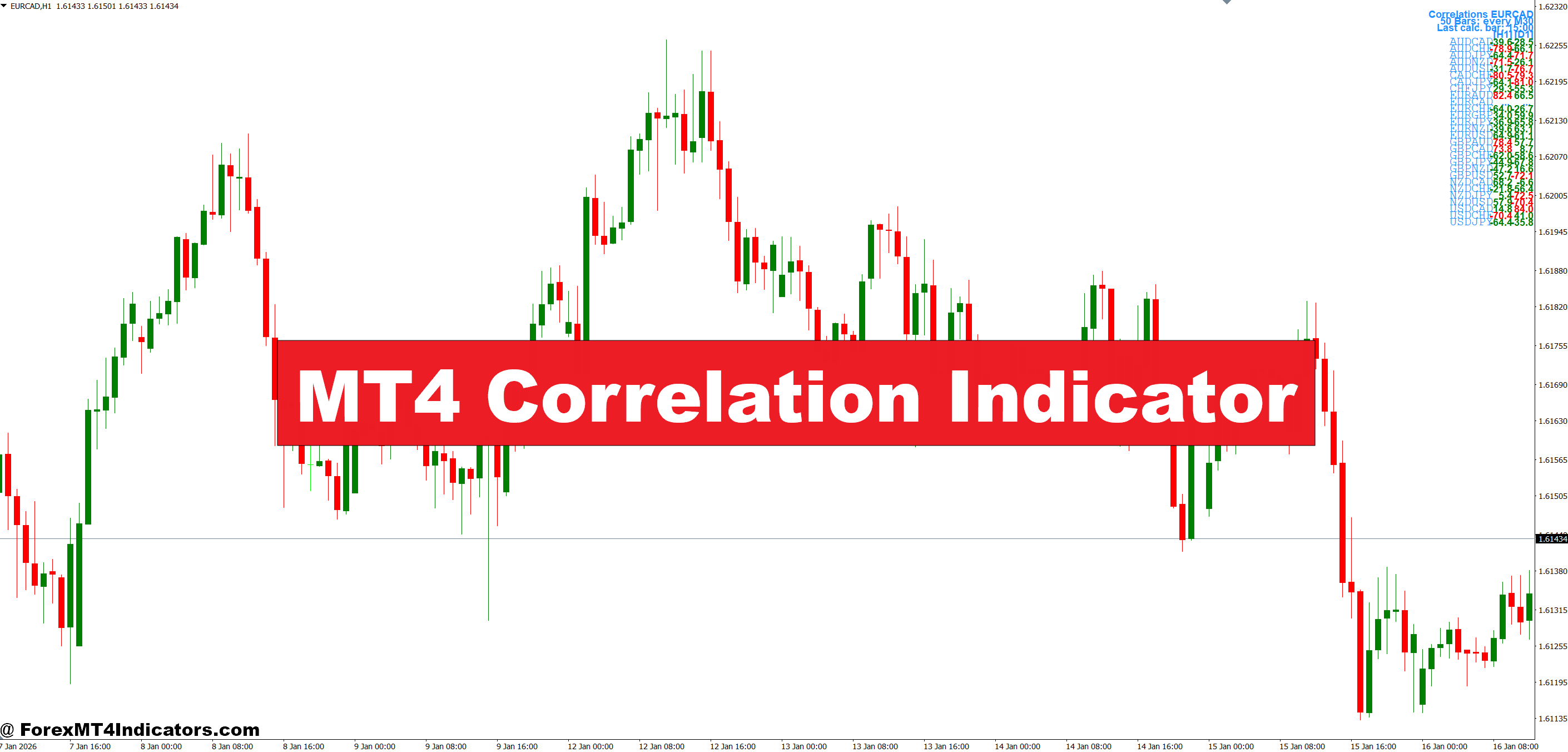
The MT4 Correlation Indicator solves this by displaying real-time correlation coefficients between currency pairs right on your charts. It measures how pairs move together (or against each other) over a specified period, giving traders the data they need to avoid conflicting positions and identify genuine trading opportunities.
What the MT4 Correlation Indicator Actually Measures
This indicator calculates the statistical correlation between two currency pairs using the Pearson correlation coefficient. The output ranges from +1.0 to -1.0, where values near +1.0 indicate pairs that move together, values near -1.0 show inverse relationships, and numbers around zero suggest no meaningful connection.
The calculation examines price changes over a set number of periods—typically 20 to 100 candles. For each period, it compares how both pairs moved and generates a coefficient. A reading of 0.75 on EUR/USD and AUD/USD means they’ve moved in the same direction about 75% of the time during the analyzed window.
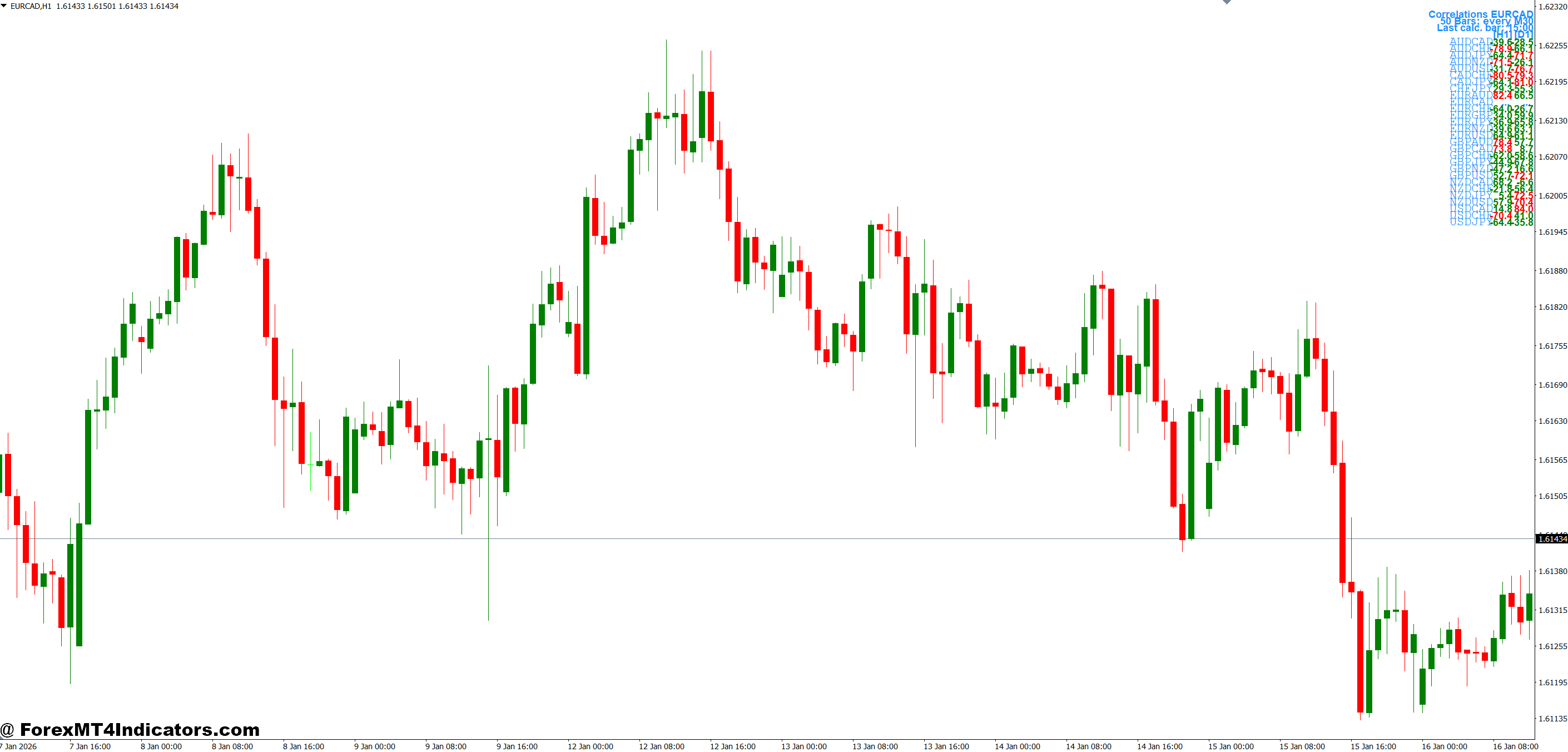
Most MT4 correlation indicators display this data in a matrix format. You’ll see a grid showing multiple pairs with color-coded cells: green for positive correlation, red for negative, and neutral tones for weak relationships. Some versions overlay the coefficient directly on your chart as a line oscillator, updating with each new candle.
How Traders Apply Correlation Analysis in Real Scenarios
Risk management comes first. If you’re already long EUR/USD with a 2% risk allocation, adding a long position on EUR/GBP when their correlation sits at 0.88 doesn’t double your opportunity—it doubles your exposure to euro strength. You’re essentially risking 4% on the same underlying move.
Diversification strategies benefit from understanding these relationships. A trader wanting three separate positions should look for pairs with correlations below 0.60. Combining EUR/USD, USD/JPY, and AUD/NZD typically provides better diversification than EUR/USD, GBP/USD, and EUR/GBP, which often move as a cluster.
Hedging gets more precise with correlation data. Say you’re long EUR/USD but expect short-term dollar strength. Instead of closing the position and re-entering later, you could hedge with a correlated pair. If EUR/USD and USD/CHF show a -0.80 correlation, a long position on USD/CHF acts as a temporary hedge while keeping your primary trade active.
Confirmation strategies also use this tool. When EUR/USD breaks above resistance, checking whether AUD/USD and NZD/USD (both typically positively correlated) confirm the move adds conviction. If all three show strength against the dollar, it suggests genuine dollar weakness rather than euro-specific news.
Adjusting Settings for Different Trading Approaches

The lookback period determines how many candles the indicator analyzes. Day traders often use 20-30 periods on a 15-minute or 1-hour chart, capturing recent correlation shifts. Swing traders prefer 50-100 periods on the daily chart, filtering out short-term noise.
Shorter periods make the indicator more reactive. On a 4-hour EUR/USD chart with a 14-period setting, you’ll catch sudden correlation changes during major news events. The NFP release in November 2024 temporarily shifted EUR/USD and GBP/USD correlation from 0.82 to 0.45 within hours as traders reacted differently to dollar strength implications for each economy.
Longer periods smooth the data but lag behind rapid market shifts. A 200-period setting on the daily chart shows the dominant correlation trend over several months. This works for position traders who care less about day-to-day fluctuations and more about structural relationships.
Some indicators let you select which pairs to monitor. Start with majors—EUR/USD, GBP/USD, USD/JPY, AUD/USD, USD/CAD—before adding cross pairs. Monitoring 20 pairs simultaneously creates information overload. Focus on the instruments you actually trade.
The Advantages This Indicator Brings to Your Trading
Visibility stands out as the primary benefit. Without correlation analysis, traders operate blind to how their positions interact. The indicator makes these relationships explicit, preventing the amateur mistake of thinking three positions equals three independent risks when they’re actually betting on the same market move.
It works across timeframes. Scalpers use it on 5-minute charts to avoid taking EUR/USD and GBP/USD scalps in the same direction when correlation hits 0.90—the second position barely improves the risk-reward ratio. Position traders use daily or weekly data to construct portfolios where pairs genuinely diversify their exposure.
The math doesn’t lie. Unlike subjective chart patterns or indicator interpretations, correlation coefficients are statistical facts. A 0.92 correlation between EUR/USD and EUR/GBP means what it means—no interpretation needed.
Limitations Every Trader Should Understand
Correlations aren’t stable. The EUR/USD and USD/CHF relationship that showed -0.95 for three months might drop to -0.60 during a Swiss National Bank intervention. Historical correlation doesn’t guarantee future behavior, especially during high-impact news or central bank policy shifts.
The indicator shows what happened, not what’s coming. A reading of 0.85 tells you two pairs moved together recently. It doesn’t predict whether they’ll continue that pattern tomorrow. Markets change, and correlations change with them.
It’s a single data point in a complex analysis. Knowing EUR/USD and GBP/USD are highly correlated doesn’t tell you which direction either will move. You still need a directional bias from technical or fundamental analysis. Correlation analysis helps position sizing and risk management—it doesn’t generate trade signals by itself.
Lagging issues affect all correlation calculations. Since the indicator analyzes past price data, rapid market shifts create temporary mismatches. During the flash crash scenarios, correlations can temporarily break down as different pairs react at different speeds to the same event.
Compared to Traditional Currency Strength Meters

Currency strength meters show the relative strength of individual currencies across multiple pairs. The MT4 Correlation Indicator focuses on pair relationships instead. Both tools complement each other but serve different purposes.
A strength meter might show the dollar strengthening across all pairs while the euro weakens. The correlation indicator reveals which dollar pairs move most similarly to each other. One answers “which currency is strong,” the other answers “which pairs move together.”
Correlation indicators provide more precise risk assessment. Knowing USD is strong doesn’t tell you if USD/JPY and USD/CAD will move identically. But a correlation reading of 0.68 between them gives you exact data on their relationship strength.
Practical Application Framework
Start each trading week by checking correlation matrices on the daily chart with a 50-period setting. Identify clusters—pairs moving together above 0.70 or inversely below -0.70. This becomes your risk map.
Before entering any trade, check correlation with existing positions. If you’re already long two pairs with 0.80+ correlation, adding a third position in that cluster provides diminishing returns. Look for opportunities in pairs showing weak correlation (between -0.40 and +0.40) to your current holdings.
Monitor correlation changes weekly. A sudden drop from 0.85 to 0.50 between normally related pairs suggests something fundamental shifted. Maybe Brexit news affected GBP pairs differently than EUR pairs, breaking their usual relationship. These shifts often signal changing market dynamics worth investigating.
Trading forex carries substantial risk. No indicator guarantees profits, and correlation relationships can break down during volatile periods. The MT4 Correlation Indicator provides data for better decisions, but traders remain responsible for managing risk and understanding that past correlations don’t ensure future relationships.
How to Trade with MT4 Correlation Indicator
Buy Entry
- Low correlation confirmation (below 0.40) – When your primary buy setup on EUR/USD shows correlation under 0.40 with existing long positions, take the trade to genuinely diversify risk across 2-3 positions without overexposure.
- Negative correlation hedge (-0.75 or lower) – Enter a buy on USD/CHF when holding losing EUR/USD longs and correlation reads -0.80, creating a protective hedge that profits if dollar strength continues while preserving your original position.
- Correlation breakdown buy – Go long EUR/USD when its typical 0.85 correlation with GBP/USD drops to 0.50 on the 4-hour chart, signaling euro-specific strength that’s diverging from broader sentiment.
- Multiple pair confirmation – Take the EUR/USD buy signal only when 3+ positively correlated pairs (GBP/USD, AUD/USD, NZD/USD all above 0.70 correlation) simultaneously break resistance, confirming genuine dollar weakness.
- Skip if overconcentrated – Don’t buy EUR/GBP if you’re already long EUR/USD and their correlation exceeds 0.80 on the daily chart—you’re doubling euro exposure, not creating opportunity.
- Post-news divergence entry – Buy the pair that underreacted when correlation temporarily drops to 0.30 after NFP data, but normally correlated pairs (0.75+) show one lagging the move by 20-30 pips.
- Inverse pair strength – Enter long AUD/USD when it shows -0.70 correlation with USD/CAD and the Canadian pair is clearly weakening, using inverse relationships to confirm your directional bias.
- Avoid during correlation spikes – Don’t buy additional positions when correlation suddenly jumps from 0.60 to 0.95 within 12 hours on the 1-hour chart—wait for stabilization as temporary correlation spikes often reverse quickly.
Sell Entry
- High correlation short clustering – Sell EUR/USD when it correlates above 0.85 with GBP/USD and both pairs reject resistance simultaneously on the daily chart, but only if you have no conflicting long positions in correlated pairs.
- Hedge with negative correlation – Short EUR/USD when holding profitable GBP/USD longs and correlation shifts to -0.65, protecting gains if the euro weakens independently while pound strength continues.
- Correlation breakdown short – Sell GBP/USD when its usual 0.80 correlation with EUR/USD collapses to 0.35 on the 4-hour timeframe, indicating pound-specific weakness diverging from euro performance.
- Failed correlation follow-through – Short the lagging pair when EUR/USD drops 50 pips but GBP/USD (normally 0.85 correlated) only falls 15 pips, expecting the correlation gap to close within 4-6 hours.
- Maximum risk exposure check – Skip the EUR/GBP short if you’re already short two pairs showing 0.75+ correlation on the daily chart—adding a third concentrates rather than diversifies your short exposure.
- Inverse confirmation sell – Enter short on USD/JPY when it shows -0.80 correlation with EUR/USD and the euro pair is rallying strongly, using the negative relationship to validate yen strength expectations.
- Correlation strength filter – Sell only when your technical setup on AUD/USD aligns with 2+ correlated pairs (correlation above 0.70) also breaking support, filtering false breakdowns from coordinated weakness.
- Don’t short correlation reversals – Avoid selling when correlation flips from -0.70 to +0.40 within 24 hours—rapid correlation changes during volatile sessions create unreliable signals until the new relationship stabilizes over 3-5 days.
Final Thoughts on Currency Correlation Analysis
The MT4 Correlation Indicator transforms invisible market relationships into actionable data. Traders using it avoid the common trap of overconcentration—thinking multiple positions provide diversification when they’re actually multiplying exposure to the same underlying move. It quantifies how pairs interact with cold statistical precision, removing guesswork from portfolio construction.
That said, it’s a tool, not a system. The coefficient values need context from broader market analysis, fundamental awareness, and proper position sizing. Used correctly, it prevents costly mistakes and helps traders build genuinely diversified portfolios. The next time you’re about to enter a second position, pull up the correlation matrix first. Those few seconds might save you from fighting yourself in the market.
Recommended MT4/MT5 Broker
XM Broker
- Free $50 To Start Trading Instantly! (Withdraw-able Profit)
- Deposit Bonus up to $5,000
- Unlimited Loyalty Program
- Award Winning Forex Broker
- Additional Exclusive Bonuses Throughout The Year
- Exclusive 90% VIP Cash Rebates for all Trades!

Already an XM client but missing out on cashback? Open New Real Account and Enter this Partner Code: VIP90
(Free MT4 Indicators Download)



Enter Your Email Address below, download link will be sent to you.