

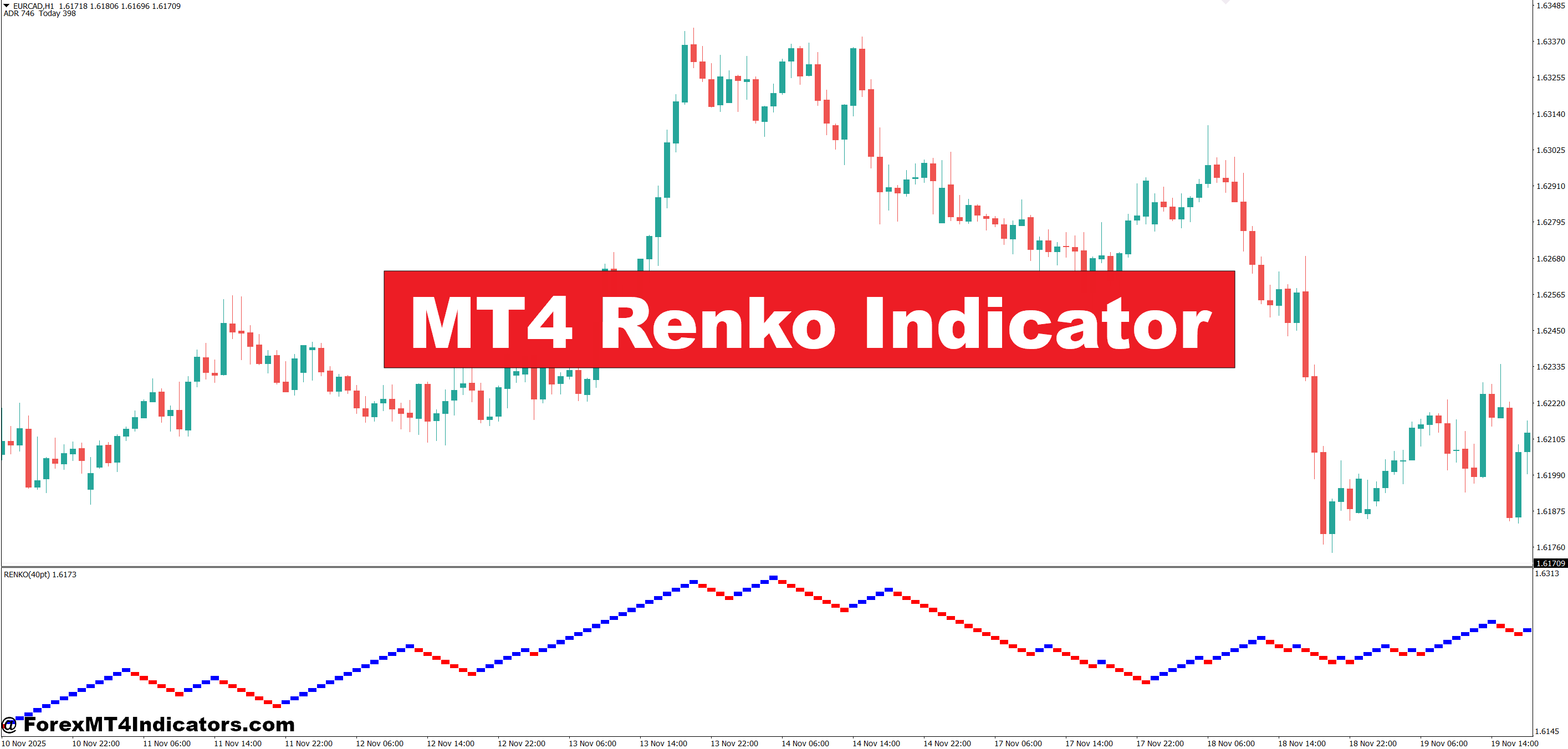
The MT4 Renko Indicator is a custom tool for MetaTrader 4 that builds Renko charts based on price movement rather than time. Each “brick” forms only after price moves a set number of pips. Time doesn’t matter. A brick can take five seconds or five hours to form.
Traditional candlestick charts print a candle every minute, hour, or day. Renko charts only print when price actually moves. If EUR/USD goes sideways for three hours within a 10-pip range, a Renko chart may show nothing new at all.
That’s why many traders use Renko as a trend-clarifying tool. It strips away small fluctuations and highlights directional moves. Green or bullish bricks show upward movement. Red or bearish bricks show downward movement. No wicks, no overlapping candles, just price progression.
On MT4, Renko indicators usually run as offline charts, though some newer versions overlay bricks directly on live charts.
How the MT4 Renko Indicator Works
The logic behind Renko is simple but effective. Traders define a brick size, such as 10 pips. A new bullish brick appears only after price moves 10 pips above the last brick’s close. A bearish brick forms after a 10-pip move in the opposite direction.
Reversals require a full brick move in the opposite direction. That rule alone filters many fake-outs. On a 10-pip Renko chart, a 6-pip pullback won’t print anything. Price must commit.
For example, when testing this on volatile NFP days, traders often notice fewer signals but cleaner moves. EUR/USD might print five consecutive bullish bricks during a strong release, instead of a mess of long-wick candles on M5.
Behind the scenes, the indicator constantly monitors bid prices. Once the predefined movement threshold is hit, it locks in a brick and waits for the next valid move.
But brick size matters. A 5-pip Renko chart reacts quickly but allows more noise. A 20-pip brick smooths trends but delays entries. There’s always a trade-off.
Practical Trading Applications and Examples
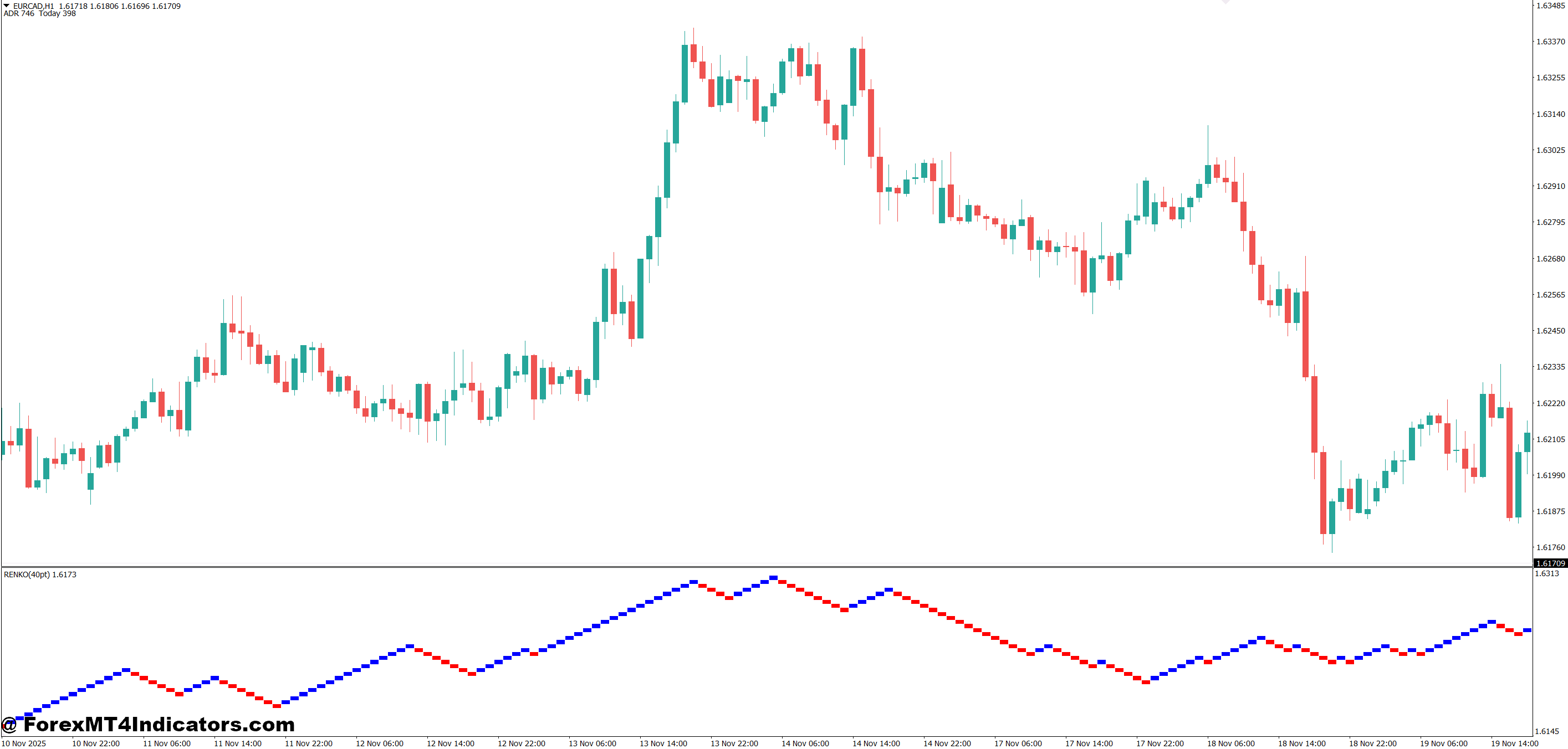
Traders often use the MT4 Renko Indicator for trend-following and breakout strategies. One common setup combines Renko with a 20-period moving average.
Here’s a real-world style example. On EUR/USD using a 10-pip Renko chart, price printed eight consecutive bullish bricks above the 20 MA during the New York session. A pullback printed only one bearish brick, then bullish bricks resumed. Traders entered on the first bullish brick close after the pullback, with a stop two bricks below. The move ran for nearly 90 pips before stalling.
Renko also helps with support and resistance. Horizontal levels stand out more clearly because price doesn’t clutter the chart with time-based noise. Breakouts often look cleaner, especially during London opens.
But Renko struggles in tight ranges. During Asian sessions on pairs like EUR/CHF, traders may wait hours for a single brick. That’s not a flaw—it’s a signal to stay flat.
Many experienced traders pair Renko with RSI(14) or MACD for confirmation, not signals. Renko shows direction. Oscillators help spot exhaustion.
Settings and Customization on MT4
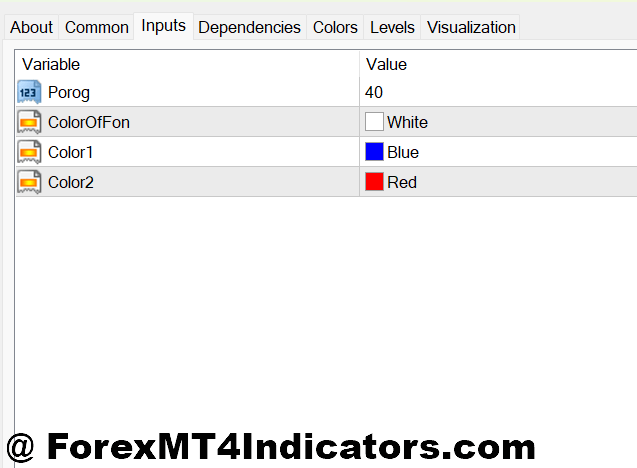
Most MT4 Renko indicators allow traders to adjust brick size, price source, and chart type. Brick size is the key setting.
For scalping on pairs like GBP/USD, traders often test 5–8 pip bricks on lower volatility days. For swing trading on H1 or H4 context, 10–20 pip bricks make more sense.
Some indicators allow ATR-based brick sizing. This adapts to volatility but can change historical structure, which some traders dislike. Fixed brick sizes are more predictable.
Another tip experienced traders know—Renko charts don’t show time gaps. A strong move during illiquid hours can look the same as a London breakout. That’s why session awareness still matters.
Always backtest settings on specific pairs. What works on EUR/USD won’t behave the same on XAU/USD or NAS100.
Advantages, Limitations, and Comparisons
The biggest advantage of the MT4 Renko Indicator is clarity. Trends look cleaner. Pullbacks are easier to spot. Emotional overtrading drops because there are fewer signals.
Renko also pairs well with price action concepts. Higher highs and higher lows stand out without squinting at wicks.
But there are real limitations. Renko hides time. A move that takes eight hours and one that takes two minutes look identical. News risk can sneak up if traders aren’t watching the clock.
Compared to Heikin Ashi, Renko filters more noise but reacts slower. Compared to standard candlesticks, it sacrifices detail for structure. That’s not better or worse—just different.
No indicator replaces context. Renko works best when traders already understand market structure, session flows, and risk management.
Trading forex carries substantial risk. No indicator guarantees profits.
How to Trade with MT4 Renko Indicator
Buy Entry

- Confirm bullish brick sequence – Enter buy after at least 3 consecutive green Renko bricks with a fixed size (e.g., 10 pips) on EUR/USD, showing clear upward momentum.
- Trade above key moving average – Take buys only when price bricks stay above the 20-period MA on a 1-hour Renko chart to avoid counter-trend traps.
- Pullback then continuation – Buy when a single red brick appears in an uptrend, followed by a fresh green brick, often seen on GBP/USD during London session.
- Break and hold resistance – Enter after price forms two bullish bricks above a prior resistance level (example: above 1.0850 on EUR/USD).
- RSI confirmation – Look for RSI(14) holding above 50 while new bullish bricks print, signaling strength, not exhaustion.
- Set fixed brick-based stop – Place stop-loss 2 bricks (20 pips on 10-pip Renko) below entry to control downside risk.
- Skip low-volatility sessions – Avoid buy signals during Asian session chop when bricks take over 30–40 minutes to form.
Sell Entry

- Confirm bearish brick sequence – Enter sell after 3 consecutive red Renko bricks on a 10–15 pip setup, showing sellers in control.
- Trade below moving average – Sell only when price stays below the 20-period MA on a 4-hour Renko chart to stay with trend.
- Pullback rejection – Sell after one green brick retraces into resistance, then a red brick prints, common on GBP/USD fake-outs.
- Support breakdown – Enter sell after two bearish bricks close below a clear support level, such as 1.2600 on GBP/USD.
- Momentum check with RSI – Favor sells when RSI(14) stays below 45, avoiding entries after sharp oversold drops.
- Defined risk per trade – Risk no more than 1–2% of account, using a stop 2 bricks above entry to avoid emotional exits.
- Avoid major news windows – Don’t sell within 15 minutes of high-impact news like NFP, when Renko can lag fast spikes.
Conclusion
The MT4 Renko Indicator offers traders a different way to read price, one that focuses on movement instead of minutes. It doesn’t predict markets, but it can improve decision-making when used with discipline.
Key takeaways stand out clearly. It filters noise and reduces whipsaw trades. It highlights trends and clean pullbacks. And it forces patience during low-quality conditions.
At the same time, it hides time and can delay entries if brick sizes are poorly chosen. That balance matters.
For traders struggling with messy charts and emotional entries, testing the MT4 Renko Indicator on a demo account is a logical next step. Used alongside solid risk rules and market awareness, it can sharpen execution and help traders see what price is actually doing, not just when it moved.
Recommended MT4/MT5 Broker
XM Broker
- Free $50 To Start Trading Instantly! (Withdraw-able Profit)
- Deposit Bonus up to $5,000
- Unlimited Loyalty Program
- Award Winning Forex Broker
- Additional Exclusive Bonuses Throughout The Year
- Exclusive 90% VIP Cash Rebates for all Trades!

Already an XM client but missing out on cashback? Open New Real Account and Enter this Partner Code: VIP90
(Free MT4 Indicators Download)


Enter Your Email Address below, download link will be sent to you.