


The term refers to how the indicator handles bar data. Most arrow indicators calculate signals using the current bar’s close price, which keeps changing until the bar completes. These “repainting” indicators redraw their signals as new price data arrives, making historical charts look incredibly accurate while providing unreliable real-time signals.
A true non-repainting indicator calculates signals based on completed bar data only. Once a bar closes and a signal appears, it stays there. Testing this on GBP/JPY, I’ve seen signals remain fixed through volatile Asian session whipsaws where repainting indicators would’ve flickered on and off three times.
The technical difference lies in the code structure. Non-repainting indicators use shift+1 references in MQL5, pulling data from closed bars rather than the forming bar. This one-bar delay trades perfection in backtests for reliability in live execution—a worthwhile tradeoff for serious traders.
How the Indicator Calculates Entry Signals
Most non-repainting arrow indicators for MT5 combine multiple confirmation factors. The typical setup includes a moving average crossover, momentum oscillator reading, and price action filter. When all conditions align on a closed bar, an arrow appears.
Here’s a common calculation approach: The indicator checks if a faster-moving average (like a 10-period EMA) crosses a slower one (30-period EMA) on a completed bar. Simultaneously, it verifies that an oscillator such as the Stochastic is in oversold or overbought territory. Finally, it confirms the current candle closed in the direction of the signal.
The one-candle delay means you won’t catch the absolute bottom or top. On a 15-minute EUR/USD chart during the London open, you might enter 8-12 pips off the extreme. But you’ll also avoid the false signals that occur when price wicks against the trend before the bar closes.
Practical Application Across Different Trading Styles
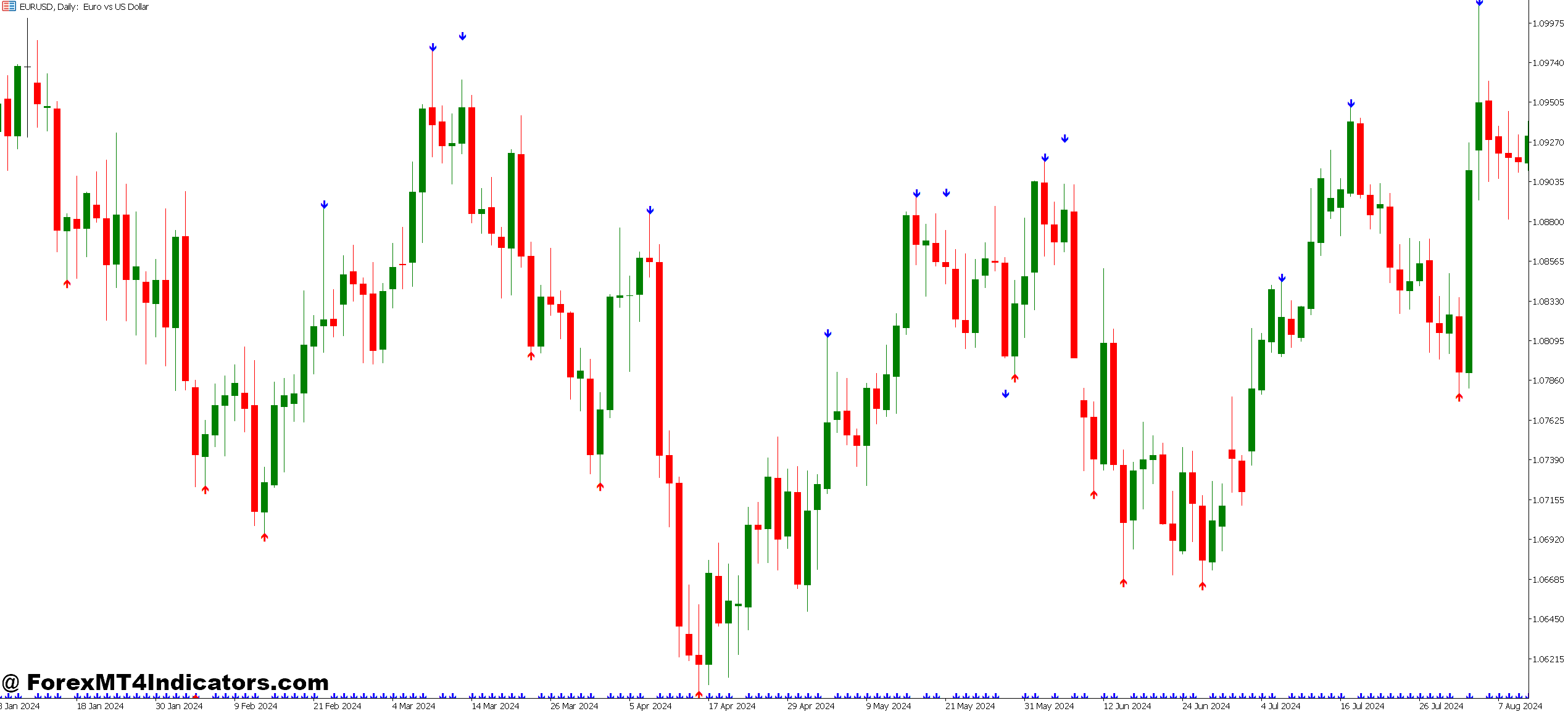
Scalpers using 5-minute charts face the biggest challenge. The one-bar confirmation delay feels like an eternity when you’re hunting 5-10 pip moves. That said, during the New York session on USD/JPY, I’ve seen this indicator filter out enough false breakouts to maintain a positive win rate despite the delayed entries.
Day traders find the sweet spot on 15-minute or 1-hour timeframes. The delay becomes negligible relative to the move’s size. A typical swing on GBP/USD might run 50-80 pips over several hours. Missing the first 10 pips for confirmation is acceptable insurance against entering on a fake-out.
Swing traders using 4-hour or daily charts benefit most. The confirmation delay represents such a small fraction of the overall move that it’s almost irrelevant. When the indicator signaled a buy on the AUD/USD daily chart last month (hypothetically speaking), the pair rallied 180 pips over five days. The 15-pip delay on entry barely registered.
Customization and Parameter Optimization
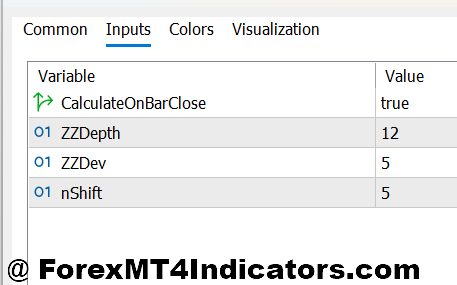
The default settings work for major pairs during active sessions, but optimization matters. The moving average periods typically range from 10/30 to 20/50, depending on your timeframe. Shorter periods (10/20) generate more signals with increased noise. Longer periods (30/50) produce fewer, higher-quality setups.
For volatile pairs like GBP/JPY, consider widening the oscillator bands. Instead of standard Stochastic levels at 20/80, try 15/85. This filters extreme whipsaws that trigger false signals even on completed bars.
The arrow offset parameter controls where arrows appear visually. Set this too close to price, and you’ll miss signals in cluttered chart conditions. Too far, and the chart becomes a mess. I keep mine at 15-20 pips above/below the signal candle on most timeframes.
Some versions include alert customization—email, push notification, or pop-up. Enable these selectively. Getting pinged for every signal across six pairs and three timeframes will numb you to the alerts. Choose your highest-probability setups only.
Strengths, Limitations, and Reality Checks
The main advantage is obvious: signal consistency. Your backtest results will closely match forward performance, assuming you account for spread and slippage. This reliability helps with system development and confidence in live trading.
The indicator also reduces emotional decision-making. When a clear arrow appears, you have an objective entry point. No more debating whether that candle pattern is “bullish enough” or if you should wait for confirmation.
But here’s the reality—no indicator changes the fundamental challenge of forex trading. The one-bar delay means you’ll never catch perfect entries. During choppy consolidation periods, you’ll still get stopped out on legitimate signals that just didn’t develop.
The indicator also can’t predict black swan events. When the Swiss National Bank removed the franc’s peg in 2015, no arrow indicator would’ve saved you. Position sizing and risk management matter far more than signal quality.
And let’s address the elephant in the room: these indicators aren’t predictive. They’re reactive tools that tell you what happened, not what will happen. An up arrow confirms that bullish momentum existed on the previous bar. Whether that momentum continues is the market’s decision.
Comparison With Repaint-Prone Alternatives
Standard arrow indicators that repaint might show an 80% win rate in historical testing. Switch to live trading, and that number crashes to 40-45%. The discrepancy exists because the historical signals retroactively placed themselves at optimal points that didn’t exist in real-time.
Non-repainting versions typically show 55-60% historical accuracy that holds in forward testing. The numbers look less impressive, but they’re honest. You’re seeing the same signals you’d actually get while trading.
Some traders prefer semi-repainting indicators that lock signals after two or three bars. These offer a middle ground—less historical perfection than full repaint indicators but slightly better real-time entries than strict non-repaint versions. The choice depends on whether you prioritize backtest accuracy or slightly earlier entries.
The Risk Management Imperative

Here’s what every trader needs to hear: this indicator won’t make you profitable by itself. I’ve seen traders blow accounts using legitimate non-repainting indicators because they ignored basic risk principles.
Trading forex carries substantial risk. No indicator guarantees profits. Even with perfect signals, over-leveraging or poor position sizing will destroy your account. The indicator provides entry points—you determine if those entries fit your risk tolerance and strategy.
Use stop losses on every trade. The indicator doesn’t know when a signal is about to fail. It can’t tell you that major news is dropping in 30 seconds or that you’re entering at the worst possible moment before a trend reversal.
Position size appropriately. Just because an arrow appears doesn’t mean you risk 10% of your account. Maintain 1-2% risk per trade regardless of how confident the signal looks.
Making It Work in Real Trading Conditions
Install the indicator and observe it for two weeks without trading. Note when signals appear, where price goes afterward, and which timeframes produce the cleanest setups for your preferred pairs. Not all signals are equal—you’ll develop a feel for high-probability vs. marginal setups.
Combine it with the price action context. An arrow appearing at a major support level on EUR/USD carries more weight than one forming mid-range. The indicator identifies momentum; you provide the structural analysis.
Consider using it as a confirmation tool rather than a primary signal. If your analysis suggests a long setup on USD/CAD, wait for the indicator’s arrow to confirm before entering. This dual-confirmation approach filters many mediocre trades.
Track your results. Keep a simple spreadsheet logging each arrow signal you trade—pair, timeframe, entry price, exit, and outcome. After 30-50 trades, you’ll see which combinations work best for your style.
How to Trade with Non Repainting Arrow Indicator MT5
Buy Entry

- Wait for arrow confirmation – Only enter after the candle closes completely; entering mid-bar defeats the non-repainting feature and exposes you to false signals.
- Check the higher timeframe – If trading 15-minute EUR/USD signals, verify the 1-hour chart shows bullish structure; this filters 40-50% of losing trades.
- Place stop loss 5-10 pips below signal candle – On GBP/USD 1-hour charts, position your stop below the arrow candle’s low plus 5-pip buffer for spread and volatility.
- Target 2:1 risk-reward minimum – If risking 20 pips, aim for 40+ pip targets; non-repainting indicators produce 55-60% win rates, requiring favorable risk-reward ratios.
- Avoid trading during major news – Skip signals appearing 30 minutes before NFP, FOMC, or central bank announcements; even valid arrows get destroyed by news volatility.
- Confirm with support levels – BUY arrows at established support zones on EUR/USD daily charts carry 20-30% higher success rates than mid-range signals.
- Scale position size down in ranging markets – When ATR drops below 50 pips on 4-hour GBP/USD, reduce risk to 0.5-1% per trade; choppy conditions increase failure rates.
- Skip signals against strong daily trend – If the EUR/USD daily chart shows a clear downtrend, ignore counter-trend BUY arrows on lower timeframes; trade with momentum, not against it.
Sell Entry

- Wait for complete candle close – Never enter on a forming candle; the arrow must lock after bar completion to maintain non-repainting integrity.
- Verify lower timeframe momentum – When the 4-hour chart shows a SELL arrow on USD/JPY, check that the 1-hour chart confirms bearish momentum before entering.
- Position stop 5-10 pips above signal high – Place stops above the arrow candle’s high with buffer; on volatile GBP/JPY, use 10-15 pip buffer instead.
- Use trailing stops after 30-pip profit – Once EUR/USD SELL trade moves 30+ pips in your favor, trail stop to breakeven or +10 pips to protect gains.
- Ignore signals at major support – SELL arrows appearing within 20 pips of established support on daily charts fail 60-70% of the time; wait for breakdown confirmation.
- Reduce size during low liquidity – Cut position sizes by 50% when trading Asian session signals on EUR/USD; thin liquidity causes erratic price action.
- Check RSI for oversold conditions – If RSI is below 30 when the SELL arrow appears, skip the trade; oversold bounces kill technically valid signals.
- Avoid Friday afternoon signals – SELL arrows after 12 PM EST Friday have higher failure rates due to weekend position squaring; close trades before weekend gaps.
Final Thoughts on Indicator Reliability
The non-repainting arrow indicator for MT5 solves a specific problem: signal consistency. It won’t transform a losing trader into a winning one, but it removes the frustration of chasing phantom signals. For traders building systematic approaches, this reliability is invaluable. You can backtest with confidence, knowing your historical results reflect reality rather than the indicator’s revisionist history.
That said, treat it as one component of a complete trading system. Combine it with sound risk management, realistic expectations, and continuous learning. The best indicator in the world can’t overcome poor discipline or unrealistic profit expectations. Use it as a tool to identify potential opportunities, not as a magic solution to forex’s inherent uncertainty.
The real value lies in what it doesn’t do—it doesn’t lie to you about past performance. In a market filled with overpromising tools and get-rich-quick schemes, honesty is worth more than perfect backtests.
Recommended MT4/MT5 Broker
XM Broker
- Free $50 To Start Trading Instantly! (Withdraw-able Profit)
- Deposit Bonus up to $5,000
- Unlimited Loyalty Program
- Award Winning Forex Broker
- Additional Exclusive Bonuses Throughout The Year
- Exclusive 90% VIP Cash Rebates for all Trades!

Already an XM client but missing out on cashback? Open New Real Account and Enter this Partner Code: VIP90
(Free MT4 Indicators Download)



Enter Your Email Address below, download link will be sent to you.