

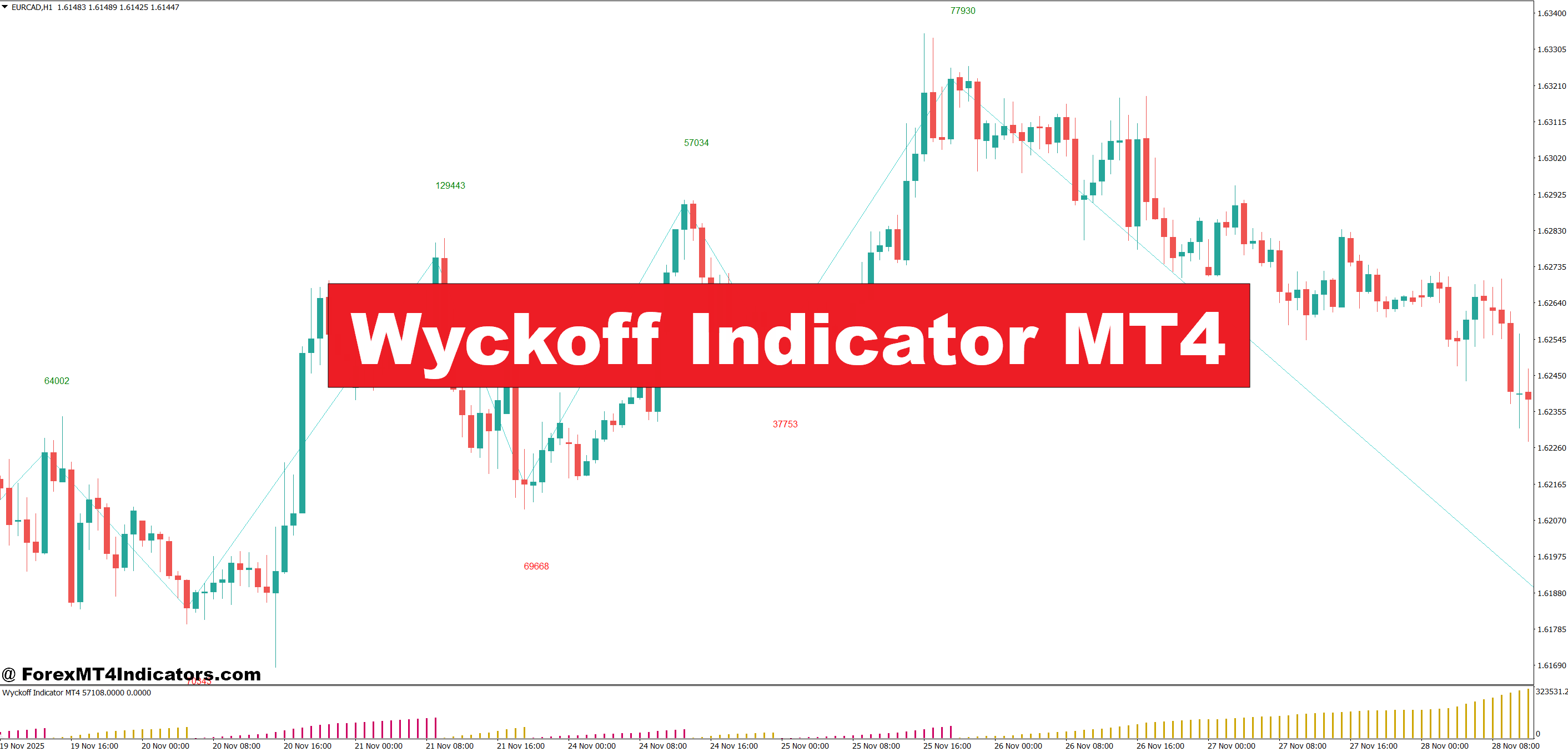
The Wyckoff Indicator for MT4 applies principles from the Wyckoff Method, a technical analysis framework focused on price-volume relationships and market structure. Unlike momentum oscillators that simply measure speed of price change, this indicator analyzes the behavior of large market participants—banks, funds, and institutional traders who move enough volume to create meaningful price shifts.
The indicator typically displays market phases: accumulation (where smart money builds positions), markup (the trending move), distribution (where positions get unwound), and markdown (the decline). Some versions overlay volume spread analysis, showing whether price ranges occurred on high or low volume, which reveals the strength behind moves.
What sets this apart from standard indicators is the focus on context. A bullish candlestick means something different in an accumulation phase versus a distribution phase. The Wyckoff framework teaches traders to read those distinctions.
How the Indicator Processes Market Data
The MT4 Wyckoff Indicator processes price and volume data to identify specific market structures. It calculates the spread (high minus low) of each bar and compares it to volume. Wide spreads on high volume suggest professional interest. Narrow spreads on high volume often signal absorption—large players soaking up orders without letting price run.
The indicator looks for key Wyckoff events like springs (false breakdowns below support that trap sellers before rallying), upthrusts (false breakouts above resistance), and tests (price revisiting support or resistance on lower volume to confirm strength). These patterns aren’t just shapes on a chart—they represent specific order flow dynamics.
For example, during accumulation, you’ll see price grinding sideways with occasional sharp drops that don’t follow through. That’s smart money shaking out weak hands before the markup phase begins. The indicator flags these structural elements, so you’re not stuck staring at choppy price action wondering what’s happening.
Real Trading Scenarios with the Wyckoff Indicator

Let’s get specific. On GBP/USD during the 4-hour timeframe in early 2024, the pair spent three weeks consolidating between 1.2650 and 1.2750. Most traders saw messy chop. The Wyckoff Indicator showed classic accumulation—multiple springs below 1.2650 that immediately reversed on declining volume, signaling no real selling pressure.
When price finally broke above 1.2750 with expanding volume, the indicator confirmed a sign of strength (SOS). That marked the transition from accumulation to markup. Traders who recognized this structure entered long positions and rode the subsequent 200-pip rally to 1.2950.
Compare that to a distribution pattern on EUR/USD in mid-2023. After a strong uptrend, price started making higher highs on progressively lower volume. The Wyckoff Indicator highlighted an upthrust—a brief spike to 1.1100 that immediately reversed. That was distribution, not continuation. Sellers were unloading into buyer enthusiasm. The markdown phase that followed dropped 300 pips over two weeks.
These aren’t cherry-picked examples designed to sell you something. They’re illustrations of how institutional behavior leaves traceable patterns. But here’s the thing—you still need to confirm entries with price action and risk management. The indicator shows you the forest; you navigate the trees.
Customizing Settings for New Trading Styles
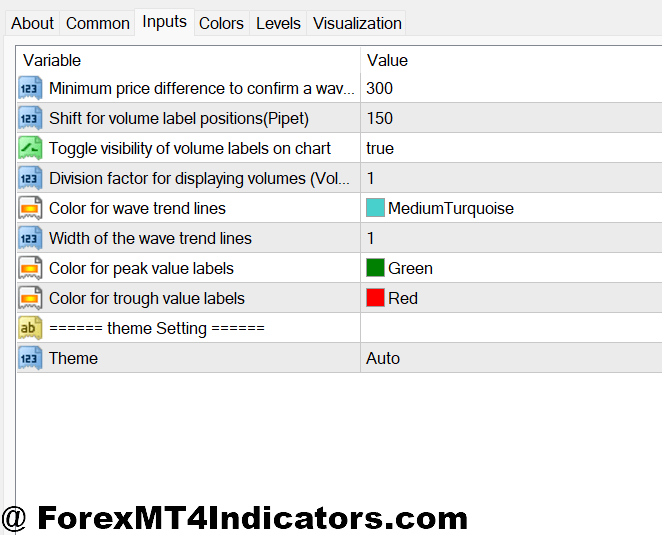
The Wyckoff Indicator for MT4 comes with adjustable parameters, though the core concepts remain consistent. Volume period settings typically default to 14 or 20 bars, which works well for daily and 4-hour charts. Scalpers on 5-minute or 15-minute timeframes might drop that to 8-10 periods to catch shorter-term institutional footprints.
Some versions include alert thresholds for volume spikes or specific Wyckoff events. Setting alerts for springs or upthrusts can save you from staring at charts all day. You’ll get notified when potential setups develop, then verify the context before entering.
The visual display matters too. Clean, minimal overlays work better than cluttered dashboards. You want to see accumulation/distribution zones clearly marked without obscuring candlesticks. Color-coded volume bars—green for up closes, red for down closes—help spot divergences quickly.
For pairs like USD/JPY that move differently than EUR/USD, you might adjust sensitivity. Yen pairs often show tighter ranges during accumulation, so your spring threshold needs tuning. That said, the fundamental logic doesn’t change. Smart money accumulates before marking up regardless of the instrument.
Strengths and Real Limitations

The Wyckoff Indicator excels at keeping traders on the right side of major moves. When you understand where institutions are positioned, you avoid common retail traps like buying distribution or selling accumulation. That alone can prevent significant losses.
It also provides objective criteria for trade selection. Instead of subjective pattern recognition, you’re looking for specific volume-price relationships. Springs either happen or they don’t. Signs of strength are measurable, not feelings.
But let’s be honest about limitations. The indicator lags during fast-moving news events. When NFP data drops or central banks make surprise announcements, Wyckoff structures don’t matter for those initial minutes. Price just goes. The methodology shines in the days and weeks surrounding those events, not during the chaos itself.
False signals occur, especially in low-liquidity markets or overnight sessions. A spring in thin Asian session trading might not carry the same weight as one during London-New York overlap. You need to filter setups based on session context.
The indicator also won’t tell you exact entry and exit points. It identifies zones and phases. You still need to combine it with support/resistance levels, candlestick patterns, or other confirmation tools. Think of it as a framework, not a complete system.
Trading forex carries substantial risk. No indicator guarantees profits, and the Wyckoff method requires study to apply correctly. Misreading accumulation as distribution—or vice versa—can put you on the wrong side of a strong move.
Why This Differs from Standard Indicators
Compare the Wyckoff approach to something like RSI or MACD. Those tools measure momentum—how fast price is moving. They’ll tell you when a market is overbought or oversold. Useful information, sure. But they don’t explain why the move happened or whether it has institutional backing.
The Wyckoff Indicator asks different questions: Who’s in control? Where are positions being built? Is this move driven by volume or just price noise? That focus on market participants rather than mathematical derivatives of price makes it a different animal entirely.
Volume-based indicators like OBV (On Balance Volume) come closer, but they lack the structural component. Wyckoff doesn’t just track volume—it interprets volume in the context of specific market phases. An OBV spike during distribution means something completely different than the same spike during accumulation.
How to Trade with Wyckoff Indicator MT4
Buy Entry

- Spring confirmation on 4-hour chart – Enter long when price drops below support (like 1.0850 on EUR/USD), then closes back above within 1-2 candles on declining volume, indicating false breakdown and accumulation.
- Sign of Strength (SOS) breakout – Buy when price breaks accumulation range resistance with volume 150%+ above 20-period average; place stop 15-20 pips below breakout candle low.
- Successful retest after markup – Enter long when price pulls back to broken resistance (now support) on lower volume during 1-hour or 4-hour timeframes, confirming smart money holding the level.
- Accumulation Phase C spring – Go long after final shakeout near end of sideways range on GBP/USD or other majors; wait for bullish engulfing candle to confirm reversal before entry.
- Volume climax reversal – Buy after heavy selling volume spike (2x+ average) that doesn’t break support, showing absorption by large players; don’t enter during news events like NFP.
- Last Point of Support (LPS) test – Enter when price dips to prior accumulation zone on 50-60% lower volume than the spring, confirming buyers still control—risk 1-2% maximum per trade.
- Jump across the Creek (JOC) – Buy when price breaks above midpoint of accumulation range with increasing volume; avoid if range lasted less than 5 days on daily charts.
- Avoid buying late distribution – Don’t take buy signals when price makes higher highs on declining volume after extended uptrend; this signals institutional selling, not buying.
Sell Entry

- Upthrust After Distribution (UTAD) – Short when price spikes above resistance then immediately reverses (within 1-3 candles) on EUR/USD 4-hour chart; place stop 20-25 pips above the spike high.
- Breakdown with Volume Confirmation – Sell when price breaks distribution range support with volume 140%+ above average; confirms markdown phase beginning.
- Failed rally during distribution – Enter short when price attempts to retest broken support (now resistance) but gets rejected on low volume, showing no institutional buying interest.
- Preliminary Supply (PSY) rejection – Short after first sharp selloff from distribution range top; wait for rally back to resistance that fails to break higher before entering.
- Selling climax exhaustion – Go short after buying climax (BC) where price spikes up on extreme volume but closes near lows; don’t trade this during major announcements.
- Last Point of Supply (LPSY) setup – Sell when price rallies back to distribution zone on weak volume (40-50% below average), confirming sellers still in control—use 1.5-2% risk per trade.
- Sign of Weakness (SOW) breakdown – Enter short when price breaks below accumulation low on GBP/USD daily chart with expanding volume, indicating failed base and smart money exiting.
- Avoid shorting in accumulation – Don’t sell when price shows multiple springs with no follow-through below support; this indicates buying absorption, not distribution—wait for clear phase shift.
Putting It to Work
The real value in Wyckoff analysis shows up when you stop fighting the market and start reading what larger players are doing. Those frustrating whipsaws that seemed random? They’re often springs and upthrusts—intentional shakeouts before the real move.
Start by identifying which phase your target pair is in. Is price coiling in a range (accumulation or distribution)? Or trending clearly (markup or markdown)? That context shapes every decision. Wait for confirmation—a spring with no follow-through isn’t tradeable. But when volume and price align with Wyckoff principles, the probability shifts in your favor.
Remember that this methodology rewards patience. Accumulation phases can drag on for weeks. Distribution can look like continuation until it doesn’t. The indicator helps you see these phases developing, but you’ve got to let them play out. Force entries before the structure completes, and you’re back to guessing.
The Wyckoff Indicator won’t turn a struggling trader into a profitable one overnight. It’s a lens for viewing markets, not a shortcut past the hard work of learning price action, risk management, and trade psychology. Used correctly, though, it gives you an edge that most retail traders simply don’t have—the ability to see beyond the candles to what’s actually happening beneath the surface.
Recommended MT4/MT5 Broker
XM Broker
- Free $50 To Start Trading Instantly! (Withdraw-able Profit)
- Deposit Bonus up to $5,000
- Unlimited Loyalty Program
- Award Winning Forex Broker
- Additional Exclusive Bonuses Throughout The Year
- Exclusive 90% VIP Cash Rebates for all Trades!

Already an XM client but missing out on cashback? Open New Real Account and Enter this Partner Code: VIP90
(Free MT4 Indicators Download)


Enter Your Email Address below, download link will be sent to you.