


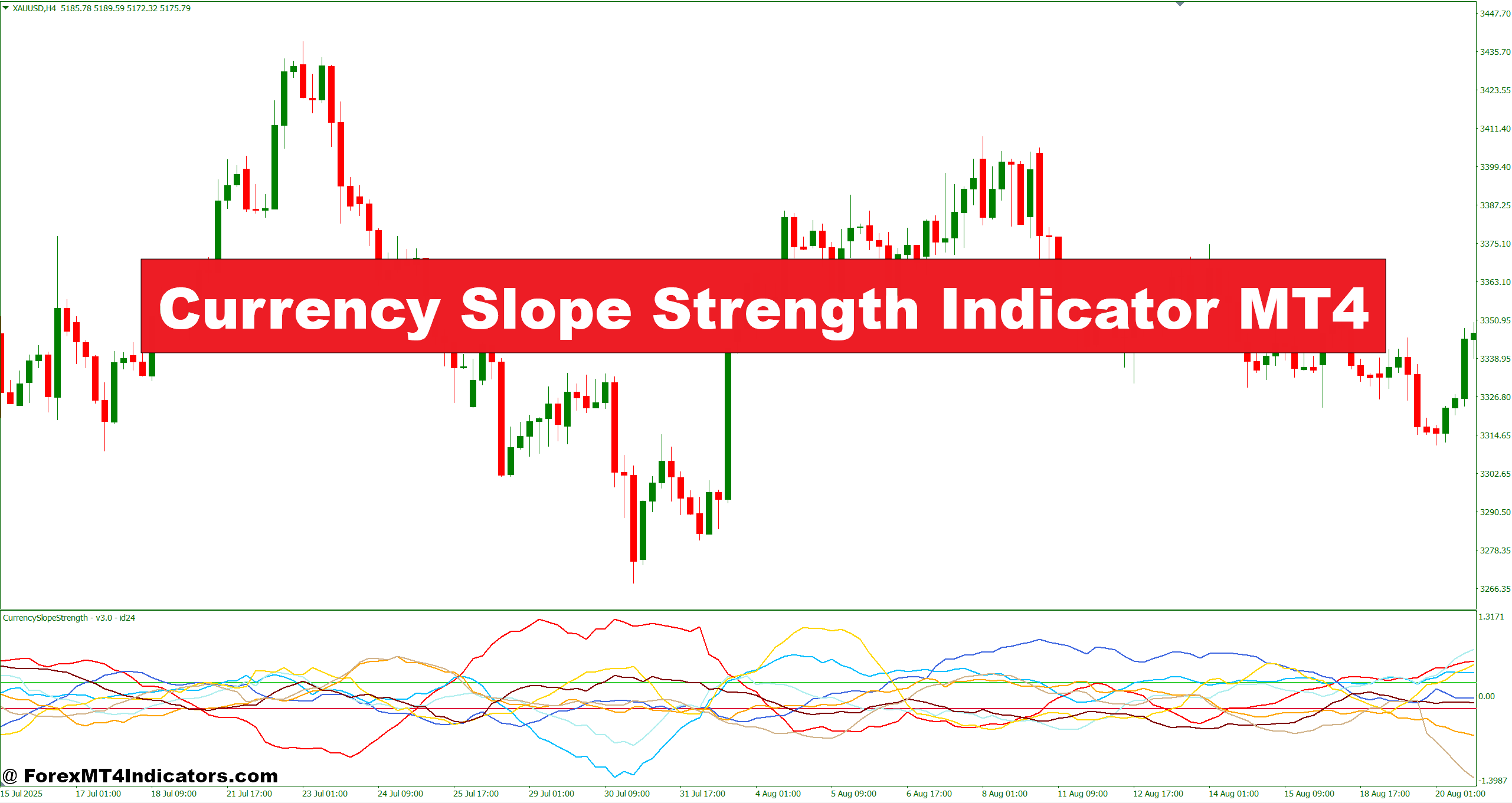
This is one of the most frustrating problems in forex trading. Traders often focus on a single pair without knowing how the underlying currencies are actually performing against the broader market. The Currency Slope Strength indicator for MT4 was built to fix exactly that gap.
What the Currency Slope Strength Indicator Actually Does
At its core, the Currency Slope Strength indicator measures the momentum direction of individual currencies — not just pairs. It calculates a slope value for each major currency (USD, EUR, GBP, JPY, AUD, CAD, CHF, NZD) by analyzing how that currency is moving across multiple pairs simultaneously.
Think of it this way: instead of just watching EUR/USD, the indicator is asking — how is the EUR doing against everything? How is the USD doing against everything? When the EUR slope is rising sharply and the USD slope is falling, that’s a high-confidence environment for a EUR/USD long. When both slopes are drifting sideways, you’re probably looking at chop.
The visual output typically appears as colored lines in a separate indicator window, one per currency. Each line represents the slope — or rate of directional change — of that currency over a defined lookback period.
How the Calculation Works
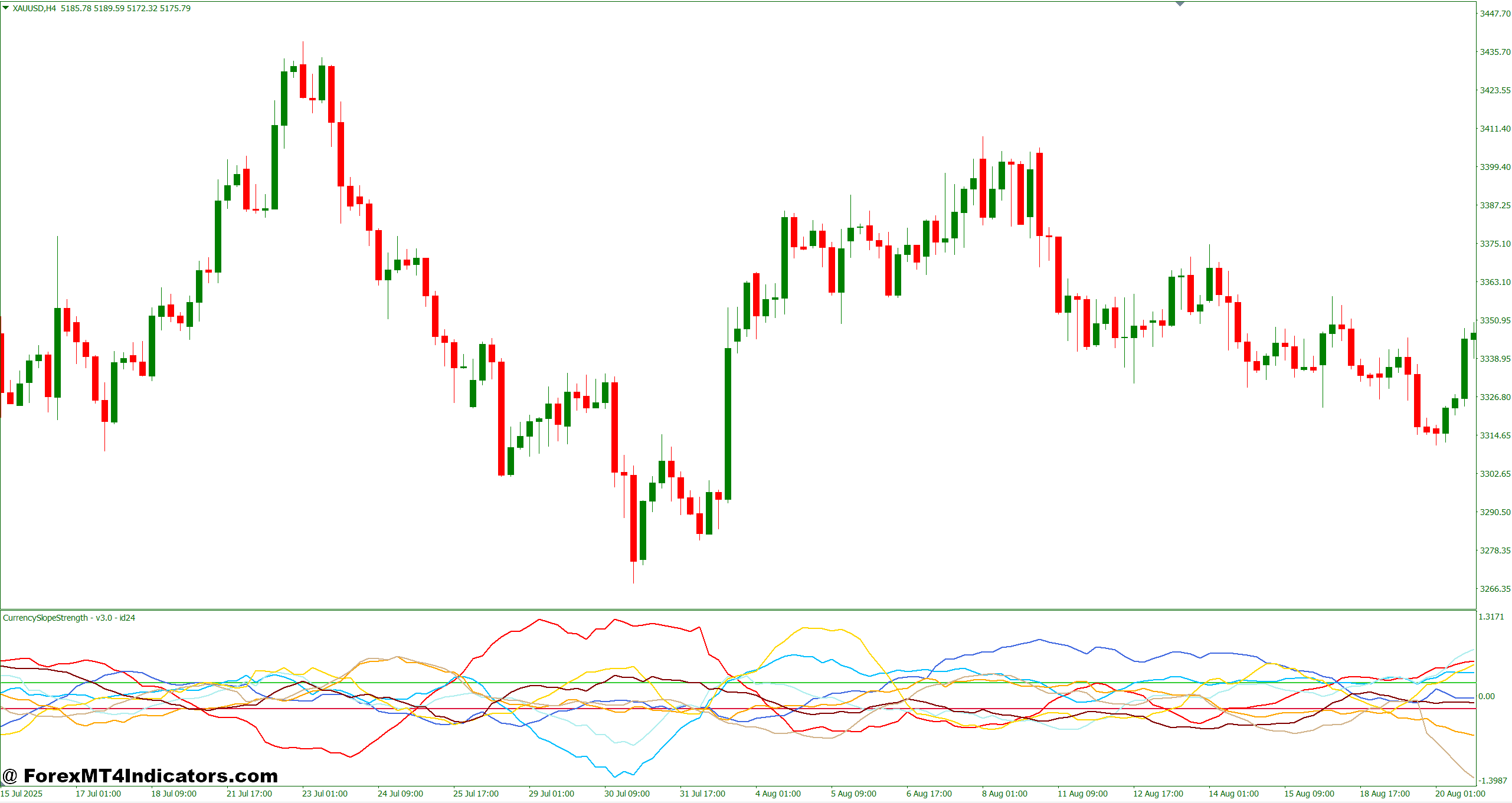
The slope calculation is derived from a linear regression applied to a currency’s composite price movement across several pairs. For example, the EUR line factors in EUR/USD, EUR/GBP, EUR/JPY, EUR/AUD, EUR/CAD, and EUR/CHF. The indicator then normalizes these values so each currency can be compared on the same scale.
A steep positive slope signals strong upward momentum. A negative slope shows weakness. Flat slopes — close to zero — suggest indecision or consolidation.
Some versions of the indicator apply a smoothing function (often a simple or exponential moving average) to reduce noise. When testing on the 1-hour chart during volatile NFP days, the unsmoothed version can spike dramatically, generating signals that reverse within two or three candles. Applying even a 3-period smoothing filter noticeably reduces that problem without lagging too far behind the actual move.
How Traders Use It in Practice
The most effective use case is divergence between two currency slopes. Here’s a specific example: on the H4 chart in late trending markets, if the AUD line is rising steadily while the USD line is dropping, that’s a textbook setup to look for AUD/USD long entries. The slope isn’t just confirming the trend — it’s quantifying which side of the trade has more energy behind it.
Entry Timing
Slope divergence alone isn’t enough to pull the trigger. Most traders pair the indicator with a price action trigger — a breakout above a minor resistance level, a rejection candle, or a moving average crossover. The slope indicator provides the directional bias; price structure provides the entry timing.
Filtering Out Bad Trades
Here’s where this tool earns its keep. If a trader is considering a GBP/JPY short but the slope indicator shows GBP is only slightly negative while JPY is also negative, the trade lacks conviction. Both currencies are weak — the pair could go anywhere. Skipping that trade avoids a potential fake-out with no clear winner.
Timeframes
The indicator works across timeframes, but the H1 and H4 charts tend to give the cleanest readings. On the M15 and lower, slope values fluctuate too quickly to be actionable unless used with very tight smoothing settings.
Currency Slope Strength Indicator MT4 Settings Worth Adjusting
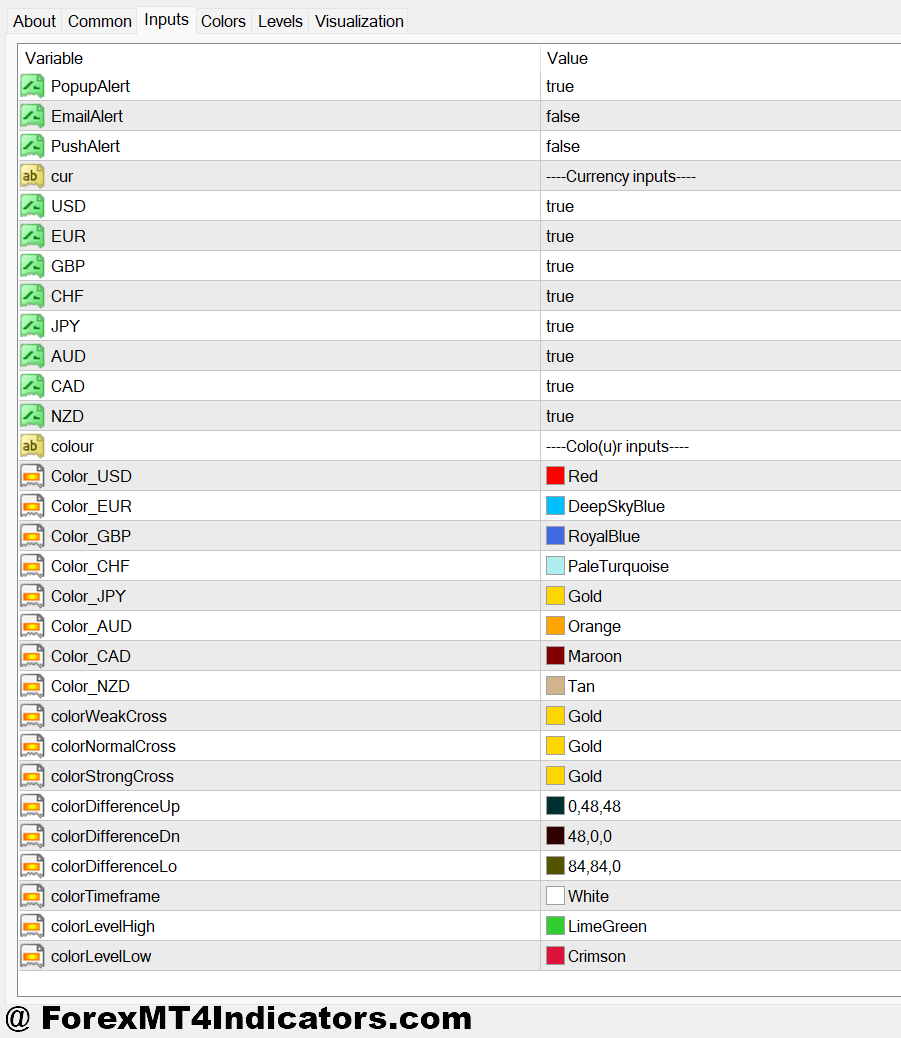
Most MT4 versions of the Currency Slope Strength indicator include a few key parameters:
The lookback period controls how many bars are used in the slope calculation. A shorter period (around 8–12 bars) makes the indicator more reactive but noisier. A longer period (20–30 bars) gives smoother lines that respond better to sustained trends but lag more on reversals.
The smoothing period (if available) should generally stay between 3 and 5. Going higher than 7 starts killing the indicator’s responsiveness to real momentum shifts.
Some versions let traders select which currency pairs feed into each currency’s calculation. If you’re trading only majors, keeping the default settings works fine. If you trade exotics, the calculation may skew depending on which pairs are included.
Honest Strengths and Weaknesses

The biggest strength is the multi-currency view. No single-pair indicator can tell you which currency is genuinely strong or weak across the market. This indicator does that cleanly and visually.
That said, it’s not perfect. During range-bound markets or major news events, slopes can cross and re-cross repeatedly, making the signals unreliable. The indicator also doesn’t tell you where to place entries, stops, or targets — that still requires price action judgment or additional tools.
Compared to a standard RSI or MACD applied to a single pair, the Currency Slope Strength has a clear edge for traders who want to understand currency-level dynamics. But unlike the Commitment of Traders data or intermarket analysis, it doesn’t factor in positioning or fundamental flows — it’s purely price-derived.
How to Trade with Currency Slope Strength Indicator MT4
Buy Entry
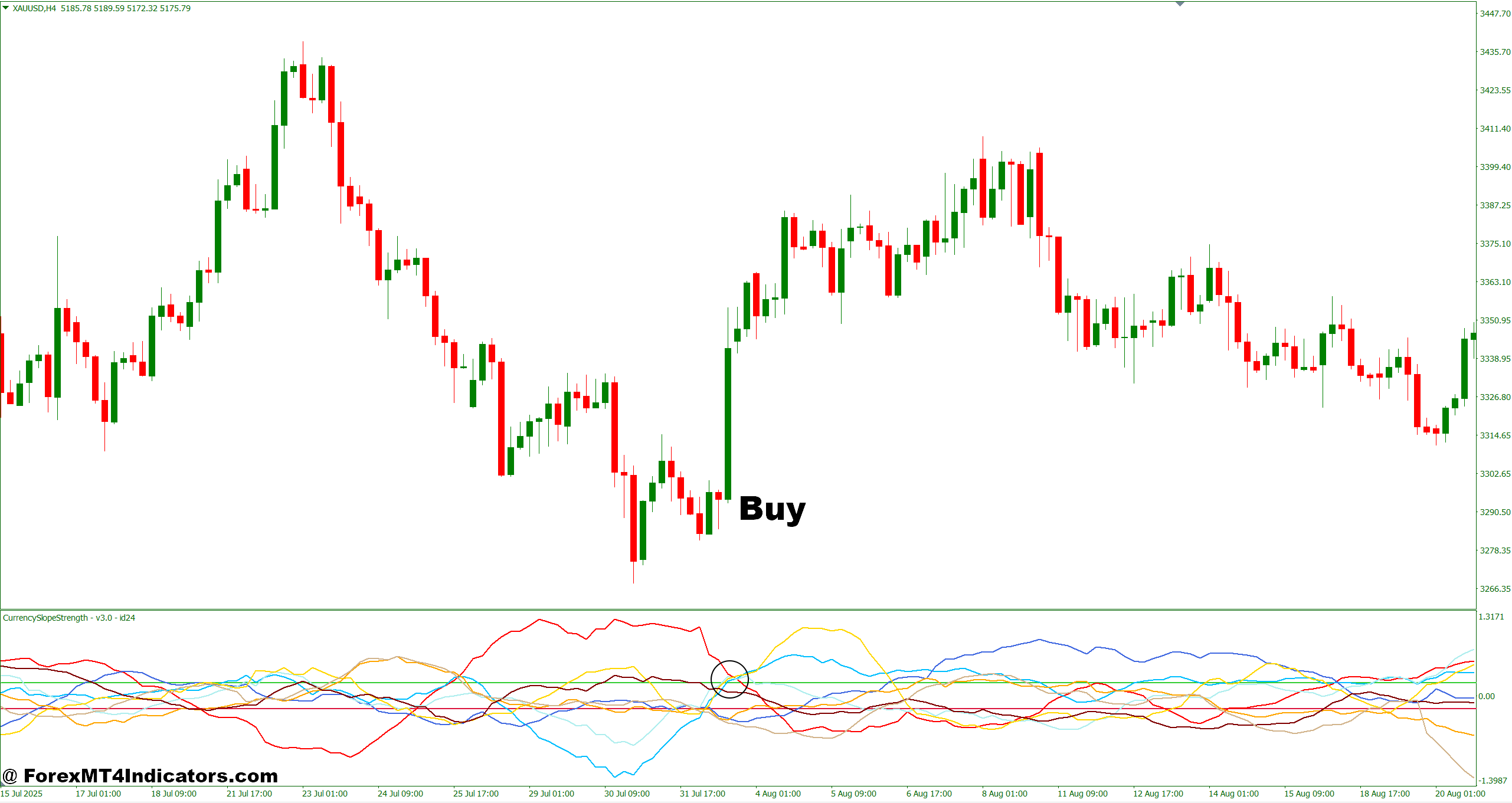
- Rising target currency slope – Enter long when the base currency’s slope line turns upward and crosses above the zero line on the 1-hour or 4-hour chart.
- Clear slope separation – Look for at least 10–15 points of visible gap between the base and quote currency lines before entering.
- Quote currency slope declining – On EUR/USD, confirm the USD slope is falling while EUR slope rises for maximum signal strength.
- Slope holds above zero for 2+ candles – Don’t jump in on the first cross; wait for confirmation that the move isn’t a fake-out.
- Avoid entries during flat slopes – If EUR and USD lines are both near zero on the 4-hour chart, skip the trade entirely.
- Align with higher timeframe bias – A buy signal on the 1-hour chart carries more weight when the daily slope also shows base currency strength.
- Scale in after pullback – If GBP/USD slope stays bullish but price dips 15–20 pips, that dip is a cleaner entry than chasing the initial breakout.
- Risk no more than 1–2% per trade – Even strong slope divergence can reverse fast on news events; size positions accordingly.
Sell Entry
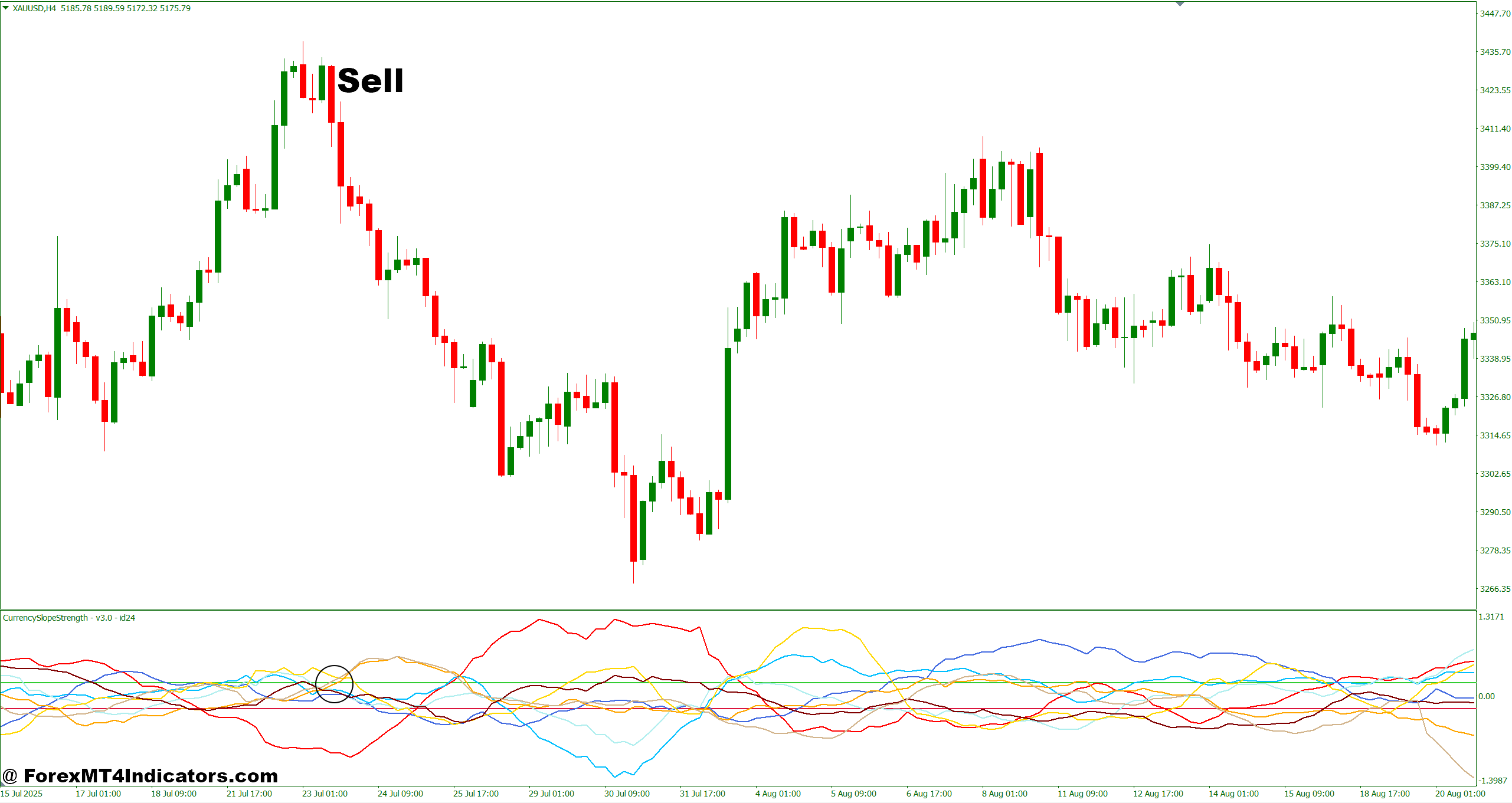
- Base currency slope turning negative – Enter short when the base currency line crosses below zero and continues declining on the 1-hour or 4-hour chart.
- Quote currency slope rising simultaneously – On GBP/USD, a falling GBP slope combined with a rising USD slope gives the strongest sell confirmation.
- Slope separation of 10+ points – Tight or overlapping slopes mean weak conviction; wait until there’s clear distance between the two lines.
- Two consecutive bearish candles after cross – Don’t sell the exact moment slopes cross; let price confirm the direction first.
- Avoid sells near major support levels – If EUR/USD is sitting on a key daily support zone, even a bearish slope signal can fail hard.
- Skip signals before high-impact news – NFP, CPI, or central bank decisions can spike slopes in both directions within minutes, making pre-news entries high-risk.
- Daily chart slope confirms downtrend – A sell signal on the 1-hour is significantly stronger when the daily chart shows the base currency has been weakening for 3+ sessions.
- Set stop-loss 15–20 pips above entry – Slope-based signals can whipsaw in choppy conditions; a tight but reasonable stop keeps losses controlled if the trade fails.
Final Thoughts
The Currency Slope Strength indicator for MT4 gives traders something genuinely useful: a real-time view of which currencies are gaining and losing momentum across the market. It’s not a shortcut, and it won’t replace solid trade management or risk control.
Used properly — as a filter to confirm directional bias before entering trades — it helps avoid the classic mistake of trading a pair where neither currency has conviction. Pairing it with structure-based entries on the H1 or H4 chart gives it the best chance to add value to a trading process.
But always remember: trading forex carries substantial risk. No indicator, including this one, guarantees profits. Position sizing and risk management remain the most important factors in long-term trading survival.
Level up your trading Learn to read the chart — not just the indicator eBook · Instant PDF Video Course · 12 modules Trading forex and CFDs carries a significant risk of loss and is not suitable for everyone. Broker links are affiliate links — we may earn a commission at no cost to you.Recommended MT4/MT5 Brokers
Free MT4 Indicator Download
Enter Your Email Address below, download link will be sent to you.