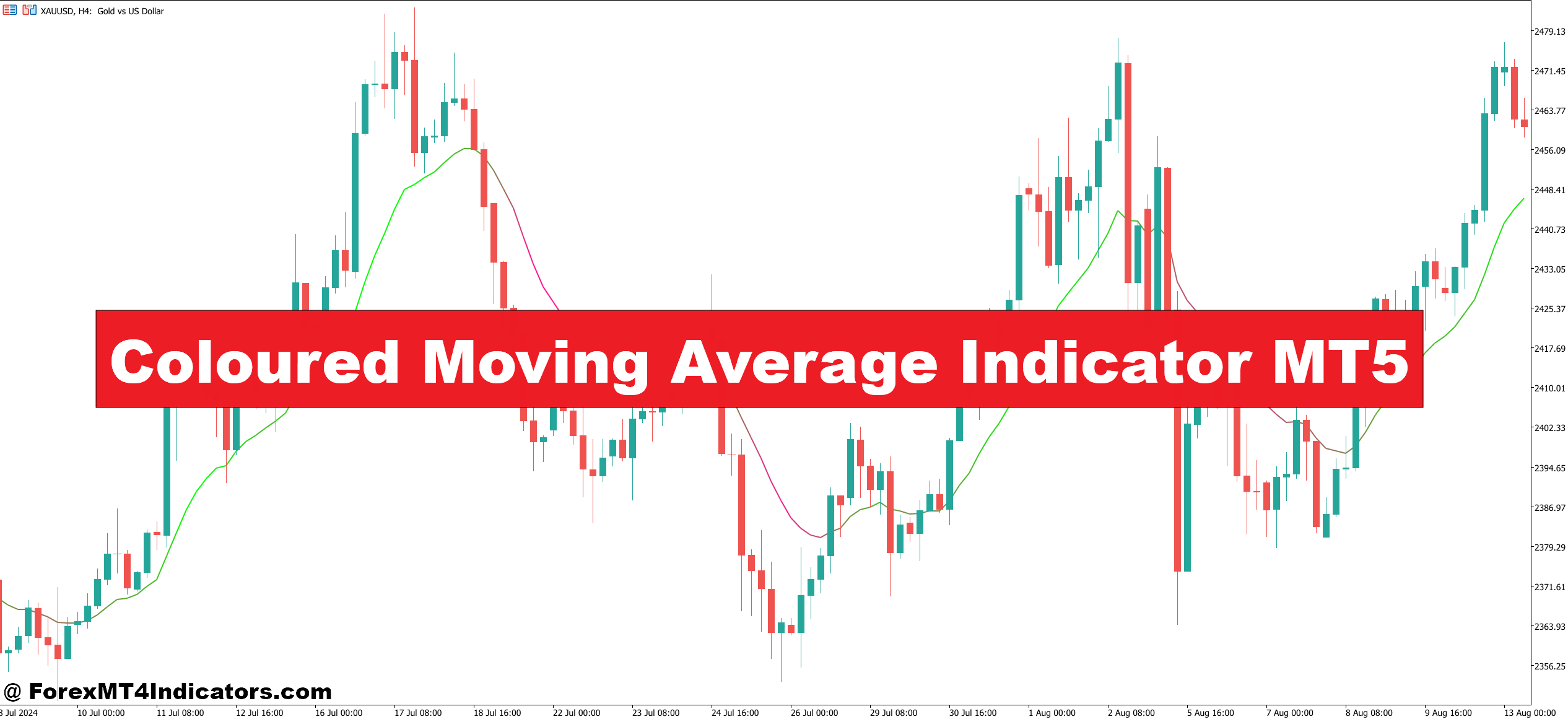
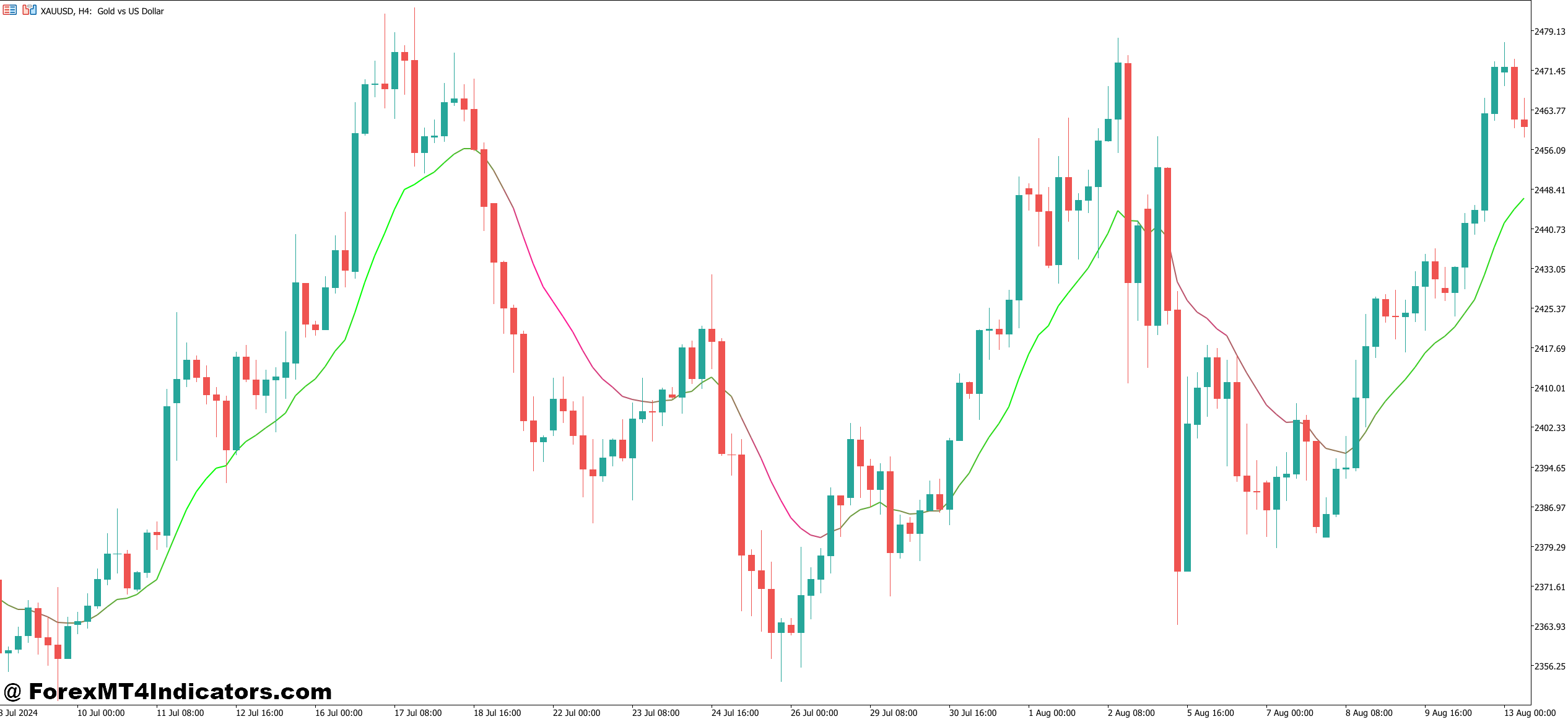
The Coloured Moving Average Indicator MT5 was designed to tackle this exact problem. Instead of relying on a single-colored line that forces traders to interpret direction manually, this tool changes color based on price movement relative to the average. That small visual shift makes a big difference in how quickly a trader can read a chart and act on momentum changes. It doesn’t remove risk—nothing does—but it cuts down on hesitation and misreads during fast-moving markets.
What Is the Coloured Moving Average Indicator?
At its core, the Coloured Moving Average Indicator is a modified moving average that assigns different colors depending on whether the price is trending up, trending down, or moving sideways. On MT5 platforms, it typically displays as a single line that shifts between green (or blue) during bullish phases and red during bearish phases. Some versions add a third color—often yellow or gray—for periods of indecision or consolidation.
The underlying calculation isn’t exotic. Most versions use a Simple Moving Average (SMA) or Exponential Moving Average (EMA) as the base. The difference is purely in the visual output. When the current price closes above the moving average, the line turns bullish. When price closes below, it shifts bearish. A few custom builds factor in the slope of the average itself—so even if price sits slightly above the line, a flattening slope might trigger a neutral color.
This might sound simple, and it is. But that simplicity is the point. During live trading, when EUR/USD is whipping around a news release, the last thing anyone needs is a cluttered chart. A color shift is processed by the brain faster than reading a crossover between two separate lines.
How Traders Use It in Real Market Conditions
Trend Confirmation and Entry Timing
The most common use case is trend confirmation. Say a trader spots a support bounce on GBP/USD on the 4-hour chart. Price has tapped a known demand zone and printed a bullish engulfing candle. Before entering, they glance at the Coloured Moving Average. If the line has just shifted from red to green, that’s an extra layer of confirmation. It doesn’t guarantee the trade works, but it stacks the odds slightly in their favor.
On the flip side, if the moving average is still red despite the bullish candle, that’s a caution flag. The broader trend might still be bearish, and that support bounce could be a short-lived pullback—what experienced traders call a “dead cat bounce.”
Filtering Choppy Markets
One of the more practical applications is filtering out chop. During the Asian session on pairs like USD/JPY, price often drifts in a tight range. A standard moving average will generate multiple false crossovers in these conditions. The Coloured Moving Average handles this a bit better because many custom versions include a buffer zone or a slope threshold before switching colors. So instead of flipping between bullish and bearish every few candles, it stays neutral—keeping a trader out of low-probability setups.
When testing this approach on AUD/USD during the typically slow Monday Asian open, the indicator held a neutral color for roughly 14 candles on the 15-minute chart. Without it, a trader following basic MA crossover rules would have entered and exited three losing trades during that same window.
Coloured Moving Average Indicator MT5 Settings and Customization Tips
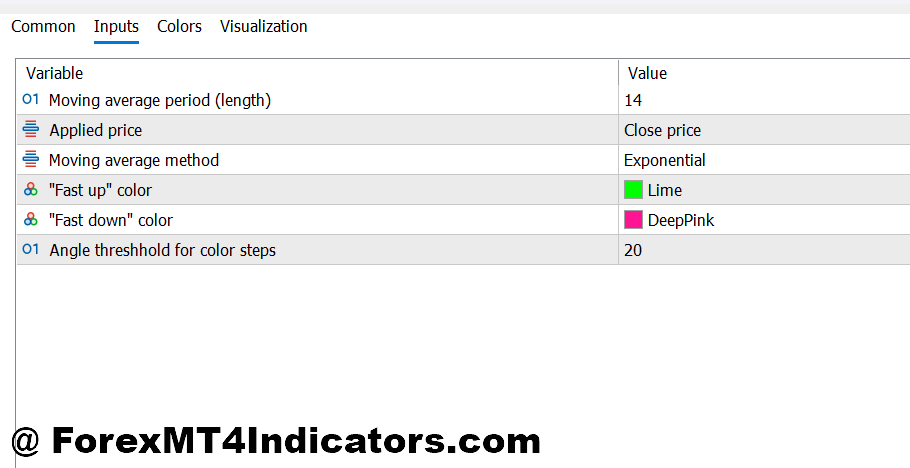
Most MT5 versions of the Coloured Moving Average allow traders to adjust the period length, the MA type (SMA, EMA, SMMA, or LWMA), and the applied price (close, open, high, low, or median). Here’s what works well in practice:
- For scalping (1-minute to 15-minute charts): A 10- to 20-period EMA responds fast enough to catch short-term moves. The trade-off is more color flips during consolidation, so pairing it with a volatility filter like the ATR helps.
- For swing trading (1-hour to daily charts): A 50-period SMA or a 34-period EMA gives smoother signals. On the daily EUR/USD chart, a 50 SMA colored variant kept traders on the right side of a 400-pip downtrend in Q3 2024, shifting red early and staying red through several minor pullbacks.
- For position trading (daily to weekly): The 100- or 200-period SMA works best. Color changes are rare here, but when they happen, they tend to mark significant trend shifts.
One underrated setting is the applied price. Most traders default to “close,” but switching to “median price” (the average of high and low) can smooth out wick-heavy candles that sometimes trigger premature color changes on pairs like GBP/JPY, which is known for its long wicks.
Strengths and Honest Limitations
What It Does Well
The biggest advantage is speed of interpretation. In a split-second, a trader knows the trend direction without doing any mental math. That matters during volatile sessions—think NFP Fridays or ECB rate decisions—when hesitation costs money. It also works across all timeframes and currency pairs without needing major adjustments, which makes it a flexible addition to most chart setups.
Compared to the standard MT5 moving average, the coloured version provides the same data with better visual clarity. And compared to more complex systems like the Ichimoku Cloud, it’s far less intimidating for traders who prefer clean charts.
Where It Falls Short
No moving average—colored or not—is a leading indicator. It reacts to price; it doesn’t predict it. During sudden reversals caused by unexpected news, the color change will always lag behind the actual move. Traders who rely on it as a standalone entry signal without additional confirmation (price action patterns, support and resistance levels, or volume analysis) will get burned eventually.
And like any MA-based tool, it struggles in ranging markets. Even with slope filters and buffer zones, extended consolidation phases will produce mixed signals. That’s not a flaw unique to this indicator—it’s a characteristic of trend-following tools in general.
How to Trade with Coloured Moving Average Indicator MT5
Buy Entry
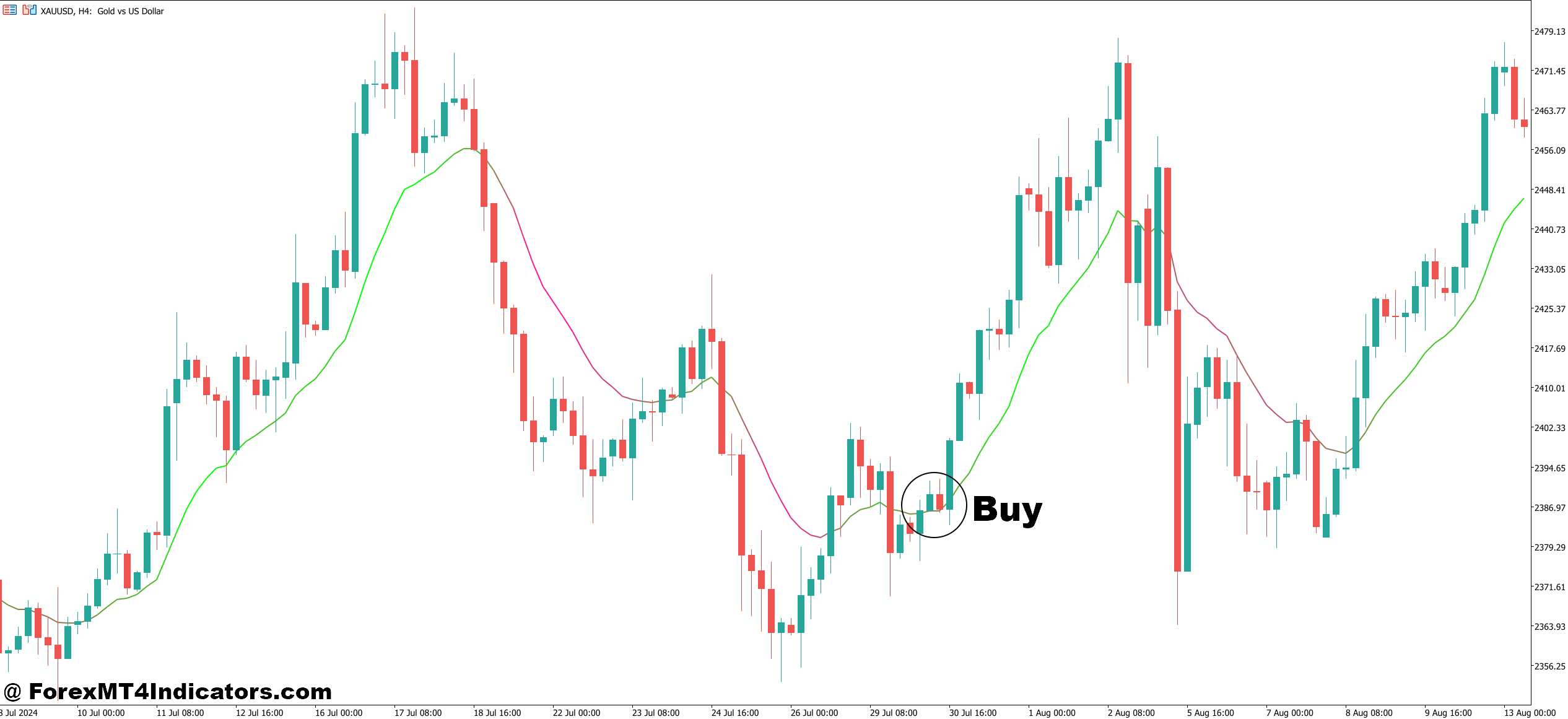
- Wait for a confirmed green color shift – Enter long only after the candle closes above the moving average and the line turns green. A mid-candle color flicker on EUR/USD 1-hour charts doesn’t count—patience here saves false entries.
- Look for price to retest the colored MA as support – After the line turns green, price often pulls back to touch it. That retest on GBP/USD 4-hour charts is a high-probability long entry, especially if the candle prints a bullish wick rejection.
- Check that the MA slope is angling upward at 30°+ – A flat green line means weak momentum. A steep rising angle on the 1-hour timeframe signals genuine buying pressure, not just a brief spike.
- Combine with a key support level – A green color shift that lines up with a daily support zone or a round number like 1.0800 on EUR/USD adds serious weight to the buy signal.
- Set stop-loss 10-15 pips below the colored MA line – Place it just beneath the indicator on the 1-hour chart. On the 4-hour, widen that to 20-25 pips to account for normal pullback noise.
- Avoid buying when the MA just turned green during low-volume Asian sessions – Color shifts on AUD/USD or USD/JPY between 11 PM and 3 AM GMT often reverse by the London open. Wait for session overlap confirmation.
- Target a minimum 1:1.5 risk-to-reward ratio – If the stop is 15 pips, aim for at least 22 pips profit. Trail the stop along the colored MA once price moves 1.5x the initial risk in your favor.
- Skip the signal entirely if the daily chart MA is still red – Trading long on the 1-hour while the daily trend remains bearish puts the trade against the bigger picture. Multi-timeframe alignment matters more than a single color flip.
Sell Entry
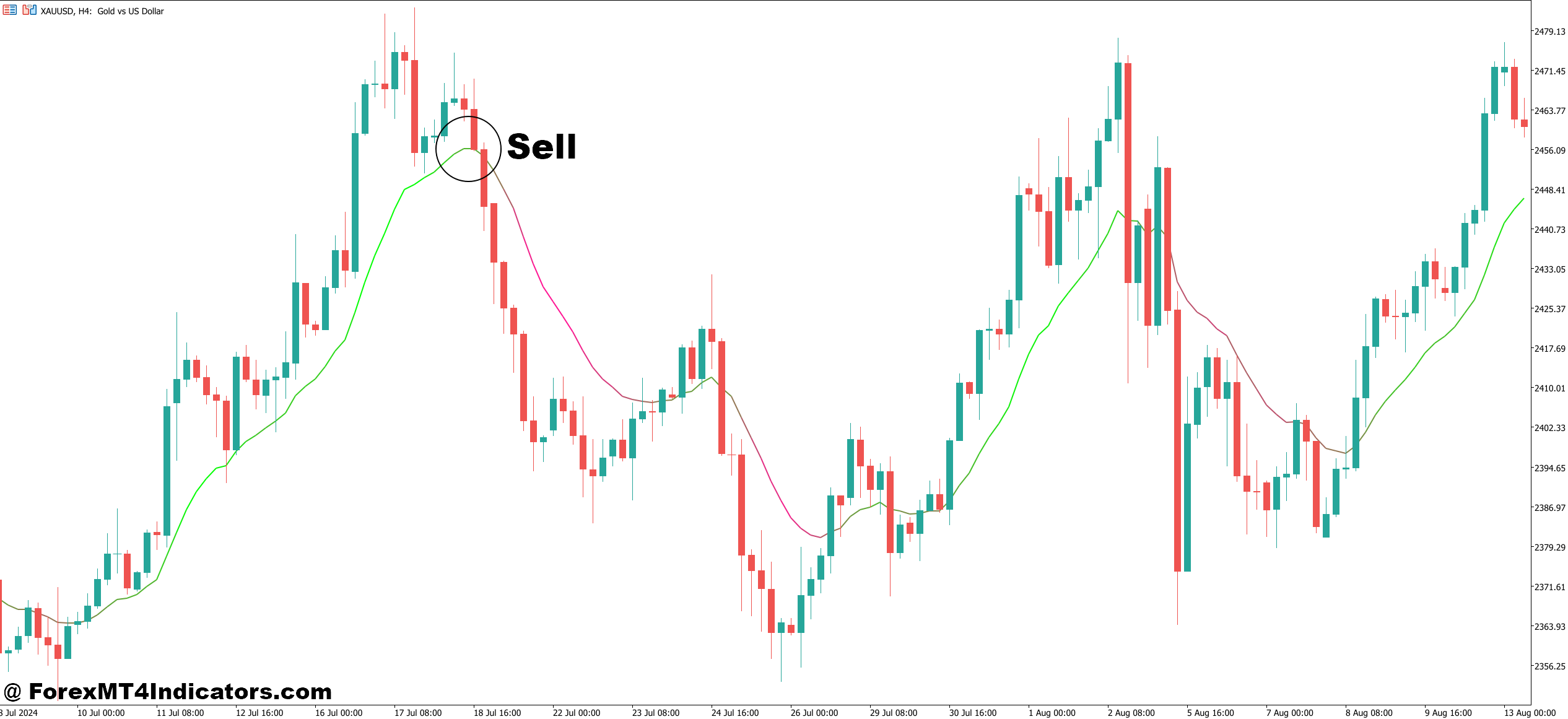
- Enter short after a confirmed red color shift on candle close – The line must turn red with a full candle closing below it. On GBP/USD 1-hour charts, wicks poking below mid-candle create fake signals roughly 40% of the time.
- Sell the pullback into a red-colored MA acting as resistance – Once the line is red and sloping down, price retracing back up to tag it offers a clean short entry, especially on EUR/USD 4-hour setups near previous breakdown levels.
- Confirm the MA slope is declining, not flattening – A flat red line on the 15-minute chart means consolidation, not a selloff. Wait for a visible downward angle before committing to the trade.
- Stack the signal with a resistance zone or a Fibonacci 50-61.8% level – A red color shift near the 1.2700 resistance on GBP/USD daily, for example, gives much stronger conviction than a standalone signal in open space.
- Place stop-loss 10-15 pips above the colored MA on the 1-hour chart – On the daily timeframe, allow 30-40 pips of breathing room. Tight stops on higher timeframes trigger premature exits during normal retracements.
- Don’t sell into a green daily MA based on a red 15-minute signal – Short-term color shifts against the dominant trend produce whipsaws more often than real moves. Always check one timeframe higher before pulling the trigger.
- Take partial profits at 1:1 risk-to-reward, then trail the rest – Close 50% of the position once the trade moves in your favor by the same amount as the stop-loss. Trail the remaining half using the colored MA—exit if it flips green.
- Avoid sell entries 30 minutes before major news releases – NFP, CPI, and central bank decisions on pairs like EUR/USD and USD/JPY create spreads that blow through stops instantly. Wait for the post-news candle to close and the MA color to settle before acting.
Final Thoughts
The Coloured Moving Average Indicator MT5 isn’t a revolutionary tool—it’s a practical refinement of one of the oldest concepts in technical analysis. Its value lies in faster visual processing, cleaner chart reading, and fewer moments of hesitation during live trades. Traders who pair it with solid price action analysis and disciplined risk management will get the most out of it. Those expecting it to work in isolation will be disappointed, just as they would with any single indicator.
Level up your trading Learn to read the chart — not just the indicator eBook · Instant PDF Video Course · 12 modules Trading forex and CFDs carries a significant risk of loss and is not suitable for everyone. Broker links are affiliate links — we may earn a commission at no cost to you.Recommended MT4/MT5 Brokers
Free MT4 Indicator Download

Enter Your Email Address below, download link will be sent to you.