Last updated:
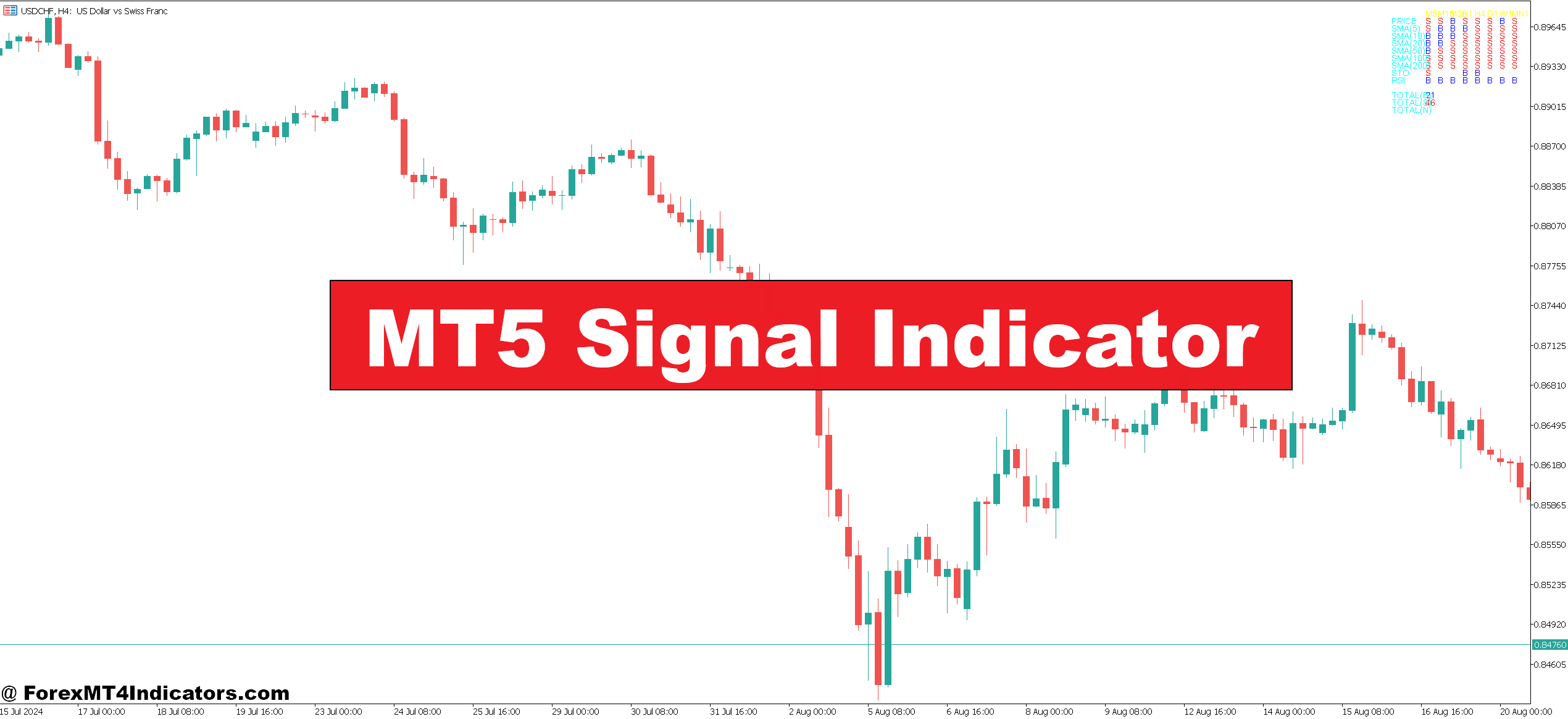
What is the MT5 Signal indicator? It prints buy and sell alerts on your MetaTrader 5 chart by combining momentum, trend, and volatility checks into a single signal, instead of relying on one crossover. Download it free below. Looking for more tools? Browse the full MT5 indicators library or try the popular Auto Buy Sell Signal indicator.
The MT5 Signal Indicator is a technical analysis tool designed to generate buy and sell alerts based on specific market conditions. Unlike simple moving average crossovers, this indicator combines multiple data points—typically including momentum oscillators, trend filters, and volatility measurements—to produce signals. When a trader installs it on their MetaTrader 5 platform, they’ll see visual alerts (arrows, dots, or bars) directly on the price chart marking potential entry points.
Most versions of this indicator work by screening for confluence. That means it’s looking for situations where several technical factors align at once. A buy signal might appear when price bounces off a support level while momentum indicators turn positive and volatility contracts—the kind of setup experienced traders hunt for manually.
The indicator doesn’t predict the future. It identifies current market structure and highlights when conditions match its programmed criteria. Think of it as a scanner that does the heavy lifting of monitoring multiple technical factors simultaneously.
How the Signal Generation Works
At its core, the MT5 Signal Indicator typically uses a combination of calculations. Many versions incorporate a trend identification component—often a modified moving average or directional movement index—paired with momentum readings like RSI or stochastic oscillators. When the trend component shows directional bias and momentum confirms it, the indicator fires a signal.
Here’s a specific example: one popular version uses a 21-period exponential moving average for trend direction, a 14-period RSI for momentum, and an ATR-based filter to avoid signals during low-volatility periods. The indicator generates a buy signal when price is above the EMA, RSI crosses above 50, and ATR exceeds a certain threshold. Sell signals work in reverse.
Some versions add pattern recognition to the mix. They scan for candlestick formations or price structure setups (like higher lows in uptrends) before triggering alerts. This added layer reduces signal frequency but can improve accuracy. Traders need to understand their specific version’s methodology because implementations vary widely. The calculation logic matters—it determines whether the indicator performs better in trending markets, ranging conditions, or both.
Real-World Application on the Charts
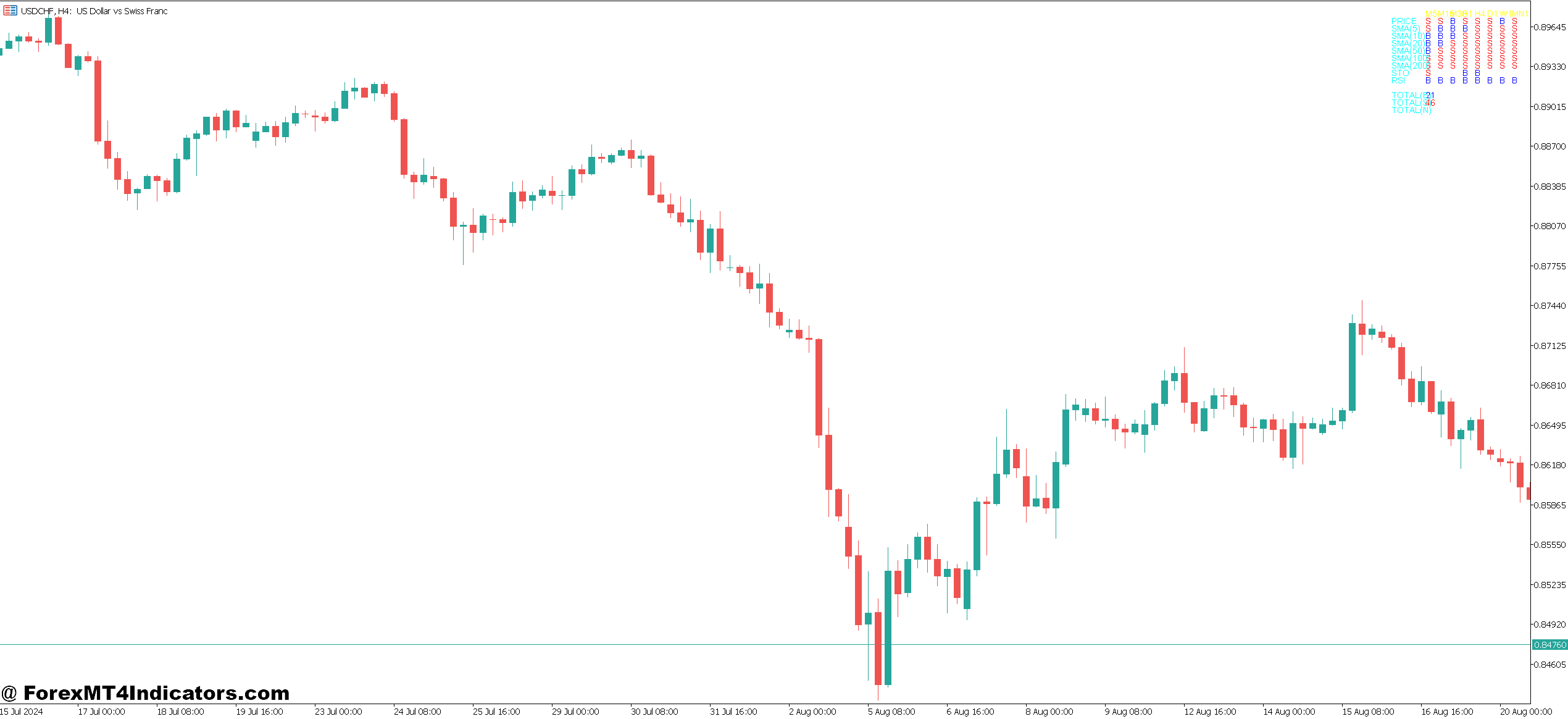
When traders apply the MT5 Signal Indicator to live markets, the results depend heavily on the pair and timeframe. Testing this on EUR/USD during the London session often produces 3-5 signals per day on the 1-hour chart. During the Asian session with its tighter ranges, signal frequency drops but false signals increase—the market simply doesn’t have enough momentum to follow through.
One trader tested this indicator on GBP/JPY, a pair known for volatility. On trending days, the signals captured 70-80 pip moves with entries within 10 pips of swing lows or highs. But when the pair entered consolidation during the July 2024 range, the same settings generated back-to-back losing trades. The lesson? Context matters more than the indicator itself.
For practical use, traders typically combine the indicator with price action. When a buy signal appears at a previous demand zone or coincides with a bullish engulfing candle, the probability increases. Naked signals in the middle of nowhere get ignored. This approach reduces trade frequency from maybe 5-6 signals per day down to 1-2 actually taken, but win rates improve significantly.
The 4-hour timeframe tends to produce more reliable signals than the 15-minute chart, simply because it filters out microstructure noise. That said, scalpers who understand their pair’s behavior can make the lower timeframes work—they just need tighter risk management.
Customizing Settings for Different Trading Styles
Most MT5 Signal Indicators come with adjustable parameters. The standard settings rarely work optimally for every trader’s approach or every currency pair. A day trader focusing on EUR/USD needs different sensitivity than a swing trader watching AUD/NZD.
The main parameters traders adjust include:
- Signal sensitivity: Higher values produce more signals (more trades, more false positives). Lower values reduce frequency but miss some moves.
- Trend filter strength: Determines how strong a trend must be before signals activate. Tighter filters work better in ranging markets.
- Confirmation bars: Some indicators let traders set how many bars must confirm before displaying a signal, reducing premature entries.
For volatile pairs like GBP/USD or USD/JPY, traders often increase the confirmation requirement to avoid getting chopped up. On slower pairs like EUR/CHF, default settings usually suffice because false breakouts happen less frequently.
Testing different parameter combinations takes time. A trader might spend weeks on a demo account adjusting settings for their preferred pairs and timeframes. There’s no universal “best” configuration. What works for catching 100-pip swings on daily charts will be completely wrong for capturing 15-pip scalps on M5 charts.
The Honest Pros and Cons
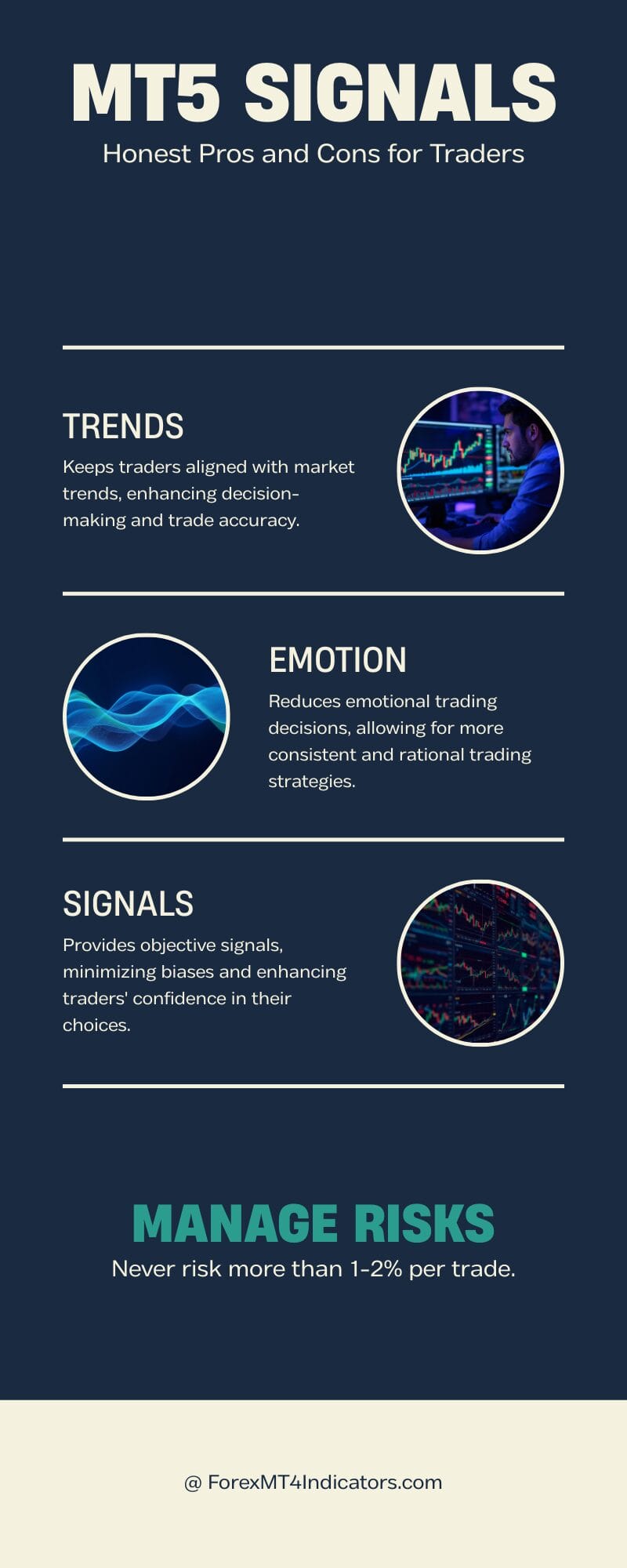
The MT5 Signal Indicator shines in certain situations. When markets trend cleanly, it keeps traders on the right side of directional moves without requiring constant chart monitoring. Traders who struggle with emotional discipline appreciate the objective signals—the indicator doesn’t get nervous or greedy. It also handles multiple pairs simultaneously, something human traders find exhausting.
But limitations exist. During choppy markets, the indicator produces whipsaws. It can’t distinguish between a legitimate breakout and a fake-out until after the fact. Traders who blindly follow every signal without considering market context will lose money. The indicator also lags—it’s reactive, not predictive. By the time all confirmation criteria align, a portion of the move has already happened. Early entries aren’t its strength.
Compared to trading purely on price action, the indicator adds structure but reduces flexibility. Price action traders can adapt their interpretation based on subtle market clues. The indicator follows its programmed rules regardless of market nuance. Neither approach is objectively better—it depends on the trader’s skillset and personality.
Trading forex carries substantial risk. No indicator guarantees profits, and the MT5 Signal Indicator isn’t an exception. Traders should always use proper risk management: position sizing, stop losses, and never risking more than 1-2% per trade. Some traders lose their entire accounts using indicators because they forget the basics.
Final Thoughts
The MT5 Signal Indicator works best as a tool within a broader trading system, not as a standalone solution. Traders who understand market structure, respect risk management, and use the indicator for confirmation rather than primary decision-making tend to get the most value from it. The indicator can save time, reduce emotional trading, and provide objective entry points—but only when applied correctly. It won’t transform a losing trader into a profitable one overnight because the problem usually isn’t the indicator, it’s the approach. For traders willing to test it properly, customize the settings, and combine it with sound trading principles, the MT5 Signal Indicator can become a useful component of their trading toolkit. Just remember: the indicator highlights opportunities, but the trader still makes the final call.
Level up your trading
Learn to read the chart — not just the indicator
eBook · Instant PDF
Video Course · 12 modules
Recommended MT4/MT5 Brokers
- ✓ *FREE *$50 to start (withdrawable)
- ✓ Deposit bonus up to $5,000
- ✓ Negative balance protection
Trading forex and CFDs carries a significant risk of loss and is not suitable for everyone. Broker links are affiliate links — we may earn a commission at no cost to you.
Free MT4 Indicator Download

Enter Your Email Address below, download link will be sent to you.