


The No Supply No Demand Indicator MT5 focuses on that missing piece. It highlights moments when the market shows weak buying or selling pressure. Instead of guessing, traders get visual clues about when volume dries up or when interest returns. This helps filter low-quality setups and improves timing around support and resistance. The next sections explain what this tool is, how it works, and how traders apply it in real charts.
What Is the No Supply No Demand Indicator MT5?
The No Supply No Demand Indicator MT5 is a technical tool based on volume spread analysis (VSA). It aims to detect bars where activity drops while price still moves. These bars suggest that professional traders are not participating strongly in that direction.
A “no supply” signal appears when price dips slightly, volume contracts, and the candle closes near the top. That hints sellers are stepping back. A “no demand” signal shows the opposite: price pushes up, volume shrinks, and the candle closes near the low. Buyers are losing interest.
Unlike trend indicators, this one does not predict direction by itself. It shows when the current move lacks support. Traders then combine it with structure, trend, or support and resistance. On MT5, it usually plots arrows or colored markers directly on the chart, making it easy to spot low-activity zones.
How the Indicator Work
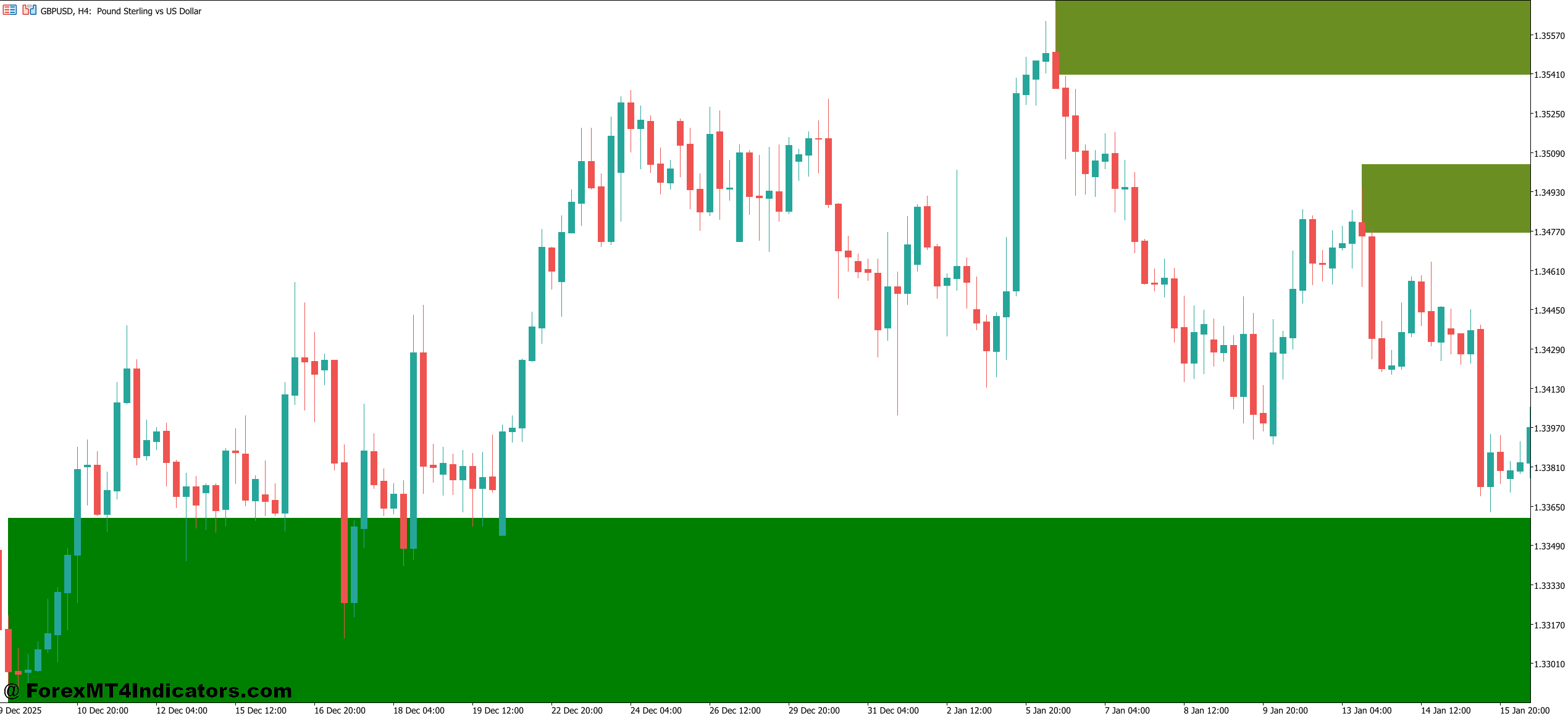
The logic is simple but strict. It reads three main elements from each candle:
- Volume – compares current tick volume to recent averages.
- Spread – measures candle size (high to low).
- Close position – checks where price closed within the candle.
For example, on a 1-hour EUR/USD chart, the indicator may require volume to be lower than the last 10 candles. At the same time, the candle must close in the upper third of its range for a no supply signal. This combination suggests sellers tried, but failed, to push price down.
A no demand signal might need volume to be lower than the previous 8 candles, with the close in the lower third of the range. That tells traders buyers pushed price up, but without commitment.
When testing this during volatile NFP days, traders often see fewer signals. That makes sense. Volume spikes and the tool avoids printing in chaotic conditions. During Asian sessions, more signals appear because liquidity thins out.
This indicator does not calculate future prices. It reacts to current market behavior. That’s why many use it as a filter rather than a trigger.
Practical Trading Applications
Spotting Weak Pullbacks
On GBP/USD, 30-minute chart, price trended up for three hours. A pullback formed with two small red candles. The indicator printed a no supply signal on the second candle. Volume was lower than the last 12 bars, and the close was near the high. Traders entered long above that candle’s high with a 15-pip stop. Price moved 45 pips before stalling near resistance.
Avoiding False Breakouts
USD/JPY broke above a range high on the 1-hour chart. The breakout candle had a small body and the indicator printed a no demand signal. Volume dropped compared to the prior impulse candle. Traders who waited avoided a long entry. Price fell back into the range and chopped for another 20 candles.
Pairing with Structure
This tool works best near key levels. A no supply signal inside a demand zone carries more weight than one in the middle of nowhere. Traders often mark daily support and resistance, then wait for the indicator to confirm weak selling or buying around those zones.
Risk still matters. A typical plan uses a fixed risk of 1% per trade. Stops go beyond the signal candle. Targets aim for at least 1:2 reward-to-risk. Some sessions produce no valid setups. That’s normal.
Trading forex carries substantial risk. No indicator guarantees profits.
No Supply No Demand Indicator MT5 Settings and Customization

Most versions of the indicator include these inputs:
- Volume Lookback Period (default 10)
- Candle Close Threshold (for example, upper 30% or lower 30%)
- Alert Settings (popup, sound, or push)
- Signal Sensitivity (strict or loose)
For scalping on M5 or M15 charts, traders often reduce the lookback to 6 or 8. This creates more signals but also more noise. On H1 or H4 charts, 12 to 20 periods smooth out random spikes.
For volatile pairs like GBP/JPY, a stricter close threshold helps. Requiring the candle to close in the top 25% for no supply avoids weak patterns. On quieter pairs like EUR/CHF, a wider threshold can be useful.
Backtesting is not optional. Traders usually scroll through at least three months of data and note win rate and drawdown. A setup that looks good on EUR/USD may fail on XAUUSD due to different volume behavior.
Advantages, Limitations, and Comparisons
Advantages
- Highlights low-participation moves that often lead to reversals.
- Works well with support, resistance, and trendlines.
- Keeps traders out of weak breakouts and late entries.
- Simple visual output, no math on screen.
Limitations
- Signals appear late during fast news moves.
- Tick volume on MT5 is broker-dependent.
- In strong trends, many no demand or no supply signals fail.
- Needs context; alone, it can mislead.
Compared to RSI, this tool does not measure overbought or oversold. It measures effort behind price. Compared to MACD, it reacts faster to shifts in participation but gives fewer trend clues. Volume Profile shows where trading happened; this indicator shows when it didn’t.
Many traders use it alongside a 50-period moving average. If price is above the average and a no supply signal prints near a pullback, the setup aligns with trend and volume behavior.
How to Trade with No Supply No Demand Indicator MT5
Buy Entry

- Wait for a No Supply candle – Enter only when a no supply signal appears near support on the 1-hour or 4-hour chart, showing sellers are losing strength.
- Confirm trend direction – Buy only if price is above the 50-period moving average on EUR/USD or GBP/USD to avoid counter-trend trades.
- Set stop-loss below the signal candle – Place SL 10–15 pips below the low on H1 or 30–40 pips on H4 to control risk.
- Target at least 1:2 risk-reward – If risking 20 pips, aim for 40 pips near the next resistance zone.
- Avoid news sessions – Don’t take buy signals during NFP or CPI releases because volume spikes can invalidate no supply patterns.
- Check volume drop – Ensure volume is lower than the previous 8–12 candles to confirm weak selling pressure.
- Trade liquid pairs only – Focus on EUR/USD and GBP/USD, and avoid exotic pairs where volume data is unreliable.
Sell Entry

- Wait for a No Demand candle – Enter when a no demand signal forms near resistance on the 1-hour or 4-hour chart, showing buyers are losing control.
- Confirm bearish structure – Sell only if price is below the 50-period moving average to stay aligned with trend.
- Set stop-loss above the signal candle – Place SL 10–15 pips above the high on H1 or 30–40 pips on H4 for protection.
- Aim for support targets – Take profit near the last support level, usually 30–60 pips away on major pairs.
- Skip choppy markets – Don’t trade when EUR/USD is stuck in a 20-pip range because no demand signals fail often in chop.
- Check shrinking volume – Confirm volume is lower than the previous 8–10 candles to validate weak buying pressure.
- Risk only 1% per trade – Keep account drawdown under control even if two trades fail in a row.
Conclusion
Traders who struggle with fake-outs often miss one thing: market interest. The No Supply No Demand Indicator MT5 helps spot when that interest fades.
It shows:
- When pullbacks lack selling pressure
- When breakouts lack buying pressure
- When price moves without support
- When waiting is better than entering
Used with structure and sound risk control, it can sharpen entries and reduce emotional trades. It will not replace chart reading or discipline. But it adds a layer most indicators ignore: participation. The smart next step is simple. Load it on a demo account, test it on one pair and one timeframe, and record results. That data will speak louder than any promise.
Recommended MT4/MT5 Broker
XM Broker
- *FREE $50 To Start Trading Instantly! (Withdraw-able Profit)
- Deposit Bonus up to $5,000
- Unlimited Loyalty Program
- Award Winning Forex Broker
- Additional Exclusive Bonuses Throughout The Year

>> Sign Up for XM Broker Account here <<
(Free MT4 Indicators Download)



Enter Your Email Address below, download link will be sent to you.