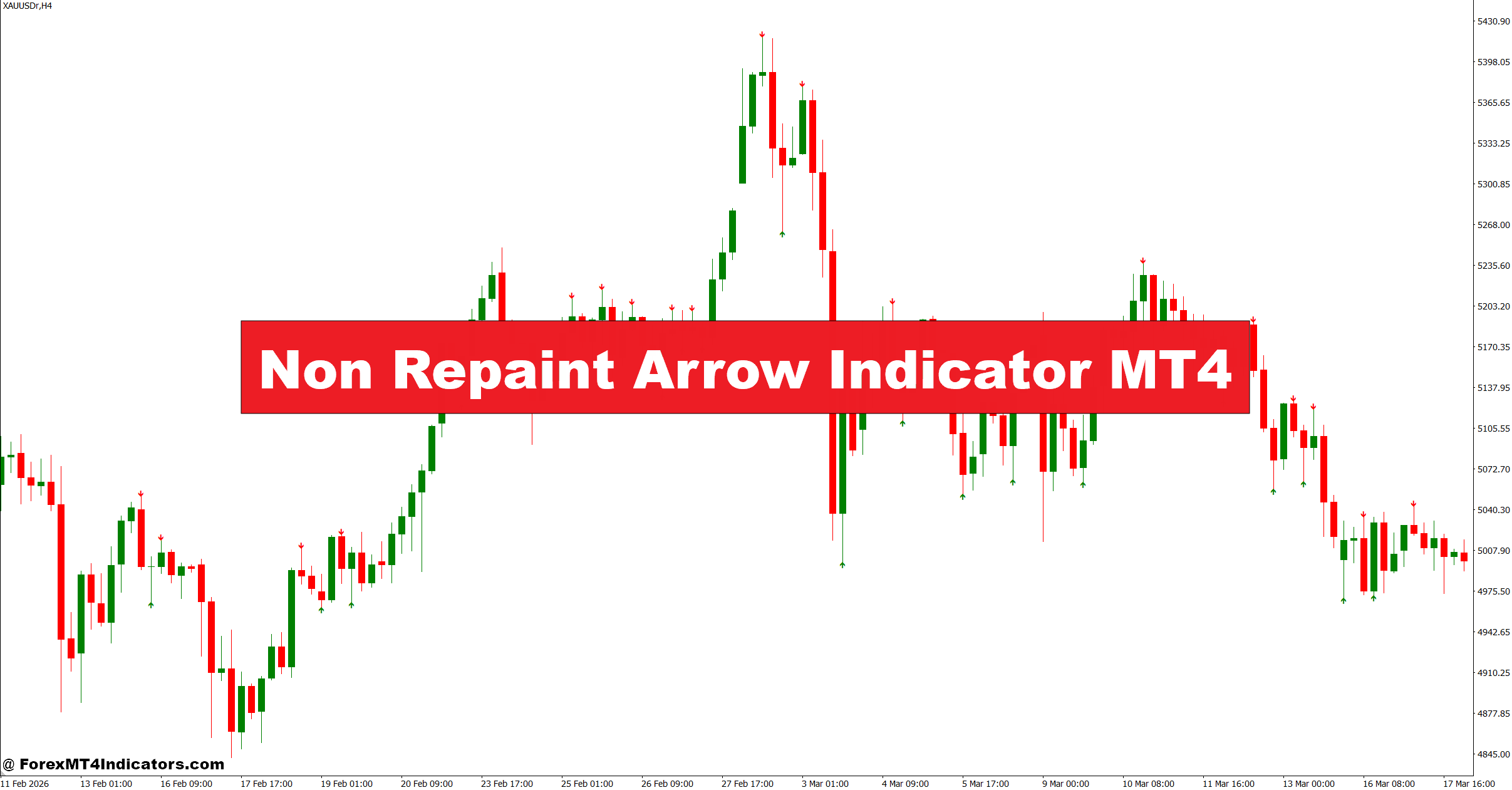
The Non Repaint Arrow Indicator MT4 changes that equation. It waits for the candle to close completely before it prints a blue buy arrow or red sell arrow. Once the arrow appears, it stays put—no redraws, no disappearing acts, no second thoughts. Traders get a clear, fixed signal they can trust for entries. That reliability lets them focus on trade management instead of wondering if the indicator changed its mind.
From here, we break down exactly what makes this tool tick, how traders apply it across different pairs and timeframes, and where it fits into a solid trading plan.
What Is the Non Repaint Arrow Indicator MT4
This MT4 tool displays simple arrows directly on the price chart to mark potential buy or sell opportunities. Blue arrows point up for buys; red arrows point down for sells. The key difference from many other arrow tools lies in its non-repainting nature. It only generates signals after a candle closes, using only confirmed price data.
Most repainting indicators peek ahead or recalculate when new ticks arrive, which turns backtesting into a fantasy and live trading into a headache. This one avoids that trap entirely. The arrow locks in place the moment the bar completes, giving traders a permanent record of every signal. That consistency matters when reviewing past performance or building a trading journal.
Experienced traders pair it with basic market structure—support and resistance levels, trend direction on higher timeframes, or simple moving averages. The indicator itself does not replace analysis; it simply highlights moments when momentum and price action line up.
How the Non Repaint Arrow Indicator MT4 Works
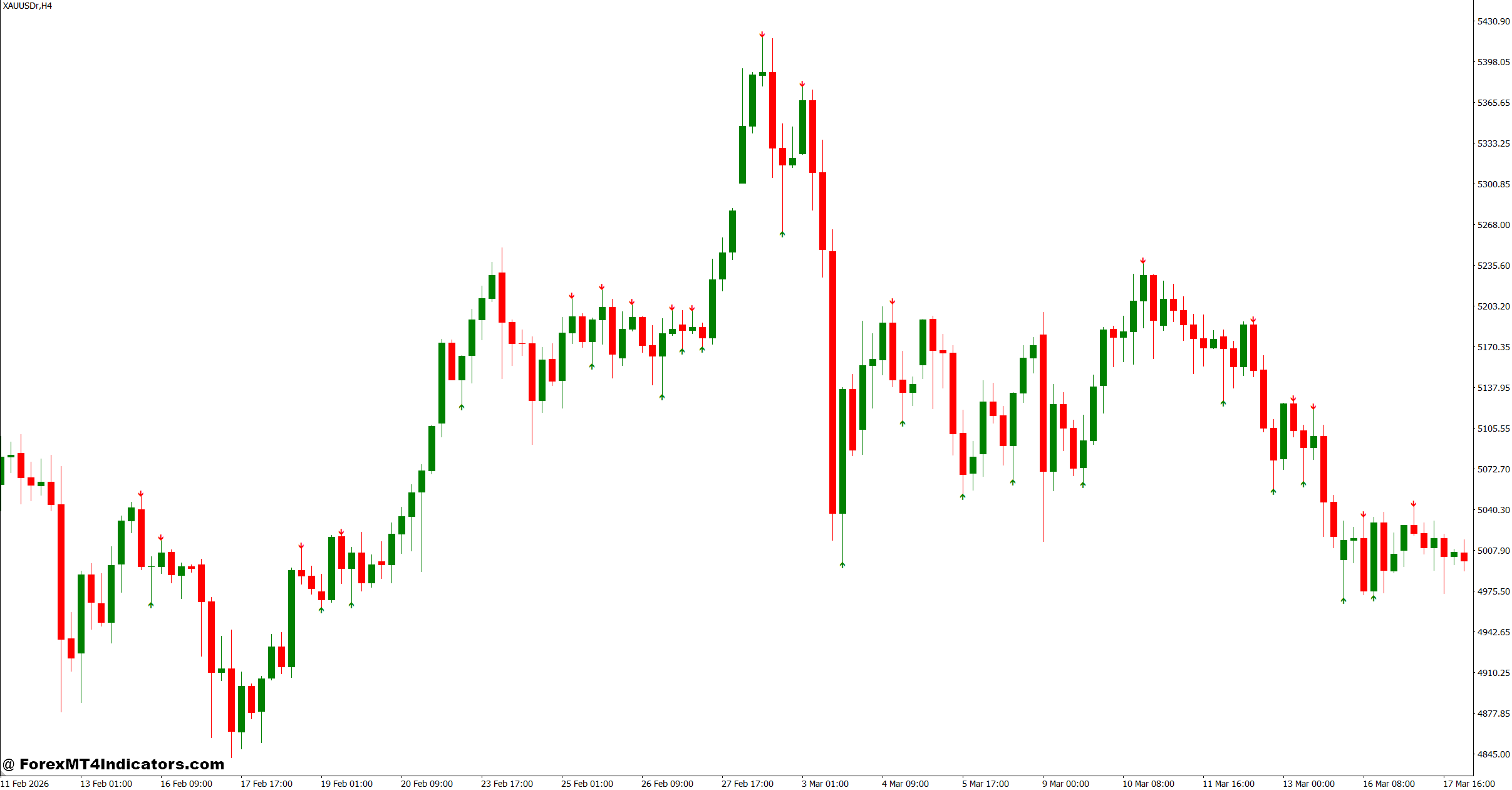
The logic stays straightforward yet effective. It scans closed candles for three main conditions: clear price structure, momentum confirmation, and enough volatility to support a move.
First, it checks the recent swing highs and lows. An uptrend shows higher highs and higher lows; a downtrend shows the opposite. Next, it looks for momentum filters such as the RSI crossing the 50 level or the MACD histogram shifting from negative to positive territory. Finally, it measures volatility through ATR to skip signals in dead-flat chop where price barely moves.
Only when all three align on a completed candle does the arrow print. No calculations use the current, unfinished bar. That built-in lag—waiting for the close—eliminates fake-outs that plague other tools during news spikes or low-liquidity sessions.
Traders who tested it on volatile NFP days noticed the arrows stayed rock-solid even as price whipsawed 30 or 40 pips right after release. The signal did not vanish when the initial spike reversed.
Real-World Trading Examples
Consider GBP/JPY on the 15-minute chart during the London open. Price had consolidated just above 187.20 for nearly an hour. Once the candle closed above that level with RSI climbing past 55 and decent ATR reading, a blue arrow appeared at 187.35. A trader entering long at the next open sat at 187.36, placed stop-loss 10 pips below the arrow candle low, and rode the move to 188.10 for a clean 70-pip gain.
On the flip side, AUD/USD on the daily chart showed a red arrow near 0.6420 after price failed at a clear resistance zone. The higher timeframe trend stayed bearish, and the arrow confirmed the rejection. A short entry after the daily close with stop above the candle high delivered a 120-pip drop over the next four sessions.
Scalpers on USD/CAD during the New York-London overlap often see 8 to 12 arrows per session on the 5-minute chart. Not every arrow wins, but the fixed signals let them quickly filter for those near key intraday levels. One recent session produced a short arrow right at a minor resistance; price dropped 18 pips in under 20 minutes before the next arrow reversed the bias.
These examples show the indicator shines when used as confirmation rather than a standalone system. Traders who wait for the arrow plus alignment with support or resistance cut their losing trades noticeably.
Adjusting Settings for Different Markets
Default parameters work well for most traders, but customization helps match individual styles. The main adjustable input is the sensitivity period, typically ranging from 5 to 30.
Shorter periods (7–10) generate more signals—great for scalping on 5-minute or 15-minute charts but noisier during ranging markets. Longer periods (20–30) filter heavily and suit swing trading on 4-hour or daily timeframes where fewer but higher-quality setups matter.
Color options let users switch arrows to whatever stands out best against their chart theme. Alert settings cover sound, email, and mobile push notifications so no one misses a signal while stepping away from the desk.
A practical tip from traders who run multiple pairs: test any new period setting on a demo account for at least two weeks across your favorite instruments. Then leave it alone. Over-tweaking every few days usually leads to curve-fitting rather than real edge.
Advantages, Limitations, and Comparisons
The biggest advantage remains reliability. Backtests match live results because signals never change after the fact. That transparency builds confidence over time. Alerts also cut screen time, which helps traders with day jobs stay consistent without burning out.
Limitations exist, of course. The indicator can lag in strong trending markets where price runs hard before momentum filters catch up. It also stays quiet during low-volatility Asian sessions on EUR/USD, which frustrates aggressive scalpers. No tool wins every trade, and expecting 80 or 90 percent accuracy sets up disappointment.
Compared with classic moving-average crossover systems, this arrow tool reacts faster once conditions clear yet avoids the whipsaw entries that plague pure price-cross indicators. Oscillators like standalone RSI often leave room for interpretation; the arrow removes guesswork at the exact moment of confirmation. Many traders who previously relied on ZigZag or fractal-based arrows switched after seeing fewer disappearing signals during chop.
How to Trade with Non Repaint Arrow Indicator MT4
Buy Entry
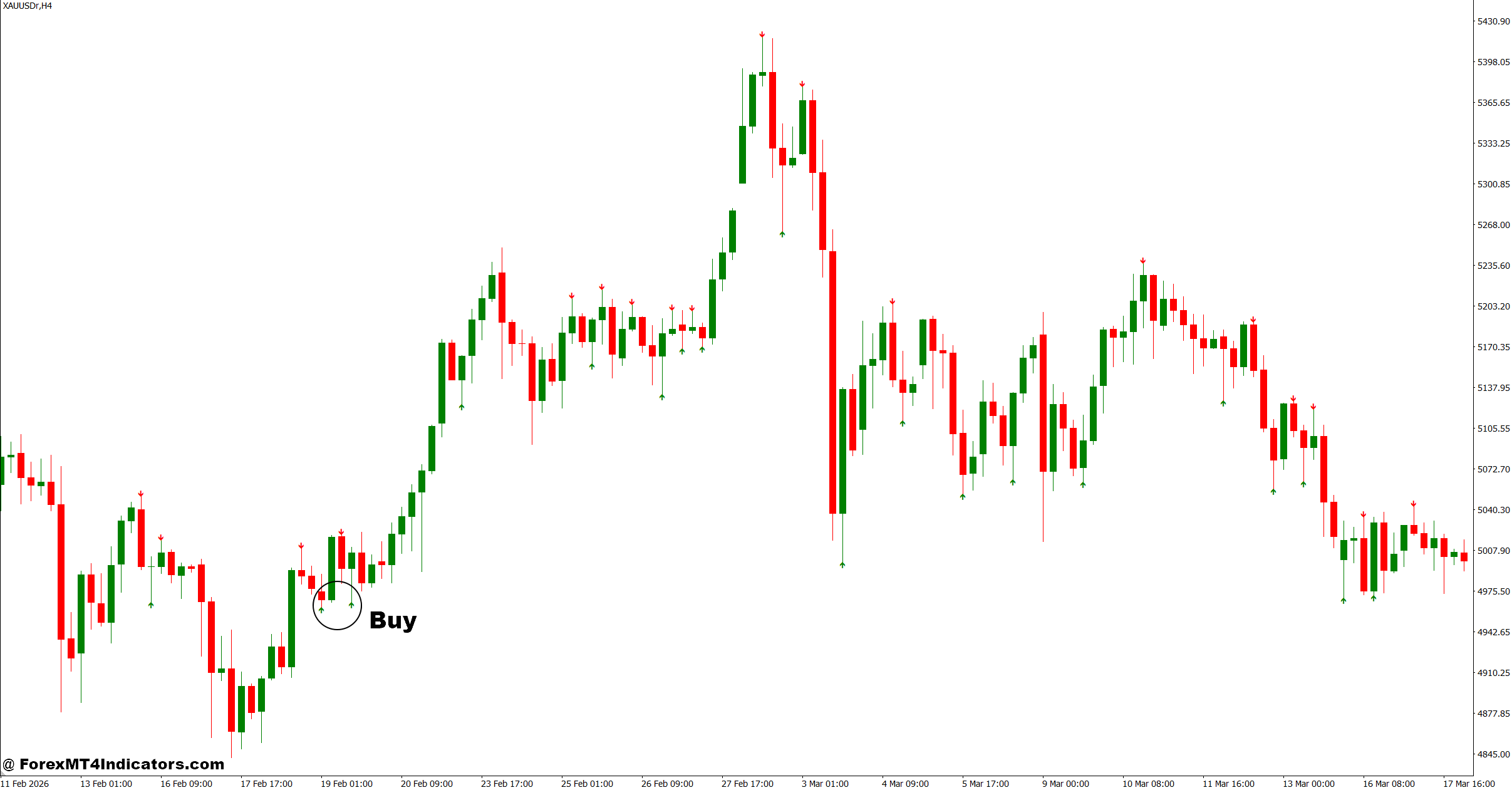
- Wait for Blue Arrow Confirmation – Only enter a long trade after a blue upward arrow prints on a fully closed candle on the 1-hour or 4-hour chart. This prevents fake signals from repainting.
- Check Higher Timeframe Trend – Take the buy signal only when EUR/USD shows higher highs and higher lows on the 4-hour or daily chart for better odds in the direction of the trend.
- Enter Near Major Support – Look for blue arrows forming right above key support levels or recent swing lows on GBP/USD for higher probability setups with tight risk.
- Place Stop Loss 12-18 Pips Below – Set your stop loss 12-18 pips below the low of the signal candle to give the trade room while protecting capital.
- Target Minimum 1:2 Risk Reward – Aim for at least 1:2 risk-to-reward on every buy trade, targeting 25-40 pips profit on 1-hour EUR/USD setups.
- Skip Signals in Choppy Markets – Avoid taking buy arrows when price is stuck between tight ranges with no clear direction on the daily chart.
- Confirm with RSI Momentum – Only buy when the 14-period RSI sits above 50 or is rising at the time the arrow appears.
- Risk Maximum 1% Per Trade – Always size your position so you risk no more than 1% of your account on any single buy signal.
Sell Entry
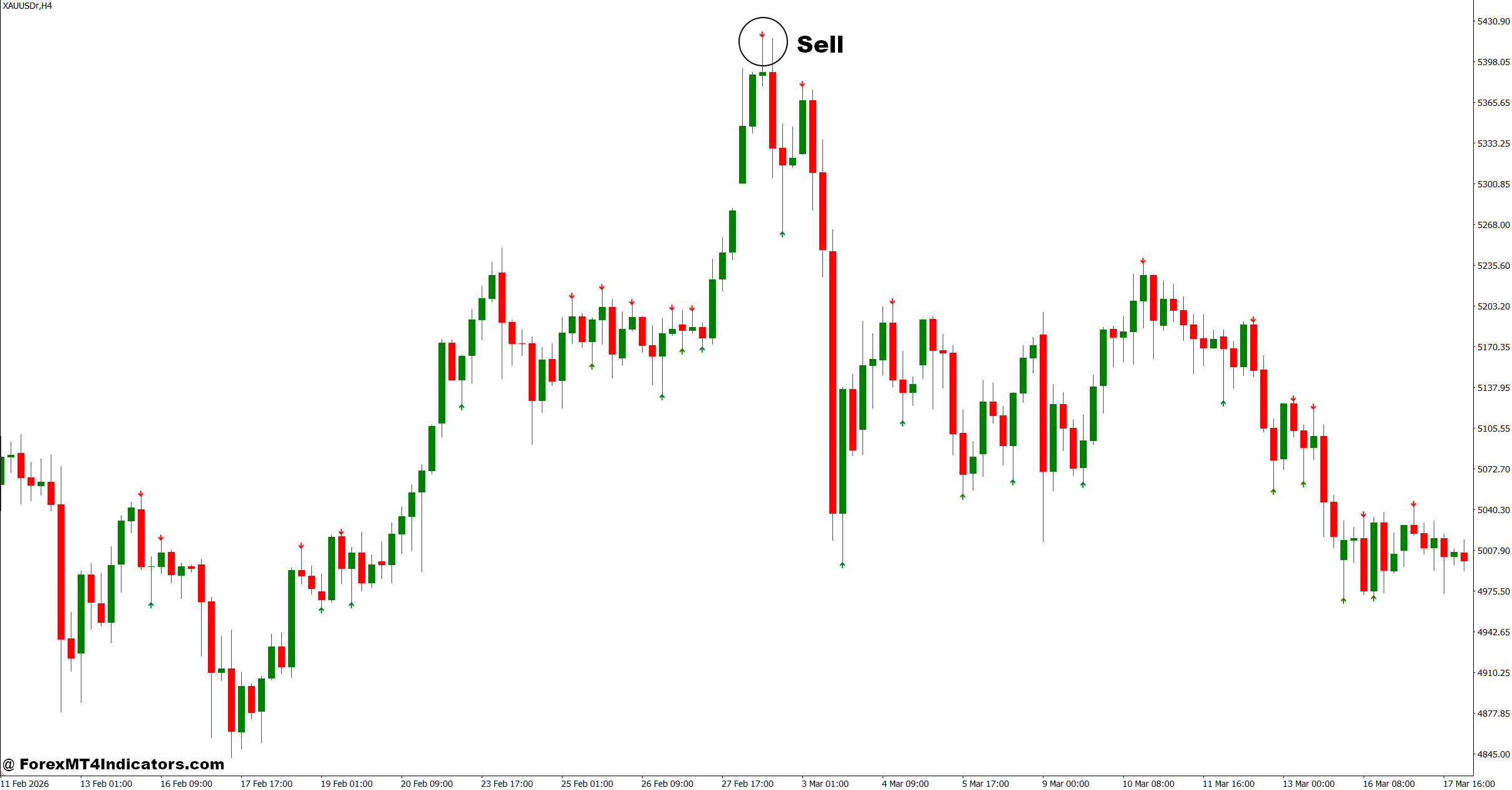
- Wait for Red Arrow Confirmation – Enter short trades only after a red downward arrow appears on a completed candle on the 1-hour or 4-hour timeframe.
- Align with Downtrend on Higher TF – Take sell signals when GBP/USD shows lower highs and lower lows on the 4-hour or daily chart.
- Sell Near Strong Resistance – Look for red arrows printing at clear resistance zones or previous swing highs for the best risk-reward entries.
- Set Stop Loss 12-18 Pips Above – Place your stop loss 12-18 pips above the high of the red arrow candle to manage risk effectively.
- Aim for 1:2 or Better Reward – Target at least twice your risk, going for 30-45 pips on 1-hour chart sell setups on EUR/USD.
- Ignore Signals Near Major News – Do not trade red arrows 30 minutes before or after high-impact news events to avoid sudden reversals.
- Check RSI Below 50 – Confirm the sell signal when RSI reads below 50 or is falling for added momentum support.
- Never Risk Over 1% – Limit your account risk to 1% maximum on every sell trade no matter how convincing the arrow looks.
Wrapping It Up
The Non Repaint Arrow Indicator MT4 delivers fixed, trustworthy signals that stay on the chart once the candle closes. It combines price structure, momentum, and volatility checks to highlight entries without the frustration of repainting. Traders see the clearest value when they combine arrows with support and resistance, higher-timeframe trend, and strict risk rules.
That said, success still hinges on the trader behind the screen. A 55 to 60 percent win rate paired with a 1.5-to-1 or better reward-to-risk ratio can produce steady results over hundreds of trades. Losses remain part of the game, especially around major news or sudden reversals.
Trading forex carries substantial risk. No indicator guarantees profits, and past performance does not predict future results. Test thoroughly on a demo account, track your stats honestly, and never risk more than you can afford to lose on any single trade. The arrows simply point the way—discipline turns those signals into a workable edge.
Level up your trading Learn to read the chart — not just the indicator eBook · Instant PDF Video Course · 12 modules Trading forex and CFDs carries a significant risk of loss and is not suitable for everyone. Broker links are affiliate links — we may earn a commission at no cost to you.Recommended MT4/MT5 Brokers
Free MT4 Indicator Download
Enter Your Email Address below, download link will be sent to you.