

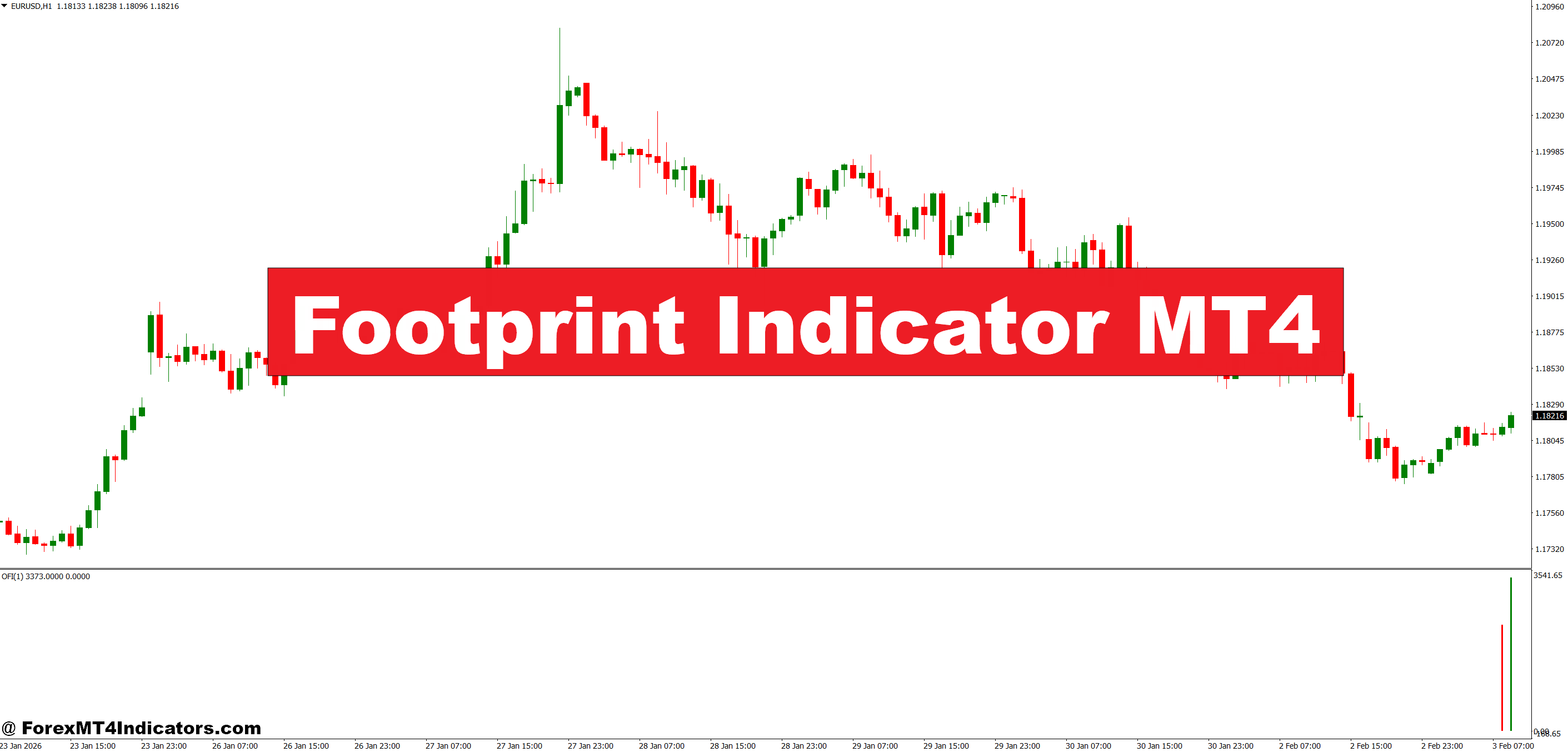
The Footprint Indicator MT4 is built to reduce that blind spot. It maps buying and selling activity at price levels so traders can judge whether a breakout has real backing or is just a quick push. Here’s how it works in practice and where it fits best.
What the Footprint Indicator MT4 Actually Shows
A footprint chart is an order-flow view of a candlestick. Instead of only showing open, high, low, and close, it displays activity inside the bar at each price level. Depending on the version, it may show bid/ask volume, volume per price, delta (buy volume minus sell volume), or imbalance (one side overpowering the other).
On MT4, the footprint display is an overlay that tries to bring that same “ladder” style information onto a normal chart. Traders use it for:
- Confirming breakouts at support/resistance
- Spotting absorption (big volume but price won’t move)
- Finding pullback entries when the market stops chasing
It doesn’t replace price action. It adds context to it, especially when a chart looks clean but the tape is messy.
How It Works: The Logic Behind Footprint Data on MT4
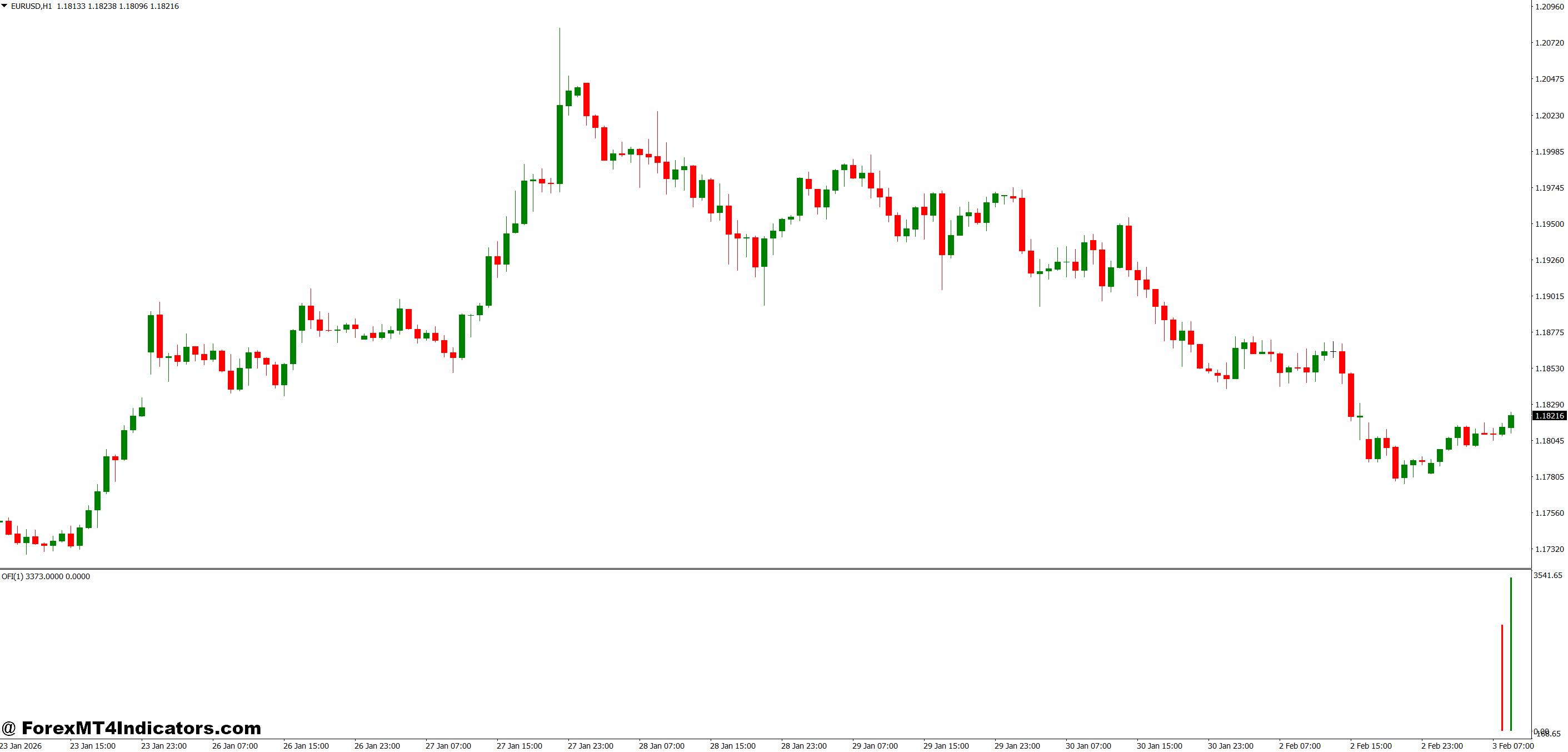
MT4 doesn’t provide centralized exchange volume for spot forex. That means most footprint-style tools on MT4 rely on tick volume (how many price updates happen) and the broker’s feed. Tick volume can still be useful because strong moves often come with more ticks, but it’s not the same as true traded volume.
Most MT4 footprint indicators follow a few common steps:
- Break each candle into price levels (for example, every 0.1 pip or 1 pip depending on settings).
- Count activity at each level using tick changes or simulated bid/ask separation from the price stream.
- Calculate delta or imbalance if the tool supports it. A simple delta model is:
- Delta = “buy-side activity” − “sell-side activity”
- Plot the footprint as numbers or blocks inside the candle, often with highlights for the highest activity (POC-style level) or strong imbalances.
Here’s the practical takeaway: the indicator isn’t reading the interbank book. It’s reading your platform’s stream and showing where activity clustered while price moved. That’s still actionable when used as a filter, not as a fortune teller.
Trading forex carries substantial risk. No indicator guarantees profits.
Practical Trading Use: Three Real Scenarios Traders Watch For
1) Breakout Confirmation at a Known Level
Say EUR/USD on the 1-hour chart is pressing into 1.0850, a level that rejected twice earlier in the week. Price finally breaks and closes above 1.0850, printing a 14-pip body.
A trader checks the footprint inside that breakout candle:
- If the highest activity clusters near the top third of the candle and delta stays positive, it suggests buyers kept lifting offers rather than dumping into the close.
- If activity spikes near 1.0850 but price stalls and delta flips negative into the close, that’s a “break and fade” warning.
In practice, some traders will wait for the next candle. If the pullback to 1.0850 shows lighter activity and no heavy selling pressure, they’ll take the long with a stop 6–10 pips below the level, depending on average spread and volatility.
2) Absorption at Support During a Down Move
On GBP/JPY M15, price drops into a prior swing low around 188.20. The candle wicks through the level, but closes back above it.
The footprint clue: heavy activity prints at 188.20–188.15, yet price can’t keep trading lower. That’s often read as absorption—selling pressure meets a buyer willing to take the other side.
A cautious approach is to wait for a structure shift: a higher low on M15 and a push above the last minor high. If that happens, traders may target the mid-range or the next resistance zone rather than trying to call a full reversal.
3) Avoiding Chop During News-Driven Whipsaw
When testing this on volatile NFP days, traders often see the same pattern: huge spikes, fast reversals, and spread expansion. A footprint view can help avoid chasing the first move.
Example: USD/CAD M5 prints a 30-pip candle right after the release, then snaps back. If the footprint shows extreme activity right in the middle of the candle and mixed delta, that’s often chop, not clean directional flow. Many traders simply stand down for 10–15 minutes and wait for the second wave, when price starts respecting levels again.
This isn’t about being “right.” It’s about not feeding the market during its messiest minutes.
Footprint Indicator MT4 Settings
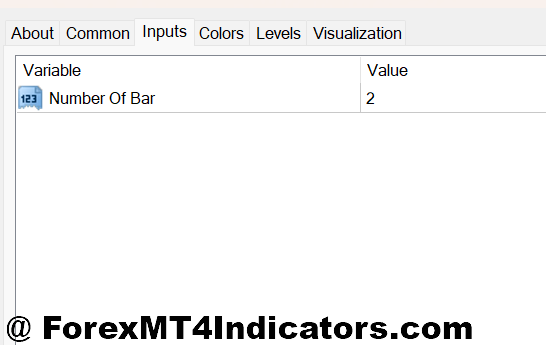
Most traders blow this part by leaving defaults on every pair. Footprint displays need tuning for readability and for the pair’s behavior.
Common parameters to adjust:
- Price step / row size:
- For EUR/USD, many traders start around 0.5 to 1.0 pip.
- For GBP/JPY, 1 to 2 pips often reads cleaner due to higher volatility.
- Lookback bars:
- Keep it modest (like 100–300 bars) to reduce MT4 lag. Footprints can get heavy.
- Highlight thresholds:
- Set a rule like “highlight levels above 150% of average activity.” This helps spot the “hot” prices fast.
- Session filters:
- If the tool allows it, focus on London and New York sessions. Asian session footprints can be thin and noisy on many pairs.
And don’t ignore broker differences. A footprint view on one MT4 feed may look cleaner than another. Traders who take it seriously will compare the same setup on two demo accounts to see how consistent the tool is.
Pros, Limitations, and How It Compares to Similar Tools
Strengths
- Adds order-flow context to price action and support/resistance
- Helps filter breakouts and spot potential fake-outs
- Useful for timing pullbacks and managing trade location (entry quality)
Limitations
- MT4 footprint tools often rely on tick volume, not centralized forex volume
- Broker feed quality can change the read
- In fast markets, the display may lag or repaint visually depending on how it updates
Comparison: Footprint vs VWAP, Volume Profile, and RSI
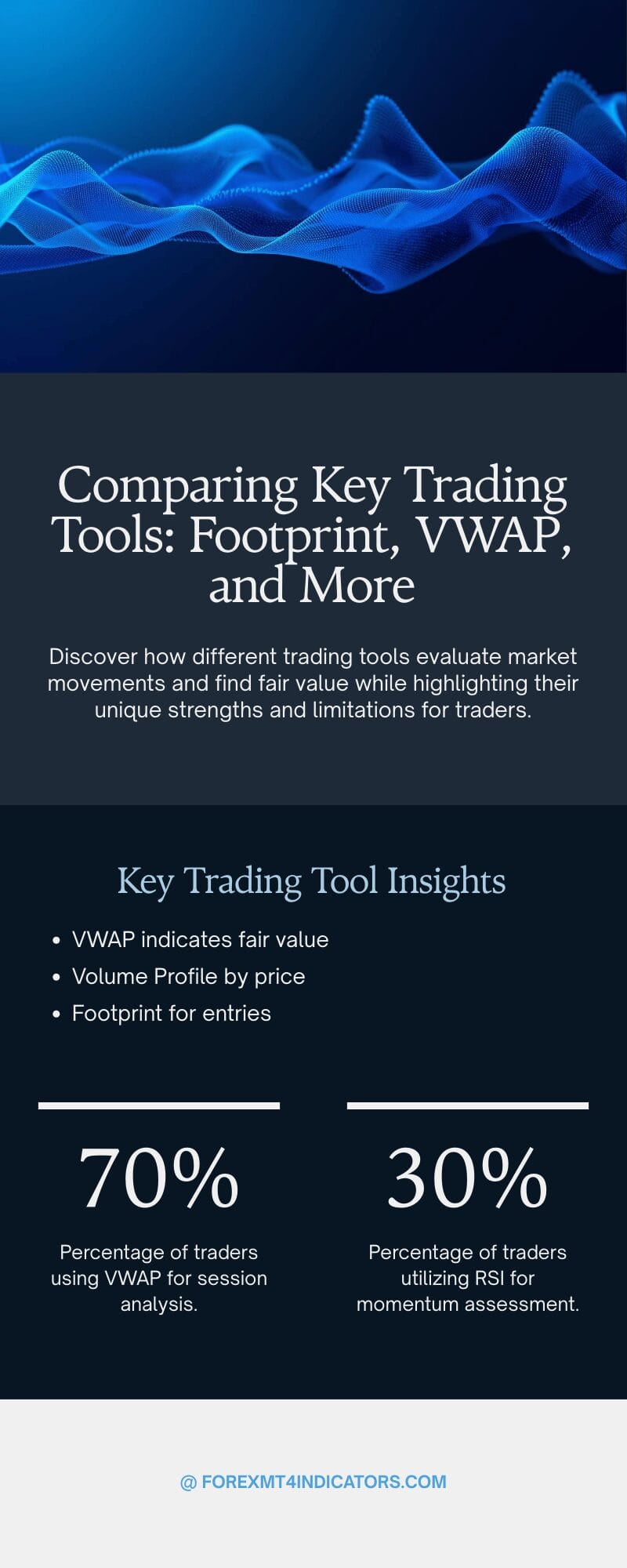
- VWAP helps with “fair value” during a session, but it won’t show where activity stacked inside a breakout candle.
- Volume Profile (or market profile style tools) shows volume by price over a range, but footprints show it bar-by-bar, which is better for entries.
- RSI (14) can warn of momentum slowing, but it can’t tell if sellers are getting absorbed at a level.
What makes footprints different? They’re closer to market microstructure. Not perfect on spot forex, but still a solid “second opinion” when price action alone looks too easy.
Trading forex carries substantial risk. No indicator guarantees profits.
How to Trade wth Footprint Indicator MT4
Buy Entry
- Buy the breakout with strong delta – On EUR/USD 1-hour, enter only if the breakout candle closes 8–15 pips above resistance and footprint delta stays positive across the top third; skip it if the close is back under the level.
- Buy the pullback to the broken level – After a breakout, wait for a retest within 3–6 pips of the level; go long when footprint shows lighter selling than the breakout candle and price holds for 2–3 candles.
- Buy after absorption at support – On GBP/USD 4-hour, if price wicks 10–25 pips below support but can’t close below it and footprint prints heavy activity at the lows, enter on the next candle break of the wick high.
- Buy the imbalance stack up – Take a long when 2–3 consecutive price rows show buy-side imbalance (one side clearly dominant) and the candle closes near the high; don’t buy if imbalance appears mid-range in chop.
- Buy the stop-run reversal – If EUR/USD sweeps a prior low by 5–12 pips and footprint shows aggressive selling that fails to push lower, buy only after a higher low forms and spread is normal (avoid this during major news).
- Buy with trend alignment – On daily + 1-hour, only take longs if daily structure is higher highs/higher lows; reduce risk when trading against daily by cutting size 30–50%.
- Buy only with a defined stop – Place the stop 2–5 pips beyond the absorption low or retest low; risk 0.5%–1% per trade and skip the setup if the stop needs more than 25 pips on EUR/USD.
- Avoid buys in dead zones – Don’t take long signals during low-liquidity hours or when the footprint is “flat” (no clear dominant side) for 5+ candles—that’s usually chop and whipsaw territory.
Sell Entry
- Sell the breakdown with strong negative delta – On GBP/USD 1-hour, short only if the candle closes 8–15 pips below support and footprint delta stays negative near the lows; don’t sell if price snaps back above the level.
- Sell the retest failure – After breakdown, wait for price to retest within 3–6 pips of the level; short when footprint shows heavy selling at the retest and the candle closes back below the level.
- Sell after absorption at resistance – On EUR/USD 4-hour, if price wicks 10–25 pips above resistance but can’t close above it and footprint prints heavy activity at the highs, enter short on a break below the wick low.
- Sell when imbalances stack down – Enter when 2–3 consecutive rows show sell-side imbalance and the candle closes near the low; avoid it if the imbalances appear during a tight 10–15 pip range.
- Sell the stop-run trap – If GBP/USD sweeps a prior high by 5–12 pips then fails to hold, short only after the next candle makes a lower high; skip if spreads widen or slippage appears.
- Sell with higher-timeframe bias – On daily + 1-hour, prioritize shorts if daily shows lower highs/lower lows; if daily is bullish, trade smaller (cut risk 30–50%) or skip.
- Sell with strict trade management – Put the stop 2–5 pips beyond the rejection wick; aim for at least 1:1.5 reward-to-risk, and take partial profit at +10–20 pips on 1-hour trades.
- Avoid sells into support or news – Don’t short straight into the next support within 10–15 pips, and avoid new entries 15 minutes before high-impact releases (NFP, CPI) because footprints get noisy and reversals get violent.
Wrap-Up: When Footprints Help and When They Don’t
The Footprint Indicator MT4 fits traders who care about entry quality and want more than candle shapes.
- It can confirm breakouts when activity supports the move and warn on fake-outs when pressure flips.
- It can highlight absorption zones, especially around clear support/resistance.
- It works best when traders pair it with structure and avoid using it as a standalone signal.
- It still has limits on spot forex, since most MT4 versions depend on tick volume and broker data.
A smart next step is simple: pick one pair (like EUR/USD), test it on H1 and M15 for two weeks, and journal the best and worst reads. The goal isn’t a perfect signal. It’s a cleaner decision at the hard moments.
Level up your trading Learn to read the chart — not just the indicator eBook · Instant PDF Video Course · 12 modules Trading forex and CFDs carries a significant risk of loss and is not suitable for everyone. Broker links are affiliate links — we may earn a commission at no cost to you.Recommended MT4/MT5 Brokers
Free MT4 Indicator Download

Enter Your Email Address below, download link will be sent to you.