

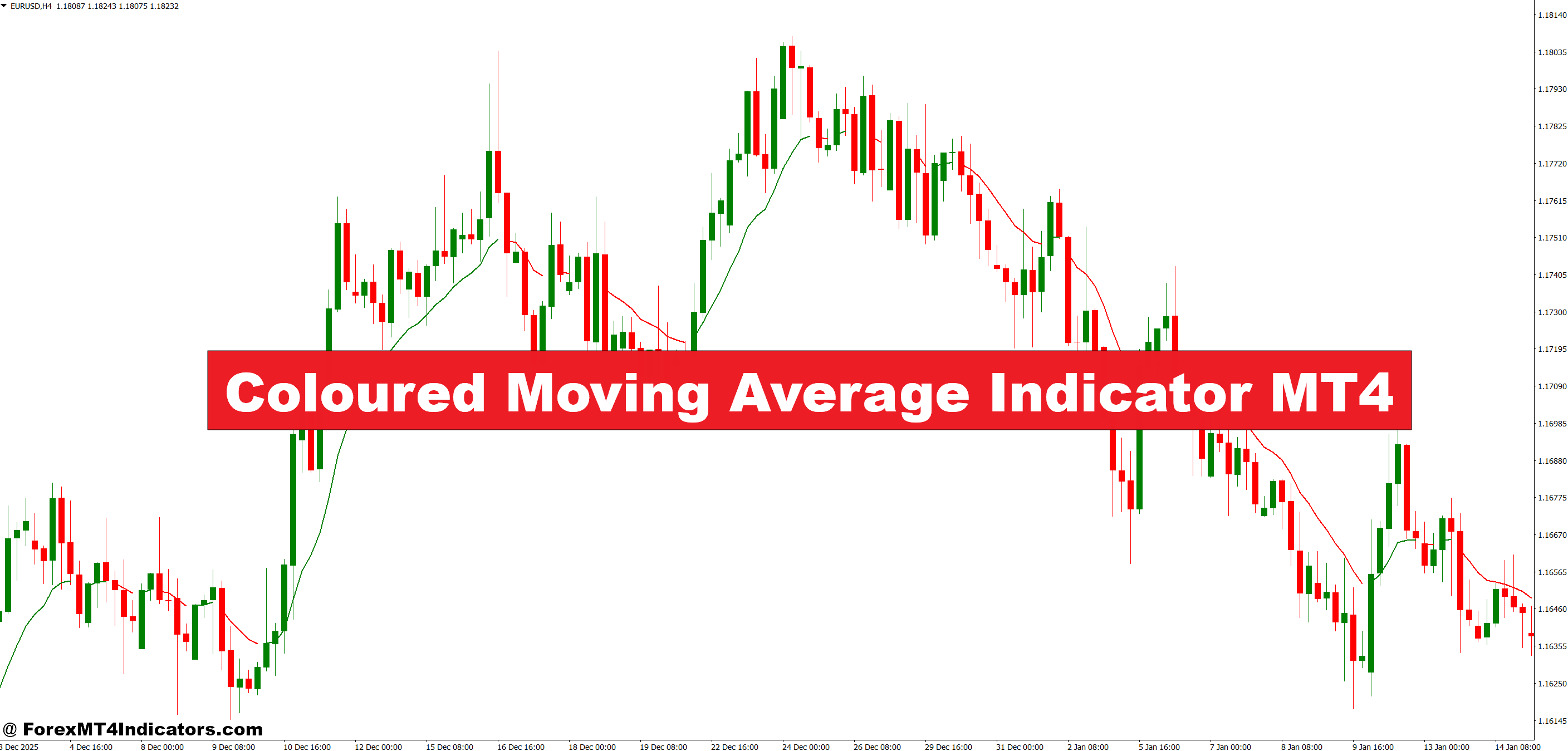
The Coloured Moving Average Indicator MT4 is a trend-following tool that plots a moving average line on the chart and shifts its color based on price behavior. Most versions use a simple moving average (SMA) or exponential moving average (EMA) as the base calculation. The color change usually reflects bullish, bearish, or neutral conditions.
For example, the line may turn green when price closes above the average and red when it closes below. Some variations add a third color, like yellow or gray, during low-momentum or sideways phases. That visual cue saves time. Traders don’t need to analyze slope angle constantly because the indicator shows it at a glance.
This indicator fits into classic technical analysis. It supports trend identification, trend confirmation, and trade filtering. Traders often pair it with support and resistance or price action patterns instead of using it alone.
How the Indicator Works Behind the Scenes
At its core, the logic is simple. The indicator calculates a moving average over a defined period, such as 20, 50, or 100 candles. It then checks price position or slope direction to decide the color.
On MT4, a common setup uses a 50-period EMA:
- Green when the EMA slopes upward and price closes above it
- Red when the EMA slopes downward and price closes below it
Some versions go deeper. They measure the difference between current and previous EMA values. If the slope exceeds a minimum threshold, the color changes. This helps reduce color flipping during market chop.
When testing this on volatile NFP days, traders often notice fewer whipsaws on higher timeframes like H1 or H4. On M5 charts, color changes can happen fast, which is useful for scalping but risky without filters.
Practical Trading Applications With Real Example

Traders mostly use the Coloured Moving Average Indicator MT4 for trend confirmation and trade filtering. It works best when price respects the moving average as dynamic support or resistance.
Example 1: EUR/USD on the 1-hour chart: During a steady uptrend, the moving average stayed green for nearly 18 candles. Price pulled back twice and bounced from the line each time. A buy entry near the second pullback offered a 35-pip move before the color flipped. That color shift warned traders to tighten stops.
Example 2: GBP/JPY on M15: The market looked bullish, but the moving average kept flipping between red and green. That color instability signaled chop. Traders who avoided entries during this phase skipped multiple fake-outs.
Many experienced traders wait for candle close confirmation. Entering mid-candle often leads to premature trades. And yes, combining it with RSI (14) or MACD improves timing, especially near session opens.
Coloured Moving Average Indicator MT4 Settings, Customization
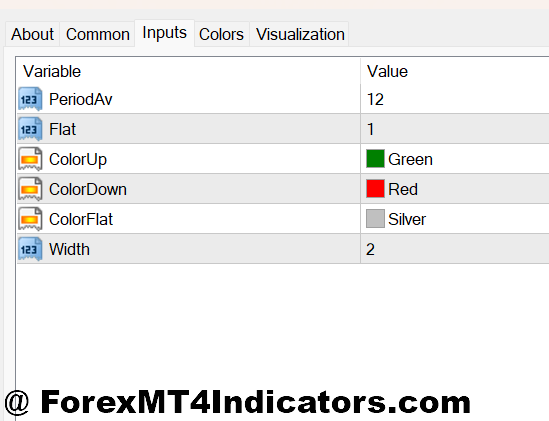
Settings matter more than most traders expect. A default 14-period moving average may work on M5 but fail on H1. Traders adjust parameters based on volatility and trading style.
Common setups include:
- Scalping (M5–M15): 20 or 25 EMA
- Intraday (M30–H1): 50 EMA
- Swing trading (H4–Daily): 100 or 200 EMA
Fast-moving pairs like XAUUSD or GBP pairs benefit from slightly higher periods to smooth noise. During Asian session ranges, longer periods help avoid constant color changes.
Customization also includes line thickness and color contrast. Clear colors reduce decision fatigue, especially during long trading sessions.
Advantages, Limitations, and Honest Trade-Offs
The biggest strength of the Coloured Moving Average Indicator MT4 is clarity. It removes guesswork about trend direction and helps traders stay disciplined. It also integrates well with price action and structure-based strategies.
But it’s not perfect. Like all moving averages, it lags. Sharp reversals will always show late. In fast reversals, traders may give back profits before the color changes. On lower timeframes, false flips can trigger emotional trades.
Trading forex carries substantial risk. No indicator guarantees profits. Smart traders treat this tool as a guide, not a signal generator. Risk management still decides long-term survival.
Comparison With Similar Indicators
Compared to a standard moving average, the colored version adds speed in decision-making. Traders react faster because visual signals reduce analysis time. Against tools like SuperTrend, it feels smoother and less aggressive.
Unlike MACD or RSI, this indicator stays on the price chart. That makes it easier to combine with support and resistance zones. It doesn’t measure momentum internally like oscillators do, so many traders pair it with one.
What makes this different? Simplicity. Fewer settings, fewer distractions, and quicker reads during live markets.
How to Trade with Coloured Moving Average Indicator MT4
Buy Entry
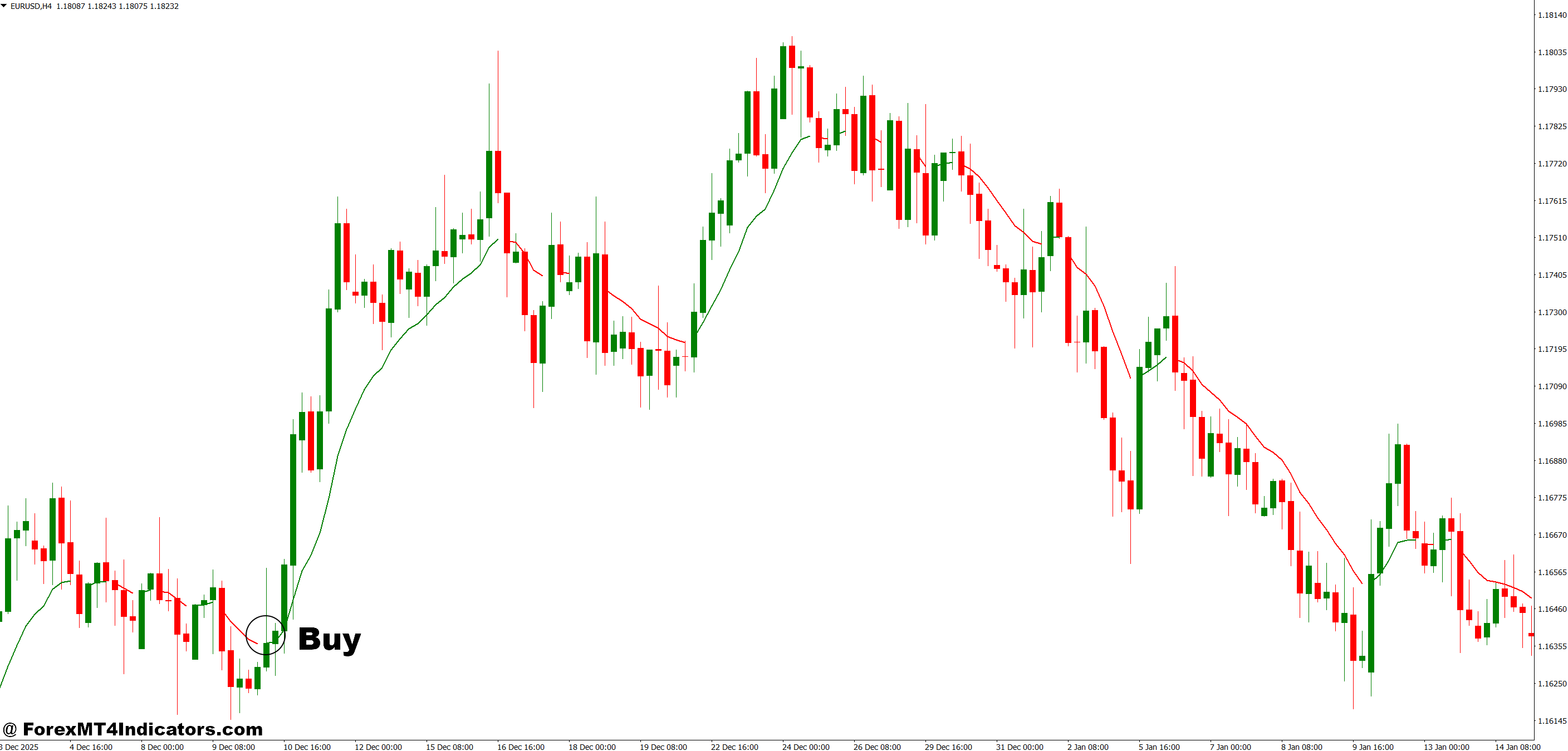
- Confirm green color on close – Enter a buy only after a full candle closes above the coloured moving average and the line turns green on the 1-hour or 4-hour chart, which confirms real bullish momentum, not an intrabar fake-out.
- Buy pullback near the line – On EUR/USD H1, wait for price to retrace within 5–15 pips of the green moving average and show rejection, which often gives a cleaner entry than chasing breakouts.
- Align higher timeframe trend – Check the daily chart first; only take buys if the coloured moving average is also green there, reducing the chance of trading against a larger trend.
- Use session timing wisely – Focus on London or New York session buys, as green signals during Asian range often lead to chop and quick reversals.
- Set stop-loss below structure – Place stop-loss 10–25 pips below the recent swing low or below the moving average, keeping risk per trade under 1–2%.
- Target realistic profits – Aim for 1:1.5 or 1:2 risk-reward, such as risking 20 pips to target 30–40 pips on GBP/USD H1.
- Avoid buys in flat markets – Skip the trade if the moving average keeps flipping colors within 3–4 candles, which signals range and whipsaw risk.
Sell Entry
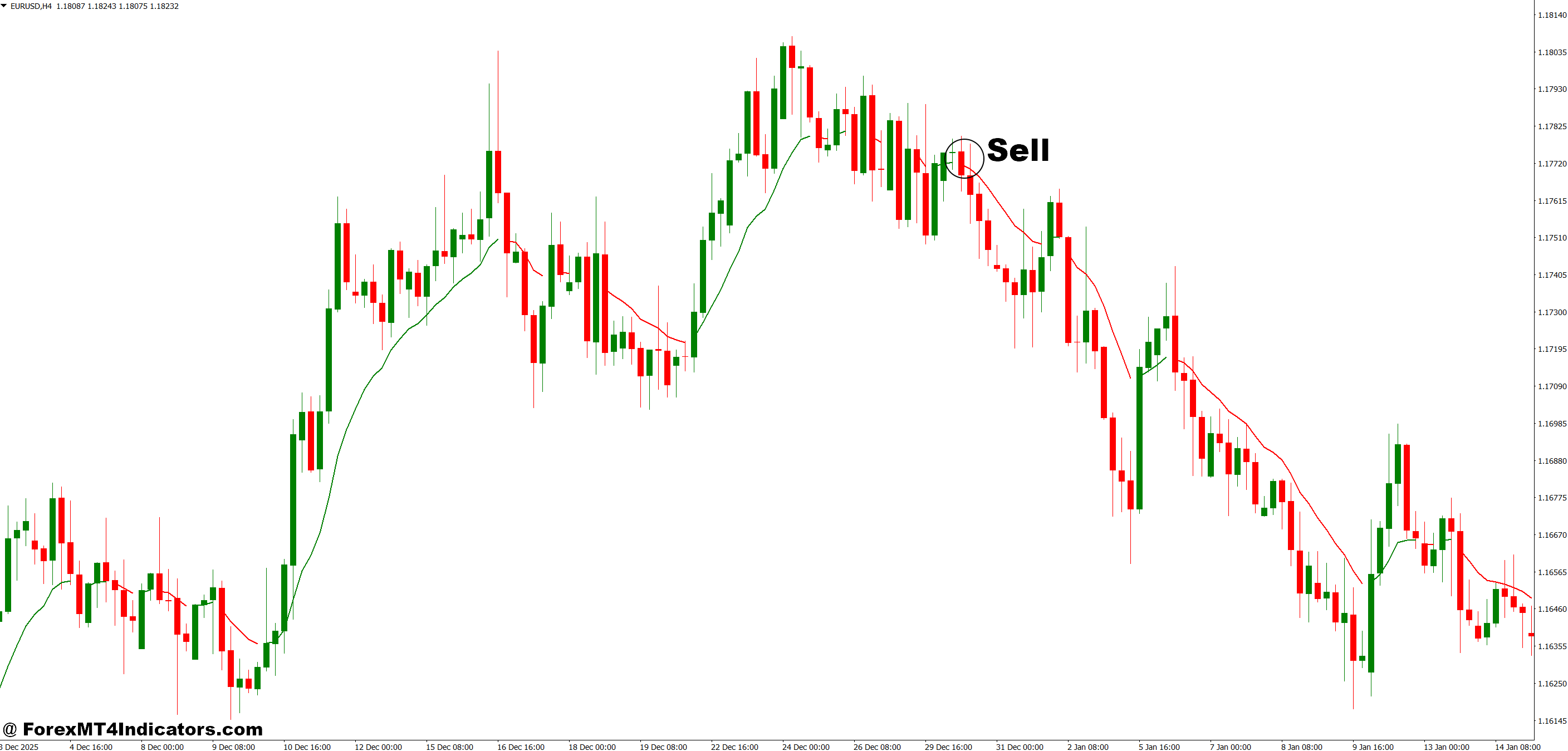
- Confirm red color on close – Enter a sell only after a candle closes below the coloured moving average and the line turns red on H1 or H4, showing sellers are in control.
- Sell the pullback – On GBP/USD H4, wait for price to pull back to within 10–20 pips of the red moving average, then reject it before entering.
- Check higher timeframe bias – Only sell if the coloured moving average is also red on the daily chart, which helps avoid countertrend losses.
- Trade active market hours – Red signals during London–New York overlap tend to follow through better than off-session signals.
- Protect with logical stops – Place stop-loss 15–30 pips above the recent swing high or just above the moving average, risking no more than 2% per trade.
- Scale out near support – Consider taking partial profit near prior support levels, often 25–50 pips away on major pairs like EUR/USD.
- Avoid sells near strong support – Don’t sell if price is less than 20 pips above a major daily support zone, even if the line turns red.
Conclusion
The Coloured Moving Average Indicator MT4 offers traders a cleaner way to read trends without overloading the chart. It highlights direction, filters noise, and supports better trade timing when markets behave.
Traders often find:
- It works best as a trend filter, not a standalone system
- Higher timeframes reduce whipsaws and stress
- Pairing it with price action improves accuracy
Used with discipline, this indicator can sharpen decision-making and reduce emotional trades. But results depend on context, patience, and risk control. The next step is simple: test it on one pair and one timeframe for two weeks. Real charts reveal more than any theory ever will.
Level up your trading Learn to read the chart — not just the indicator eBook · Instant PDF Video Course · 12 modules Trading forex and CFDs carries a significant risk of loss and is not suitable for everyone. Broker links are affiliate links — we may earn a commission at no cost to you.Recommended MT4/MT5 Brokers
Free MT4 Indicator Download
Enter Your Email Address below, download link will be sent to you.