

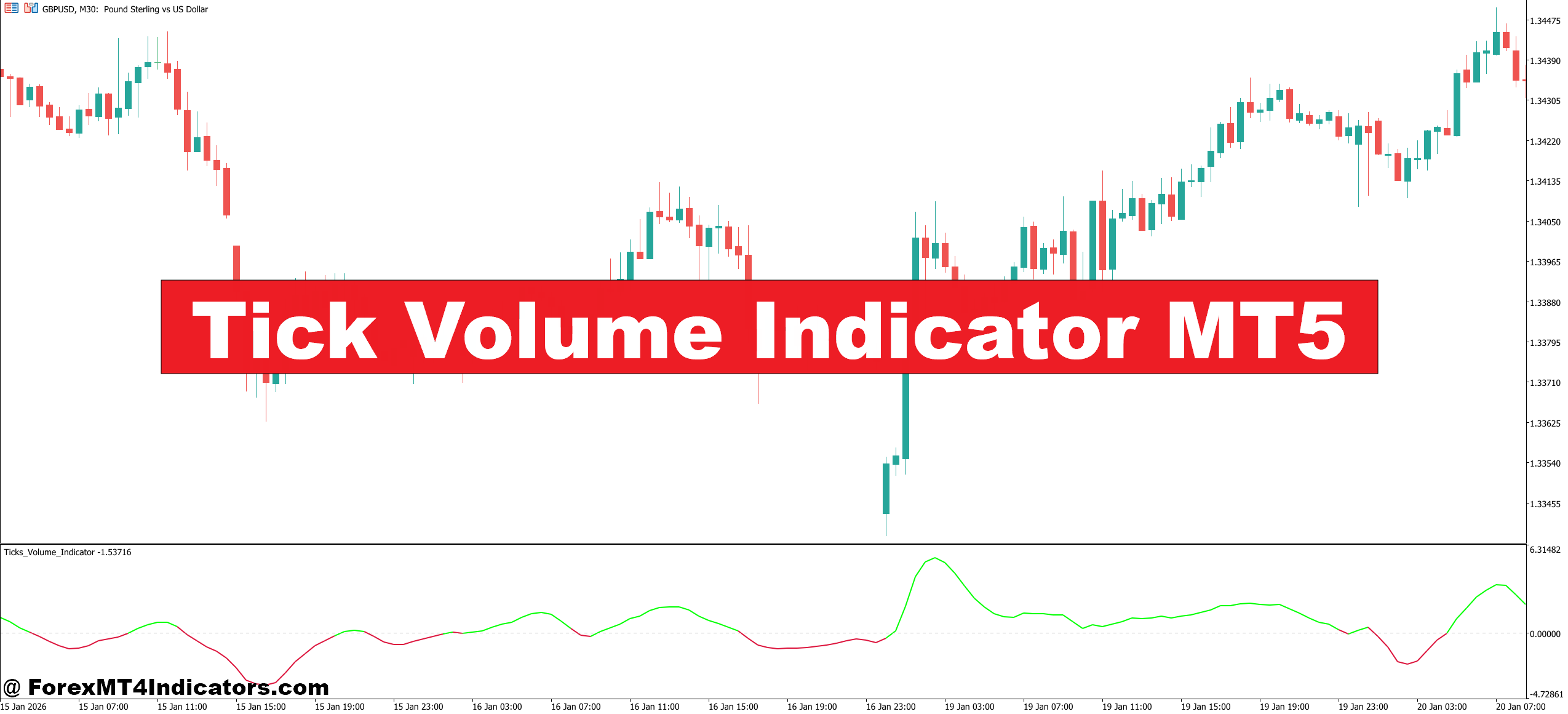
The tick volume indicator counts price updates during a specific timeframe. Each time a currency pair’s price changes—whether by one pip or ten—it registers as a tick. On a 15-minute chart, for example, the indicator tallies every price change within those 15 minutes and displays it as a histogram below the price chart.
Here’s what separates it from actual volume: tick volume doesn’t measure how many contracts or lots traded. It simply counts activity. During London open, when GBP/USD might register 3,000 ticks in an hour, you’re seeing high participation. At 3 AM EST when the same pair logs 150 ticks, the market’s essentially asleep.
The correlation between tick volume and actual trading volume runs surprisingly high—studies have shown 90%+ correlation on major pairs. Why? Because when large institutional orders hit the market, they create rapid price changes. Those rapid changes generate more ticks. A bank executing a $500 million EUR/USD order doesn’t move the market in one smooth line—it creates dozens or hundreds of price updates as liquidity providers react.
How Traders Apply Tick Volume in Practice
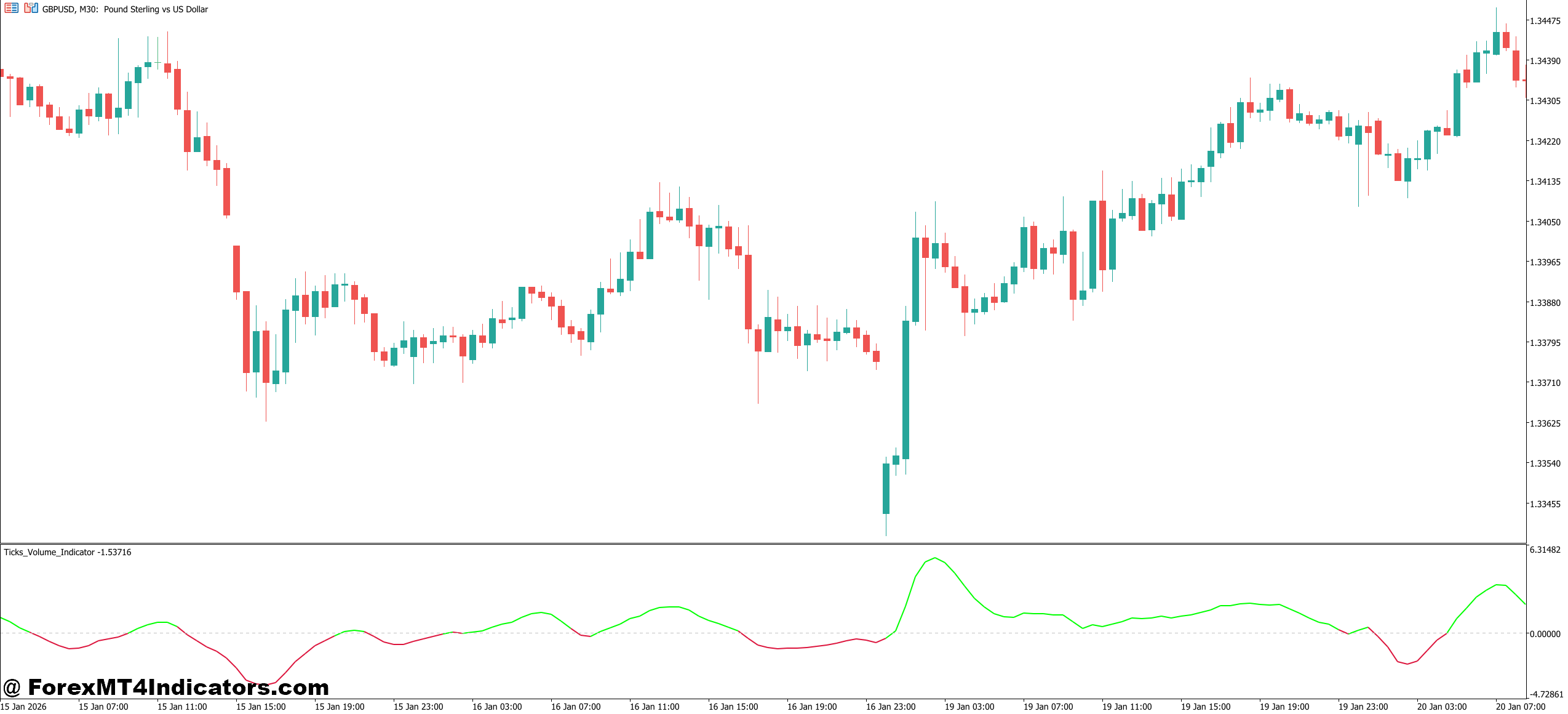
The most straightforward application involves breakout confirmation. When AUD/USD breaks above a resistance level with tick volume three times the 20-bar average, that’s institutional participation pushing through. The same breakout with below-average ticks? Probably retail traders getting faked out before the real move happens in the opposite direction.
I’ve seen this play out repeatedly on GBP/JPY during Asian session closes. Price will probe the day’s high around 7:30 AM EST, but tick volume stays flat. An hour later, when London traders arrive and push through the same level with volume spiking 250%, that breakout tends to stick. The difference isn’t the price level—it’s the conviction behind the move.
Divergences offer another edge. When USD/CAD makes a higher high but tick volume makes a lower high, the bulls are losing steam. Fewer market participants are willing to chase the move higher. That’s your cue to watch for reversals or at minimum, tighten stops on long positions. Spotted this divergence on the December 2024 USD/CAD rally near 1.4400—price pushed up while volume faded for two days before a sharp 200-pip correction.
Trend traders use expanding volume to confirm momentum. During the September 2024 EUR/USD downtrend, each lower swing came with increasing tick volume. That tells you sellers are getting more aggressive, not exhausted. Compare that to a trend where volume contracts on each new low—usually means the move is running out of gas.
Tick Volume Indicator MT5 Settings
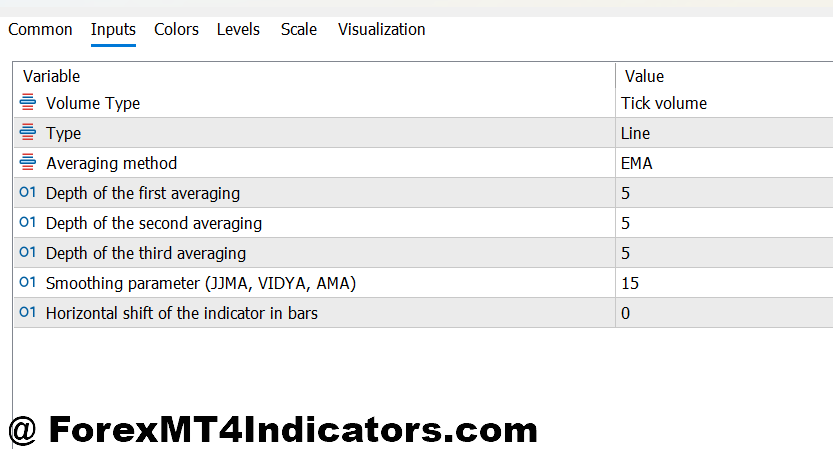
The standard MT5 tick volume indicator doesn’t require complex setup, but how you read it depends on your timeframe. Scalpers on 1-minute charts during New York session might see average volumes around 400-600 ticks per bar on EUR/USD. Drop below 200 ticks, and you’re trading in dead water where spreads eat your profits.
Day traders typically watch the 5-minute or 15-minute charts. Here’s a practical baseline: calculate the 20-period average of your volume bars. When current volume exceeds 150% of that average during a breakout, the move has legs. Below 75% of average? Treat it with skepticism.
For swing traders on 4-hour or daily charts, volume patterns matter more than absolute numbers. Look for volume expansion on trend continuation bars and volume contraction during pullbacks. A healthy uptrend in NZD/USD, for instance, should show heavier volume on up-bars than down-bars over a week’s worth of data.
Some traders overlay a moving average directly on the volume histogram—a 10-period MA works well. When current bars poke above this MA during your trade signal, it adds confirmation. This works particularly well on ranging pairs like EUR/CHF, where genuine breakouts stand out against the noise.
Advantages and Honest Limitations
The biggest advantage is availability—tick volume comes standard with MT5, no third-party data required. It updates in real-time across all currency pairs and timeframes. For traders transitioning from stocks, it provides the familiar volume histogram they’re accustomed to analyzing.
It excels at filtering false breakouts. That alone has saved countless accounts from getting chopped up in tight ranges. When USD/JPY consolidated between 149.50 and 150.00 for three sessions in January 2025, tick volume helped identify which breakout attempts had genuine participation versus which were just liquidity hunts.
But let’s address the limitation head-on: tick volume isn’t true volume. A single 100-lot institutional order could generate the same tick count as ten 1-lot retail orders if they create similar price volatility. During major news events like Non-Farm Payrolls, tick volume spikes wildly, but that doesn’t always represent sustainable directional conviction—sometimes it’s just chaos.
The indicator also lags during extremely quiet periods. Between Christmas and New Year’s, when major banks shut down, tick volume drops so severely that normal analysis breaks down. Same issue on currency pairs outside the majors. Try using tick volume on exotic pairs like USD/TRY, and the erratic behavior makes interpretation difficult.
Tick Volume vs Real Volume Indicators
Traders coming from futures markets often ask about the difference between tick volume and actual futures volume data. CME futures volume for EUR/USD futures (6E contract) shows exact contract quantities—if 50,000 contracts traded, you know real money changed hands. Tick volume on spot forex only shows activity intensity.
That said, accessing real futures volume requires additional data subscriptions and futures chart platforms. For pure spot forex traders on MT5, that’s not practical. Third-party volume indicators like Better Volume or VSA-based tools attempt to analyze tick volume more granularly, but they’re still working from the same underlying data—price changes, not actual transactions.
The On-Balance Volume (OBV) indicator takes a different approach, accumulating volume based on price direction rather than absolute volume. During a strong EUR/GBP uptrend, OBV rises as it adds volume from up-bars and subtracts volume from down-bars. This creates a trend line separate from price that can show divergences. The drawback? OBV accumulates over time, making it less useful for short-term traders focused on immediate market participation.
Ultimately, tick volume wins on simplicity and availability. It won’t tell you everything, but it answers the essential question: is anybody actually trading this move?
Practical Integration into Trading Systems
Smart integration means combining tick volume with existing technical analysis, not treating it as a standalone system. When a 50-period EMA crossover on USD/CHF coincides with volume expansion, the signal carries more weight. When the same crossover happens on declining volume, consider it a yellow flag.
Risk management improves with volume context too. Position sizing can adjust based on volume readings—reduce size by 25-30% when entering breakouts with marginal volume, increase slightly when conviction is clear. This doesn’t mean overleveraging; it means calibrating risk to probability.
One technique that works well: plot previous session’s high-volume bars with vertical lines. These often mark significant support and resistance levels because they represent areas where the market spent time and established value. When EUR/USD returns to a level that previously showed 400% average volume, expect a reaction.
That said, never rely on tick volume alone for trade decisions. Trading forex carries substantial risk, and no indicator—including tick volume—guarantees profitable outcomes. Use it as one data point among several: price action, support/resistance, trend structure, and broader market context.
How to Trade with Tick Volume Indicator MT5
Buy Entry
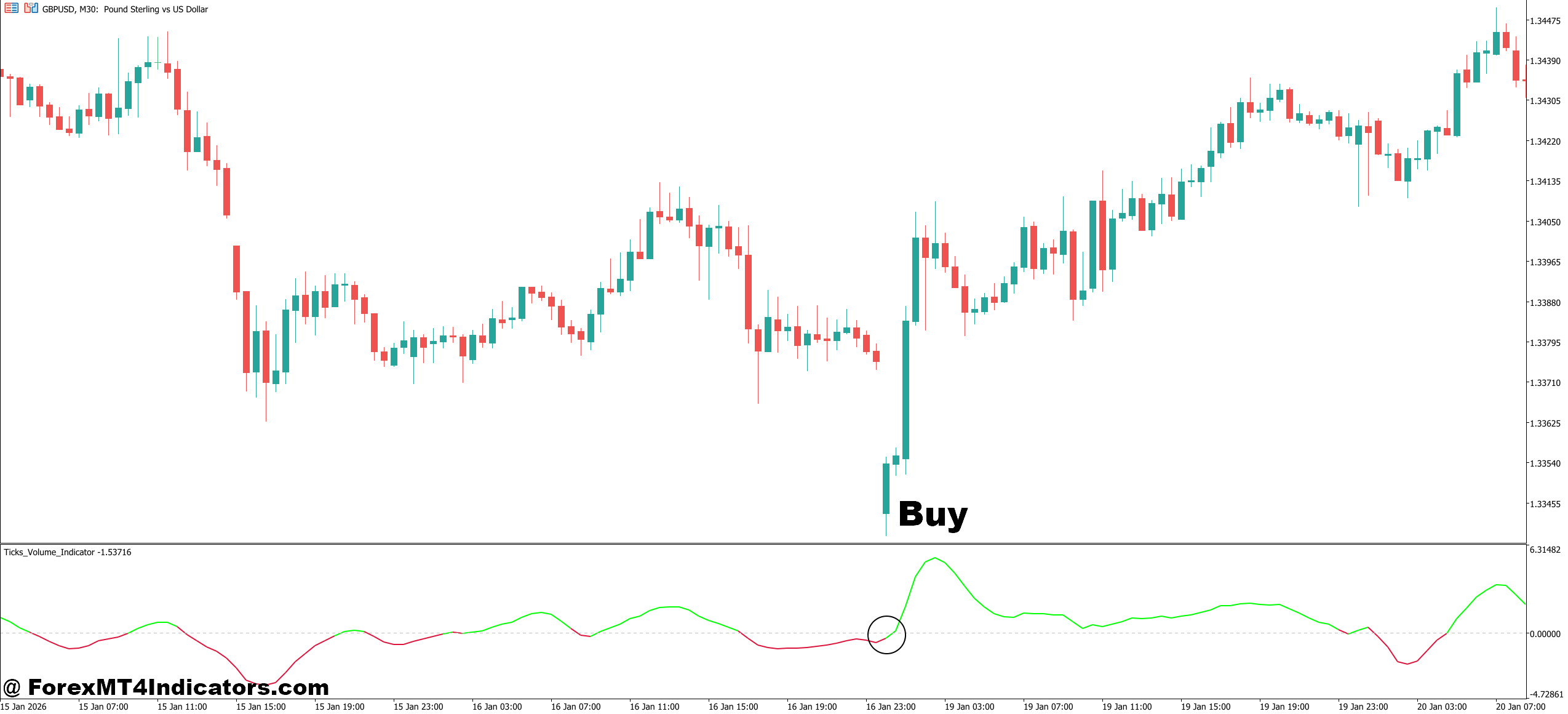
- Volume surge on breakout above resistance – When EUR/USD breaks a key resistance level with tick volume exceeding 200% of the 20-bar average, enter long as this confirms institutional participation behind the move.
- Higher highs with expanding volume – If GBP/USD makes a new swing high on the 4-hour chart and tick volume increases by at least 30% compared to the previous swing high, enter long as buyers are gaining strength.
- Volume contraction during pullbacks – When price retraces 38-50% in an uptrend but tick volume drops below 60% of average, enter long at support as weak selling pressure suggests trend continuation.
- Morning breakout confirmation – On 1-hour charts during London open (3-4 AM EST), enter long when price breaks overnight range with volume spiking above 150% average—avoid if volume stays flat.
- Divergence reversal signal – After a downtrend, when price makes a lower low but tick volume makes a higher low, enter long on the first bullish engulfing candle as selling exhaustion is confirmed.
- Volume expansion at support zones – When USD/JPY hits a major support level and tick volume jumps 180%+ with a bullish rejection candle, enter long with stops 15-20 pips below the wick.
- Avoid low-volume breakouts – Never enter long on breakouts during Asian session (7 PM – 2 AM EST) if tick volume is below 70% of daily average—these are typically false moves that reverse quickly.
- Risk 1-2% per trade maximum – Even with strong volume confirmation, limit position size to risk no more than 2% of account balance as no setup guarantees success in forex trading.
Sell Entry
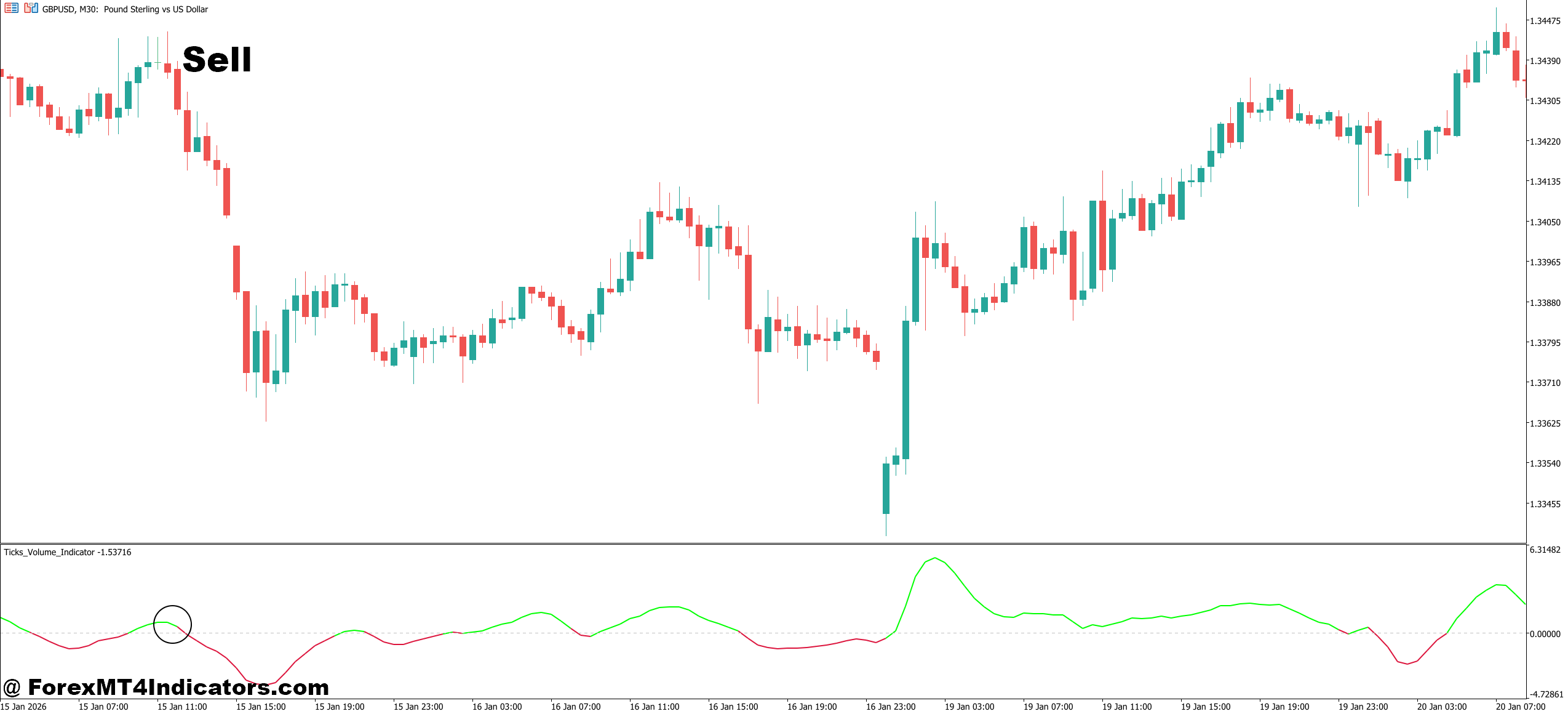
- Volume spike on resistance rejection – When GBP/USD hits resistance on the daily chart with tick volume exceeding 220% of average and forms a bearish reversal candle, enter short as heavy selling is confirmed.
- Lower lows with increasing volume – If EUR/USD creates a new swing low on the 4-hour chart with tick volume 40%+ higher than the previous low, enter short as bears are accelerating downward pressure.
- Weak rallies with declining volume – During a downtrend, when price bounces 30-40% but tick volume stays below 50% of the average down-move, enter short at resistance as buyers lack conviction.
- Failed breakout with volume drop – When USD/CAD breaks above resistance but tick volume is only 80% of average and price reverses within 2-3 candles, enter short immediately as it’s a liquidity trap.
- Bearish divergence confirmation – After an uptrend, when price makes a higher high but tick volume makes a lower high, enter short on the first strong bearish candle below the 50-period EMA.
- News event fade with volume context – If EUR/USD spikes 60+ pips on news but tick volume drops 50% within 15 minutes of the initial move, enter short as the rally lacks follow-through participation.
- Avoid selling in strong volume uptrends – Don’t take short signals when the last 3-5 bars show consistently rising volume on up-candles—wait for volume to contract before entering against the trend.
- Cut losses at 1.5-2x average daily range – If your short position on GBP/JPY moves against you by more than 150 pips (roughly 1.5x ADR), exit regardless of volume readings as the market structure has changed.
Key Takeaways for Practical Application
Tick volume gives forex traders on MT5 a legitimate read on market participation without access to centralized exchange data. It confirms breakouts, spots divergences, and helps distinguish institutional moves from retail noise. The correlation with actual volume is strong enough on major pairs to make it actionable, though traders should understand they’re working with a proxy, not perfection. Setup requires minimal effort—the indicator ships with MT5—but interpretation demands experience watching how volume behaves across different market conditions and sessions. Used alongside solid price action analysis and proper risk management, it adds a dimension that purely price-based systems miss. The market doesn’t just tell you where price is going; it tells you how many participants agree with that direction.
Level up your trading
Learn to read the chart — not just the indicator
eBook · Instant PDF
Video Course · 12 modules
Recommended MT4/MT5 Brokers
- ✓ *FREE *$50 to start (withdrawable)
- ✓ Deposit bonus up to $5,000
- ✓ Negative balance protection
Trading forex and CFDs carries a significant risk of loss and is not suitable for everyone. Broker links are affiliate links — we may earn a commission at no cost to you.
Free MT4 Indicator Download

Enter Your Email Address below, download link will be sent to you.