

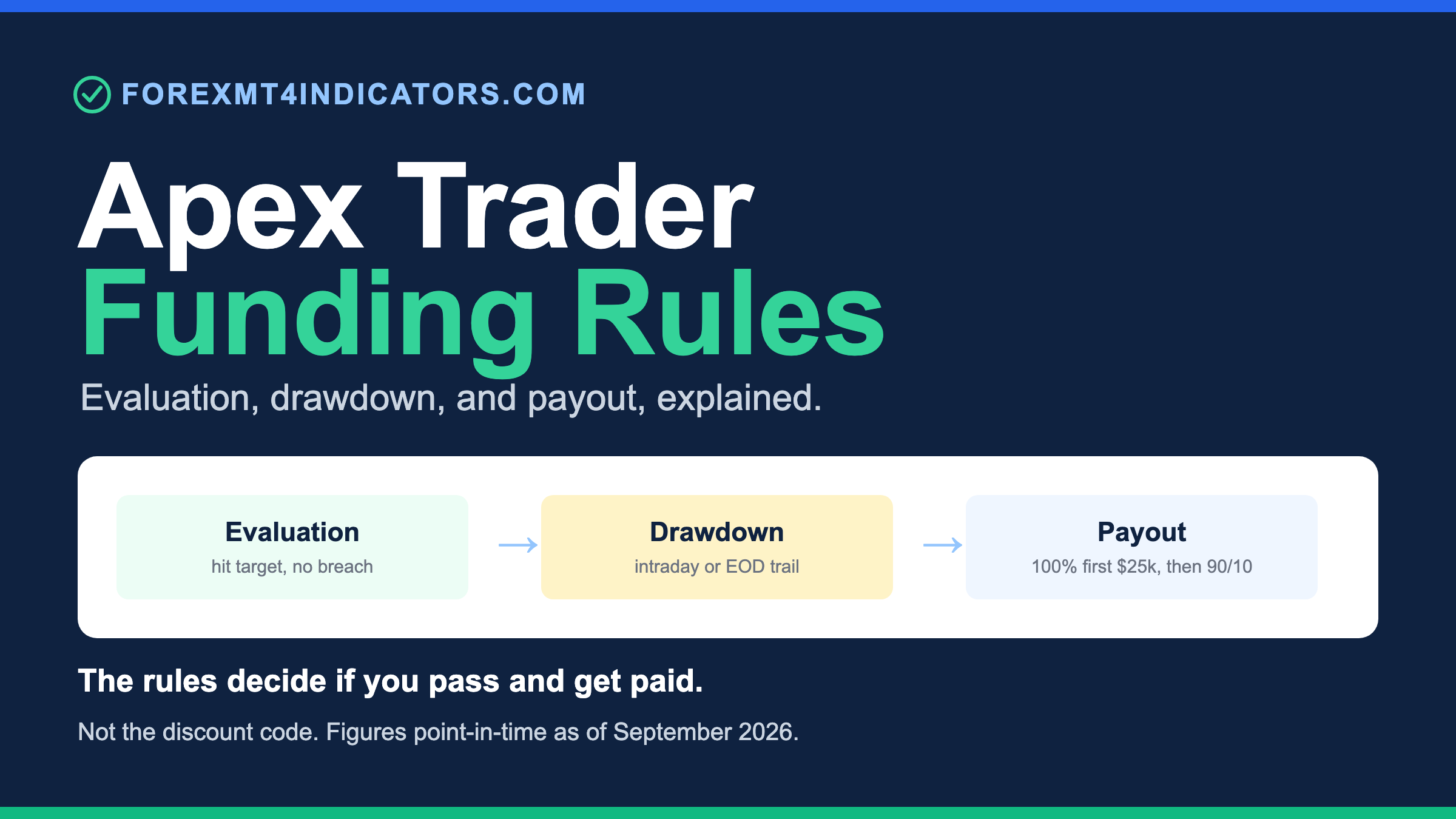
Apex Trader Funding uses a one-step evaluation: hit a fixed profit target without breaching a trailing drawdown, then pay a one-time activation fee to go live. As of September 2026, its rebuilt program offers 25K, 50K, 100K, and 150K accounts with a 50% consistency rule and 100% payouts on your first $25,000, then a 90/10 split, per Apex’s Help Center.
One warning before any numbers: prop-firm rules change often through promos and policy updates, and Apex in particular runs near-constant discounts and rewrote its whole program in 2026. Every figure below is point-in-time as of September 2026, read from Apex’s own Help Center and pricing configurator. Confirm current terms on Apex’s official pages before you pay. This article explains how the rules work and what to watch for, not whether you will pass or profit.
What Apex Trader Funding actually is
Apex is a US futures prop firm, not a forex or MT4 broker. You trade exchange-listed CME futures contracts on a simulated evaluation, and if you pass and activate, on a simulated funded account where the profits are real. If you come from spot FX on MetaTrader, the trader profile is similar (retail speculator chasing funded capital), but the instruments, platform, and drawdown culture are different. If prop trading is new to you, start with what a prop firm is before comparing specific firms.
On 2026-03-01 Apex fully rebuilt its program, commonly called “Apex 4.0,” per change summaries from Phidias and Apex’s homepage (as of August 2026). The evaluation is now a one-time fee instead of a monthly subscription, and the lineup dropped to 25K, 50K, 100K, and 150K sizes. The old “legacy” model still runs for pre-March-2026 accounts and was re-listed as a limited-time promo. The two programs use different numbers, so do not mix them.
The core Apex evaluation rules are simple to state: reach the profit target and do not breach the trailing drawdown, per Apex’s Help Center (as of September 2026). There is no minimum number of trading days to pass, so you can clear it in a single day. Consistency and contract scaling are not applied during the evaluation itself. New evals come in two drawdown flavors, Intraday Trail and EOD Trail, which is where the real decision sits.
Apex account sizes, targets, and drawdown
Each Apex account size pairs a fixed profit target with a fixed maximum trailing drawdown, per Apex’s Help Center (as of September 2026). The numbers are the same for the Intraday and EOD evaluation variants. Note that the new-program contract caps are smaller than legacy, for example the new 50K allows 6 minis versus the legacy 50K’s 10, per Apex’s pricing configurator (as of September 2026).
The 30-day access window is the other constraint people forget. A new eval gives 30 consecutive calendar days, weekends and holidays included, and expires automatically at 6:00 PM ET on Day 30 with no extensions, per Apex’s Help Center (as of September 2026). It is a one-time fee that does not renew, and new evals have no reset option. If you breach the drawdown or run out of days, you buy a fresh evaluation, per Apex’s Help Center (as of September 2026).
The Apex 50K account rules are the most-searched configuration, so use them as your reference: $3,000 target, $2,000 max drawdown, 6 minis, and a $1,000 EOD Daily Loss Limit if you pick the EOD variant. The Daily Loss Limit is an EOD-only feature in the evaluation; Intraday-Trail evals have no daily loss cap, per Apex’s Help Center (as of September 2026).
The trailing threshold: the make-or-break rule
The trailing threshold is the rule that ends most Apex evaluations, so it deserves the most care. A trailing drawdown is a loss floor set a fixed distance below your account’s highest point; it ratchets up as you make new highs and never moves back down. The two Apex variants differ in when that floor updates, and that timing changes how hard the account is to hold.
The Intraday Trail updates in real time off your peak balance, and that peak includes unrealized gains from open positions, per Apex’s Help Center (as of September 2026). Every new equity high tightens the floor, even a floating profit you never bank, and if balance touches or falls below the threshold at any moment, positions auto-liquidate and the eval fails immediately. Giving back open profit can breach you. That is why the intraday trail is the harsher of the two.
The EOD Trail is more forgiving on intraday noise. Apex recalculates the EOD threshold once per trading day at the close, 4:59:59 PM ET, from that day’s closing balance, and then fixes it for the next session, per Apex’s Help Center (as of September 2026). Intraday dips are allowed as long as balance never touches the threshold set that morning. In exchange, the EOD variant adds a Daily Loss Limit, so the forgiveness is not free.
The trail does not always climb forever, and where it locks depends on the account and platform. In a Performance Account (the funded stage), the Intraday threshold stops rising once it reaches Starting Balance plus $100, then stays fixed; on a 50K PA it locks at $50,100, reached once the highest balance hits $52,100, per Apex’s Help Center (as of September 2026). In Rithmic and Wealthcharts evaluations, the threshold stops trailing when it reaches the profit-target balance, for example $53,000 on a 50K, reached at a $55,000 peak. On Tradovate evaluations, the intraday drawdown trails indefinitely and never stops, per Apex’s Help Center (as of September 2026).
Minimum days and the 50% consistency rule
There is no minimum number of trading days to pass the Apex evaluation, but payouts are different. To request a payout on a funded PA you need 5 qualifying trading days, which do not have to be consecutive, per Apex’s Help Center (as of September 2026). A day only qualifies if it meets the per-size Minimum Daily Profit, and that figure depends on the drawdown variant. On the Intraday variant it is $100 on a 25K, $200 on a 50K, $250 on a 100K, and $300 on a 150K; the EOD variant runs higher, for example $250 on a 50K, per Apex payout guides (as of September 2026).
The consistency rule is a funded-account gate, not an evaluation gate. Apex’s rule states that no single profitable day may account for 50% or more of your total profit since your last approved payout, or since inception if you have not been paid yet, per Apex’s Help Center (as of September 2026). The quick check is your highest profit day divided by 0.5, which is the minimum total profit you must reach before that day stops blocking the payout. Apex raised this from the legacy 30% rule around March 2026, per Apex’s Help Center and TradeDupe (as of 2026).
A violation does not fail your account; it blocks the payout request until continued trading rebalances the ratio back under 50%. That is the point of the rule: firms want profit spread across several days, not one lucky spike. You can model your own ratio with the prop firm consistency calculator before you request. The consistency requirement resets after each approved payout, per Apex’s Help Center (as of September 2026).
Apex payout rules and the activation fee
Apex’s new program pays you 100% of your first $25,000 in payouts per account, then a 90/10 split in your favor beyond that, per Apex’s Help Center and 2026 payout guides (as of September 2026). The minimum payout is $500 per request regardless of size, and payouts can be up to weekly once you clear the 5-day requirement. Each withdrawal is also capped by a per-request ladder that rises with each payout. Each PA allows a maximum of 6 payouts, after which the PA closes and you must pass a new evaluation, per Apex’s Help Center (as of September 2026).
Two balance thresholds control when you can withdraw at all. The Safety Net equals your drawdown limit plus $100 and must be maintained for the life of the PA, so only profit above it is withdrawable; on the Intraday 50K PA that is $52,100, per Apex’s Help Center (as of September 2026). To actually request a payout you need Safety Net plus the $500 minimum, which is $52,600 on the 50K, or the payout option is hidden, per Apex’s Help Center (as of September 2026).
Now the fees, which are two separate charges people conflate. The evaluation is a one-time fee, not a subscription: standard Intraday-Trail list prices are $167 for the 25K, $249 for the 50K, $399 for the 100K, and $599 for the 150K, often discounted around 90% by a live promo code, per Apex’s pricing configurator (as of September 2026, medium confidence). Passing does not make the account live on its own.
A separate one-time activation fee of $59 per account, flat across all four sizes on the Intraday Standard variant, is due within 7 calendar days of passing, per Apex’s configurator and PA Activation page (as of September 2026, medium confidence). Miss that window and you must pass a new eval; Apex also sells a “No Activation Fee” variant at a higher up-front price. A trader may hold up to 20 accounts, per Apex’s Help Center (as of September 2026).
Futures prop vs FTMO-style forex prop
If you trade forex on MT4 or MT5, the biggest adjustment is not the fee, it is the drawdown structure. FTMO-style forex prop funds spot FX and CFDs, sizes accounts in lots and pips, and usually runs on MetaTrader with rules built around a max daily loss plus an overall max loss. Apex funds CME futures, sizes accounts in contracts with dollar-based drawdown, and runs on futures platforms like Rithmic and Tradovate. Compare the mechanics directly against our FTMO rules breakdown so the differences are concrete.
The trap is the trailing max drawdown. A forex trader used to a fixed daily-loss cap can be blindsided by an intraday trailing floor that moves with unrealized profit, because there is no equivalent to giving back an open gain and losing cushion you never banked. Contract sizing is the other shift: instead of lots and pips you plan in ticks and points, and margin works differently.
Model a futures position before you size one with the futures margin calculator. The general challenge-passing discipline still transfers, and our guide to passing a prop firm challenge covers the process side.
Common mistakes with Apex rules
The costliest mistake is comparing prop firms on headline price instead of on rules. What decides whether you pass and get paid is the drawdown type, the consistency percentage, and the payout minimums, not the discounted eval fee. A second common error is treating open profit as safe under the Intraday Trail; it raises your floor the instant it appears. A third is forgetting the 30-day clock, since the new eval expires whether or not you have traded.
On the funded side, traders lose payouts to the Safety Net and the consistency rule more than to drawdown. Profit sitting below the Safety Net is not withdrawable while the account is open, and one oversized day can freeze a payout until you trade the ratio back under 50%, per Apex’s Help Center (as of September 2026). Finally, do not mix legacy and new-program numbers: the legacy 50K drawdown is $2,500 and the new one is $2,000, and the 250K and 300K sizes exist only in legacy, per Apex’s Help Center (as of September 2026). For how these payout mechanics stack against other futures firms, see our prop firm payout rules compared breakdown.
Trading futures or forex carries a high risk of loss and is not suitable for everyone; prop-firm evaluations charge non-refundable fees, most participants do not reach a funded payout, and “funded” accounts here are simulated. Nothing above is financial advice or a promise of passing or profit. All figures are point-in-time as of September 2026, several fee items are medium confidence, and Apex changes rules and prices frequently, so verify every number on Apex’s official pages before you pay.
Frequently asked questions
Can I pass the Apex evaluation in one day?
Yes, in principle. Apex states there is no minimum number of trading days to pass, so you may clear it as soon as you hit the profit target, per Apex’s Help Center (as of September 2026). The 5-day minimum applies to payouts on the funded account, not to the evaluation.
What is the difference between Apex Intraday Trail and EOD Trail accounts?
The Intraday Trail updates the drawdown floor in real time and includes unrealized open-trade profit, so it is harsher on giving back gains, per Apex’s Help Center (as of September 2026). The EOD Trail updates the floor only once per day at the 4:59:59 PM ET close and then fixes it, but it adds a Daily Loss Limit. Intraday is unforgiving on intraday swings; EOD trades that forgiveness for a daily cap.
Does the Apex trailing drawdown ever stop trailing?
Usually, but it depends on the account and platform. On a funded Intraday PA the threshold locks at Starting Balance plus $100, and on Rithmic and Wealthcharts evals it stops at the profit-target balance, per Apex’s Help Center (as of September 2026). On Tradovate evaluations, the intraday drawdown trails indefinitely and never stops.
How soon can I get my first Apex payout?
After 5 qualifying trading days, each meeting the Minimum Daily Profit for your size, and only once you also clear the Safety Net plus $500 minimum balance, per Apex’s Help Center (as of September 2026). On a 50K Intraday account that means at least $200 profit on 5 separate days and a balance above $52,600. Payouts can then run up to weekly.
Is the Apex activation fee a monthly charge?
No. The activation fee, listed at $59 per account on the Intraday Standard variant, is a one-time charge to convert a passed eval into a live PA, due within 7 calendar days of passing, per Apex’s configurator and PA Activation page (as of September 2026, medium confidence). The evaluation fee is also one-time in the new program and does not renew. Apex offers a separate “No Activation Fee” variant at a higher up-front price.
Why did my Apex payout get blocked even though I was profitable?
Almost always the 50% consistency rule or the Safety Net. If one day made up 50% or more of your profit since the last payout, the request is blocked until you trade the ratio back under 50%, per Apex’s Help Center (as of September 2026). If your balance is below the Safety Net plus $500, the payout option is hidden entirely.
Are Apex’s 250K and 300K accounts still available?
Only under the legacy program, not the new Apex 4.0 lineup. The current program offers 25K, 50K, 100K, and 150K only, while the 75K, 250K, and 300K sizes remain in the pre-March-2026 legacy model, per Apex’s Help Center (as of September 2026). Legacy accounts keep monthly billing, resets, and the 30% consistency rule, so their numbers do not match the new program.
Ready to put this into practice?
Open an account with a regulated broker and apply what you have learned. These are the three brokers we recommend:
Trading forex and CFDs carries a significant risk of loss and is not suitable for everyone. Broker links are affiliate links — we may earn a commission at no cost to you.