Last updated:
Last updated: November 18, 2026 · By: Tim Morris
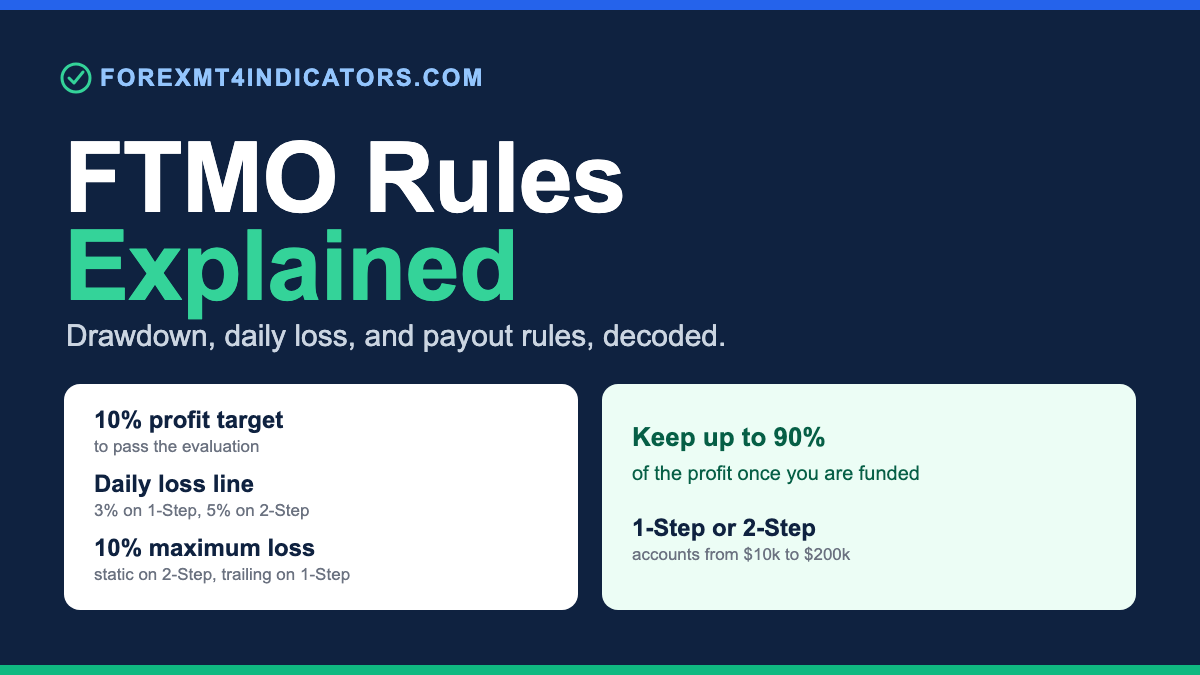
FTMO, a proprietary trading (prop) firm, pays traders a share of profit on simulated accounts. Its core rules, checked 18 November 2026: a 10% profit target (then 5% in the 2-Step Verification), a daily loss limit fixed at 3% (1-Step) or 5% (2-Step) of initial capital, and a 10% maximum loss, trailing on the 1-Step and static on the 2-Step.
The 2-Step needs at least 4 trading days per phase, the 1-Step adds a 50% Consistency rule, and the split is 90% on the 1-Step versus 80% rising to 90% on the 2-Step. The no-evaluation Instant Account uses a 3% daily limit, a 10% intraday trailing maximum loss, its own 30% Consistency rule and a 90% split.
FTMO rules compared (checked 18 November 2026)
| Rule | 1-Step Challenge | 2-Step Challenge | Instant Account |
|---|---|---|---|
| Profit target | 10% | 10%, then 5% (Verification) | None |
| Max daily loss | 3% ($3,000 on $100,000) | 5% ($5,000 on $100,000) | 3% ($3,000 on $100,000) |
| Maximum loss | 10%, trails at end of day | 10%, static | 10%, trails intraday |
| Min trading days | None listed | 4 per phase | None listed |
| Consistency | 50% (formerly Best Day) | None | 30% |
| Time limit | Unlimited | Unlimited | Unlimited |
| Profit split | 90% | 80%, rising to 90% | 90% |
| Fee refund | No | Yes, with first reward | No |
| Account type and leverage | Standard, up to 1:100 | Standard up to 1:100 or Swing up to 1:30 | Standard, up to 1:100 |
| Sizes | $10,000 to $200,000 | $10,000 to $200,000 | $5,000 to $100,000 |
We checked every rule here against FTMO’s own pages on 18 November 2026: the Trading Objectives, How it works, the Forbidden Trading Practices and the FAQ. FTMO replaced the 1-Step Best Day rule with a Consistency rule and launched the Instant Account in October 2026, so confirm the current version on ftmo.com before you buy.
How do the 1-Step and 2-Step FTMO Challenges differ?
FTMO’s 1-Step Challenge is a single phase, while the 2-Step splits the test into two; each funded account keeps its own path’s loss limits. FTMO also runs a separate futures programme with its own rules, which this guide does not cover. For a verdict on who FTMO suits, see our FTMO review.
The 1-Step FTMO Challenge asks for a 10% profit target under a 3% daily loss limit and a 10% trailing maximum loss, plus a Consistency rule (formerly the Best Day rule), with no second stage before funding.
The 2-Step FTMO Challenge has two phases. FTMO calls the product and its first phase the FTMO Challenge (10% target), and the second phase the Verification (5% target). Both phases run a 5% daily loss limit and a 10% static maximum loss, and each requires at least 4 trading days.
Clear either path and you move to a funded account, which FTMO calls an FTMO Account: there is no profit target, but the daily-loss and maximum-loss rules still apply. Our primer on what a prop firm is explains the evaluation-then-funded model.
What is FTMO’s profit target?
FTMO’s profit target is 10% of initial capital on the 1-Step, and on the 2-Step it is 10% in the Challenge phase, then 5% in the Verification. It is the amount your account must grow before a phase counts as passed.
FTMO counts the target on your balance with all positions closed, so a floating (unrealised) profit on an open trade that touches the number does not pass you. Hitting it is not the only condition either: the 2-Step also needs its 4 trading days per phase, and the 1-Step needs the Consistency rule met. To track how much of the target, the qualifying days and both loss allowances you have used, and whether a planned trade still fits, our prop firm challenge planner does the arithmetic.
How is FTMO’s daily loss (daily drawdown) calculated?
FTMO’s Maximum Daily Loss, which most traders call the daily drawdown, caps how much your account can fall inside one trading day. Break it once and the account fails, even if you are in profit for the week.
Two terms keep it straight. The daily loss limit is a fixed dollar amount: 3% of initial capital on the 1-Step (and the Instant Account) and 5% on both phases of the 2-Step, and each funded account keeps its path’s figure. The daily floor is your 00:00 CE(S)T balance minus that limit.
FTMO sets the floor in three steps:
- Daily loss limit = 3% or 5% of initial capital, so its dollar size never changes as the account grows or shrinks.
- FTMO records your balance at 00:00 CE(S)T (midnight Central European Time: CET in winter, CEST in summer). That is 23:00 GMT in winter or 22:00 GMT in summer, which is 04:30 or 03:30 IST and 06:00 or 05:00 WIB.
- Today’s floor = that balance minus the daily loss limit. If your equity (balance plus floating profit or loss, after swaps, the overnight financing charges, and commissions) drops below it at any moment, the account fails.
On a $100,000 2-Step account the daily loss limit is always $5,000. Day 1’s floor is $95,000. If the balance is $102,000 at the next 00:00 CE(S)T, Day 2’s floor is $97,000 ($102,000 minus $5,000), not the $96,900 you get if you wrongly take 5% of that day’s balance. On a $100,000 1-Step account the limit is always $3,000, so a $102,000 day-start balance gives a $99,000 floor.
Two consequences follow:
- A growing account gives you no extra daily room.
- Because the floor starts from the balance, not equity, a loss held through midnight eats into the next day. With a $102,000 balance and a $1,500 floating loss at 00:00 CE(S)T, equity starts at $100,500 against a $97,000 floor, leaving $3,500 of room, not $5,000.
Revenge trading (trading bigger to win back a loss quickly) after an early loss is the classic way to break this line; our guide to passing a prop firm challenge treats staying inside it as the first job.
Is FTMO’s maximum drawdown static or trailing?
FTMO calls your overall drawdown limit the maximum loss: 10% of initial capital on every account, static on the 2-Step and trailing on the 1-Step. The two models set the floor differently:
- 2-Step floor = 90% of initial capital. It never moves, so on a $100,000 account the floor sits at $90,000 through both phases and the funded account, however high your balance climbs first.
- 1-Step floor = the highest 00:00 CE(S)T balance so far (or initial capital, if higher) minus 10% of initial capital. It only moves up, and intraday highs do not lift it.
In FTMO’s own 1-Step example, a $104,000 end-of-day balance moves the floor to $94,000, and a later $103,000 day leaves it at $94,000.
One reset matters on the funded 1-Step account: when you withdraw a reward (FTMO’s word for a profit payout) and FTMO provides the new FTMO Account, the maximum loss resets to 90% of initial capital ($90,000 on $100,000). Our prop firm trailing drawdown calculator shows where the moving floor sits when you enter the $10,000 drawdown amount and your highest end-of-day balance.
The practical effect: on the trailing model, closed profit carried past midnight lifts the floor for good. From a $108,000 end-of-day high the 1-Step floor is $98,000, so equity more than $10,000 under that high (below $98,000) ends the account, a slide that can only happen across several days because the $3,000 daily limit stops any single day first; the 2-Step static floor would still be $8,000 further down at $90,000.
Key rule: size each trade against the nearer of today’s daily floor and the maximum-loss floor, not against initial capital. Once you have picked a risk amount that fits inside the nearer floor, convert that risk and your stop distance into a lot size.
How many trading days does FTMO require, and is there a time limit?
FTMO requires at least 4 trading days in each phase of the 2-Step Challenge, lists no minimum for the 1-Step, and sets no time limit on either. A trading day counts only when you open at least one position between 00:00 and 23:59 CE(S)T, so a day on which you only close or hold older trades does not count.
On the 1-Step, the Consistency rule still rules out a one-day pass. Because your best day can be at most half of your total profit, the profit must come from at least two days.
FTMO lists the trading period as unlimited, so you are not racing a 30-day clock, but the loss limits apply every day the account is open.
What is FTMO’s Consistency rule (formerly Best Day)?
FTMO’s 50% Consistency rule applies to the 1-Step only (the 2-Step has none; the Instant Account has its own 30% version): your best day can be no more than 50% of your total profit, where total profit is the net of every trading day, losing days included. It covers 1-Step accounts from orders placed on or after 12 October 2026, or any account merged on or after that date, and FTMO checks it before you pass and before each reward on the funded account.
Accounts opened directly from orders before 12 October 2026, and not merged since, keep the legacy Best Day rule: the best day can be no more than 50% of Positive Days’ Profit, the sum of your winning days only. FTMO’s 1-Step product page still labels the row Best Day Rule, so go by your order or merge date. Both versions measure profit from closed trades.
The new Consistency rule is stricter than the legacy Best Day rule, because a losing day shrinks the total your best day is measured against:
- Example: winning days of $6,000, $4,000 and $2,000, plus one losing day of $1,000.
- Legacy Best Day rule: $6,000 / $12,000 (winning days only) = 50%, within the limit, so you can pass.
- New Consistency rule: $6,000 / $11,000 (net of all days) = 54.5%, over the limit, so you keep trading until it falls to 50% or less.
Exceeding the 50% Consistency limit is not a breach: FTMO says you keep trading until the best day is 50% or less, and only then can you pass or take a reward. Its Forbidden Trading Practices page also bans spreading one day’s profit across several days with hedges, opposing positions or partial closes to get around the rule. Our prop firm consistency calculator checks the share: choose signed net profit (losing days included) for the new rule, or positive-days profit (winning days only) for the legacy rule.
Can you trade news or hold over the weekend on FTMO?
On FTMO, the weekend-holding and news restrictions bind Standard funded accounts and the Instant Account; Swing accounts and the Challenge and Verification phases are exempt. FTMO offers two account types on the 2-Step, Standard and Swing, and Swing is not offered on the 1-Step or the Instant Account (FTMO’s Swing FAQ).
Weekend holding
On a Standard funded account or the Instant Account you must close positions before any market break longer than 2 hours (FTMO’s holding FAQ). For forex, which trades through weekday nights, the weekend is the main break this covers, so ordinary weekday overnight forex holds are not affected. Stock CFDs close for more than 2 hours every night, and FTMO’s Swing FAQ lists “overnight for equities” as a covered break, so on a Standard funded or Instant account close them before each daily close.
Trading hours vary by instrument and around holidays, so check each symbol’s hours in the platform before you hold anything else overnight.
News trading
On a Standard funded account or the Instant Account, FTMO’s rule bars any order from executing, including a stop loss, take profit or pending order being filled, from 2 minutes before to 2 minutes after a restricted news release; violating it may result in termination of the FTMO Account or FTMO Instant Account (FTMO’s news FAQ). The restriction covers only instruments linked to that release. For US releases that means USD pairs, XAU/USD, the US indices and the dollar index, so a gold trader on a Standard account must stand aside around Non-Farm Payrolls (NFP) and the Consumer Price Index (CPI).
Positions opened more than 2 minutes before the release can stay open, but a stop or target that fills inside the window still breaks the rule. Orders an EA places count too; our prop firm EA rules guide compares the news windows at seven firms.
The Swing account lifts both restrictions, provided you avoid the Forbidden Trading Practices, which still ban opening a fresh trade into scheduled major news (see the gap-trading rule below). The trade-off is leverage: up to 1:30 on Swing, versus up to 1:100 on Standard (1:100 means each $1 of margin can control up to $100 of position). If holding through weekends is central to your plan, compare prop firms that suit swing traders.
Gap trading: banned on every account
FTMO’s FAQs let Swing and evaluation accounts hold over the weekend and trade news “provided that the Forbidden Trading Practices are avoided”, and that page bans gap trading: opening trades when major news is scheduled, or two hours or less before a market closes for at least two hours. Holding an existing position through the weekend is fine on those accounts; opening a fresh one in the last two hours before the close, or into scheduled major news, is not, on any account.
How do FTMO payouts and the profit split work?
FTMO pays a reward, a share of simulated profit paid in real money: 90% on the 1-Step and the Instant Account, and 80% rising to 90% on the 2-Step. You can request the first one from the 14th day after your first trade on the funded account.
Account sizes
FTMO offers both Challenges in five sizes: $10,000, $25,000, $50,000, $100,000 and $200,000; the Instant Account runs from $5,000 to $100,000. The percentages are identical across sizes; only the dollar amounts scale (a 5% daily loss limit is $2,500 on $50,000 and $10,000 on $200,000).
Profit split
A 1-Step funded account pays 90% from the first reward. A 2-Step funded account starts at 80% and, per FTMO’s withdrawal FAQ, rises to 90% when you meet the Scaling Plan conditions:
- at least 4 months of trading as an FTMO Trader under the same order;
- at least 10% net profit over those 4 months;
- at least 2 processed rewards in the same period;
- a positive account balance at the time of the scale-up.
The split also rises to 90% if you reach FTMO’s separate Premium Programme, whose entry tier needs at least 4 reward withdrawals of 4% or more and no failed FTMO Account in the past four months. FTMO’s 2-Step page markets the split as “up to 90%”, which is the ceiling, not the starting split.
Fee refund
FTMO refunds 100% of the 2-Step Challenge fee when you request your first reward, to the payment method you bought with; the 1-Step and Instant fees are not refundable (FTMO’s refund FAQ). The refund is tied to that first reward, not to passing.
Payout timing
- Close all positions and pending orders, then request the reward in Account MetriX on the 14th day or later after your first trade on that account. Instant Account traders also complete FTMO Identity before the first reward.
- FTMO reviews the account and replies within 1–2 business days.
- Once FTMO approves the reward, you submit your withdrawal details in the FTMO Traders section.
- The reward is typically sent within 1–2 business days after the invoice is approved, by bank wire, Visa Direct or Mastercard Send (up to $20,000), Skrill (up to $3,000) or cryptocurrency. The minimum closed profit is $20 for bank wire and card transfers and $50 for crypto.
Our prop firm payout calculator applies your split, and any withdrawal charges, to an eligible reward to show the net amount. For how other firms structure splits and withdrawals, see prop firm payout rules compared.
What are the FTMO Instant Account rules?
Everything above applies to the two Challenges. The Instant Account, launched on 12 October 2026, skips the evaluation and tightens the loss rules. You pay a one-time fee, the account is active once the purchase completes, and there is no profit target.
- Sizes and split: $5,000 to $100,000, a 90% reward split, leverage up to 1:100 and a fee that is not refundable.
- Daily loss: the Instant Account’s daily loss limit is 3% of initial capital, set like the Challenges ($1,500 on a $50,000 account).
- Maximum loss: 10%, trailing intraday. It moves up the moment a trade closes at a new balance high, rather than once a day, and it never moves down.
- Consistency: Instant’s own 30% Consistency rule (best day no more than 30% of total profit) must be met before each reward; going over is not a breach, and the total restarts from zero after each reward. The Scaling Plan does not apply.
Unlike the funded 1-Step account, the Instant maximum loss does not reset when you withdraw a reward. FTMO warns that once your balance exceeds 110% of initial capital, a reward withdrawal would breach the limit. On a $50,000 account, a closed balance of $56,000 puts the floor at $51,000, and a withdrawal that takes the balance back to $50,000 lands $1,000 under it.
Swing is not offered on the Instant Account, so every Instant Account is the Standard type and, not being an evaluation account, follows the weekend-holding and 2-minute news rules from your first trade.
What breaches an FTMO account? A worked $100,000 example
Illustrative round numbers on a $100,000 account, not the figures your FTMO dashboard shows.
On a $100,000 2-Step Challenge, the 10% profit target is $10,000, so the Challenge phase passes at a $110,000 balance with all trades closed, once you have 4 trading days. The daily loss limit is a fixed $5,000. Say a day opens with a $104,000 balance at 00:00 CE(S)T: that day’s floor is $99,000, not the $98,800 a percent-of-balance calculation gives, and equity under $99,000 fails the account even though the static floor is $9,000 further down.
The 10% static maximum loss fixes the other floor at $90,000 for good. Below a $95,000 balance that floor becomes the nearer line: open a day at $93,000 and the $88,000 daily floor never comes into play, because equity under $90,000 ends the account first.
On a $100,000 1-Step Challenge the daily loss limit is a fixed $3,000 and the maximum loss trails. Close a day at a new high of $105,000 and both lines move overnight: the next day’s daily floor is $102,000 and the trailing floor is $95,000. A slide of more than $3,000 from that open ends the account on the daily rule.
Same 10% headline, different failure points: know which line is nearer before you size the next trade.
Common mistakes when reading FTMO’s rules
- Assuming both models drawdown the same way. Traders copy a 2-Step plan onto a 1-Step account and get caught by the trailing floor. Fix: confirm whether your maximum loss is static or trailing before your first trade, because it changes how much banked profit you can afford to give back.
- Assuming the daily loss grows with the account. The daily loss limit is fixed at 3% or 5% of initial capital and is subtracted from the 00:00 CE(S)T balance, not from equity. Fix: each day, take the day-start balance minus $3,000 or $5,000 (on $100,000), and remember that a floating loss held through midnight already counts against it; check today’s remaining loss room before your next trade (the planner works from the limit and losses you enter, not from FTMO’s dashboard).
- Racing an imaginary clock. Fix: there is no time limit, so wait for setups.
- Ignoring the Consistency rule on the 1-Step. A single outsized day can clear the target on paper yet keep you from passing, and on newer accounts losing days shrink the total it is measured against. Fix: keep risk per trade steady so profit builds from several genuine trading days, and if one day runs over 50%, keep trading normally until it falls back. Do not split one trade’s profit across days with partial closes or hedges, which FTMO bans.
- Picking Standard when the strategy needs Swing. A weekend or news trader on a Standard funded account keeps running into the restricted-news and weekend-holding rules. Fix: choose Swing on the 2-Step if you hold over weekends or hold through news (the gap-trading ban still applies), and accept the 1:30 leverage cap.
- Reading the profit split as guaranteed income. The split is a share of simulated profit, not a wage. Fix: size risk to survive first, because the share of nothing is nothing.
Risk disclaimer: Forex and CFD trading carries a high level of risk and may not be suitable for all traders. The strategies and indicators described in this article are educational. Past performance does not guarantee future results. Always test on a demo account before risking real capital.
Frequently asked questions
What are FTMO’s rules?
Each FTMO Challenge sets a profit target, a daily loss limit and a maximum loss. The 1-Step uses a 10% target, 3% daily loss, 10% end-of-day trailing maximum loss and a 50% Consistency rule. The 2-Step uses 10% then 5% targets, 5% daily loss, 10% static maximum loss and at least 4 trading days per phase. The Instant Account has no target, 3% daily loss, a 10% intraday trailing maximum loss and a 30% Consistency rule.
What is FTMO’s maximum drawdown?
FTMO’s maximum loss is 10% of initial capital on both Challenge models, but the reference behaves differently. On the 2-Step it is static, so a $100,000 account fails if equity falls below $90,000. On the 1-Step it trails at end of day: the floor sits $10,000 under your highest end-of-day balance (or initial capital, if higher), only rises, and resets to $90,000 after a reward withdrawal on the funded account.
What is FTMO’s daily loss limit?
FTMO’s daily loss limit is 3% of initial capital on the 1-Step and the Instant Account and 5% on the 2-Step, and funded accounts keep their path’s figure. The dollar amount is fixed: $3,000 or $5,000 on $100,000. Each day FTMO subtracts it from your balance at 00:00 Central European Time (CET/CEST), and equity below that floor fails the account.
How many trading days do you need on FTMO?
The 2-Step Challenge requires at least 4 trading days in each phase, the Challenge and the Verification. A day counts only if you open at least one position between 00:00 and 23:59 Central European Time (CET/CEST). FTMO lists no minimum for the 1-Step, but the 50% Consistency rule means the profit must come from at least two days. Neither model has a time limit.
What is FTMO’s Best Day or Consistency rule?
FTMO’s 50% Consistency rule applies to the 1-Step Challenge and its funded account; the 2-Step has none, and the Instant Account has its own 30% version. For orders placed from 12 October 2026, or accounts merged on or after that date, your best day can be at most 50% of total net profit, losing days included; older accounts that have not been merged since keep the Best Day rule, measured against winning days only. Going over is not a breach, but you keep trading until the share is 50% or less before you can pass or take a reward.
What profit split does FTMO pay?
The 1-Step and the Instant Account pay 90% from the first reward. The 2-Step starts at 80% and rises to 90% once you meet the Scaling Plan or Premium Programme conditions. Only the 2-Step fee is refunded, with your first reward withdrawal. The split is a share of simulated profit, not a promise of income.
How long do FTMO payouts take?
You can request your first FTMO reward from the 14th day after your first trade on the funded account, with all positions closed. FTMO reviews the request within 1–2 business days, and once the invoice is approved the reward is typically sent within 1–2 business days by bank wire, Visa Direct or Mastercard Send, Skrill or cryptocurrency.
Can you hold trades over the weekend on FTMO?
Yes during the Challenge and Verification, and on a Swing account (2-Step only, up to 1:30 leverage). On a Standard funded account you must close before any market break longer than 2 hours, including the weekend and, for stock CFDs, each nightly close. The Instant Account is Standard-only, so it must close before the weekend. On every account, FTMO’s gap-trading ban forbids opening a fresh trade in the last two hours before a close of two hours or more, or into scheduled major news.
Explore forex broker accounts
Visit these broker websites to check the account options, regional availability and terms that apply to you before opening an account.
Trading forex and CFDs carries a significant risk of loss and is not suitable for everyone. Broker links are affiliate links; we may earn a commission if you use them.