Last updated:
Last updated: November 18, 2026 · By: Tim Morris
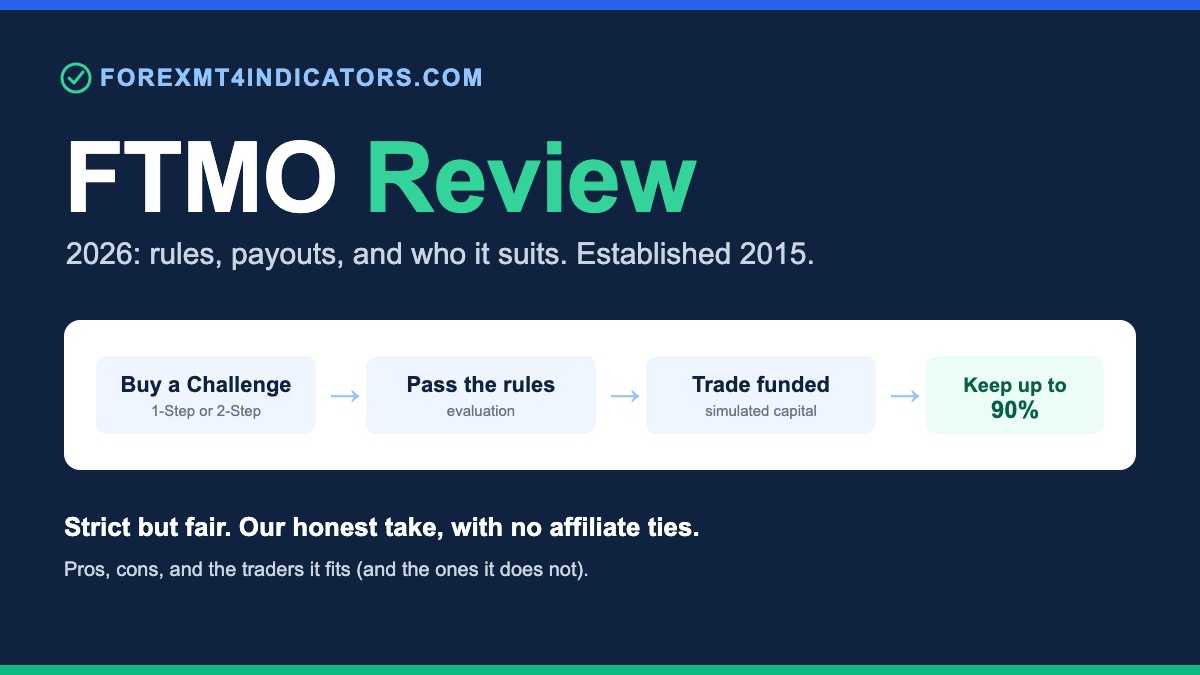
FTMO is a forex and CFD prop firm, established in 2015, that pays traders up to 90% of simulated profit once they pass a 1-Step or 2-Step Challenge, or with no evaluation on its Instant Account. Its rules are strict but fair, only the 2-Step fee is refunded, and it suits disciplined traders, not gamblers.
This review covers FTMO’s three routes and the payout terms that matter before you pay. We hold no affiliate relationship with FTMO, so it weighs real pros against real cons.
FTMO 1-Step vs 2-Step vs Instant Account (checked 18 November 2026)
| Term | 1-Step Challenge | 2-Step Challenge | Instant Account |
|---|---|---|---|
| Profit target | 10% | 10%, then 5% | None |
| Daily loss limit | 3% of initial capital | 5% of initial capital | 3% of initial capital |
| Maximum loss | 10%, trails at end of day | 10%, static | 10%, trails intraday |
| Best-day cap (Consistency rule) | 50% of total profit (orders from 12 Oct 2026) | None | 30% of total profit |
| Minimum trading days | None listed | 4 per phase | None listed |
| Time limit | None | None | None |
| Profit split | 90% | 80%, rising to 90% | 90% |
| Fee refund | No | Yes, with first reward | No |
| Sizes | $10,000 to $200,000 | $10,000 to $200,000 | $5,000 to $100,000 |
Static means the loss floor never moves; trailing means it moves up as your balance grows. We checked every rule in this table against FTMO’s own pages: the Trading Objectives, the Instant Account page and the FAQ. FTMO replaced the 1-Step Best Day rule with a Consistency rule and launched the Instant Account in October 2026, so confirm the current terms on ftmo.com before you buy.
What is FTMO?
FTMO is a proprietary trading firm that funds traders who pass a rules-based evaluation, then pays them a share of the profits they produce. If the model itself is new to you, start with our primer on how the prop firm model works, then come back here for the FTMO specifics.
One detail matters before anything else. FTMO accounts are simulated accounts, not your own live brokerage capital. FTMO pays your share, which it calls a reward, in real money, so you are earning a payout for hitting targets under its rules, not compounding a live balance of your own. That is standard for the online prop sector, not a mark against FTMO.
FTMO also runs a separate futures programme, which this review does not cover.
How does FTMO work?
For most traders, FTMO works in three steps: pass an evaluation, receive a funded account (FTMO calls it an FTMO Account), then withdraw a share of the profit. You choose between two evaluation models and, since October 2026, an Instant Account that skips the evaluation; none of them has a time limit.
2-Step Challenge
The 2-Step is FTMO’s classic route. On a $100,000 account you hit the first phase’s target (the FTMO Challenge) once your balance reaches $110,000 with all trades closed, then the Verification at a 5% target. Each phase needs at least 4 trading days, and a day counts only if you open a position on it. Both phases run under a 5% daily loss limit and a static 10% maximum loss, the split starts at 80%, and this is the only route whose fee is refunded.
1-Step Challenge
The 1-Step FTMO Challenge has a single phase with a 10% profit target and no minimum trading days listed. It runs under a tighter 3% daily loss limit, a 10% end-of-day trailing maximum loss and a 50% Consistency rule, so one outsized day cannot carry your whole pass. It pays 90% from the first reward, but the fee is non-refundable.
Instant Account
The FTMO Instant Account has no evaluation: you pay a one-time fee, the account is active once the purchase completes, and there is no profit target. It runs under a 3% daily loss limit, a 10% maximum loss that trails intraday and its own 30% Consistency rule. It pays 90% and comes in sizes from $5,000 to $100,000, and the fee is non-refundable.
Which FTMO account should you choose?
- 2-Step if you want the fee refund, the roomier 5% daily loss limit, a static floor, or the Swing account.
- 1-Step if you want one phase and 90% from the first reward, and can live with a 3% daily limit, an end-of-day trailing floor and the 50% Consistency rule.
- Instant Account if you would rather pay to skip the test, accepting a non-refundable fee, an intraday trailing floor with no reset and the 30% Consistency rule.
Which FTMO rules can end your account?
Two Trading Objectives end an account the moment you cross them: the daily loss limit and the maximum loss. On a Standard funded or Instant account, breaking the news or weekend-holding rule can also get the account terminated.
Daily loss limit
FTMO’s daily loss limit (its Maximum Daily Loss) is a fixed dollar amount: 3% of initial capital on the 1-Step and Instant Account, 5% on the 2-Step. It does not grow when your account grows. Each day FTMO takes your balance at midnight CE(S)T (Central European Time, CEST in summer) and subtracts that amount, and if your equity (your balance plus or minus the profit or loss on open trades, after swaps and commissions) drops below that line, the account fails.
On a $100,000 account, a day that opens at a $102,000 balance fails below $97,000 of equity on the 2-Step, or below $99,000 on the 1-Step. A floating loss (a loss on a trade that is still open) held past midnight already uses up part of the next day’s room.
Maximum loss: static or trailing
FTMO’s maximum loss is 10% of initial capital on every account, but the floor moves differently on each:
- 2-Step: static. The floor stays at 90% of initial capital ($90,000 on $100,000), however high your balance climbs.
- 1-Step: trails at end of day. The floor sits 10% of initial capital below your highest midnight CE(S)T balance, only moves up, and resets to 90% of initial capital after a reward withdrawal on the funded account.
- Instant Account: trails intraday. The floor moves up the moment a trade closes at a new balance high and does not reset, so FTMO warns that once your balance exceeds 110% of initial capital, a reward withdrawal would breach it.
A trailing floor tightens as you profit, which catches traders who model it as static; our trailing drawdown calculator shows where it sits.
Consistency rule
On the 1-Step, orders placed on or after 12 October 2026 (or accounts merged since) use the Consistency rule: your best day can be no more than 50% of your total profit, losing days included. Older 1-Step accounts keep the legacy Best Day rule, which counts winning days only. Going over is not a breach; you keep trading until the share is 50% or less before you can pass or take a reward. The Instant Account has its own 30% version, and the 2-Step has none.
Weekend and news restrictions
These restrictions apply on a Standard funded account and on the Instant Account:
- Market breaks: close positions before any break longer than 2 hours, such as the weekend for forex and each nightly close for stock CFDs.
- News: no order may execute on the affected instruments from 2 minutes before to 2 minutes after a restricted news release, including a stop loss or take profit being filled.
The Challenge and Verification phases are exempt, as is the Swing account type (2-Step only), which trades at up to 1:30 leverage instead of up to 1:100 (1:100 means each $1 of margin can control up to $100 of position). Gap trading is banned on every account, exempt or not: no fresh trades into scheduled major news, or in the last two hours before a market closes for two hours or more.
For worked dollar examples of every limit, read the full FTMO rules breakdown.
How do FTMO payouts work, and is the fee refunded?
FTMO’s payout terms are where its reputation is strongest. A funded FTMO trader keeps up to 90% of the simulated profit, one of the higher splits in the sector. The funded account has no profit target: you stay within the loss rules (plus the Consistency rule on the 1-Step and Instant Account) and withdraw what you make.
The 1-Step and the Instant Account pay 90% from the first reward. The 2-Step starts at 80% and rises to 90% in one of two ways: by meeting FTMO’s Scaling Plan conditions (including at least 4 months of trading, 10% net profit and 2 processed rewards over that period), or by qualifying for its Premium Programme. As plain arithmetic, not a forecast, $5,000 of simulated profit pays a $4,500 reward at 90%, or $4,000 at 80%.
FTMO refunds 100% of the 2-Step Challenge fee when you request your first reward, to the payment method you bought with; the 1-Step and Instant fees are not refundable (FTMO’s refund FAQ). So a 2-Step trader who passes and reaches a first reward recovers the entry cost. Our prop firm payout calculator applies your split, and any withdrawal charges, to an eligible reward to show the net amount.
The fee rises with account size and is paid once per attempt. It is the real cost you carry if you fail, so size the account to what you can afford to lose, not to the payout you are dreaming about. Our challenge cost calculator tallies fees, retries and refunds, keeping the 2-Step refund conditional until it is paid.
You can request your first reward from the 14th day after your first trade on the funded account, with all positions and pending orders closed (FTMO’s withdrawal FAQ); our payout date calculator helps you plan around that wait. Instant Account traders must also complete FTMO Identity before the first reward. FTMO reviews the request within 1–2 business days and typically sends the reward within 1–2 business days of approving the invoice.
The pros
- Track record and longevity. FTMO was established in 2015, which lowers the risk that the firm fails to pay you or keeps your fee.
- High profit split. Up to 90% sits at the generous end of the sector, and the 1-Step and Instant Account pay 90% from the first reward.
- Fee refund on the 2-Step. Getting 100% of the 2-Step fee back with the first reward lowers the real cost for traders who pass.
- No time limit. No countdown pushes you into rushed, oversized trades.
- Three ways in. The 1-Step, the 2-Step and the no-evaluation Instant Account let you match the rule set to your style.
- Published, consistent rules. The limits are published with worked examples and apply equally to every trader on the same product, though some Forbidden Trading Practices, such as overleveraging, are judged at FTMO’s discretion.
The cons
Weigh these drawbacks before you pay.
- Your fee is at risk. If you fail the evaluation, the fee is gone: it buys an attempt, not a funded seat.
- The rules are strict. One bad day can close an account you were winning on.
- It is a simulated model. You are trading a simulated account and earning a reward, not building your own live capital.
- Results depend on you. Funding does not add edge (a strategy that makes money over many trades). If your strategy is not already profitable on your own account, size alone will not fix it.
- Standard-account restrictions. The weekend and news rules on Standard funded accounts and the Instant Account can clash with swing styles unless you pick the 2-Step Swing account (up to 1:30 leverage).
- Tighter rules on the newer routes. The 1-Step and Instant Account pair a 3% daily limit with a trailing maximum loss and a Consistency rule, which leaves less room than the 2-Step.
- Repeat attempts cost money. If you fail and try again, each attempt is a fresh fee.
Who should use FTMO, and who should skip it?
FTMO suits disciplined traders who already trade a small account with steady risk control and a tested strategy. It does not suit beginners or anyone hunting a fast payout.
For that trader, the evaluation is a fair test of skill. FTMO also suits traders who cannot fund a large account themselves: paying a fee to trade a $100,000 simulated account and keep most of the profit is rational for someone who lacks the capital, not the skill.
If you are still learning the basics, paying fee after fee on failed attempts is an expensive way to discover you are not ready. Study how to pass a prop firm challenge on a demo first, and buy the evaluation only when your results are already consistent.
It also fits traders whose process is sound but whose own capital took a hit: an evaluation lets you trade meaningful size again for a known, capped cost.
If holding through weekends or trading the news is central to your edge, the 2-Step Swing account removes those restrictions, but the gap-trading ban still applies and its lower leverage changes your position sizing; check the margin a position needs at 1:30. For alternatives, compare swing-friendly prop firms.
Common mistakes traders make on the FTMO Challenge
- Treating the daily loss limit as a soft guideline. One reckless day can end an FTMO account outright, even one that is in profit for the week. Fix: set a hard personal stop at roughly half the daily loss limit, track it with our daily risk limit planner, and walk away when you hit it.
- Front-loading one huge day. On 1-Step accounts ordered from 12 October 2026, the Consistency rule caps your best day at 50% of total profit, losing days included, so one lucky spike will not pass you on its own. Fix: aim for several steady days and check the share with our consistency calculator (choose signed net profit for accounts on the new rule, or positive-days profit for legacy Best Day accounts). Never split one trade’s profit across several days by closing it in pieces or opening an opposite trade, which FTMO bans.
- Buying too large an account. A fee you cannot comfortably lose adds pressure that breaks discipline. Fix: start at a tier whose fee you can afford to write off entirely.
- Rushing because you expect a deadline. FTMO has no time limit. Fix: trade your normal frequency and let the pass come at its own pace.
- Ignoring the Standard-account restrictions. Weekend holds and orders that execute inside the 2-minute restricted news window are not allowed on Standard funded or Instant accounts. Fix: if you trade that way, pick Swing on the 2-Step (the gap-trading ban still applies).
- Skipping demo preparation. Paying for an evaluation before your edge is proven turns tuition into lost fees. Fix: rehearse the exact FTMO rules on a demo until passing feels routine.
The honest verdict
FTMO earns its reputation. It is one of the most established online prop firms, and its rules are strict but fair. Its payout terms (the up-to-90% split and the 2-Step fee refund) are documented and consistent, not teaser marketing.
It is not a shortcut to income. The evaluation is a filter, not a formality, and your fee is at genuine risk. If you already trade with discipline and a tested edge, FTMO is a fair and reputable way to trade larger size; if you are chasing a fast payout, it will likely cost you fees.
Rules and terms checked against FTMO’s own pages on 18 November 2026; FTMO changes them, so always verify on the firm’s official site before you buy.
Risk disclaimer: Forex and CFD trading carries a high level of risk and may not be suitable for all traders. The strategies and indicators described in this article are educational. Past performance does not guarantee future results. Always test on a demo account before risking real capital.
Frequently asked questions
Is FTMO legit?
Yes, FTMO is a legitimate, well-known proprietary trading firm that was established in 2015 and has a long public record of paying withdrawals. It is open about its rules, fees, and simulated-account model. The main caveat is the one every prop firm shares: your fee is at risk if you fail.
Is FTMO worth it?
FTMO is worth it for a disciplined trader who already has a tested, risk-controlled edge and wants to trade larger size than they can self-fund. For that trader, the up-to-90% split and the 2-Step fee refund make the economics attractive. It is not worth it if your strategy is not yet consistently profitable, because funding does not add edge.
How much does FTMO cost?
FTMO charges a one-time fee per attempt, and the fee rises with the account size you choose. Challenge accounts range from $10,000 to $200,000 of simulated capital, and Instant Accounts from $5,000 to $100,000. Only the 2-Step fee is refunded, in full, when you request your first reward. Fees vary by currency and change, so check the price for your tier on ftmo.com.
What is the FTMO Instant Account?
The FTMO Instant Account, launched in October 2026, is a funded account you buy without an evaluation. It has no profit target, a 3% daily loss limit, a 10% intraday trailing maximum loss that does not reset after a withdrawal, a 30% Consistency rule and a 90% split. Sizes run from $5,000 to $100,000 and the fee is not refundable.
Does FTMO actually pay out?
FTMO has a long, public track record of processing trader withdrawals. Funded traders keep up to 90% of simulated profit as a reward paid in real money, and can request the first one from the 14th day after their first trade on the funded account. You still have to respect the loss rules to keep the account.
How much can you realistically make with FTMO?
There is no honest fixed answer, and anyone quoting a guaranteed figure is selling you something. Your return depends on your own skill, consistency, account size and rule discipline. Many traders make nothing because they fail the evaluation or breach a rule, so treat any income as uncertain and earned, never promised.
What are FTMO’s biggest downsides?
FTMO’s biggest downsides are that your fee is lost if you fail, the daily loss limit is unforgiving, and the account is simulated rather than your own live capital. On Standard funded accounts and the Instant Account you must close positions before market breaks longer than 2 hours (the weekend for forex, every night for stock CFDs), and no order may execute on affected instruments from 2 minutes before to 2 minutes after restricted news. None of these are hidden, but they catch traders who do not read the terms.
Is FTMO a good first prop firm?
FTMO can be a good first prop firm, because its clear rules and strong reputation lower the risk of losing your fee to an unreliable firm. But learn to trade profitably on a demo or a small live account first, then treat FTMO as the step that scales a skill you already have.
Explore forex broker accounts
Visit these broker websites to check the account options, regional availability and terms that apply to you before opening an account.
Trading forex and CFDs carries a significant risk of loss and is not suitable for everyone. Broker links are affiliate links; we may earn a commission if you use them.