

Tickmill Social Trading supports eligible MT4 and MT5 accounts, with provider performance fees up to 50%. Check instrument compatibility, offer terms and copy risk.
Tickmill Social Trading lets eligible clients connect an account to a strategy provider so trades can be copied automatically. The tool supports MT4 and MT5, but compatibility is not complete across every instrument. A provider can also charge a performance fee. Copying therefore changes who makes the trade decision; it does not remove costs or the possibility of loss.
I would begin with the subscription conditions and the downside of the strategy, not its place in a ranking. A high return can come from high leverage, concentrated exposure or an unusually favourable period. None of those tells you what the next month will look like.
Account and platform requirements
The current Social Trading page says you need an active Tickmill trading account. MT4 and MT5 are supported. An MT4 follower cannot copy stock CFD trades that require MT5, so compare the provider’s instruments with your account before subscribing.
The strategy-provider page gives a minimum account balance of $250 or equivalent for someone becoming a provider. That is not a universal follower minimum. The user manual says each provider offer can specify a follower minimum.
The general Social FAQ states that new strategy-provider registrations from South Africa are not currently accepted. That is a role-specific restriction, not proof that every South African follower is prohibited or accepted. Entity, residence and account availability still require checking.
Performance fees are only one layer of cost
| Cost or setting | Current public description | What to inspect |
|---|---|---|
| Joining the tool | No separate tool charge for Tickmill clients | Underlying trading charges remain |
| Performance fee | Provider may charge up to 50% of profit | Percentage and calculation basis |
| Fee period | Weekly or monthly | When charged and how open profit is treated |
| Follower minimum | Set in provider offer | Current requirement before subscribing |
| Copy ratio / limits | Follower settings available | Effect on exposure and existing positions |
The percentage applies under the selected offer’s rules. Before subscribing, ask how previous losses, deposits, withdrawals and unrealised profit affect the fee calculation. The public summary does not justify assuming every offer uses the same high-water-mark treatment.
For simple illustrative arithmetic only, a 20% fee on a $100 eligible profit base is $20. That leaves $80 from that base before any other amount not already included. It does not mean you earn $100, nor does it explain which entries the actual offer includes in its profit base. Do not subtract the same commission twice when checking a statement.
Read spread and commission costs and swap-free holding rules if applicable. A tool described as free can still generate normal trading costs on every copied order.
What to inspect in a strategy
- History length: establish how long the account has traded and whether the record is live or demo.
- Drawdown: examine the depth and duration of losses, including open trades where the platform exposes them.
- Exposure: look for concentrated positions, correlated instruments and large leverage.
- Position sizing: check whether losses lead to larger orders, grid accumulation or averaging down.
- Trading frequency and holding period: estimate the spread, commission and overnight cost burden.
- Capacity to copy: confirm every instrument and minimum volume is compatible with your account.
- Offer conditions: record the fee percentage, fee period, minimum balance and exit behaviour.
Tickmill says its rating combines weighted return and volatility characteristics without disclosing the exact formula. Treat that ranking as a sorting tool, not an independent safety score. A badge or position near the top of a list does not prove suitability for your capital or risk limit.
How the documented follower workflow works
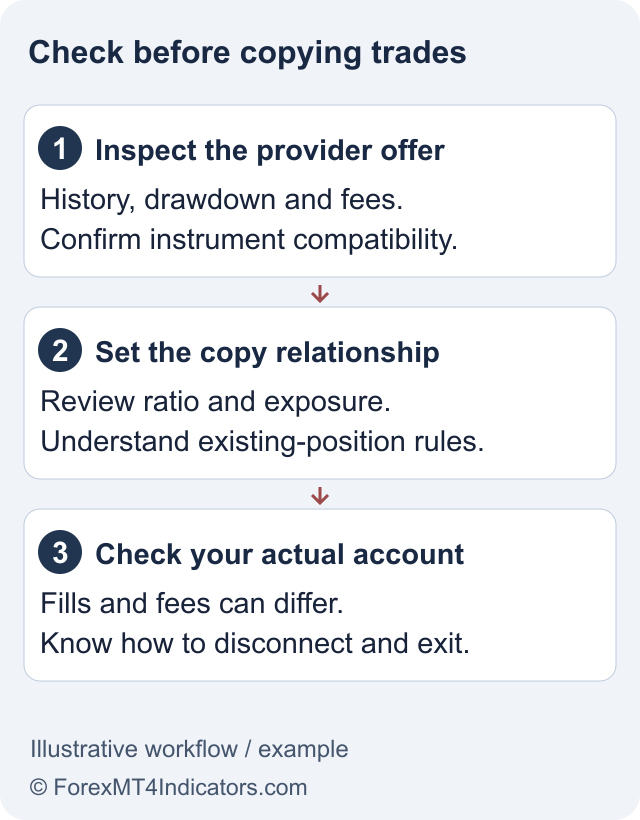
- Open the official Social Trading link through Tickmill’s website, and confirm your account is eligible.
- Register the trading account as a follower using the documented credentials. Keep account access private.
- Select a provider and read the current offer conditions before connecting.
- Set a copy ratio and any available limits according to the loss you are prepared to bear.
- Check whether connection copies existing positions or only new orders, and how minimum volume or rounding will affect your account.
- After activation, verify the actual copied positions, volume and margin rather than assuming they match perfectly.
- Review the subscription and risk settings periodically, and understand the disconnect procedure before you need it.
The official illustrated manual documents account connection and offer settings. We have not opened a follower account or tested copying. If the current interface differs, follow its current confirmation screens and ask support about unclear behaviour.
Why copied results can differ
Tickmill’s own disclaimer says follower fills can differ from the provider’s prices and that volatile markets can produce slippage. Account size, lot rounding, missing instruments, fees and the time you connect can also change the result. A provider’s percentage return should not be presented as the return you will receive.
Manual intervention creates another difference. The FAQ says followers can close copied trades and place their own orders. That can be useful, but it also means your account may no longer track the provider’s open exposure. Keep a record of changes you make.
Disconnecting from a provider and closing positions are separate actions to verify. Do not assume pressing a subscription button automatically exits all open trades. Read the confirmation and inspect the trading account afterwards. Existing market exposure can remain your responsibility.
A practical decision rule
If you cannot explain the strategy’s worst visible loss, the copy ratio and the exit process, you are not ready to judge it from the return figure. Reduce uncertainty before considering a live allocation. Use money you can afford to lose and review the margin implications of simultaneous copied positions.
The Tickmill review and withdrawal guide cover broker and funding questions separately. A good-looking strategy does not resolve concerns about the account or payment route.
Frequently asked questions
Does Tickmill currently offer copy trading?
Its current public Social Trading service connects eligible live MT4 and MT5 accounts to providers. Residence, entity and account conditions apply.
Is Tickmill copy trading free?
The tool has no separate joining charge for clients, but providers can charge a performance fee and normal spread, commission and holding costs remain.
What is the minimum follower balance?
The provider offer can specify it. The $250 figure on the strategy-provider page refers to becoming a provider, not every follower account.
Can MT4 copy every MT5 trade?
No. Tickmill says an MT4 follower cannot copy stock CFD trades that are available only on MT5.
Will I get the provider’s return?
Not necessarily. Timing, slippage, account size, rounding, instrument availability and fees can make results differ, and past performance does not predict future returns.
Sources and review method
Checked 11 September 2026. This guide uses public broker documentation and the independent sources listed below. We did not open a funded account, test a withdrawal, measure execution or verify a customer complaint.
Official broker websites
Read the current terms and restrictions for your actual residence. These links do not establish that a broker or service is available or authorised where you live.
Forex and CFD trading carries a significant risk of loss and is not suitable for everyone. These are affiliate links; we may earn a commission if you use them.