


Tickmill usually quotes one working day to process withdrawals, with longer method-specific arrival estimates. Check wallet availability and deposit-return rules.
A Tickmill withdrawal has two clocks: the broker’s processing time and the payment provider’s delivery time. The public funding page generally says requests process within one working day. That should not be read as a promise that every bank or card receives funds within that time.
Before submitting, check that the money is available in the correct wallet, your verification is complete and the receiving method meets the deposit-return rules. If a request is already blocked, use the withdrawal-problem guide rather than submitting repeated requests.
Published withdrawal timing and its limits
| Method in global table | Broker processing label | Estimated arrival label |
|---|---|---|
| Bank wire | Within one working day | 2–7 working days |
| Credit/debit card | Within one working day | Up to 8 working days |
| Skrill / Neteller | Within one working day | Instant after processing |
| Crypto payments | Within one working day | About 12–48 hours |
| UnionPay | Within one working day | Up to 48 hours |
Source: Tickmill funding table. These are provider estimates, subject to country availability and checks. The same page’s narrative also gives a shorter bank estimate of 1–3 working days. Because the wording differs, ask for the estimate attached to your actual transaction and distinguish it from a guarantee.
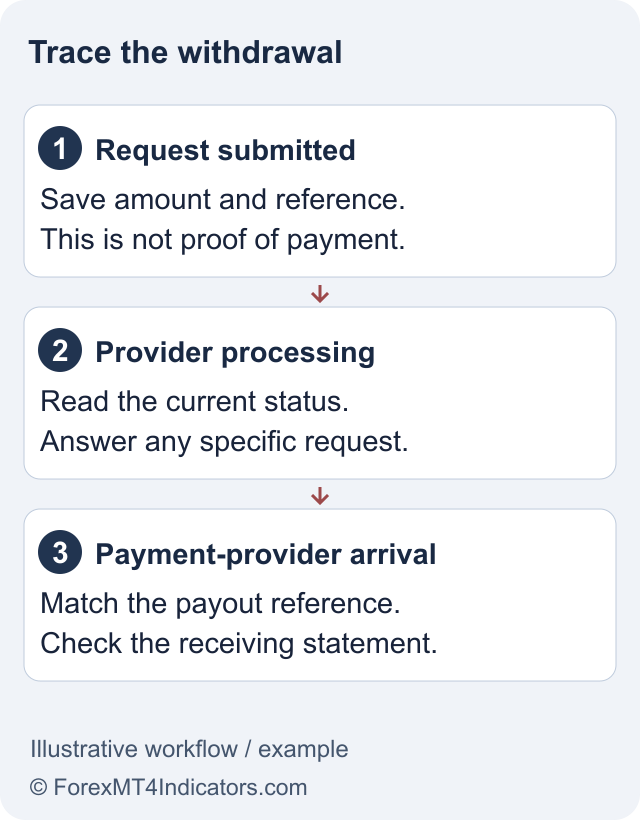
Working days exclude periods when the relevant processing service is closed. A status of “processed” is also different from “received.” Ask for the payment trace when the broker says it has sent the funds and the receiving institution cannot find them.
Why withdrawals can be split across methods
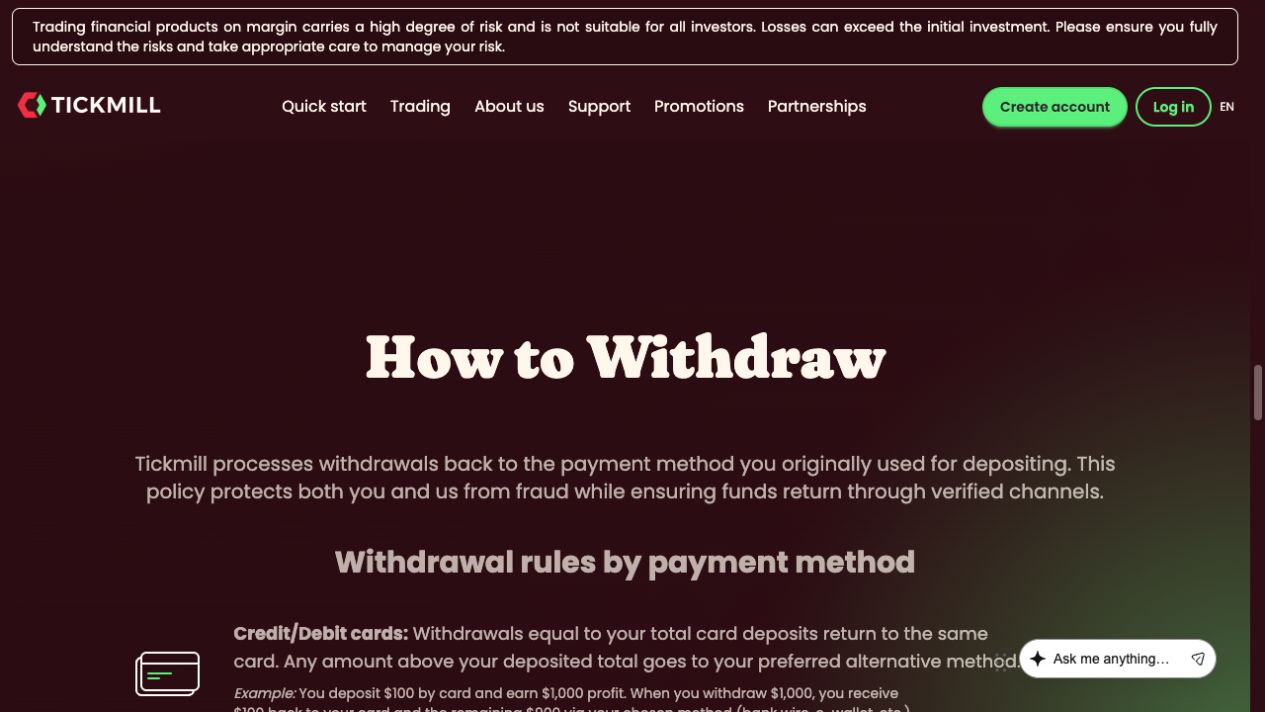
Tickmill says card deposits must be returned to the same card up to the deposited total, with surplus going through an eligible alternative method. Where both cards and another method were used, card return takes priority. This means your preferred destination may not receive the whole withdrawal.
For an illustrative mixed-funding case, suppose you deposited $200 by card and $300 by an e-wallet, with nothing previously returned. A $350 withdrawal could be split as $200 to the card and $150 to the e-wallet under that priority. The amounts add to $350. A card limit, expired card or unavailable method may require support to confirm the replacement route.
Do not supply a friend’s bank account to avoid the return rule. Obtain the permitted route in writing, especially after a card replacement or bank-account closure. The deposit guide explains why choosing the original payment method carefully matters.
How to request a withdrawal
- Enter the official Client Area and review any verification or account messages first.
- Check the chosen wallet’s available balance and base currency. Funds supporting open positions may not all be available to withdraw.
- Select Withdraw beside the wallet or use the withdrawal navigation tab.
- Choose an eligible receiving method, taking account of card-return priority and your previous deposits.
- Enter the amount and review the minimum, currency and destination details before submitting.
- Save the request reference and date. Track the entry in Transaction History.
- When processed, compare the receiving bank or wallet record with the broker record. If it remains missing beyond the relevant estimate, request a payment trace.
The public table lists a 25 minimum withdrawal for many methods, but the method and currency shown in your account govern the request. Check the displayed currency rather than converting that number into a universal local-currency minimum.
We did not submit a withdrawal. These steps are based on the provider’s public instructions and should be checked against the current interface.
Withdrawal fees and currency differences
The provider states that it does not charge ordinary withdrawal fees, while intermediary banks, e-wallet providers and conversion may cost money. A smaller receipt is not automatically evidence that the broker charged a fee: request the breakdown and compare both currencies.
Suppose the broker confirms a 100 USD payment and your local bank receives a converted amount. You need the conversion rate and any intermediary deductions before calculating the difference. Comparing 100 USD with a local-currency number without an exchange rate cannot identify an error.
The funding page also reserves remedies for abuse of payment methods. Avoid turning “zero ordinary withdrawal fee” into “no fee can ever apply.” The account agreement and fee guide provide the broader context.
Verification and an available balance
A wallet balance does not necessarily mean that all of it is immediately withdrawable. Confirm whether a pending verification request, open-position margin, payment review or promotional condition affects the amount. Ask for the precise reason rather than guessing from a greyed-out button.
The Welcome Account is particularly easy to misunderstand. Its initial $30 cannot be withdrawn; qualifying profit must first meet the campaign’s separate transfer conditions. That differs from withdrawing ordinary own-funded wallet money.
If the issue is identity documentation, use the verification guide. If it is trading-account access, the login guide may help establish which credentials or account status you are using.
Keep a short evidence trail
Retain the request reference, amount, currency, destination type, submission time, current status and relevant correspondence. Do not post full account or card details publicly. A clear record helps the broker and receiving institution identify the same transaction.
Recent review-profile complaints mention withdrawal and wallet restrictions. They are customer allegations, not a measured failure rate or proof of your case. Our Tickmill review covers the limits of that feedback. What matters for an unresolved request is a written status, the missing action and a dated next step.
Frequently asked questions
How long does a Tickmill withdrawal take?
The global page generally quotes one working day for broker processing. Arrival depends on the method, and its bank estimates differ between table and prose. Confirm the estimate for your request.
Does Tickmill charge a withdrawal fee?
The public page says no ordinary broker withdrawal fee. Intermediary banks, payment providers or conversion may still cost money, and agreement exceptions can apply.
Why is my withdrawal going to my card?
The provider returns card deposits to the original card up to the deposited amount before sending eligible surplus through another method.
Can I withdraw all my trading balance?
Not necessarily. Check available wallet funds, open-position margin, verification and any applicable account or promotional restrictions.
What should I do when processed funds do not arrive?
Ask for the payment reference or trace, then contact the receiving provider with it. Preserve the case record and escalate if the stated delivery estimate has passed.
Sources and review method
Checked 11 September 2026. This guide uses public broker documentation and the independent sources listed below. We did not open a funded account, test a withdrawal, measure execution or verify a customer complaint.
Official broker websites
Read the current terms and restrictions for your actual residence. These links do not establish that a broker or service is available or authorised where you live.
Forex and CFD trading carries a significant risk of loss and is not suitable for everyone. These are affiliate links; we may earn a commission if you use them.