

Last updated: July 5, 2026 · By: Tim Morris, founder of ForexMt4Indicators.com
A demo account trades virtual money on the real platform, so it is the place to learn order types and test a strategy, but it hides slippage, requotes, and emotion. Switch to live only after a documented edge across 100+ demo trades over 2-3 months and a written plan — then start with a balance you can afford to lose.
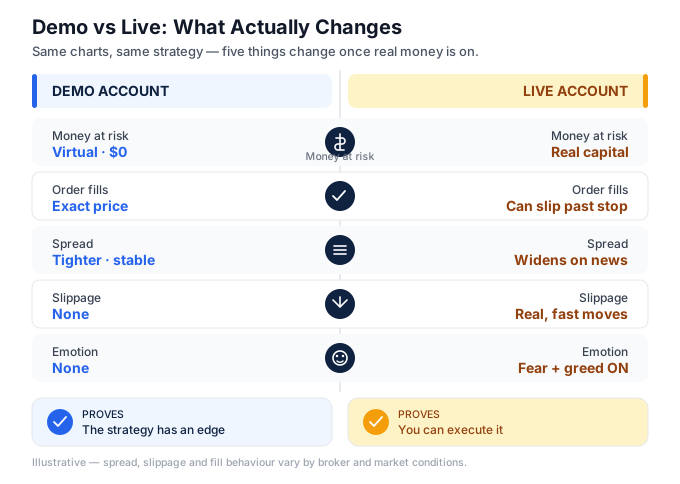
The diagram above lays demo and live side by side on the things that actually cost you money — fills, spread, emotion, and the money at stake. The rest of this guide turns that comparison into a switch decision you can make with confidence.
If you are still learning how the market fits together, our forex trading guide covers the fundamentals; this article is about the bridge between practising and putting real money on the line.
What is a demo forex account
A demo account is a practice account funded with virtual money that runs on the same MT4 or MT5 platform your broker uses live. You place trades, set stops, and watch your balance move — but nothing is real.
It exists for one reason: to let you learn the mechanics of trading without paying tuition in blown accounts. Every broker offers one free, and you should use it before you fund anything — demo practice is one of the seven steps in our step-by-step guide to starting forex trading.
The demo is genuinely good at three jobs. It teaches you the platform, it lets you test whether a strategy has an edge, and it lets you rehearse order types until they are automatic.
Platform mechanics. You learn where the buttons are — how to place a market order, attach a stop loss and take profit, modify a position, and read your equity and margin. Fumbling these live, with money on the line, is how beginners fat-finger a 1.0 lot instead of 0.01.
Strategy testing. You can forward-test a set of rules over dozens of trades and see whether it produces a positive expectancy before it costs you anything. This is the demo’s most valuable use, and the one most beginners skip.
Order-type practice. Market orders, buy limits, sell stops, trailing stops — you can rehearse all of them until placing the right one is muscle memory. If the difference between a buy stop and a buy limit is fuzzy, the demo is where you fix that, not a live account.
Why does a demo account lie to you
A demo account tells the truth about the platform and lies about the market. The fills are cleaner than reality, and — the part that ends most trading careers — there is no real money on the line, so your discipline is never actually tested.
Understanding exactly how the demo flatters you is what separates traders who transition well from traders who go live overconfident and give it all back.
The first set of lies is mechanical. Demo servers fill your orders in an idealised world that live execution does not match.
Fills are unrealistically clean. On demo, your market order fills at the price you clicked and your stop fills at the exact level you set. Live, in a fast market, price can gap straight through your stop — that gap is called slippage, and it means your loss can be larger than the stop you drew.
No requotes. On a live account during news, your broker can reject your order and ask you to accept a new price — a requote — while price runs away from you. Demo almost never requotes, so you never learn to handle the moment your entry does not fill.
Sometimes tighter spreads. Some demo feeds quote a friendlier, more stable spread than the live account does, especially around the rollover and during news. A strategy that looks profitable on a 0.6-pip demo spread can bleed out on a live spread that widens to 3 pips at the exact moments you trade.
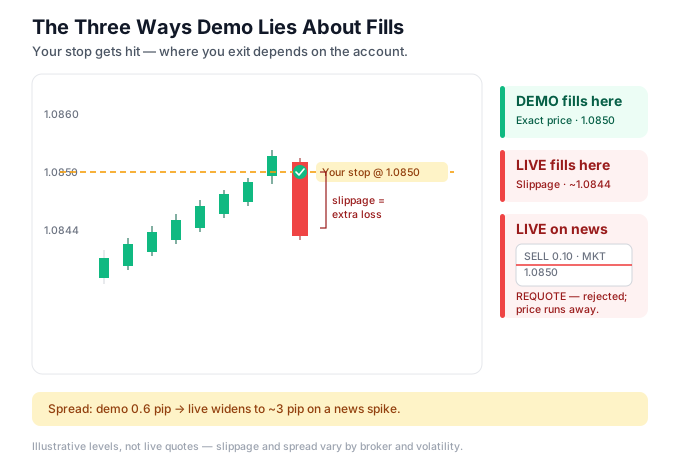
The second set of lies is the one that matters more. The demo removes the single most important variable in trading: your own money.
No real emotion. When the balance is fake, a $200 drawdown is a number. When it is your rent, that same $200 triggers fear, and fear makes you close winners early, move stops, and revenge-trade. None of that shows up on demo, so your discipline is completely untested.
This is why “I’m profitable on demo” is a weaker claim than beginners think. You have proven the strategy has an edge — you have not proven that you can execute it when it is your money on the line.
The psychology gap between demo and live
The gap between a demo trader and a live trader is not skill — it is psychology. Fear and greed only switch on when the money is real, and they attack the exact habits that made you profitable on demo.
On demo, you follow your plan because there is no cost to following it and no reward for breaking it. Live, every open trade is tugging at you.
Fear shows up as cutting winners early and hesitating on valid setups. You watch a trade go 15 pips into profit, feel the urge to lock it in, and close at 15 pips a trade your plan said to hold for 40. Over a month that habit alone can turn a winning system into a losing account.
Greed shows up as oversizing and over-trading. After two wins you feel invincible, double your lot size on the third trade, and a normal loss now hurts three times as much. The demo never taught you to sit still because sitting still on demo cost you nothing.
The fix is not to eliminate emotion — you cannot. The fix is to make the money small enough, early enough, that the emotion is manageable while you build the habit of following your plan with real skin in the game. That is the entire argument for starting live tiny.
When should you switch from demo to live
Switch when you can prove an edge and prove you will follow it. Do not switch because you are bored of demo, because you had one good week, or because a video told you real money “focuses the mind.” Use this checklist — every item, not most of them.
A documented edge over 2-3 months. Not one good week. A record showing your strategy produces positive expectancy across a real sample of market conditions — trending, ranging, and news.
At least 100 demo trades logged. Fewer than 100 and your results are noise; a 60% win rate over 15 trades tells you nothing. 100+ trades is the minimum sample where a genuine edge starts to separate from luck.
A written trading plan. Your entry rules, stop rules, target rules, and risk-per-trade written down before you fund anything. If you cannot write your strategy in one page, you do not have one yet.
Every trade journaled. You are already recording each demo trade — setup, entry, exit, result, and what you felt. A trade journal is the tool that proves the edge is real and not a story you are telling yourself.
Money you can afford to lose. Fund a small live account with capital that, if it went to zero, would not change your life. This is not your savings and not money you need next month.
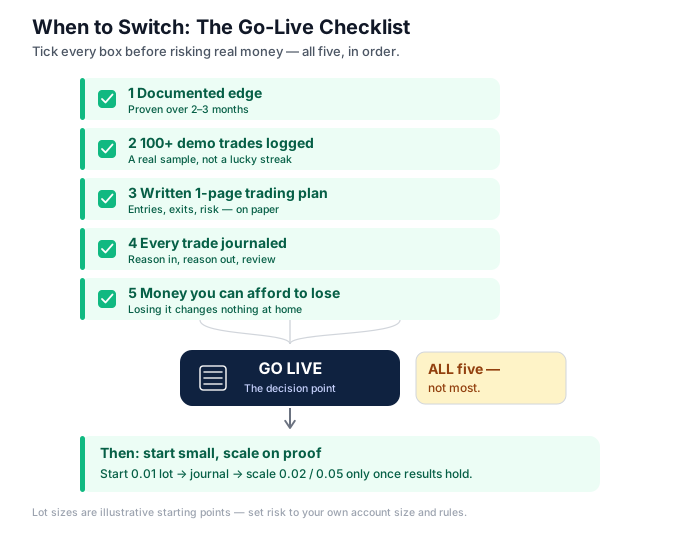
The checklist is deliberately strict because the cost of switching too early is high. A beginner who goes live after two good demo weeks, at full size, is not testing a strategy — they are donating.
How to transition from demo to live
Going live is not a switch you flip once — it is a graduated handover. Move in micro lots, keep everything else identical, and journal every trade so you can see the psychology gap open up and close it.
Start with micro lots (0.01). On a USD-quoted major, 0.01 lot is $0.10 per pip — a 30-pip loss costs $3. That is small enough to keep fear manageable while still being real money, which is the whole point. You want the emotion present but survivable.
Trade the exact same strategy. Do not “upgrade” your rules the day you go live. The only variable you are changing is that the money is now real; changing the strategy at the same time means you learn nothing about either. Same pairs, same setups, same stops.
Journal every single trade. Record the setup, entry, exit, result, and — critically — what you felt and whether you followed your plan. The live journal is where you catch yourself cutting winners early or oversizing, the two habits the demo could never reveal.
Scale up slowly, and only on proof. After 20-30 live trades that show you are executing your plan under real emotion, step up from 0.01 to 0.02, then 0.05. Size follows demonstrated discipline, never a good feeling.
Demo vs live: what actually changes
Read this before you fund an account — it tells you exactly which parts of your demo experience will survive contact with a live market and which will not.
| Demo account | Live account | |
|---|---|---|
| Money at risk | Virtual — zero | Real capital |
| Order fills | At your exact price | Can slip past your stop |
| Requotes | Almost never | Possible during news |
| Spread | Often tighter, stable | Widens on news and rollover |
| Slippage | None or minimal | Real, especially in fast moves |
| Emotion | None | Fear and greed, fully on |
| What it proves | The strategy has an edge | You can execute the edge |
| Best for | Learning platform, testing strategy | Building real discipline |
The honest takeaway: demo proves the strategy, live proves the trader. They are two different tests, and passing the first does not pass the second. That is why you go live small — you are running the second test with the stakes turned down.
What about gold (XAU/USD)
Demo flatters every instrument, but it flatters gold the most. XAU/USD is where the gap between demo fills and live fills does the most damage to a beginner’s account.
On demo, gold fills your stop at the exact price you set. Live, in a fast New York move or around CPI, NFP, and FOMC, gold can slip several dollars past your stop before you are out — and on gold, $1 of price is 100 pips.
Remember the gold math: 1 pip on XAU/USD is a $0.01 move, and a standard lot is 100 ounces, so 1 pip = $1 per standard lot. A stop that slips $3 past your level is 300 extra pips of loss — $3 per 0.01 lot, $30 per 0.10 lot — that never appeared once in your demo results.
The rule is simple: never size a live gold position off demo results. Demo gold looks calm and precise; live gold, during a news spike, is neither. If you tested a gold strategy on demo, cut your live size and widen your stops before you trust it with real money.
Common mistakes traders make switching to live
Demo-hopping instead of committing. Every time a demo account dips, the beginner resets it or opens a fresh one, so they never sit through a real drawdown. Fix: treat the demo like a live account — no resets. A drawdown you did not survive is not a strategy you have proven.
Trading 10x bigger size on demo than you could ever afford live. A $100,000 demo lets you trade 1.0 lots; your $500 live account can trade 0.01. Your demo “success” was built on size you will never use. Fix: set your demo balance to match the live account you will actually fund, and trade the lot sizes you will actually place.
Jumping to live after one good week. A single profitable week is noise, not an edge. Going live on it means you sized up right before the strategy’s normal losing streak arrives. Fix: demand 100+ trades over 2-3 months before you fund a cent.
Going live at full size to “make it serious.” Starting at 0.10 or 1.0 lot means the first normal drawdown triggers fear you have never handled, and you blow up learning a lesson micro lots would have taught for $3. Fix: start at 0.01 and scale up only on proof of discipline.
Changing the strategy the moment money is real. Going live and “improving” the rules at the same time means you can never tell whether a bad result came from the market, the new rules, or your nerves. Fix: change one variable — the money — and keep the strategy frozen for your first 30 live trades.
Ignoring margin and leverage until the margin call. Beginners who never watched their margin on demo get surprised when a live position’s margin requirement and floating loss combine into a stop-out. Fix: watch your free margin on every live trade from day one, and keep used margin low.
Frequently asked questions
How long should I trade on a demo account before going live?
Plan for 2-3 months and at least 100 logged trades, not a fixed number of days. The goal is a sample large enough to show a real edge across trending, ranging, and news conditions. If you only have 20 trades, you have a story, not a strategy — keep going until the sample is honest.
Why am I profitable on demo but losing on a live account?
Because demo removes the two hardest parts of trading: slippage and emotion. Live, your stops slip in fast markets and fear makes you cut winners early and oversize after wins. The strategy did not break — your execution did. The fix is starting live at 0.01 lots so the emotion is survivable while you build discipline.
Is a demo account exactly like a live account?
No. The platform is identical, but the fills are not. Demo fills at your exact price with little slippage, rarely requotes, and often shows a tighter, more stable spread. Live adds real slippage, requotes during news, wider spreads at rollover, and the emotional weight of real money — which changes how you trade.
How much money should I start with on a live forex account?
Only money you can afford to lose entirely — never savings or next month’s rent. For most beginners that means a small account of $100-$500 traded at 0.01 lots. The amount matters less than the size: micro lots keep the emotion real but survivable while you prove you can execute live.
Should I trade gold on demo before going live?
Yes to learn the mechanics, but never size a live gold position off demo results. Demo fills your XAU/USD stop at the exact price; live gold can slip several dollars past it in a fast New York or news move, and $1 on gold is 100 pips. Test on demo, then cut size and widen stops for live.
What lot size should I use when I first go live?
Start at 0.01 (micro) lot. On a USD-quoted major that is $0.10 per pip, so a 30-pip loss costs about $3 — real enough to trigger emotion, small enough to survive learning. Scale to 0.02 and 0.05 only after 20-30 live trades prove you can follow your plan under real money.
Do I need a written trading plan before going live?
Yes. If you cannot write your entry, stop, target, and risk-per-trade rules on a single page, you do not have a strategy — you have a habit of clicking. The plan is what you journal against live, so you can see whether a losing streak came from the market or from you abandoning the rules.
How do I know if my demo results show skill or luck?
Sample size and journaling. A 60% win rate over 15 trades is noise; the same rate over 100+ trades in varied conditions is a signal. Journal every trade with setup, result, and whether you followed your plan. If the edge survives 100 trades and a real drawdown you did not reset, it is probably real.
Risk disclaimer: Forex and CFD trading carries a high level of risk and may not be suitable for all traders. The strategies and indicators described here are educational. Past performance does not guarantee future results. Test on a demo account before risking real capital.
Ready to put this into practice?
Open an account with a regulated broker and apply what you have learned. These are the three brokers we recommend:
Trading forex and CFDs carries a significant risk of loss and is not suitable for everyone. Broker links are affiliate links — we may earn a commission at no cost to you.