

Last updated: July 5, 2026 · By: Tim Morris, founder of ForexMt4Indicators.com
Forex trades a few liquid currency pairs around $9.6 trillion a day, 24 hours 5 days a week, on high leverage (1:30 to 1:500), cost paid in the spread. Stocks are thousands of companies traded during exchange hours on low leverage (1:2 to 1:4), paid in commission. Forex suits short-term leveraged trading on a small account; stocks suit long-term ownership.
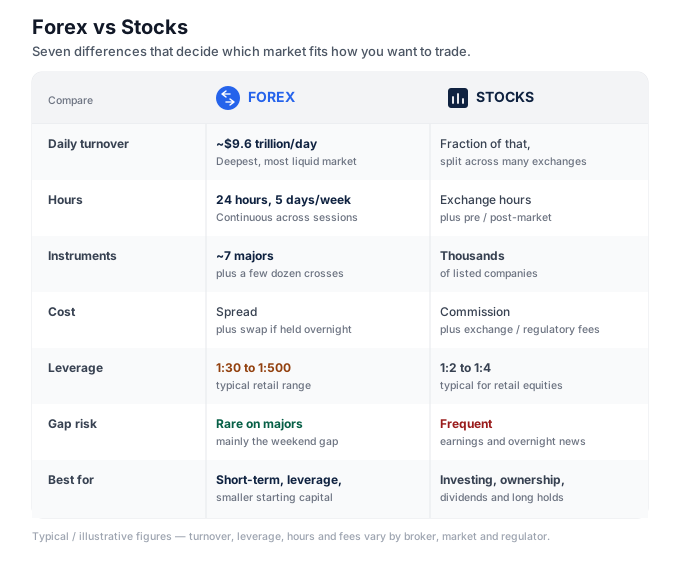
The table above puts the two markets side by side on the seven differences that actually change how you trade: size, hours, instruments, cost, leverage, gap risk, and who each one suits. The rest of this guide walks through each row so you can decide where to put your screen time.
If you are still learning how the currency market itself works, our forex trading guide covers the mechanics; this article compares that market against equities so you can choose between them with clear eyes.
How big is forex compared to the stock market
Forex is the largest financial market on earth by turnover. The Bank for International Settlements measured average daily foreign-exchange turnover at roughly $9.6 trillion in April 2025, up from $7.5 trillion in 2022.
No single stock exchange comes close to that daily flow. Equity trading is split across hundreds of venues — the New York Stock Exchange, Nasdaq, London, Tokyo, and dozens more — and even the largest handle a fraction of forex’s daily volume.
For you as a trader, size means liquidity, and liquidity means your orders fill close to where you expect. On EUR/USD the spread is often under 1 pip and slippage on a normal-sized retail order is negligible.
A single stock does not carry that depth. A large-cap like Apple fills cleanly, but a small-cap can gap between price levels, fill your stop far from where you set it, and widen its spread the moment volume dries up.
The practical takeaway: forex’s concentration into a few deep pairs is a feature. You get the tightest, most reliable fills in the market by trading the majors — EUR/USD, GBP/USD, USD/JPY — instead of spreading attention across thousands of thinner instruments.
When can you trade forex vs stocks
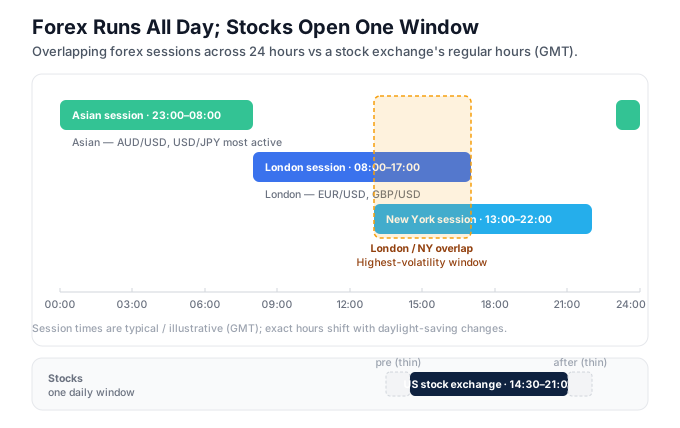
Forex runs 24 hours a day, 5 days a week. It opens with the Sydney session on Monday morning in Asia and closes on Friday evening in New York, with no exchange bell in between — you can trade at 3 a.m. or 3 p.m.
Stocks trade only during their exchange’s hours. The main US session runs 09:30 to 16:00 New York time, with limited pre-market and after-hours windows that carry thinner liquidity and wider spreads.
That difference reshapes your day. A forex trader in Asia can trade the London session (08:00-17:00 GMT) after work; a US-stock trader in Asia is asleep through most of the regular session.
Forex’s continuous clock also means each pair has a “home” window when it moves most. AUD/USD and USD/JPY are most active in the Asian session (23:00-08:00 GMT); EUR/USD and GBP/USD come alive in the London session and the London/New York overlap (13:00-17:00 GMT), the highest-volatility window of the day.
The flip side of a 24-hour market: there is no forced close to protect you. A stock trader’s position stops moving at the bell. A forex position keeps running while you sleep, which is exactly why an untended trade needs a stop loss every time.
How many instruments does each market have
Stocks give you thousands of choices. A single exchange lists hundreds to thousands of companies, and globally there are tens of thousands of tradeable equities across sectors, sizes, and countries.
Forex gives you a short, focused list. There are seven major pairs, a couple dozen actively-traded crosses, and a longer tail of exotics most retail traders never touch. Serious traders watch 3 to 6 pairs and ignore the rest.
Neither is strictly better — they demand different work. Stock selection is a research problem: earnings, balance sheets, sector rotation, management. Currency selection is a macro problem: interest-rate differentials, central-bank policy, and how two economies compare.
For a trader with limited time, forex’s narrow universe is an advantage. Learning the range, spread, and session behaviour of EUR/USD is achievable; learning the fundamentals of 5,000 companies is not. If you want to understand what those pairs are, our currency pairs explained guide breaks down majors, minors, and exotics.
What does it cost to trade forex vs stocks
The cost structures are built differently, and comparing them wrong is how traders misjudge their edge.
Forex cost is mostly the spread — the gap between the bid and ask price, paid on every trade whether you win or lose. On EUR/USD that gap is often under 1 pip; on an exotic it can run 30 to 80 pips. Our spread in forex guide covers how that number becomes your real entry cost.
The second forex cost is swap (rollover) — interest paid or received for holding a position past the daily rollover, based on the interest-rate gap between the two currencies. Hold a high-rate exotic overnight and swap can cost more than the spread did.
Stock cost is usually a commission plus exchange and regulatory fees. Many brokers advertise “zero commission” on stocks, but they recoup it through wider spreads or payment-for-order-flow, so the cost is still there, only hidden.
Here is the honest comparison: for short-term, high-frequency trading, forex’s tight major spreads are usually cheaper than round-trip stock commissions. For long-term holding, a one-time stock commission beats paying swap night after night on a leveraged forex position.
| Forex | Stocks | |
|---|---|---|
| Primary cost | Spread (every trade) | Commission + exchange fees |
| Overnight cost | Swap (rate differential) | None (you own the share) |
| Best case | Tight major spread, sub-1 pip | Zero/low commission on large caps |
| Worst case | Wide exotic spread + high swap | Fees + wide spread on illiquid stocks |
| Cheaper for | Short-term, frequent trading | Long-term holding |
How does leverage differ between forex and stocks
Leverage is the sharpest difference between the two markets, and the one that ruins the most beginner accounts.
Leverage is a multiplier on your position size. At 1:100 leverage, $1 of margin controls $100 of position. Forex brokers commonly offer 1:30 to 1:500 depending on jurisdiction; some offshore brokers advertise more.
Stock leverage is far lower. A cash stock account has no leverage — you pay full price for the share. A margin stock account typically offers 1:2 (in the US) up to around 1:4 for pattern day traders, and you pay interest on the borrowed portion.
That gap cuts both ways, and this is the part most articles skip. High forex leverage lets a $500 account take meaningful positions — but it magnifies losses as fast as gains. A 1:100 position that moves 1% against you wipes 100% of the margin behind it.
The most important sentence in this article: over-leverage is the single most common reason new forex traders blow up. The leverage is not the problem — using all of it is. Our leverage in forex guide shows how to size a position so leverage is available but not fully deployed.
The discipline is simple to state and hard to hold: risk a fixed small percentage per trade (the 1% rule), let the stop distance set the lot size, and treat the broker’s maximum leverage as a ceiling you rarely approach — not a target.
How does gap and volatility risk compare
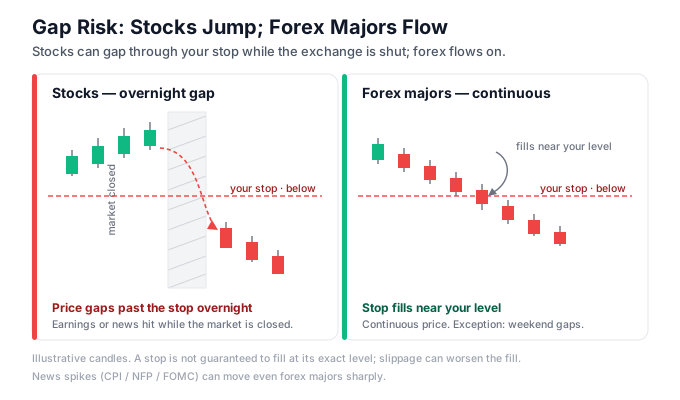
Stocks gap. A company reports earnings after the bell, or news breaks overnight, and the stock opens the next morning at a completely different price — right through where your stop sat.
That overnight gap risk is structural to equities. Earnings, guidance changes, lawsuits, and macro shocks all land while the exchange is closed, and your stop loss cannot protect you against a price that never traded at your level.
Forex majors rarely gap like that. Because the market runs 24 hours across overlapping global sessions, price moves continuously — there is usually no closed window for a gap to form. The main exception is the weekend: a Sunday-open gap can appear after a Friday-to-Monday news event.
This does not make forex safer overall. Majors trade continuously but can still move violently around scheduled news — CPI, NFP, and FOMC releases routinely spike EUR/USD and gold within seconds. Continuous does not mean calm.
The distinction that matters for your stops: on stocks, plan for the overnight gap you cannot see; on forex, plan for the news spike you can schedule around on the economic calendar.
Where does gold (XAU/USD) fit in
Gold, quoted as XAU/USD, is a useful middle ground for traders torn between the two markets. It trades with forex mechanics but is driven like an asset.
On the mechanics side, XAU/USD trades 24/5 like a currency pair, on leverage, with cost paid in the spread (typically 15 to 35 pips on retail brokers). If you like the forex workflow — MT4/MT5, sessions, spread-based entry — gold slots straight into it.
On the driver side, gold behaves like a macro asset, not a currency. It moves on safe-haven flows, real yields, inflation expectations, and geopolitical stress — the kind of forces that also move equities, often in the opposite direction during a risk-off panic.
The pip math is its own thing: 1 pip on gold is a $0.01 move, a standard lot is 100 ounces, so that works out to $1 per pip per standard lot, $0.10 per pip per 0.10 lot, $0.01 per pip per 0.01 lot. Gold’s daily range runs roughly $20 to $50, which is thousands of pips at $0.01 each, so it needs wider stops and smaller lots than EUR/USD.
For a trader who likes forex’s mechanics but wants exposure to something that is not a pure currency bet, gold is the natural bridge — one instrument, forex plumbing, asset-style drivers.
What suits whom: a decision framework
Neither market is “better.” They suit different capital, time, and temperament. Use this framework to place yourself.
Small account, want leverage: forex. A $500 account can take meaningful positions in forex; the same $500 buys a couple of shares of a large-cap stock and cannot be leveraged much on a cash account.
Short-term or intraday focus: forex. Tight major spreads, 24-hour access, and no overnight gap on majors make frequent trading cleaner. Day-trading US stocks also faces pattern-day-trader rules on smaller accounts.
Long-term investing, want ownership: stocks. You own a piece of a company, can collect dividends, and pay no nightly swap. Forex has no equivalent of “buy and hold for a decade.”
Limited research time: forex. Watching 3 to 6 pairs is a smaller universe to master than screening thousands of companies.
You want to trade on a macro thesis: either — but forex expresses it more directly. A view on US interest rates is a cleaner forex trade (dollar pairs) than trying to pick the right stock to benefit.
You are new and prone to over-trading: stocks are more forgiving of a beginner’s leverage mistakes, because the leverage is capped low. Forex demands the risk discipline before it rewards you.
Common mistakes traders make choosing between forex and stocks
Using maximum forex leverage because it is offered. A 1:500 account does not mean risk 500× — it means the ceiling is high. Fix: size every position off a fixed percentage risk (the 1% rule) and the stop distance, never off the available leverage.
Comparing “zero-commission” stocks to spread-cost forex directly. Zero-commission stock brokers recoup cost through wider spreads or order-flow. Fix: compare total round-trip cost (spread + commission + fees + swap), not the headline number.
Ignoring overnight gap risk on stocks. Setting a tight stop on a stock before earnings assumes price moves through your level — it can gap past it. Fix: on stocks, size for the gap or close before scheduled earnings; do not rely on the stop alone.
Assuming forex is “safe” because majors do not gap. Continuous price does not mean low risk — CPI and NFP spikes can move a pair 100+ pips in seconds. Fix: check the economic calendar and avoid holding through high-impact releases unless that is the trade.
Spreading a small account across too many instruments. New traders open a stock account and a forex account and watch dozens of tickers. Fix: pick one market to learn first, master 3 to 6 instruments, and add the second market only once profitable.
Treating gold like a normal forex pair. XAU/USD trades with forex mechanics but ranges far wider and is driven by macro flows. Fix: use gold’s own pip math ($0.01 pip, 100 oz lot) and wider stops; never apply a EUR/USD stop size to gold.
Forex vs stocks: the side-by-side summary
This is the whole comparison in one place. Read it before you decide where to open your first account — and if forex is where you land, our step-by-step guide for beginners walks you through the setup.
| Forex | Stocks | |
|---|---|---|
| Daily turnover | ~$9.6 trillion (BIS, Apr 2025) | Fraction of forex, split across exchanges |
| Trading hours | 24 hours, 5 days a week | Exchange hours + limited pre/post-market |
| Instruments | ~7 majors, a few dozen crosses | Thousands of individual companies |
| Primary cost | Spread (+ swap overnight) | Commission + exchange fees |
| Typical leverage | 1:30 to 1:500 | 1:2 to 1:4 (margin), 1:1 (cash) |
| Gap risk | Rare on majors (weekend only) | Frequent (earnings, overnight news) |
| Ownership | None — you trade the price | You own a share of the company |
| Best for | Short-term, leverage, small capital | Investing, ownership, dividends |
The clearest way to read this: forex is a leveraged, short-term, macro-driven market with a narrow focus and continuous access. Stocks are a lower-leverage, ownership-based market with a huge instrument list and defined hours. Your capital, time, and temperament decide which fits.
Frequently asked questions
Is forex better than stocks for beginners?
Neither is strictly better. Forex suits beginners with small accounts who want leverage and a narrow set of instruments to learn, but its high leverage punishes over-trading. Stocks are more forgiving of leverage mistakes because leverage is capped low, but they need more capital and research. Start with whichever matches your capital and time, and test on a demo first.
Which is more liquid, forex or stocks?
Forex is far more liquid overall — around $9.6 trillion in daily turnover (BIS, April 2025), more than any single stock exchange handles. That said, liquidity is instrument-specific: a major forex pair and a large-cap stock both fill cleanly, while an exotic pair or a small-cap stock can have wide spreads and thin depth.
Can you trade forex and stocks at the same time?
Yes. Many traders hold both, and some brokers offer forex, stock CFDs, and gold in one MT5 account. The risk is spreading a small account and limited attention across too many instruments. If you are starting out, learn one market and 3 to 6 instruments first, then add the second once you are consistently profitable.
Why is forex leverage so much higher than stocks?
Currency pairs move in small daily percentages compared to individual stocks, so brokers offer higher leverage to make those moves tradeable. Stocks are more volatile per instrument and can gap on news, so regulators and brokers cap stock leverage far lower (around 1:2 to 1:4). High forex leverage magnifies both gains and losses — use a fraction of what is offered.
Do forex markets gap like stocks?
Forex majors rarely gap because the market trades continuously 24 hours across overlapping global sessions, so there is usually no closed window for a gap to form. The main exception is the weekend, when a Friday-to-Monday news event can open Monday at a different price. Stocks gap regularly on earnings and overnight news because the exchange is closed for hours each day.
Is gold trading more like forex or stocks?
Gold (XAU/USD) is a hybrid. It trades with forex mechanics — 24/5 hours, leverage, spread-based cost, MT4/MT5 — but it moves on macro drivers like an asset: safe-haven flows, real yields, and inflation. It is a useful middle ground for traders who like the forex workflow but want exposure to something other than a pure currency pair.
Which is cheaper to trade, forex or stocks?
It depends on your style. For short-term, frequent trading, forex’s tight major spreads (often under 1 pip on EUR/USD) usually beat round-trip stock commissions. For long-term holding, a one-time stock commission beats paying swap night after night on a leveraged forex position. Always compare total cost — spread, commission, fees, and swap — not the headline rate.
Should I learn forex or stocks first?
Learn the one that matches your situation. If you have a small account ($500-$5,000) and want to trade actively, forex’s low capital requirement and narrow instrument list make it an efficient starting point — provided you respect leverage. If you have more capital and prefer longer holding periods with less screen time, stocks fit better. Either way, demo-trade before risking real money.
Risk disclaimer: Forex and CFD trading carries a high level of risk and may not be suitable for all traders. The strategies and indicators described here are educational. Past performance does not guarantee future results. Test on a demo account before risking real capital.
Related reading
Ready to put this into practice?
Open an account with a regulated broker and apply what you have learned. These are the three brokers we recommend:
Trading forex and CFDs carries a significant risk of loss and is not suitable for everyone. Broker links are affiliate links — we may earn a commission at no cost to you.