

Last updated: June 30, 2026 · By: Tim Morris, founder of ForexMT4Indicators.com
Leverage in forex is borrowed buying power from your broker, expressed as a ratio, that lets a small deposit control a much larger position: at 1:100, $1 of your money controls $100 of currency, so margin is 1% of the position. It magnifies both profit and loss equally.
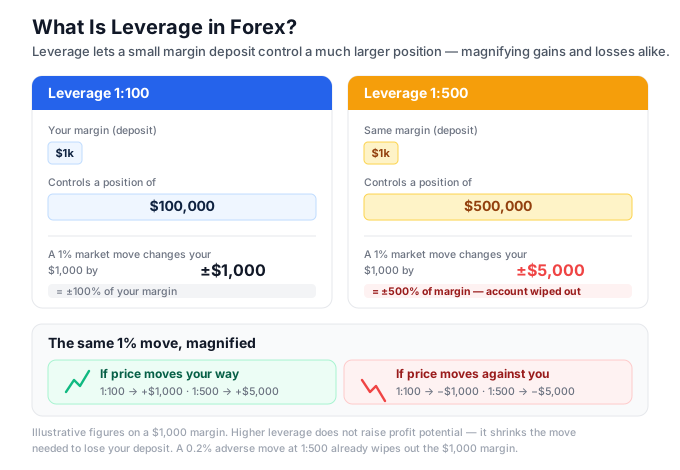
The diagram above shows the core mechanic: leverage is a multiplier on position size, not on your edge. Below we break down the exact margin math for 1:100 and 1:500, the difference between leverage and risk, and the mistake that blows up most new accounts. If you are new to the market itself, start with our guide to forex trading first.
Table of contents
- What is leverage in forex?
- How does leverage actually work?
- How 1:100 and 1:500 leverage work
- Leverage vs margin vs risk
- How to use leverage safely
- Leverage on XAU/USD (gold)
- Common mistakes with leverage
- Leverage vs margin — what’s the difference?
- Frequently asked questions
What is leverage in forex?
The whole mechanic reduces to one formula: the margin (the slice of your own money the broker locks to hold a trade) equals the position’s notional value (the full size of the position in the quote currency) divided by the leverage ratio. Rearrange it and you can read leverage two ways — as the multiple your deposit controls, or as the fraction of the position you must fund yourself.
Margin and leverage are therefore two sides of the same coin: higher leverage means a smaller margin requirement for the same trade. At 1:100, every $1 of your capital controls $100 of currency value, so you fund 1% of the position.
The standard formula is simple:
Required margin = Position size (notional value) ÷ Leverage ratio.
So a position with a notional value of $100,000 needs $1,000 of margin at 1:100, or $200 at 1:500. The rest is supplied by the broker, and you never borrow cash that hits your bank account — the leverage exists only to size the trade.
This is why a trader with a $500 account can place trades worth tens of thousands of dollars, and also why the same trader can lose that $500 faster than they expect. The multiplier works in both directions with no exceptions.
How does leverage actually work?
When you open a trade, the broker checks one thing first: do you have enough margin? It calculates the position’s notional value, divides by your account leverage, and freezes that amount as “used margin.” The rest of your balance stays as “free margin” to absorb losses.
Notional value is the full size of the position in the quote currency. For 1 standard lot of EUR/USD — a lot being the standardised trade-size unit, where one standard lot is 100,000 units — at an illustrative price of 1.1000, the notional value is $110,000. Real prices move every second — treat 1.1000 here as a round teaching number, not a live quote.
At 1:100 leverage, the margin to open that 1.00 lot is $110,000 ÷ 100 = $1,100. At 1:500, the same position needs only $110,000 ÷ 500 = $220. Same trade, same risk per pip — a pip being the smallest standard price move, 0.0001 on most pairs — the only thing that changed is how much of your own cash is tied up.
Profit and loss are driven by pip movement, not by leverage. One standard lot on a USD-quoted pair is worth about $10 per pip. A mini lot (0.10) is $1 per pip, and a micro lot (0.01) is $0.10 per pip. If you want to size a position to a fixed dollar risk, our lot size calculator does the arithmetic for you.
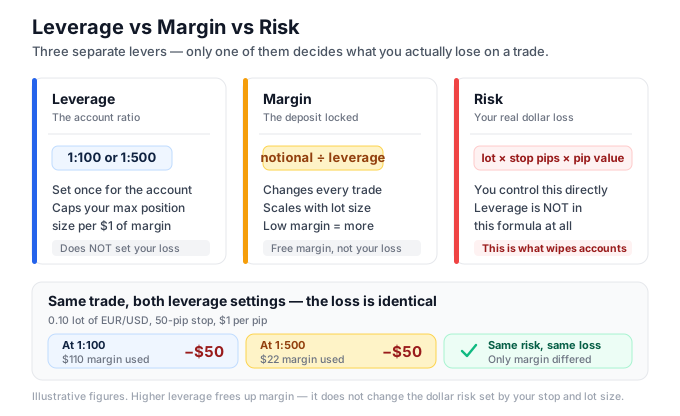
Here is the key insight most beginners miss: leverage changes the margin, not the dollars you win or lose per pip. A 50-pip loss on a 0.10 lot costs $50 whether your account leverage is 1:100 or 1:500. Position size and pip value decide the damage; the leverage ratio only decides how many positions you are allowed to open.
How 1:100 and 1:500 leverage work
The two most common retail leverage settings are 1:100 and 1:500. The difference between them is purely the margin requirement, shown in the table below.
| Detail | 1:100 leverage | 1:500 leverage |
|---|---|---|
| Margin as % of notional | 1% | 0.2% |
| Margin for 1.00 lot at 1.1000 | $1,100 | $220 |
| Margin for 0.10 lot at 1.1000 | $110 | $22 |
| Pip value (0.10 lot) | $1 per pip | $1 per pip |
| Max notional on a $1,000 account | $100,000 | $500,000 |
Notice the pip value row does not change. At both leverage settings, a 0.10 lot is worth $1 per pip. The 1:500 account needs less margin to hold the same trade, which frees up balance to open more or larger positions.
That freed-up balance is the trap. A $1,000 account at 1:500 can technically open positions worth up to $500,000 in notional value. Doing so would mean a single 20-pip move against you could erase the account. The capacity to over-position is the real risk of high leverage, not the ratio itself.
A worked example makes it concrete. Suppose you have $1,000 and 1:500 leverage, and you open 0.10 lot of EUR/USD at 1.1000. Margin used is $110,000 ÷ 10 ÷ 500 = $22, leaving $978 of free margin. Your risk is still set by your stop: a 50-pip stop at $1 per pip is a $50 loss, or 5% of the account, regardless of the 1:500 setting.
The same 0.10 lot at 1:100 ties up $110 of margin instead of $22, but the stop, pip value, and dollar risk are identical. Higher leverage gave you more free margin; it did not make the trade riskier on its own.
Leverage vs margin vs risk
These three terms get tangled constantly, and the confusion is what wrecks accounts. They are related but distinct, and you control them separately.
Leverage is the ratio your broker grants (1:100, 1:500). It sets the maximum position size you can open per dollar of margin. You usually pick it once when you open the account.
Margin is the deposit locked to hold a specific position. It rises and falls with your position size and the leverage setting. When free margin runs too low, you get a margin call and positions may be closed automatically.
Risk is the dollar amount you actually stand to lose on a trade. It is set by your position size multiplied by your stop-loss distance in pips multiplied by the pip value — and nothing else. Leverage does not appear in that calculation.
The trader’s job is to fix risk first, then let margin and leverage fall where they may. Say you risk 1% of a $1,000 account ($10) on a trade with a 50-pip stop; at $0.10 per pip per micro lot, that is a 0.02 lot position. The required margin is trivial at any sensible leverage, and the risk is controlled because you sized to it. To check margin on a specific trade, use our margin calculator.
How to use leverage safely
High leverage is not the enemy — uncontrolled position size is. A 1:500 account run with 1% risk per trade is safer than a 1:30 account run with 10% risk. The setting matters less than the discipline. Here is how to keep leverage on your side.
Size positions by risk, not by available margin. Decide your dollar risk before you look at lot size. Risk a fixed 1% to 2% of the balance per trade and back-calculate the lot from your stop distance.
Always trade with a stop loss. Leverage without a stop is how a 20-pip move closes your account. The stop is what converts an open-ended position into a defined, survivable loss.
Watch free margin, not only balance. Your margin level (equity ÷ used margin) should stay well above the broker’s stop-out threshold. If it drops near 100%, you are over-positioned and one move from a forced close.
Treat 1:500 as a margin convenience, not a position-size invitation. Use the lower margin requirement to hold more cash in reserve, not to pile on five times the lots.
Keep total exposure across open trades in check. Three correlated positions at 0.10 lot each behave like one 0.30 lot trade. Count your real combined exposure, not the per-trade lot size.
The traders who survive their first year are not the ones who avoid leverage. They are the ones who decided their maximum loss per trade in advance and never let the leverage ratio talk them out of it. If you are still building that habit, our seven-step beginner guide covers broker choice, leverage and margin, demo practice and 1% position sizing in order.
Leverage on XAU/USD (gold)
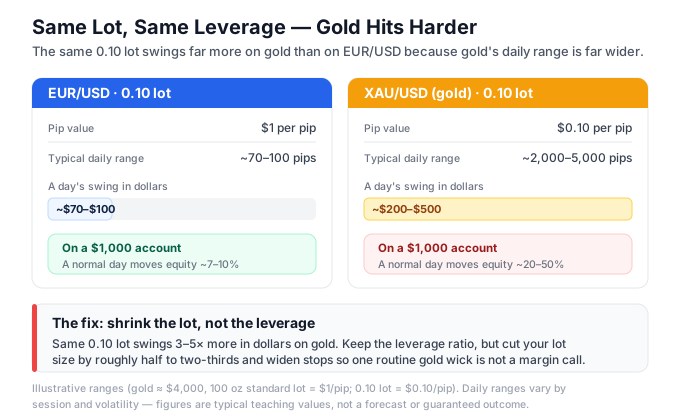
Gold (XAU/USD) is the most-traded retail instrument in 2026, and leverage behaves differently on it in one practical way: the dollar swings are bigger, so the same leverage hurts more.
On gold, one pip is a $0.01 price move — the last decimal of the XAU/USD quote. That makes the pip value $1 per pip per standard lot (100 oz), $0.10 per pip per 0.10 lot (10 oz), and $0.01 per pip per 0.01 lot (1 oz). A full $1.00 move in gold is therefore 100 pips, worth $100 on a standard lot. The catch is gold’s average daily range: roughly $20 to $50, which is 2,000 to 5,000 pips — several times the dollar swing of a major pair.
That wider range changes the math on a leveraged account. A 0.10 lot gold position (10 oz) in a normal session can swing $200 to $500 in unrealised profit or loss before lunch, because a $20 to $50 daily range on 10 oz is exactly that dollar move. On a $2,500 account, that is an 8% to 20% equity swing from a position that felt small. Gold demands wider stops and therefore smaller lot sizes for the same dollar risk.
A practical rule: when you move a strategy from EUR/USD to XAU/USD, cut your lot size by roughly half to two-thirds to account for gold’s wider stops. The leverage ratio stays the same; your position size must shrink so that one of gold’s routine wicks does not become a margin call.
Common mistakes with leverage
Confusing high leverage with high risk. Leverage sets margin, not loss per pip. Fix: judge risk by position size and stop distance, not by the 1:100 or 1:500 label on the account.
Sizing positions to maximum margin. A $1,000 account can open $500,000 of notional value at 1:500, but that does not mean it should. Fix: size every trade to a fixed 1% to 2% account risk and ignore the maximum.
Trading without a stop loss. A leveraged position with no stop has an undefined, account-sized downside. Fix: set the stop before you enter, and let it define your position size.
Ignoring free margin until the margin call. New traders watch balance and forget margin level until positions are force-closed at the worst price. Fix: monitor your margin level and keep it comfortably above the broker’s stop-out percentage.
Stacking correlated trades. Opening EUR/USD, GBP/USD, and AUD/USD longs at once multiplies dollar exposure because they often move together. Fix: treat correlated positions as one combined trade when you total your risk.
Forgetting pip value scales with lot size. Doubling the lot doubles the dollar-per-pip and the loss. Fix: know your pip value per lot before entering, and confirm the dollar risk matches your plan.
Leverage vs margin — what’s the difference?
Readers searching “what is leverage” almost always also mean “what is margin,” and conflating them leads to bad position sizing. The table settles it.
| Leverage | Margin | |
|---|---|---|
| What it is | A ratio of position size to your capital | The cash deposit locked to hold a position |
| Expressed as | 1:100, 1:500 | A dollar amount or % of notional |
| Set by | The broker / your account choice | Your position size and leverage together |
| Changes per trade? | No — fixed for the account | Yes — scales with lot size |
| Direct effect | Caps your maximum position size | Determines free margin and margin-call risk |
Think of leverage as the ceiling and margin as the rent. Leverage decides how big a position you are allowed to open; margin is the actual deposit charged when you open one. A 1:500 account has a high ceiling and cheap rent, but the position you choose to open is what determines whether you survive.
Both are mechanical facts of the account. Neither one decides your profit or loss — that is set entirely by pip movement, position size, and the pip value of the pair you trade.
Frequently asked questions
What does leverage mean in simple terms?
Leverage means using a small amount of your own money to control a much bigger trade, with your broker supplying the rest. If your account has 1:100 leverage, $100 of your cash can control a $10,000 position. You only put up a fraction (the margin) as a deposit; the broker covers the difference. It scales the size of the position, not the quality of the trade — every gain and loss is multiplied to the same degree.
Is leverage free, or do you pay interest on it?
There is no upfront interest charge for using leverage — you do not borrow cash that lands in your account, so there is no loan repayment. What you can pay is an overnight swap (also called a rollover): a small credit or debit applied when you hold a leveraged position past the daily rollover time, set by the interest-rate difference between the two currencies. Trades opened and closed the same day usually pay no swap, so intraday leverage is effectively free, while positions held for days or weeks accrue swap each night.
How does leverage actually work in forex?
Leverage lets a small deposit control a larger position, with your broker funding the rest. The ratio (1:100, 1:500) sets how much margin you need: margin equals the position’s notional value divided by the leverage. At 1:100 that is 1% of the position; at 1:500 it is 0.2%. Profit and loss still come from pip movement, not from the ratio itself.
What does 1:500 leverage mean?
1:500 leverage means $1 of your capital controls $500 of currency, so the required margin is 0.2% of the position’s notional value. A $110,000 position needs only $220 of margin. The pip value is unchanged versus a lower leverage setting — 1:500 reduces the margin locked up, freeing balance that you should not automatically use to open bigger trades.
Is 1:500 leverage too high for beginners?
1:500 is not dangerous by itself; over-sizing positions is. The high setting tempts new traders to open lots far larger than their account can absorb. If you size every trade to 1% to 2% risk with a stop loss, 1:500 is fine. If you trade by “maximum margin available,” even 1:30 will eventually wipe you out.
What’s the difference between leverage and margin?
Leverage is the ratio of position size to your capital (1:100). Margin is the actual cash deposit locked to hold a position. They are linked: higher leverage means a smaller margin requirement for the same trade. Leverage is set for the account; margin changes with every trade depending on your lot size and the pair’s price.
Does higher leverage mean higher risk?
Not directly. Two accounts at 1:100 and 1:500 trading the identical 0.10 lot with the same 50-pip stop lose the same $50 — leverage only changes the margin tied up. Risk is set by position size times stop distance times pip value. Higher leverage becomes higher risk only when traders use the freed margin to open larger positions.
How much can I lose with leverage?
You can lose your entire account, and on most retail accounts no more — negative-balance protection (where offered) caps losses at your deposit. The faster you lose it depends on position size, not the leverage label. A large leveraged position with no stop can erase an account in a single fast move, which is why a stop loss is non-negotiable.
What leverage should I use on a small account?
For a $500 to $5,000 account, the leverage setting matters far less than your risk per trade. Many traders pick 1:100 to 1:500 and then risk a fixed 1% to 2% per trade with a stop. The discipline of fixed-percentage risk — not the ratio — keeps a small account alive long enough to learn.
Does leverage work the same on gold (XAU/USD)?
The margin math is identical: margin equals notional value divided by leverage. What differs is gold’s wider range. One gold pip is a $0.01 move, so a $20 to $50 daily range is 2,000 to 5,000 pips, and a 0.10 lot (10 oz) at $0.10 per pip swings $200 to $500 a day. The same lot size swings far more in dollars on gold, so cut your lot size by roughly half to two-thirds and use wider stops when applying leverage to XAU/USD.
Glossary of related terms
- Leverage — a ratio (1:100, 1:500) showing how much position size each dollar of margin controls.
- Margin — the deposit locked to hold a leveraged position; equals notional value divided by leverage.
- Notional value — the full size of a position in the quote currency (1.00 lot of EUR/USD at 1.1000 = $110,000).
- Pip — the smallest standard price move; 0.0001 on most pairs, 0.01 on JPY pairs. See what is a pip.
- Pip value — the cash value of a one-pip move; about $10 per pip per standard lot on a USD-quoted pair.
- Lot — the standardised position size; standard = 100,000 units, mini = 10,000, micro = 1,000.
- Margin level — equity divided by used margin, shown as a percentage; a low level risks a margin call.
- Margin call — a broker warning (and possible forced close) when free margin runs too low.
- Free margin — the balance not locked as used margin, available to absorb losses or open new trades.
- Stop-out level — the margin level at which the broker automatically closes positions.
Related reading
Risk disclaimer: Forex and CFD trading carries a high level of risk and may not be suitable for all traders. The strategies and indicators described in this article are educational. Past performance does not guarantee future results. Always test on a demo account before risking real capital.