

Last updated: June 30, 2026 · By: Tim Morris, founder of ForexMT4Indicators.com
A pip is the standard smallest price move in a forex pair: 0.0001 for most pairs, 0.01 for JPY pairs. It is the unit you measure profit, loss, spread, and risk in. On a USD-quoted standard lot (a lot is the standardised trade size — a standard lot is 100,000 units), one pip is worth about $10; a mini lot, $1; a micro lot, $0.10.
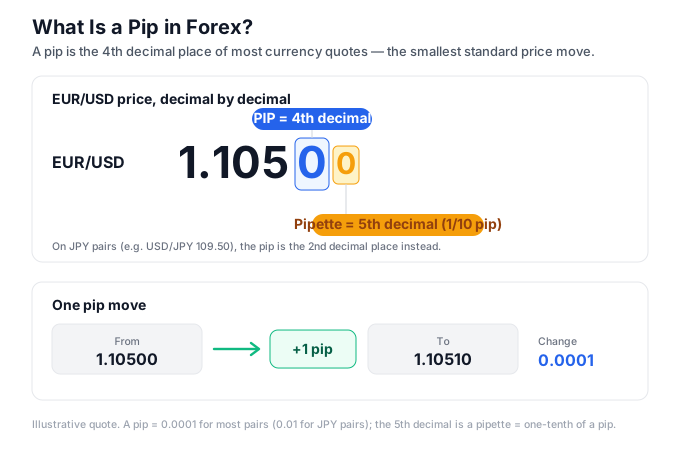
The diagram below breaks a EUR/USD quote down to the pip and a pipette (one-tenth of a pip) so you can see exactly which digit moves. Once you can read that digit, the rest of forex math — the spread (the bid-ask gap you pay to enter), stop size, and position size — follows directly.
This guide is part of our wider forex trading foundation series. It covers what a pip is, what one pip is worth across lot sizes, how to calculate pip value by hand, and the gold and JPY cases that trip up new traders.
What is a pip
A pip (price interest point) is the standardised smallest unit of price change in a currency pair. For the majority of pairs — EUR/USD, GBP/USD, AUD/USD, USD/CHF — one pip is the fourth decimal place: 0.0001.
So if EUR/USD moves from 1.1000 to 1.1001, that is a one-pip move. A move from 1.1000 to 1.1050 is 50 pips. The pip is the ruler; everything else in trading is measured against it.
For pairs quoted with the Japanese yen — USD/JPY, EUR/JPY, GBP/JPY — one pip is the second decimal place: 0.01. A move on USD/JPY from 157.00 to 157.01 is one pip. JPY pairs use fewer decimals because the yen’s per-unit value is much smaller than the dollar’s.
The pip standardises the conversation. When a trader says “I took 30 pips” or “my stop is 20 pips,” every other trader knows what that means regardless of account size, broker, or lot. It is the shared language of price movement.
Why the pip matters in forex trading
The pip is the bridge between price movement and money. Price moves in pips; your account moves in dollars. Pip value is the exchange rate between the two, and you cannot size a trade correctly without it.
Every risk decision runs through the pip. Your stop loss is a number of pips. Your risk in dollars is pips multiplied by pip value multiplied by lot size. Skip the pip and you are guessing at position size — which is how small accounts blow up on a single trade.
Pips also let you compare setups across instruments fairly. A 40-pip move on EUR/USD and a 40-pip move on GBP/USD give the same dollar outcome at the same lot size (both USD-quoted). That comparability is why traders journal results in pips and R-multiples, not raw cash. The spread — your cost to enter — is quoted in pips too, so the same math gives you the dollar cost of every trade.
What is one pip worth
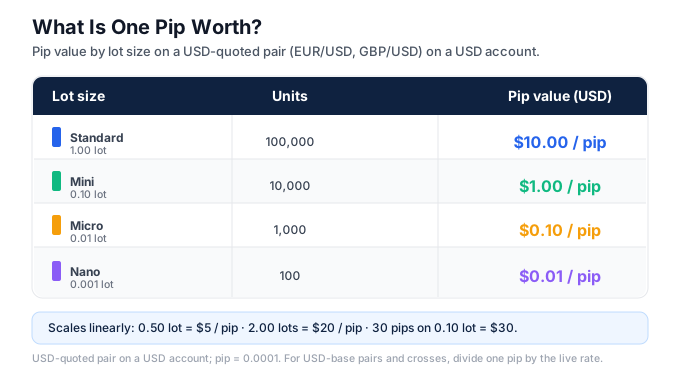
Pip value depends on three things: the pair, the lot size, and your account currency. The cleanest case — and the one worth memorising — is a USD-quoted pair (the pair ends in USD, like EUR/USD or GBP/USD) on a USD account.
For those pairs, pip value is fixed because the quote currency is your account currency:
| Lot size | Units | Pip value (USD-quoted pair) |
|---|---|---|
| Standard (1.00) | 100,000 | $10.00 per pip |
| Mini (0.10) | 10,000 | $1.00 per pip |
| Micro (0.01) | 1,000 | $0.10 per pip |
| Nano (0.001) | 100 | $0.01 per pip |
These numbers scale linearly. A 0.50 lot is 5× a 0.10 lot, so it is $5 per pip. A 2.00 lot is $20 per pip. Hold this table in your head and you can size most major-pair trades without a calculator.
A worked example makes it concrete. You buy 0.10 lot of GBP/USD and price moves 30 pips in your favour: 30 pips × $1.00 = $30 profit. The same 30 pips on a 1.00 lot would be $300. Same move, different lot, 10× the result.
Pip value is fixed only for pairs where USD is the quote currency. For pairs where USD is the base (USD/JPY, USD/CAD, USD/CHF) or for crosses with no USD (EUR/GBP, AUD/JPY), pip value shifts slightly with the live exchange rate. The next section shows why.
How to calculate pip value by hand
The base formula is short:
Pip value = (one pip ÷ exchange rate) × position size in units
The “one pip” term is 0.0001 for most pairs and 0.01 for JPY pairs. From there, three cases cover almost everything you will trade.
Case 1: USD is the quote currency (EUR/USD, GBP/USD, AUD/USD)
Here the math collapses to the fixed USD-quoted pip values. One pip (0.0001) × 100,000 units = $10 per standard lot, full stop. No conversion is needed because the pip is already denominated in USD.
For a 0.10 lot: 0.0001 × 10,000 = $1.00. For a 0.01 lot: 0.0001 × 1,000 = $0.10. This is why USD-quoted majors are the easiest pairs to size.
Case 2: USD is the base currency (USD/JPY, USD/CAD, USD/CHF)
Now the pip is denominated in the quote currency, so you divide by the live price to convert back to USD.
For USD/JPY at 157.00: pip value per standard lot = (0.01 ÷ 157.00) × 100,000 = $6.37 per pip. The pip is 0.01 here because it is a JPY pair. As USD/JPY rises, each pip is worth slightly less in USD; as it falls, slightly more.
Case 3: A cross with no USD (EUR/GBP, EUR/JPY, AUD/CAD)
Calculate the pip value in the quote currency first, then convert to USD using that quote currency’s USD rate.
For EUR/GBP at 0.8500: pip value = 0.0001 × 100,000 = £10 per standard lot. Convert with GBP/USD at, say, 1.2700: £10 × 1.2700 = $12.70 per pip. The extra step is the only thing that makes crosses feel harder — the principle is identical.
If you would rather skip the arithmetic on live numbers, our pip value calculator does all three cases with current rates pulled in automatically.
What is a pipette (fractional pip)
A pipette is one-tenth of a pip — the fifth decimal place on most pairs, or the third decimal on JPY pairs. Brokers added it for finer pricing precision.
On a five-decimal EUR/USD quote like 1.10852, the “5” is the pip and the trailing “2” is the pipette. The price has moved 2 pipettes, or 0.2 pips, above 1.1085. The diagram near the top of this guide labels exactly this digit.
Pipettes matter for two reasons. First, they make spreads look bigger than traders expect — a “12” on the broker’s display is 1.2 pips, not 12 pips. Second, they let brokers compete on tighter pricing, sometimes shaving a fraction of a pip off the cost of entry.
Do not confuse a pipette with a pip when reading your platform. Most beginner “my spread is huge” panics come from misreading the fifth decimal as whole pips.
Pips on XAU/USD (gold)
Gold trips up almost every trader who arrives from forex, because “pip” is used loosely on XAU/USD. On gold, one pip is a $0.01 price move — the last decimal of the quote — for example, $2,350.00 to $2,350.01. A standard XAU/USD lot is 100 ounces, so a $0.01 move on 100 ounces is $1.00.
That gives gold its own pip-value-per-lot figures: $1.00 per pip per standard lot (100 oz), $0.10 per pip per 0.10 lot (10 oz), $0.01 per pip per 0.01 lot (1 oz). A full $1.00 move in gold is therefore 100 pips, worth $100 on a standard lot ($10 on a 0.10 lot, $1 on a 0.01 lot). The price scale, not the per-lot structure, is what differs from a USD forex pair.
The trap is range. Gold routinely covers $20-$50 in a single day — roughly 2,000-5,000 pips at $0.01 per pip — and throws wicks that dwarf forex. A 20-pip stop that is normal on EUR/USD H1 gets wicked out almost instantly on XAU/USD. Plan gold stops in the thousands of pips and size down accordingly.
Many gold platforms also quote a “point” and a “pip” inconsistently, so always confirm what one tick is worth on your specific broker before sizing. Our Gold (XAUUSD) Pip Value Explained walkthrough and the calculator settle this for any broker: $0.01 = 1 pip = $1 per standard lot.
How pips connect to spread and lot size
Three numbers turn a chart into a trade plan: pip value, spread, and lot size. They are linked by simple multiplication.
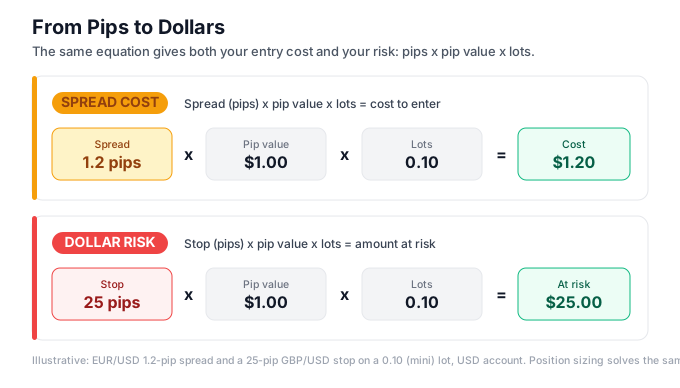
Spread cost in dollars = spread (in pips) × pip value × lots. A 1.2-pip EUR/USD spread on a 0.10 lot costs 1.2 × $1.00 = $1.20 to enter. The same spread on a 1.00 lot costs $12. Spread is a per-lot tax, so it scales with size.
Risk in dollars = stop distance (in pips) × pip value × lots. A 25-pip stop on a 0.10 lot of GBP/USD risks 25 × $1.00 = $25. To risk a fixed $50 with a 25-pip stop, you would trade 0.20 lots.
Position sizing runs that equation backwards: pick your dollar risk and stop in pips, then solve for lots. Our lot size calculator does this in one step, and our guide to the spread covers the cost side in depth.
This is the whole reason the pip exists as a unit. It is the constant that lets you move cleanly between price, cost, and risk without re-deriving the math on every trade. Getting comfortable with that math early is part of how to begin trading forex safely.
Common mistakes traders make with pips
Reading the pipette as a pip. A five-decimal quote adds one more decimal place (10× finer resolution) than a pip-level quote. Fix: the pip is the 4th decimal (2nd on JPY pairs); the last digit is one-tenth of that.
Assuming pip value is always $10 per lot. It is $10 only on USD-quoted standard lots. Fix: for USD-base pairs and crosses, divide one pip by the live exchange rate, then multiply by position size.
Using forex pip habits on gold. A 20-pip stop is sane on EUR/USD and suicidal on XAU/USD, where one pip is only $0.01. Fix: size gold stops in the thousands of pips to match its $20-$50 daily range, and reduce lots accordingly.
Forgetting the spread when counting pips. A 5-pip target with a 1.5-pip spread only nets 3.5 pips. Fix: subtract the spread from every short-target scalp before deciding if the setup is worth it.
Mixing pip value with account currency. A trader on a EUR account assumes $10 per pip. Fix: convert pip value into your account currency, not USD, when the two differ.
Ignoring JPY’s different pip. Treating USD/JPY’s pip as 0.0001 inflates every calculation 100×. Fix: JPY pairs use 0.01 as the pip, always.
Pip vs pipette vs point
These three terms get used interchangeably and they should not be. Settling the difference removes most quote-reading confusion.
| Pip | Pipette | Point | |
|---|---|---|---|
| Definition | Standard smallest move | One-tenth of a pip | Smallest digit the broker shows |
| Forex value | 0.0001 (0.01 on JPY) | 0.00001 (0.001 on JPY) | Usually the pipette |
| Where you see it | 4th decimal | 5th decimal | Last decimal on the platform |
| Used for | Stops, targets, spread | Fine pricing precision | Broker tick definition |
| Common error | — | Misread as whole pips | Confused with pip on gold |
In everyday trading, “pip” is the unit you plan with, “pipette” is the precision digit, and “point” is whatever your specific broker defines as one tick. When a broker says “points,” check whether they mean pips or pipettes before you size anything.
Frequently asked questions
What is a pip in forex in simple terms
A pip is the standard smallest price move in a currency pair — 0.0001 for most pairs, 0.01 for JPY pairs. It is the unit you measure profit, loss, stops, and spread in. If EUR/USD moves from 1.1000 to 1.1010, that is a 10-pip move.
What does pip stand for
Pip stands for “price interest point” (also written “percentage in point”). It is the standardised smallest price move in a currency pair — 0.0001 on most pairs and 0.01 on JPY pairs — and it is the unit traders use to quote moves, stops, targets, and spread.
Is a pip the same as a point
No. A pip is the standardised smallest move (0.0001 on most pairs, 0.01 on JPY pairs), while a “point” is whatever the smallest digit your broker’s platform displays — usually a pipette (one-tenth of a pip) on a five-decimal feed. When a broker quotes “points,” confirm whether they mean pips or pipettes before sizing a trade, because the two differ by a factor of 10.
How much is one pip worth
On a USD-quoted pair, one pip is worth $10 per standard lot (100,000 units), $1 per mini lot (0.10), and $0.10 per micro lot (0.01). For USD-base pairs and crosses, the value shifts with the live exchange rate, so divide one pip by the current price and multiply by your position size.
What is the difference between a pip and a pipette
A pipette is one-tenth of a pip — the fifth decimal on most pairs, the third on JPY pairs. On a 1.10852 EUR/USD quote, the “5” is the pip and the “2” is the pipette. The most common beginner error is reading the pipette digit as whole pips, which makes spreads look 10× larger than they are.
How do I calculate pip value for gold (XAU/USD)
On gold, one pip is a $0.01 move (the last decimal of the quote), and a standard XAU/USD lot is 100 ounces, which gives $1.00 per pip per standard lot, $0.10 per 0.10 lot, and $0.01 per 0.01 lot. A full $1.00 move in gold is 100 pips, worth $100 on a standard lot. The difference from forex is range — gold covers $20-$50 a day, or roughly 2,000-5,000 pips, so stops need to be far wider than on forex pairs. Confirm what one tick means on your broker, since gold “points” and “pips” are quoted inconsistently.
Why is the pip different on JPY pairs
JPY pairs use 0.01 as one pip instead of 0.0001 because the yen’s per-unit value is roughly 100× smaller than the dollar’s. A quote like 157.00 only needs two decimals to express meaningful moves, so the pip sits in the second decimal place rather than the fourth.
How many pips is a good stop loss
There is no universal number — it depends on the pair, timeframe, and volatility. On EUR/USD H1, stops of 20-40 pips are common; on XAU/USD H1, stops run into the thousands of pips because one gold pip is just $0.01 and the metal’s wicks are large. Size the stop to the chart structure first, then set lot size so your dollar risk stays within your plan.
Glossary of related terms
- Pip (price interest point) — the standard smallest price move; 0.0001 on most pairs, 0.01 on JPY pairs.
- Pipette — one-tenth of a pip; the fifth decimal on most pairs.
- Spread — the gap between bid and ask, quoted in pips; your cost to enter. Read more
- Lot — the standardised trade size; standard = 100,000 units, mini = 10,000, micro = 1,000.
- Pip value — the dollar worth of one pip for a given pair and lot size.
- Spread cost — spread in pips × pip value × lots; the dollar cost of opening a position.
- Base currency — the first currency in a pair (EUR in EUR/USD).
- Quote currency — the second currency in a pair (USD in EUR/USD); the pip is denominated here.
Related reading
- Forex trading: how the market works
- What is the spread in forex
- Pip value calculator
- Lot size calculator
- Currency pairs explained
Risk disclaimer: Forex and CFD trading carries a high level of risk and may not be suitable for all traders. The strategies and indicators described in this article are educational. Past performance does not guarantee future results. Always test on a demo account before risking real capital.