

Last updated: July 20, 2026 · By: Tim Morris, founder of ForexMt4Indicators.com
A requote is a broker’s refusal to fill your order at the price you clicked, followed by an offer of a new price you must accept or reject. Your order is not executed — it is rejected and re-offered. That is what separates a requote from slippage, where the order does fill, at a different price.
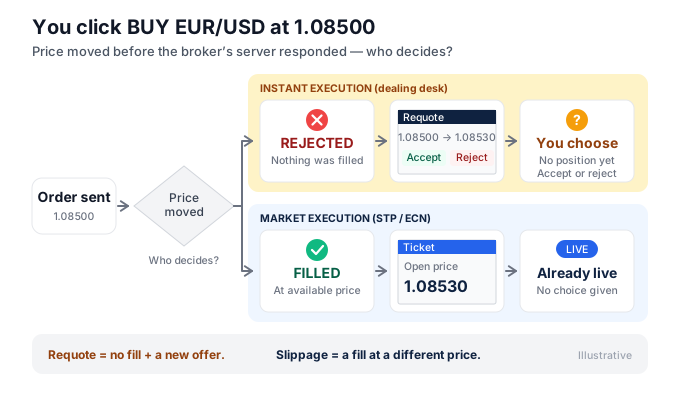
The diagram above traces the two paths a market order can take when price moves between your click and the broker’s response. One ends in a pop-up asking permission; the other ends in a fill you never approved. Our slippage in forex guide covers that second path in full, and we will not repeat it here.
Requotes are less about your timing than about who sits on the other side of your order. Understanding how forex brokers work — whether yours quotes a price it can decline or routes you to a market — explains most of what follows.
What is a requote in forex?
A requote happens when you send a market order at a displayed price and the broker responds that the price is no longer available. Instead of filling you, it returns a new bid or ask and asks whether you accept.
Nothing has executed at that moment. You have no position and no ticket — you have a dialog box and a few seconds to decide.
In MT4 and MT5 the message is blunt — a “Requote” window showing the old price beside the new one, with Accept and Reject buttons.
The mechanic exists because some brokers quote a price they are not obliged to honour. The quote is an invitation, not a firm offer. When the market moves in the gap between your click and their server, they hand the decision back to you.
Requote vs slippage — what is the actual difference?
This is the confusion that costs traders the most, because the two feel identical in the moment and are fixed by different actions.
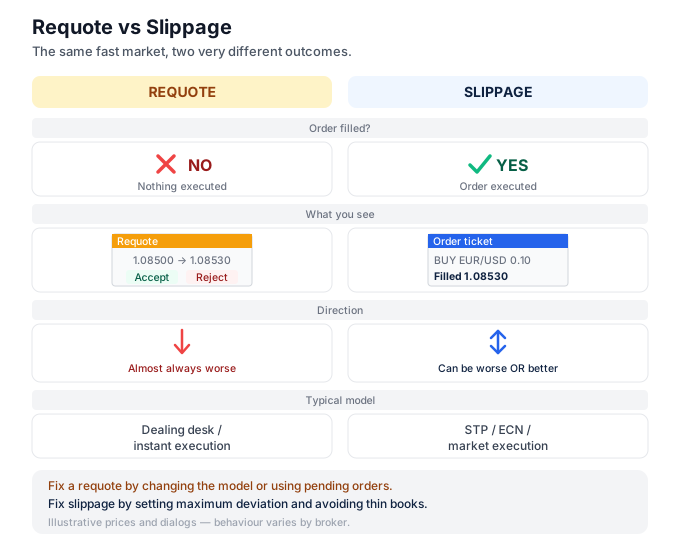
A requote is a rejection plus a new offer. Slippage is a completed fill at an unexpected price. In one you still have a choice; in the other the choice was made for you.
| Requote | Slippage | |
|---|---|---|
| Did the order fill? | No — rejected | Yes — filled |
| What you see | A pop-up offering a new price | A ticket at a price you did not click |
| Your next action | Accept or reject | Nothing — it is done |
| Direction | Almost always worse for you | Can be worse or better |
| Typical execution model | Dealing desk / market maker | STP, ECN, and most market routing |
| Main cost | Missed entries, chasing price | The price difference on the fill |
| How you reduce it | Change execution model, use pending orders | Set maximum deviation, avoid thin liquidity |
Read the “direction” row twice. Slippage can land in your favour — a buy filling below your requested price is positive slippage, and it happens often enough to notice.
A requote almost never favours you. If price had moved to a better level, there would be no reason to ask permission.
That asymmetry is the practical test. If you review a month of trades and every re-offered price was against you, you are not looking at random market noise — you are looking at the execution model doing what it is designed to do.
Why do requotes happen?
There are two causes, and only one of them is about the market.
The first is genuine price movement. In a fast market the quote on your screen can be a second old, and a second is a long time during a data release. The broker cannot fill a stale price without eating the difference, so it asks.
The second is structural, and it matters more. Requotes are characteristic of dealing-desk or market-maker execution, where the broker is your counterparty and quotes a price it retains the right to decline.
Under true STP or ECN routing, your order passes to liquidity providers and fills at whatever is available. There is no permission step, so the same fast market produces slippage instead of a requote.
Frequent requotes are therefore a property of the account type you opened, not of your reaction speed. That choice is made at signup, which is why our guide to your first forex trade covers broker and account type before you ever place one. No amount of clicking faster changes a model built to ask.
Thin liquidity compounds both causes. When the order book is shallow — exotic pairs, the Asian session on a European cross, the minutes around a rollover — there is less depth to absorb your order.
When do requotes cluster?
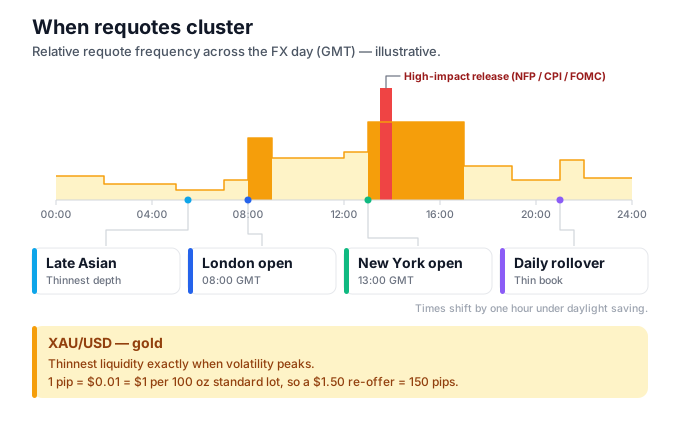
They are not evenly spread across the week. In our own trade logs they bunch into four windows, and knowing them removes most of the problem without changing anything else.
High-impact news releases. CPI, non-farm payrolls, and FOMC decisions produce the densest requote clusters of the month. NFP prints at 08:30 New York time — 13:30 GMT in winter, 12:30 GMT during US daylight saving — and the first 60 to 120 seconds are the worst of it.
Session opens. The London open around 08:00 GMT and the New York open around 13:00 GMT bring a burst of orders before depth rebuilds. Times shift by an hour when the northern hemisphere changes clocks.
Thin hours. The late Asian session and the daily rollover window carry the least depth of the 24-hour cycle. Spreads widen, and quotes go stale faster than they do at midday London.
Exotic and low-volume pairs. USD/TRY, USD/ZAR, and similar pairs sit in a permanently thinner book. What counts as a fast market on EUR/USD is an ordinary Tuesday on an exotic.
Cross-reference those windows against your own requote history before blaming the platform. If your rejections concentrate in the first two minutes of a red-folder release, the fix is a calendar, not a support ticket.
Why did my order get requoted? A three-step diagnostic
Work through these in order. The answer changes what you do next.
Step 1 — Check the clock against the calendar. Was the order sent within two minutes of a scheduled high-impact release, a session open, or the rollover? If yes, the cause is market conditions, and the fix is timing.
Step 2 — Check your account’s execution model. Find the account type in your broker’s contract specifications — “instant execution” is the model that requotes; “market execution” generally is not. If you are on instant execution and requoted outside volatile windows, the model is the cause.
Step 3 — Check the direction pattern. Log 20 requotes with the requested price, the re-offered price, and whether the trade was in profit or loss. If re-offers cluster on orders that would have closed a losing position, that pattern is worth escalating.
That third step is the one traders skip. A broker that requotes entries and exits at random is behaving like a broker in a fast market; one that mainly finds the price unavailable when you are cutting a loss is showing you something else.
Document it with timestamps and screenshots either way. The same evidence file is what you need if a dispute later reaches your broker’s regulator, and it is the sort of record that also matters when you withdraw funds from a broker and want a clean account history behind you.
Does gold (XAU/USD) get requoted more?
Yes, and the cost is heavier than the same event on a major.
Gold’s liquidity thins at exactly the moment its volatility spikes. Around CPI, NFP, and FOMC, XAU/USD sees both more requotes and wider slippage than EUR/USD, because the order book empties as the range explodes.
The math makes it expensive. One gold pip is a $0.01 move, a standard lot is 100 ounces, so a pip is worth $1 per standard lot. Gold’s daily range of $20 to $50 is roughly 2,000 to 5,000 pips.
A rejected order you re-accept $1.50 higher has cost 150 pips before the trade begins. The same rejection on EUR/USD, moving 3 pips, is a rounding error by comparison.
Treat gold entries around scheduled data as pending orders, or as trades you do not take. Chasing a re-offered gold price during an NFP spike is the most reliably expensive habit we see in reader trade logs.
How do you reduce requotes?
You cannot remove them entirely, and any service claiming otherwise is selling something. You can make them rare enough to stop mattering.
Match the execution model to how you trade. Market execution accepts slippage in exchange for a fill; instant execution offers price certainty with the right to requote. If you trade news or scalp fast conditions, a model that can decline your order is the wrong tool. Check the contract specifications before funding, and use our how to choose a forex broker checklist.
Use pending orders instead of chasing market orders. Our forex order types guide covers which order does what; the short version is that a limit order will not fill at a worse price, so there is nothing to requote.
Stay out of the first two minutes of high-impact news. Waiting 120 seconds costs you nothing on any strategy with a multi-hour hold, and it removes the densest requote window of the month.
Trade during liquid sessions. London and New York carry the deepest books. The same setup traded at 03:00 GMT on a cross meets a fraction of the depth.
Set a maximum deviation where the platform offers it. In MT4 and MT5, “maximum deviation from quoted price” lets an order fill within a tolerance instead of bouncing back, converting small requotes into small, bounded slippage.
Size and time trades to the instrument. Wider-range instruments need earlier entries, not faster clicking. A spread comparison shows where depth is thinnest, since spread and liquidity move together.
Point 5 is where most traders find immediate relief. A deviation of a few pips on a major turns a rejection into a fill you can live with, and you keep control of the ceiling.
Common mistakes traders make with requotes
Re-clicking repeatedly into a moving market. Each rejection is followed by another click at a worse level, and three rounds later the entry is nowhere near the plan. Fix: one rejection means the setup is gone. Cancel and wait for the next.
Blaming the platform instead of the execution model. Traders reinstall MT4, change VPS, and upgrade internet to solve something that is written into the account type. Fix: read the contract specifications for your account and confirm whether it is instant or market execution.
Trading news on a dealing desk. Instant execution and a red-folder release are the worst possible combination, because both the volatility and the right to decline peak at once. Fix: either move to market execution for news trading or stay flat through the release.
Treating a requote as slippage in the trade journal. Logging them together hides the pattern, because one is a fill and the other is a rejection. Fix: track them in separate columns with the requested and re-offered price.
Accepting every re-offered price out of impatience. The pop-up creates urgency, and urgency is what makes traders take an entry 8 pips worse than the level their plan specified. Fix: decide in advance the maximum worse-price you will accept, and reject anything past it.
Using market orders for exits during volatility. Getting requoted while closing a losing position is where requotes do real damage, and traders write it off as bad luck. Fix: place a stop-loss order at entry so the exit is already resting in the book.
Frequently asked questions
What does requote mean in forex trading?
A requote means the broker declined to fill your order at the price you clicked and offered a different price instead. Nothing executed — you get a pop-up with the old and new price and must accept or reject. It is most common with dealing-desk or instant-execution accounts during fast-moving markets.
Is a requote the same as slippage?
No. A requote is a rejection followed by a new offer, so no trade happens until you accept. Slippage is a completed fill at a price different from the one you requested. Requotes give you a choice; slippage does not.
Requotes are almost always worse for you, while slippage can go either way.
Why does my broker keep requoting me?
Two causes. Either you are trading during fast or thin conditions — news releases, session opens, exotic pairs — or your account uses an execution model that quotes prices it can decline. Check whether your account type is instant execution or market execution in the contract specifications; that single detail explains most repeat requotes.
How do I stop getting requotes in MT4?
Set a maximum deviation from the quoted price in the order window, which lets small differences fill instead of bouncing back. Use pending orders rather than market orders in fast conditions. Avoid the first minutes of high-impact news. If requotes persist in calm markets, the account’s execution model is the cause.
Do ECN brokers requote?
Generally no. Under true ECN or STP routing, your order goes to liquidity providers and fills at the available market price, so a fast market produces slippage rather than a rejection. Verify the routing in the broker’s own contract specifications rather than its marketing pages, and confirm current terms before funding.
Are requotes a sign of a scam broker?
Not on their own — requotes are a normal feature of instant-execution pricing. The warning sign is a pattern: re-offers concentrated on your losing exits, or requotes in calm midday conditions on EUR/USD. Log 20 events with timestamps and prices before drawing a conclusion, and escalate with that evidence.
Does gold get requoted more than currency pairs?
Yes. XAU/USD liquidity thins exactly when volatility rises, so requotes and slippage both increase around CPI, NFP, and FOMC. The cost is larger too: at $1 per pip per 100-ounce standard lot with a 2,000 to 5,000 pip daily range, a re-offered gold price can be 150 pips worse before you have a position.
Glossary of related terms
- Requote — a broker’s rejection of your order at the displayed price, with a new price offered for your approval.
- Slippage — a completed fill at a price different from the one requested; can be negative or positive.
- Instant execution — a model where the broker quotes a price it may decline; the model that produces requotes.
- Market execution — a model where the order fills at the available market price, producing slippage instead.
- Dealing desk / market maker — a broker that acts as counterparty to your trade and sets its own quotes.
- Maximum deviation — an MT4/MT5 setting defining how far from the quoted price an order may still fill.
- Liquidity — the depth of orders available at a given price; thin liquidity worsens fills.
Related reading
Risk disclaimer: Forex and CFD trading carries a high level of risk and may not be suitable for all traders. The strategies and indicators described here are educational. Past performance does not guarantee future results. Test on a demo account before risking real capital.
Ready to put this into practice?
Open an account with a regulated broker and apply what you have learned. These are the three brokers we recommend:
Trading forex and CFDs carries a significant risk of loss and is not suitable for everyone. Broker links are affiliate links — we may earn a commission at no cost to you.