

Last updated: July 20, 2026 · By: Tim Morris, founder of ForexMt4Indicators.com
Non-Farm Payrolls (NFP) is the monthly change in US jobs excluding farm work, published by the Bureau of Labor Statistics inside the Employment Situation report. It usually lands on the first Friday of the month at 8:30am US Eastern. Spreads widen, stops slip, and price often spikes then reverses within minutes.
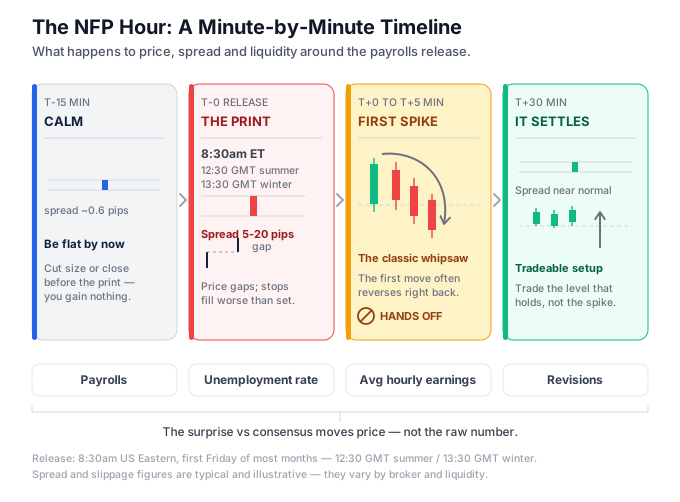
The diagram above lays the NFP hour out on a single timeline — the calm before, the spread blowout at the release, the first spike, and the point where direction usually settles. The rest of this guide turns that timeline into decisions you can make before Friday arrives.
NFP sits at the top of every high-impact event list, so start by learning to read a forex economic calendar properly — the release time, the consensus forecast, and the previous figure are the three numbers that decide how the next hour behaves.
What is the Non-Farm Payrolls report?
NFP is one line inside a larger monthly publication called the Employment Situation report, produced by the US Bureau of Labor Statistics. The headline number is the net change in US payroll employment for the previous month, excluding farm workers, private household employees, and a few other categories.
The “non-farm” exclusion exists because agricultural hiring swings hard with the seasons and would distort the trend. Stripping it out leaves a cleaner read on the health of the US labour market.
Traders care because the US dollar sits on one side of roughly nine out of every ten forex transactions in a market turning over about $9.6 trillion a day (BIS Triennial Survey, April 2025). A number that changes the outlook for the dollar changes the price of almost everything on your platform.
NFP is not released alone. Two companion numbers arrive in the same second, and on some months they matter more than the headline.
What is actually in the release?
| Component | What it measures | Why traders watch it |
|---|---|---|
| Non-farm payrolls | Net change in US jobs, in thousands | The headline; compared against consensus forecast |
| Unemployment rate | Share of the labour force without work, as % | Feeds the Fed’s employment mandate directly |
| Average hourly earnings | Wage growth, month-on-month and year-on-year | The inflation signal inside a jobs report |
| Revisions | Restated figures for the prior one to two months | Can flip the meaning of the headline entirely |
Read all four together. A strong headline paired with a rising unemployment rate and a large downward revision to the prior month is a weak report wearing a strong number.
When is NFP released?
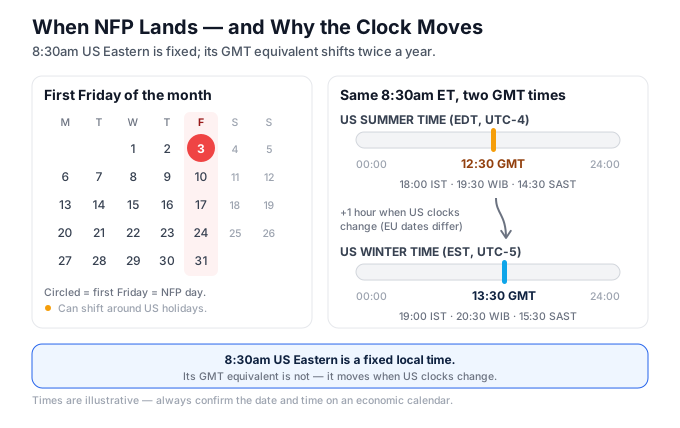
NFP is normally published on the first Friday of the month at 8:30am US Eastern time. In US summer time that is 12:30 GMT; in US winter time it is 13:30 GMT.
That one-hour shift catches traders out twice a year, because the United States and Europe change their clocks on different dates. If you plan your session in GMT, IST, WIB, or SAST, the release drifts against your local schedule and you can be mid-position when you expected to be flat.
For orientation: 12:30 GMT is 18:00 IST, 19:30 WIB, and 14:30 SAST. In US winter time add one hour to each — 19:00 IST, 20:30 WIB, and 15:30 SAST.
The date can also move. When the first Friday falls close to a US public holiday, the Bureau of Labor Statistics sometimes shifts the release, and the schedule is occasionally disrupted by government funding gaps. Confirm the exact date and time on a calendar the same week — our economic calendar tool shows the release in your own timezone so you are not converting by hand.
Why does NFP move price so hard?
The mechanism is short: jobs data feeds the Federal Reserve’s rate path, and the rate path drives the dollar. Employment is half of the Fed’s dual mandate, so a surprise in payrolls moves the market’s expectation of what the Fed does next.
That expectation is where the price move actually comes from. Currencies are repriced against each other largely on the gap between two countries’ interest rates, which is why interest rates move forex prices more consistently than almost any other input.
The critical point most beginners miss: the market does not react to the number, it reacts to the surprise — the gap between the actual figure and the consensus forecast. A payrolls print of 180,000 is bullish for the dollar against a 120,000 forecast and bearish against a 250,000 forecast. The same number, two opposite reactions.
Revisions carry the same weight. If the headline beats by 40,000 but the previous two months are revised down by a combined 90,000, the net picture is weaker than the headline suggests and the dollar can sell off on a “beat.” Watch how central bank decisions move forex and you will see the same surprise-versus-expectation logic running underneath every macro release.
What actually happens in the first minutes?
Liquidity does not disappear at 12:30 GMT — it steps aside. Market makers widen their quotes because nobody wants to be on the wrong side of a number they cannot see coming, and that shows up on your platform in four ways.
Spreads widen. A pair that trades at 0.6 pips can quote 5 to 20 pips through the release, and exotics far wider. Those are typical retail observations, not fixed figures — spread behaviour varies by broker and account type, so check your own platform’s history around a past NFP rather than trusting a number from an article.
Fills slip. Your stop is an instruction to sell at market once a level trades, not a promise of that price. When price gaps through it, you get the next available fill, which is what slippage in forex means in practice — and on market-execution accounts a rejected order can come back as a requote instead.
Price gaps. On fast releases the chart can jump 30 to 60 pips between two ticks with no tradeable price in between. Limit orders inside that gap never fill; stop orders inside it fill on the far side.
The first spike often reverses. The classic NFP pattern is a violent move in one direction within seconds, then a reversal that runs through or past the starting price over the next 5 to 30 minutes. It happens because the initial burst is algorithmic reaction to the headline, and the reversal is human traders pricing in the unemployment rate, earnings, and revisions.
What are the three honest ways to handle NFP?
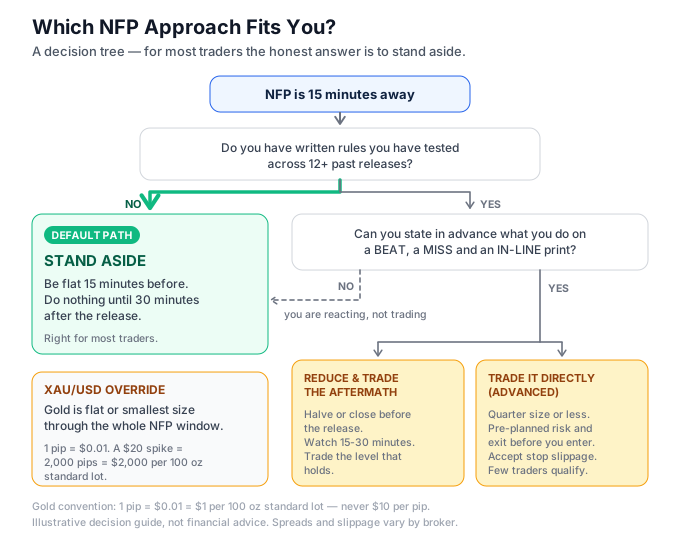
There are exactly three defensible approaches. Anything else is gambling with extra steps.
1. Stand aside. Be flat 15 minutes before, do nothing until 30 minutes after. This is the right answer for most retail traders and it is not a cop-out — skipping one hour a month costs you nothing and removes the single largest source of unplanned loss in the retail calendar.
2. Flatten or reduce, then trade the aftermath. Close or halve positions before the release, watch the first 15 to 30 minutes without touching the mouse, then trade the level that holds once the spread normalises. This is the approach we use. It gives you the volatility without the coin flip.
3. Trade it directly — advanced only. Enter with pre-planned risk, position size cut to a quarter or less of normal, and full acceptance that your stop can fill far past its level. Only take this route if you have written rules and have tested them across at least a dozen past releases — if those foundations are not in place yet, work through the full step-by-step guide for beginners first.
The filter that decides which one applies is simple: if you cannot state, in advance, what you will do at each of the three outcomes — beat, miss, in line — you are not trading the release, you are reacting to it. Our news impact filter helps you rank which events on the week’s calendar are worth flattening for at all.
Before, during, and after — the NFP timeline
Treat this as a checklist you run once a month, not a strategy you improvise on the day.
T-24 hours. Confirm the date and exact time on the calendar, including the daylight-saving conversion. Note the consensus forecast for payrolls, unemployment rate, and average hourly earnings.
T-1 hour. Decide your approach — stand aside, reduce, or trade — and write it down. Check what open positions you hold and what they would cost you on a 60-pip adverse gap.
T-15 minutes. Close or reduce as planned. Cancel pending orders sitting near the current price; a buy stop 20 pips above the market is a lottery ticket during NFP, not a breakout entry.
T-0 to T+5 minutes. Hands off the mouse. Spreads are at their widest and the first move is the least reliable of the session. Watch, do not click.
T+5 to T+30 minutes. Let a candle close on your working timeframe. Check the revisions and the earnings figure against the headline before forming a bias.
T+30 minutes onward. Spreads have usually normalised. If a clear level has held and your setup appears, trade it with your standard risk. The move after the dust settles is more tradeable than the spike.
What about gold (XAU/USD)?
Gold is one of the most NFP-sensitive instruments on the platform, and it is where unprepared traders take the biggest damage. Payrolls move rate expectations, rate expectations move real yields, and gold prices off real yields more directly than any currency pair does.
The scale is the problem. XAU/USD routinely moves several dollars within minutes of the release — and because 1 gold pip is a $0.01 move, a $5 to $20 swing is 500 to 2,000 pips. At the house convention of $1 per pip per 100-ounce standard lot, a $20 move against a single standard lot is a $2,000 hit.
The rule follows from the math: gold positions should be flat through NFP, or in the smallest size you trade. A 0.01 lot on gold risks $0.01 per pip, which makes a 2,000-pip spike a $20 event rather than an account event.
If you must hold gold through the release, widen the stop to sit outside the plausible spike range and cut the lot size to keep the dollar risk identical. Never keep the stop tight and the size normal — that combination is what turns one release into a month of lost progress.
Common mistakes traders make around NFP
Holding a tight stop into the release. A 15-pip stop on EUR/USD through NFP is not risk management; it is a near-certain exit at a worse price than you planned. Fix: be flat, or widen the stop and cut the lot size so the dollar risk stays the same.
Trading the first candle. The initial spike is algorithmic and frequently reverses through your entry within minutes. Fix: wait for the first 5 to 15 minutes to close, then trade the level that survived.
Ignoring revisions. Traders read the headline, take the trade, and get run over when the market prices in a 90,000 downward revision to prior months. Fix: read the headline, unemployment rate, earnings, and revisions together before forming a bias.
Forgetting the daylight-saving shift. The release moves between 12:30 and 13:30 GMT twice a year, and clock changes in the US and Europe are not on the same date. Fix: confirm the release time on the calendar in your own timezone during the same week.
Leaving pending orders near the market. Breakout orders parked 20 pips away get triggered by the spike and stopped by the reversal. Fix: cancel or move pending orders at least 15 minutes before the release.
Sizing gold like a currency pair. A normal EUR/USD lot size on XAU/USD through NFP can produce a four-figure swing in under a minute. Fix: treat gold as its own instrument — smallest size or flat.
Revenge-trading the reversal. Getting stopped on the spike and immediately doubling in on the retrace is the most expensive habit in the retail calendar. Fix: close the platform for 30 minutes; a written pre-release plan and the work covered in our trading discipline guide is what stops this from repeating monthly.
How NFP compares to the other big US releases
| NFP | CPI | FOMC decision | |
|---|---|---|---|
| Frequency | Monthly, usually first Friday | Monthly | 8 times a year |
| Typical time | 8:30am US Eastern | 8:30am US Eastern | 2:00pm US Eastern |
| What it signals | Labour-market strength | Inflation pressure | The rate decision itself |
| Move profile | Sharp spike, frequent reversal | Sharp spike, more directional follow-through | Spike, then a second move on the press conference |
| Most-affected | USD majors, XAU/USD, US indices | USD majors, XAU/USD | Everything USD, plus bonds |
NFP and CPI both trade on the surprise, and both hit at the same time of day. The practical difference is that CPI tends to hold its direction more often, while NFP more frequently gives back the first move once the sub-components are read.
FOMC is a different animal because the decision is usually anticipated and the real volatility arrives during the press conference that follows. If you have a rule for handling NFP, it transfers to CPI with minor changes and needs rewriting for FOMC.
Frequently asked questions
What time is NFP released?
Non-Farm Payrolls is normally released on the first Friday of the month at 8:30am US Eastern time — 12:30 GMT in US summer time and 13:30 GMT in US winter time. The GMT time shifts with daylight saving, and the date can move around US holidays, so confirm it on an economic calendar the same week.
Should beginners trade the NFP release?
For most beginners, no. Spreads widen, stops slip, and the first move frequently reverses, so the outcome depends more on execution conditions than on analysis. Standing aside for one hour a month costs nothing. A better path is to flatten before the release and trade the setup that appears once spreads normalise.
Why does price spike then reverse after NFP?
The first burst is algorithmic reaction to the headline number in the first seconds. Human traders then read the unemployment rate, average hourly earnings, and the revisions to prior months, which often paint a different picture. When that fuller read contradicts the headline, price retraces through or past its starting point.
What is a good NFP number for the US dollar?
There is no fixed threshold — what matters is the surprise against the consensus forecast. A print of 180,000 is dollar-positive against a 120,000 forecast and dollar-negative against a 250,000 forecast. Rising average hourly earnings and a falling unemployment rate generally reinforce a strong headline; large downward revisions undercut it.
Does NFP affect gold (XAU/USD)?
Strongly. Payrolls shift rate expectations, which move real yields, and gold prices off real yields directly. XAU/USD routinely moves several dollars within minutes of the release — a $5 to $20 swing equals 500 to 2,000 pips at $0.01 per pip. Hold gold through NFP flat or in your smallest size.
Will my stop loss protect me during NFP?
Not reliably at the exact price. A stop is an instruction to exit at market once a level trades, so if price gaps past it you get the next available fill, which can be considerably worse. Guaranteed stop products exist at some brokers with their own costs and conditions — verify current terms before relying on one.
How long does NFP volatility last?
The violent phase is usually the first 5 minutes, with elevated volatility and wider-than-normal spreads for roughly 30 minutes. Direction often only settles after the market has digested the revisions and earnings data. Waiting 30 minutes before taking a new position removes most of the execution risk.
Can I widen my stop loss instead of closing before NFP?
Yes, provided you cut the position size by the same proportion so the dollar risk is unchanged. Widening the stop while keeping normal size increases risk rather than managing it. Work out the lot size from the wider stop and your fixed risk amount, never the other way around.
Risk disclaimer: Forex and CFD trading carries a high level of risk and may not be suitable for all traders. The strategies and indicators described here are educational. Past performance does not guarantee future results. Test on a demo account before risking real capital.
Ready to put this into practice?
Open an account with a regulated broker and apply what you have learned. These are the three brokers we recommend:
Trading forex and CFDs carries a significant risk of loss and is not suitable for everyone. Broker links are affiliate links — we may earn a commission at no cost to you.