

Last updated: July 20, 2026 · By: Tim Morris, founder of ForexMt4Indicators.com
Trading discipline is built by design, not by trying harder. Write rules you can follow on your worst day, cap risk at 1% with a hard daily loss limit, journal every trade including the ones you skipped, and review weekly on process. Measure rule adherence — “28 of 30 days without a breach” — never profit.
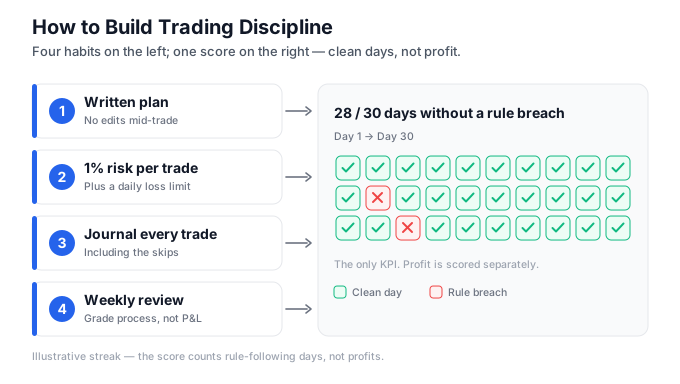
The diagram above is the whole programme on one page: four habits feeding a 30-day streak, with the only number that counts being days without a rule breach. Everything below turns that picture into a schedule you can start tomorrow, and it assumes you already have a forex trading plan written down.
If you do not have one yet, write it first. A discipline programme without rules to be disciplined about is a mood, and moods do not survive a losing week. If you are earlier than that, start with the complete beginner walkthrough, which covers brokers, leverage, demo practice and 1% position sizing in order.
Why is discipline a system, not willpower?
Willpower depletes. It is highest at 07:00 on a Monday with a flat account and lowest at 23:00 on a Thursday after three losers — exactly when a bad decision costs the most.
Systems do not deplete. A rule reading “maximum two trades per day” holds at 23:00 on Thursday whether you feel strong or not, because a calmer version of you made the decision in advance.
The second half of a system is friction. Willpower asks you not to do the wrong thing; friction makes the wrong thing harder — a closed platform after your daily limit, or gold off the watchlist.
We think of it as a circuit breaker. You do not stand at the fuse box holding the wire; you install a switch that trips on its own. Most traders who call themselves “undisciplined” have no switch installed at all.
What are the four habits that carry trading discipline?
Four habits do the heavy lifting, and the 30-day plan below installs them one at a time rather than all at once.
Habit 1: A written plan you do not edit mid-trade
Your plan names the pairs, the timeframes, the session hours, the setup conditions, and the exact entry, stop, and target — all set before the position opens.
The rule that matters is the editing rule: no changes while a trade is live. You may improve the plan on a Sunday with a clear head; you may not widen a stop at 15:40 because price is 8 pips from taking you out.
Moving a stop mid-trade is the most common breach we see. It converts a defined 1% loss into an undefined one, and undefined losses are how accounts end.
Habit 2: Fixed 1% risk and a hard daily loss limit
Fix risk per trade at 1% of equity and stop varying it by conviction. On a $5,000 account that is $50 per trade, which on a 25-pip EUR/USD stop is a 0.20 lot at $10 per pip per standard lot.
Then add the daily loss limit — the layer most traders skip. Two consecutive losers, or a 3% day, and the platform closes until tomorrow. The limit exists because the trade after two losses is almost never a plan trade.
If you size up after a loss to “get it back,” you have inverted the maths: your largest position sits on your least clear-headed decision.
Habit 3: A journal entry for every trade — including the ones you skipped
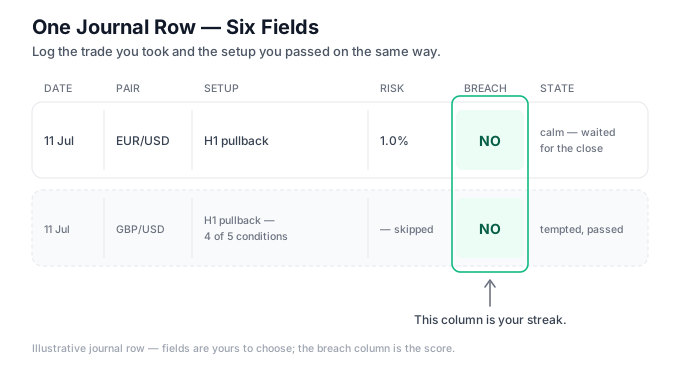
Log every trade you take, and every setup you saw and passed on. The skips are the higher-value data: they show whether your filter is working or whether fear is doing the filtering.
Each entry needs six fields: date, pair, setup name, risk in percent, rule breaches (yes/no + which), and one sentence on your state of mind. Six fields take 40 seconds and can live in a spreadsheet or in our trade journal.
The breach field is the one you will be tempted to leave blank. Leave it blank and the programme collapses, because the streak is measured in that column and nowhere else.
Habit 4: A weekly review that grades process, not profit
Every Sunday, spend 30 minutes on the week. Count the breaches, read the state-of-mind notes, and grade yourself on execution alone.
A week where you followed every rule and lost 1.4% is a pass. A week where you broke three rules and made 4% is a fail, and the 4% is the dangerous part — the market paid you for the behaviour you are trying to remove.
Write one adjustment per week, no more. Change five rules at once and you never learn which one did anything.
The 30-day discipline plan, week by week
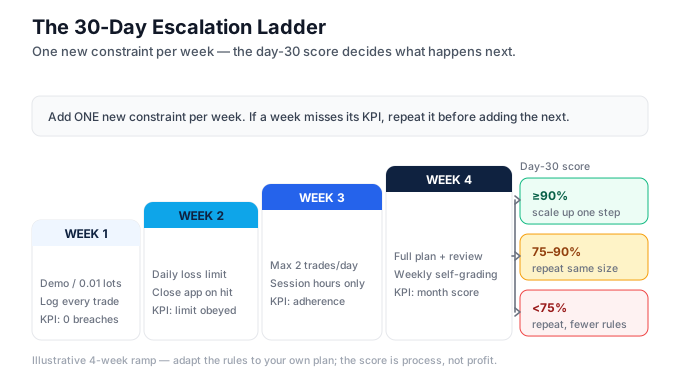
The programme escalates one constraint per week. Each week has a single key performance indicator, and you do not add the next constraint until the current one holds.
Week 1 (days 1-7): demo or minimum size, journal every trade
Trade a demo account or the smallest lot your broker allows — 0.01 where available. The demo vs live account trade-off matters here: demo removes the emotion you are training against, so micro-lot live is the stronger option if you can stomach it.
Journal every trade and every skipped setup, all six fields, no exceptions. Your only KPI this week is zero rule breaches. Profit and loss is not measured, not discussed, and not celebrated.
Expect days 3 to 5 to be the hard ones. That is when the novelty fades and the first “this setup is close enough” temptation arrives.
Week 2 (days 8-14): add the daily loss limit and stop on hit
Keep Week 1 running and add the limit: two consecutive losses or a 3% drawdown ends the day. When it hits, close the platform — not minimise it, close it.
The stop-on-hit behaviour is the habit, not the number. Traders who honour the limit the first day it triggers usually honour it later; those who make one exception rarely stop at one.
KPI for the week: zero breaches plus full compliance on every limit trigger. If the limit fires twice and you obeyed twice, that is a successful week regardless of the balance.
Week 3 (days 15-21): reduce trade count and stay in your session
Now cut volume. Cap yourself at two trades per day and take only A-grade setups — the ones matching every condition in your plan, not four out of five.
Add the session rule: no trades outside your chosen window. If you trade the London session (08:00-17:00 GMT, which shifts against local clocks with daylight saving), then 22:00 GMT is not a trading hour, however good the chart looks.
KPI: zero breaches, zero out-of-session trades, and a lower trade count than Week 2.
Week 4 (days 22-30): full plan adherence, weekly review, then assess
Run every rule at once for nine days, then do the full review. Count your streak, read the whole journal, and score the month with the scorecard below.
A trader who runs the programme twice and comes out with a real streak is further ahead than one who scales up on a 60% adherence month.
How do you score a month on process?
Use a fixed scorecard so a good month cannot be argued into existence after the fact. Score each row out of the points shown, total out of 100, and record it alongside the streak.
| Process metric | How to measure it | Points |
|---|---|---|
| Days without a rule breach | Count from the journal breach column | 30 |
| Trades taken exactly as planned | Planned trades ÷ total trades | 20 |
| Risk held at 1% | Trades at correct size ÷ total trades | 15 |
| Daily loss limit obeyed | Times obeyed ÷ times triggered | 15 |
| Journal entries completed | Entries ÷ (trades + skipped setups) | 10 |
| Weekly reviews completed | Reviews done ÷ 4 | 10 |
Notice what is absent: profit, win rate, and R-multiple. Putting them on this sheet reintroduces the exact incentive the programme removes.
A worked example: 28 of 30 clean days (28 points), 22 of 25 trades as planned (17.6), 25 of 25 at 1% (15), the limit obeyed 3 of 3 times (15), 30 of 32 entries logged (9.4), and 4 of 4 reviews (10) — a total of 95, a scale-up month even if the account finished down.
How does a streak tracker keep the habit alive?
Draw 30 boxes on paper or in a note and fill one per day with a tick or a cross. The visual is the point: a chain of 19 ticks creates something you do not want to break at 23:00 on day 20.
Record two things per box — breach or no breach, and the trade count. That is enough to see patterns without building a second journal.
When you break the chain, mark the cross and continue the same tracker. A month with one cross on day 12 is a 29-day success, and traders who restart from zero after every slip almost always abandon the programme in week two.
Does gold (XAU/USD) change the plan?
Discipline is tested hardest on gold. XAU/USD moves roughly $20 to $50 on a normal day — about 2,000 to 5,000 pips at the standard $0.01 per pip, where a 100oz standard lot is worth $1 per pip — and that range invites oversizing and revenge trades in a way EUR/USD does not.
For these 30 days, trade gold in the smallest lots available or leave it off the watchlist entirely until the streak is intact. There is no rule requiring you to trade the most volatile instrument on your platform while you are still installing the habit.
If you keep it, apply two extra constraints: no gold trades in the 30 minutes around CPI, NFP, or FOMC releases, and a stop sized to gold’s range rather than the pip number you use on majors. A 25-pip stop that works on EUR/USD is noise on XAU/USD.
Discipline vs motivation: what actually holds
Traders try to solve a systems problem with a feelings solution. The difference is worth settling early.
| Motivation-based | System-based | |
|---|---|---|
| Source | Feeling ready, being “focused” | Written rules + friction |
| Behaviour under stress | Degrades fast after losses | Unchanged; the rule is the rule |
| Failure mode | One bad session undoes a month | One breach, logged, streak continues |
| What you measure | Profit, how the week “felt” | Breaches, adherence percentage |
| Time to rebuild after a slip | Days of low confidence | Next morning, same rules |
| Scales with account size | No — pressure rises with size | Yes — 1% is 1% at any balance |
The right-hand column is boring, which is the feature. Boring systems survive the Thursday-night version of you, and that version decides whether your month works.
Common mistakes that break a discipline streak
These seven end streaks, and they sit on top of the wider set of beginner forex mistakes this programme makes structurally harder.
Grading yourself on profit. A profitable week with three breaches teaches you that breaking rules pays. Fix: score the month with the process scorecard above and record profit separately, in a different place.
Journaling only the losers. Winners taken outside your plan are the trades that will end your account later, and they never get logged. Fix: log every trade and every skipped setup, breach column filled in on all of them.
Resetting the streak to zero and giving up. One cross on day 12 becomes “I failed, start again in January.” Fix: keep the same 30-day tracker, mark the cross, and carry on — you are counting clean days, not perfection.
Adding constraints all at once. Loss limit, trade cap, session rule, and a new setup in week one guarantees a breach by day 4. Fix: one constraint per week, in the order given, and never add the next while the current one is still failing.
Treating a demo streak as proof. Perfect adherence on demo money says little about your behaviour when $50 is real. Fix: move to micro lots by Week 2 so the streak is being tested against genuine loss aversion.
Outsourcing the decision instead of fixing the behaviour. Signals, robots, and copy trading look like discipline solutions but transfer the problem — you still choose when to switch them off, usually at the worst moment. Fix: finish the 30 days on your own execution first.
Using the account balance as a mood ring. Checking equity ten times a day makes every fluctuation an emotional event. Fix: check at the end of your session only.
What to do after day 30
Score the month, then pick one of three paths. At 90% or above: increase size by one step, or add a single pair — one change, then another 30 days. 75% to under 90%: repeat at the same size and fix the rows that lost points. Below 75%: repeat with one trade per day and one pair, because the problem is scope, not character.
Whatever the score, keep the journal and the weekly review permanently. Losses are the real test of the system, and handling trading losses becomes procedural rather than emotional once the review is a fixed appointment.
One last piece of friction: know your broker’s withdrawal process before you need it. Traders who understand how to withdraw from a broker are less likely to treat the account as a scoreboard they can never cash out of. Processing times vary by broker and method and change often — verify current terms with your own broker.
Frequently asked questions
How long does it take to become a disciplined trader?
Thirty days is enough to install the four core habits and produce a measurable streak; holding them under real pressure takes several months of repetition. Judge progress by adherence percentage rather than by feeling disciplined. The clearest jump usually lands in weeks two and three, when the loss limit starts firing.
Why do I keep breaking my trading rules?
Usually because the rules were written for an ideal day rather than a bad one, or because nothing stops you breaking them. Rewrite each rule as a yes/no test, then add friction — a daily loss limit, a closed platform, a reduced watchlist. Rules you cannot measure are not rules.
Should I practise discipline on a demo or a live account?
Both, in sequence. Demo suits week one while you build the journaling habit, but it removes the loss aversion you are training against. Move to the smallest live lot size by week two.
What is a realistic daily loss limit?
Two consecutive losing trades or 3% of equity is a common retail convention, and prop firm rules typically sit near a 5% daily limit — though terms differ by firm and change, so verify current rules before relying on them. The exact number matters less than stopping when it hits.
How do I stop revenge trading after a loss?
Make the next trade impossible rather than resisting it. The daily loss limit plus closing the platform removes the decision entirely; a note in your journal explaining why you stopped reinforces it. Revenge trading is a friction problem, not a character problem.
Do I need to journal trades I did not take?
Yes, and they are often the more useful entries. Skipped setups tell you whether your filter is working or whether hesitation is costing valid trades, which is information no P/L statement contains. One line per skip is enough.
Is gold too volatile to trade while building discipline?
Gold is not off-limits, but its 2,000 to 5,000-pip daily range makes oversizing and revenge trades far easier. Trade XAU/USD in the smallest lots available during the 30 days, or leave it out until your streak is intact and your stop sizing reflects gold’s range rather than a major’s.
What should I do if I break the streak on day 25?
Mark the cross, write down what triggered it, and finish the remaining days on the same tracker. Twenty-nine clean days out of 30 is a strong month; restarting from zero is what ends most discipline programmes before week three.
Risk disclaimer: Forex and CFD trading carries a high level of risk and may not be suitable for all traders. The strategies and indicators described here are educational. Past performance does not guarantee future results. Test on a demo account before risking real capital.
Ready to put this into practice?
Open an account with a regulated broker and apply what you have learned. These are the three brokers we recommend:
Trading forex and CFDs carries a significant risk of loss and is not suitable for everyone. Broker links are affiliate links — we may earn a commission at no cost to you.