Last updated: July 6, 2026 · By: Tim Morris, founder of ForexMt4Indicators.com
Handling a trading loss well is a skill, not a feeling. A loss is a cost of doing business, not a verdict on you. Close the platform, step away for a set time, separate a good trade that lost from a rule-break, log it honestly, and re-enter only when the next setup meets your rules.
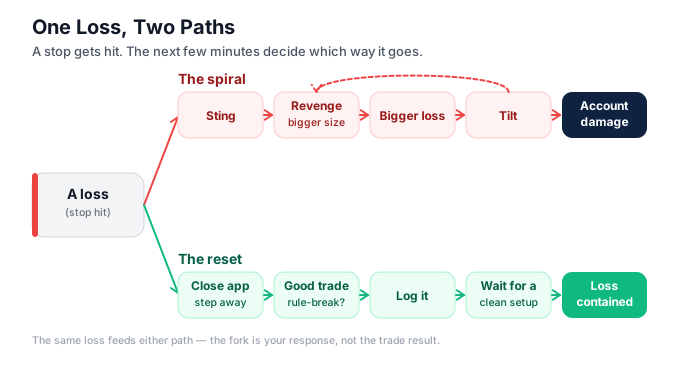
The diagram above shows the fork every trader hits after a red trade: the spiral path on one side, the reset path on the other. The rest of this guide turns that fork into a routine you can run the next time a stop gets hit.
Mishandling a loss sits near the top of the most common beginner forex mistakes we watch wreck accounts — the loss itself is rarely the problem, but the trade you take to “get it back” usually is. This is a how-to on the emotional side of losing, the skill that actually keeps an account alive.
Why a losing trade is a cost of doing business
No strategy wins every trade. A setup with a 55% win rate still loses 45 times out of 100, and those losses arrive in clusters, not in a neat alternating pattern.
A loss on a trade you took correctly is not a mistake. It is the price you pay for the wins — the same way a shop pays rent whether or not customers walk in that day.
The market pays you across a sample of trades, never on any single one. When you tie your mood to one outcome, you hand a random result the power to change how you trade the next ten.
Detaching self-worth from a single trade is the core mental move. You are not a bad trader because a trade lost; you are a bad trader only if you broke your own rules to take it.
Professionals in every field carry this framing. A poker player folds losing hands without flinching, an insurer expects a share of claims — both price loss into the model in advance instead of treating each one as a shock. Your trading is the same business.
How the loss spiral actually works
The damage rarely comes from the first loss. It comes from the chain reaction that follows it, and that chain is mechanical enough to name.
It runs like this: a loss stings, the sting demands action, the action is a revenge trade sized too big, the revenge trade loses more, and now you are on tilt — trading from emotion instead of rules.
Each turn of the loop raises your position size and lowers your judgement. By the third revenge trade, the original loss is small next to the hole you have dug chasing it.
Tilt is the real account-killer, not the first red trade. One un-reset reaction can undo weeks of disciplined trading in a single afternoon.
The spiral is powered by a real urge to make the discomfort stop, and the fastest way to stop it feels like winning the money straight back. That instinct is exactly backwards — the relief you are chasing is what sizes the next trade too big and starts the next loop.
| After a loss | Spiral response | Reset response |
|---|---|---|
| First thought | “I need to get it back now” | “Was that a good trade or a rule-break?” |
| Next action | Re-enter immediately, larger size | Close the platform, step away |
| Position size | Increased to recover faster | Unchanged, still 1% risk |
| Time to next trade | Seconds to minutes | After a set break, next valid setup only |
| Typical outcome | Bigger loss, then tilt | Loss stays contained |
The mental reset method, step by step
The reset is a fixed routine you run every time, so you are not relying on willpower in the exact moment willpower is lowest. Four steps.
1. Close the platform and step away for a set time. Physically leave the screen — 15 minutes minimum, longer after a hard loss. You cannot revenge-trade a platform that is closed.
2. Separate the two questions. Ask whether it was a good trade that happened to lose, or a rule-break. A valid setup that hit its stop is not a mistake; entering early, moving your stop, or over-sizing is. Only rule-breaks are real mistakes to fix.
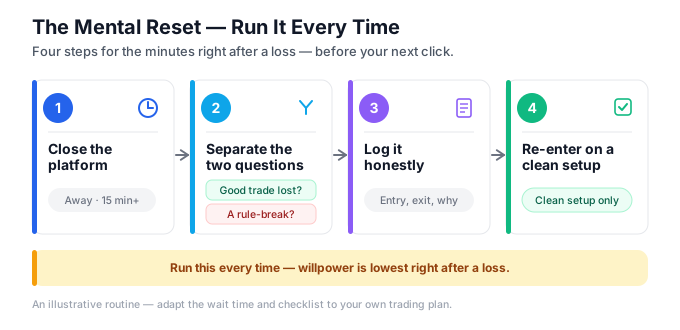
3. Log it honestly in your journal. Write down the setup, whether you followed your rules, and how you felt — before you touch the chart again. Honest logging turns a loss into data instead of a wound; a structured trade journal makes the habit stick.
4. Do not re-enter until you have reset and the next setup is clean. Re-entry is earned by a calm head and a setup that meets every rule — never by the clock or the urge to be flat on the day. If the next valid setup is tomorrow, the next trade is tomorrow.
New traders should drill this routine on a demo account before moving to live, where the sting is real but the money is not. The reset is a habit, and habits are cheaper to build in practice mode. If you are still finding your feet, it sits alongside the other fundamentals in our step-by-step guide to starting forex trading.
Good trade vs bad trade: judge the process, not the outcome
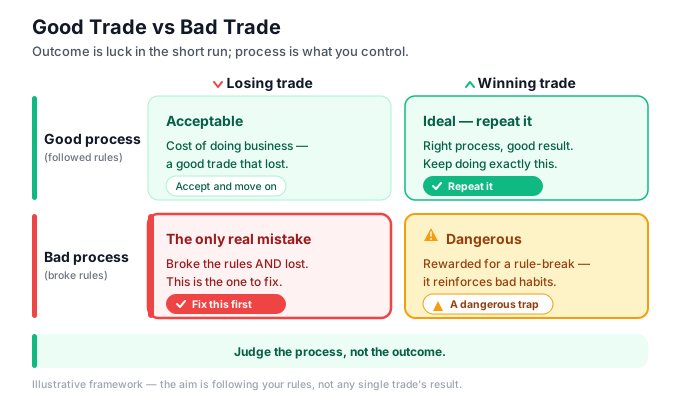
The most useful reframe is to score trades on process, not result. A trade has two independent axes: did you follow your rules (good or bad process), and did it win or lose.
That gives four boxes. Three of them are fine and one is the only one worth losing sleep over.
| Winning trade | Losing trade | |
|---|---|---|
| Good process (followed rules) | Ideal — repeat it | Acceptable cost of doing business |
| Bad process (broke rules) | Dangerous — rewarded for a mistake | The only real mistake — fix this |
The trap box is top-right: a rule-break that won. It feels great and teaches the worst possible lesson, that breaking rules pays.
The box you must accept is bottom-left: a good trade that lost. Punishing yourself for it trains you to hesitate on your next valid setup, which costs more than the loss did.
Why a hard daily loss limit and 1% sizing keep you off tilt
Two mechanical guardrails do most of the emotional work for you, so the reset routine has less to fight against.
The first is a hard daily loss limit. Stop trading for the day after two losing trades in a row or a 3% account drawdown, whichever comes first — the number matters less than the fact that it is fixed in advance.
The second is position sizing that keeps any single loss survivable. Risk 1% of the account per trade, so a loss removes 1% and nothing more; at that size, no single stop-out hurts enough to trigger tilt.
The two work together. Small size keeps each loss from stinging enough to start the spiral, and the daily limit caps the damage if the spiral starts anyway.
Your trading plan should define these numbers before the session, when you are calm, because you will not set fair limits mid-spiral. A drawdown calculator makes the streak math concrete — it shows how far 1% risk lets a losing run go before it becomes a real dent.
On a prop firm evaluation the daily loss limit is not optional — it is enforced for you, and breaching it can end the account. Typical challenges cap daily loss around 5% and total drawdown around 10%, but these figures are illustrative and vary by firm, so verify the current terms before you buy one.
Leverage is what turns a normal loss into a tilt trigger, because oversized positions on thin margin make each red trade hurt far more than 1%. Keep the size small and the reset routine has an easy job.
What about gold (XAU/USD)?
Gold losses arrive faster and larger than forex-pair losses, so the reset discipline matters even more on XAU/USD. Its daily range routinely runs $20 to $50 — roughly 2,000 to 5,000 pips at $0.01 per pip, which works out to $1 per pip per standard 100-ounce lot.
That range means a revenge trade on gold moves against you at speed. A single un-reset revenge trade on a full-size gold position can do multi-day damage in one session, wiping out a week of careful forex gains.
The fix is the same routine, applied harder: smaller size on gold, wider stops for its noise, and the same hard stop after two losers. If you cannot run the reset calmly, gold is the last instrument you want to be revenge-trading.
Common mistakes traders make after a loss
Revenge sizing. Doubling or tripling position size on the next trade to win the loss back faster. Fix: hold size flat at 1% no matter what the last trade did — the size rule is not up for renegotiation after a red trade.
Trading to “get it back” the same day. Treating a green daily total as the goal instead of following your setups. Fix: accept red days as normal; the market does not owe you a recovery by the close, and forcing one usually deepens the hole.
Moving on without a review. Closing the platform in disgust and never asking whether the loss was a good trade or a rule-break. Fix: log every loss the same day; a loss you do not review is a lesson you pay for twice.
No daily loss limit. Trading with unlimited downside for the session, so one bad run has no floor. Fix: set a hard stop — two losers or 3% down — and honour it even when the “perfect” setup appears right after.
Punishing yourself for good trades that lost. Treating every red result as proof you are failing, which breeds hesitation. Fix: score the process, not the outcome; a valid setup that lost needs no correction.
Trading through tilt. Staying at the screen while angry, convinced the next trade will fix your mood. Fix: the reset step exists for this — closed platform, set break, no exceptions when you feel the heat rising.
Everyone takes losing streaks. A run of five or six losses in a row is normal even for a profitable strategy, and it says nothing about your worth as a trader — only that variance is doing what variance does.
Frequently asked questions
How do I stop revenge trading after a loss?
Make revenge trading physically impossible for a set window: close the platform and step away for at least 15 minutes after any loss. Then judge whether the trade was a rule-break or a good trade that lost, log it, and re-enter only on a clean setup — never to win the money back.
Is it normal to have a losing streak in forex?
Yes. Even a strategy with a 55% win rate produces runs of five or six consecutive losses purely from variance. Losing streaks say nothing about your skill or worth; they are the normal texture of a positive-expectancy system playing out across a sample of trades.
How much should I risk per trade to avoid emotional trading?
Risking 1% of your account per trade is the common benchmark. At 1%, a single loss removes a small, survivable slice, so no one stop-out stings enough to trigger a revenge trade. Smaller size is the most reliable way to keep emotion out of the next decision.
What is a daily loss limit and where should I set it?
A daily loss limit is a fixed point where you stop trading for the day. A common rule is to stop after two losing trades in a row or a 3% account drawdown, whichever comes first. The exact number matters less than setting it in advance and honouring it once hit.
How do I know if a losing trade was actually a mistake?
Separate process from outcome. If you followed every rule and the trade still hit its stop, it was a good trade that lost — not a mistake. A mistake is a rule-break: entering early, moving your stop, over-sizing, or trading outside your plan. Only rule-breaks need fixing.
Why do I feel so bad after a losing trade?
Because most traders tie self-worth to individual results, and a loss reads as personal failure. It is not. The market pays across a sample of trades, so any single loss is a data point, not a verdict. Detaching your identity from one outcome is the core skill this guide teaches.
Does the mental reset method work for prop firm challenges?
Yes, and it matters more there. Prop firm accounts enforce daily loss limits, so one un-reset revenge run can end the evaluation. Run the same routine — step away, review, wait for a clean setup — and keep risk small, often 0.5% per trade, to stay well inside the firm’s limits.
Risk disclaimer: Forex and CFD trading carries a high level of risk and may not be suitable for all traders. The strategies and indicators described here are educational. Past performance does not guarantee future results. Test on a demo account before risking real capital.
Ready to put this into practice?
Open an account with a regulated broker and apply what you have learned. These are the three brokers we recommend:
Trading forex and CFDs carries a significant risk of loss and is not suitable for everyone. Broker links are affiliate links — we may earn a commission at no cost to you.