Last updated:
Last updated: July 6, 2026 · By: Tim Morris, founder of ForexMt4Indicators.com
A forex trading plan is a written rulebook that fixes what you trade, when, and how much you risk before the market can tempt you. A complete plan names your watchlist, your timeframes and sessions, exact setup rules, risk per trade capped at 1%, a daily loss limit, entry-stop-target rules, and a journaling plus weekly review routine.
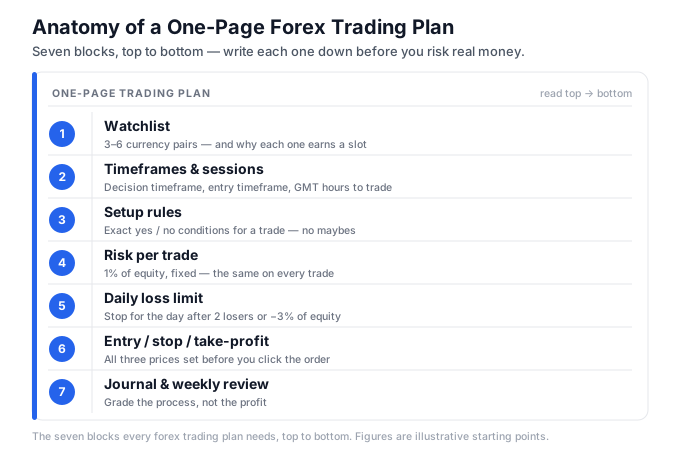
The diagram above breaks a one-page plan into the seven blocks every version needs. The rest of this guide fills each block with rules you can test, then hands you a copy-usable template and a worked example. If you don’t have a live account yet, our beginner’s walkthrough covers how to open and fund your first account, plus the broker, leverage and demo steps that come before any plan.
Most losing accounts don’t fail on strategy — they fail on discipline, and a plan is how you buy discipline in advance. If you have already lost money guessing your way through trades, our common beginner forex mistakes guide shows the exact holes a written plan closes.
Why a written plan beats a plan in your head
A plan in your head rewrites itself every time price moves against you. The moment you are down 30 pips, your brain will quietly loosen the stop and call it “giving the trade room.” A written plan removes that vote.
Writing the rules down does three things. It makes each rule testable, visible, and separate from the emotion of a live trade — because you decided the rules when no money was on the line.
The goal is not a perfect plan. The goal is a plan specific enough that a stranger could read it and take the same trade you would. If two traders reading your rules would enter at different prices, the rules are too vague to test.
What every forex trading plan must include
A usable plan answers seven questions in order. Skip one and you have left a gap the market will find. We will walk each block, then assemble them into a template.
1. Which markets you trade — a focused watchlist
You do not trade “the forex market.” You trade a short, named list of pairs you know well. Most consistent traders watch 3 to 6 instruments and ignore the rest.
Pick pairs with tight spreads and enough range for your style — EUR/USD, GBP/USD, and USD/JPY are the standard starting three. Add one cross or gold only once the first three are profitable. A watchlist of 20 pairs means you know none of them.
Write down why each pair is on the list: its typical spread, its normal daily range, and the session it moves in. This is also where you decide whether you lean on chart signals or economic data — our technical vs fundamental analysis breakdown helps you commit to one primary lens instead of switching mid-trade.
2. Your timeframes and sessions
Name the timeframe you make decisions on and the one you time entries on. An H1 swing trader and an M5 scalper reading the same chart see different trades — your plan must say which one you are.
Tie your trading to real market windows, not “whenever I’m free.” The forex trading sessions each have a personality: the London session (08:00–17:00 GMT) trends, the London/New York overlap (13:00–17:00 GMT) is the highest-volatility window, and the Asian session (23:00–08:00 GMT) is quieter and better for range work.
State your hours in GMT with a local translation, and state when you do not trade — the minutes around high-impact news, the last hour of the New York session, and any day you are tired or tilted. Rules about when to stay out matter as much as rules about when to enter.
3. Your setup rules — exact and testable
This is the block traders write worst. “Buy on a pullback in an uptrend” is not a rule — it is a mood. A rule names the exact, checkable conditions for a valid entry.
Turn each condition into something you can answer yes or no to before the candle closes. For an H1 pullback trader that might read: price above the 50 EMA, a pullback that touches the 20 EMA, and a bullish engulfing candle that closes back above the 20 EMA. Three yes-or-no checks, no judgement calls.
If a condition needs your opinion to evaluate, rewrite it until it doesn’t. Every setup rule should survive the stranger test — someone else reading it should mark the same candles as valid setups that you would.
4. Risk per trade and a daily loss limit
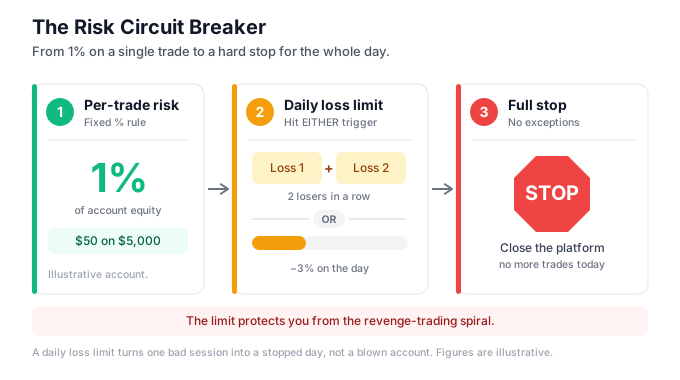
Fix your risk per trade at 1% of account equity and never override it. On a $2,000 account that is $20 a trade; on $5,000 it is $50. This single rule is what keeps a bad run from becoming a blown account.
Then add a daily loss limit — the circuit breaker most plans forget. A workable default: stop trading for the day after two consecutive losers or once you are down 3% for the day, whichever comes first. The limit protects you from the revenge-trading spiral where one loss becomes six.
Risk per trade and your daily limit together set your worst realistic day. Feed your win rate, risk-reward, and 1% risk into our risk of ruin calculator to see how survivable your numbers are — most traders discover 2% risk raises their odds of ruin sharply, more than doubling them, often several-fold. When the day’s limit hits, closing the platform is the trade.
5. Entry, stop, and take-profit rules
Every trade needs its three prices decided before you click, not after. Your plan states how each is set so you are never improvising with money live.
- Entry: the exact trigger — for example, “enter at market on the close of the confirmation candle,” not “enter when it looks ready.”
- Stop loss: placed at a level the market must break to prove you wrong — beyond the swing low or the setup candle — then sized so that distance equals 1% of equity.
- Take profit: a defined target at a fixed risk-reward, such as 1:2, or a partial-exit rule (close half at 1R, move the stop to breakeven, let the rest run).
Notice the order: you find the stop first, then size the position to the stop. Never pick a lot size first and squeeze the stop to fit it — that is backwards, and it is how accounts die.
6. A journaling routine
A trade you don’t record is a lesson you paid for and threw away. Log every trade the day you take it: the pair, the setup, your entry-stop-target, the screenshot, and one line on whether you followed the plan.
The follow-the-plan column is the important one. A losing trade that obeyed every rule is a good trade; a winning trade you took on a whim is a bad trade that happened to pay. Grade the process, and the results follow.
Use a structured log rather than memory — our trade journal tool tags each entry by setup and follow-through so patterns surface after 20 trades instead of 200. Keep it boring and keep it daily.
7. A weekly review that grades process, not profit
Once a week, sit with your journal and score the week on rule-following, not on money. Ask three questions: Did I only take valid setups? Did I hold risk at 1%? Did I respect my daily loss limit?
A green week on all three is a good week even if it was flat.
Money is noise over a small sample — 20 trades tell you almost nothing about a strategy but a great deal about your discipline. Review the discipline weekly and adjust one thing at a time.
Losing streaks are where plans get abandoned, which is exactly when they matter most. Our guide on handling trading losses covers the review habits that keep a drawdown from turning into a rewrite of every rule.
If you use XM for virtual practice, the XM demo-account guide explains the setup and account checks. Match the practice balance and position sizes to your written plan, and keep demo observations separate from claims about live execution.
The one-page trading plan template
Copy this into a note and fill every field. If a field is blank, that part of your trading is running on impulse.
| Block | What to write | Example entry |
|---|---|---|
| Watchlist | 3–6 named pairs + why | EUR/USD, GBP/USD, USD/JPY (tight spread, deep liquidity) |
| Timeframes | Decision TF / entry TF | H4 for bias, H1 for entries |
| Sessions | Hours in GMT + when NOT to trade | London 08:00–12:00 GMT; no trading around red news |
| Setup rules | Exact yes/no conditions | Above 50 EMA + pullback to 20 EMA + bullish engulfing |
| Risk per trade | Fixed % of equity | 1% ($50 on $5,000) |
| Daily loss limit | Stop-for-the-day trigger | 2 losers in a row OR −3% day |
| Entry / Stop / TP | How each price is set | Entry on close; stop below swing low; TP at 1:2 |
| Journaling | What you log, when | Every trade same day + follow-plan score |
| Weekly review | What you grade | Rule-following, not P&L, every Sunday |
The template is deliberately short. A plan you will actually read fits on one page; a 12-page plan is one you wrote once and never open.
A worked example: the H1 EUR/USD pullback trader
Here is the template filled in for one concrete style, so you can see what “specific enough to test” looks like.
Watchlist: EUR/USD only, for the first three months. One pair, learned deeply, beats six pairs half-understood.
Timeframes and sessions: H4 sets the trend bias; H1 times the entry. Trade the London session, 08:00–12:00 GMT (13:30–17:30 IST, 15:00–19:00 WIB). No new trades after 12:00 GMT.
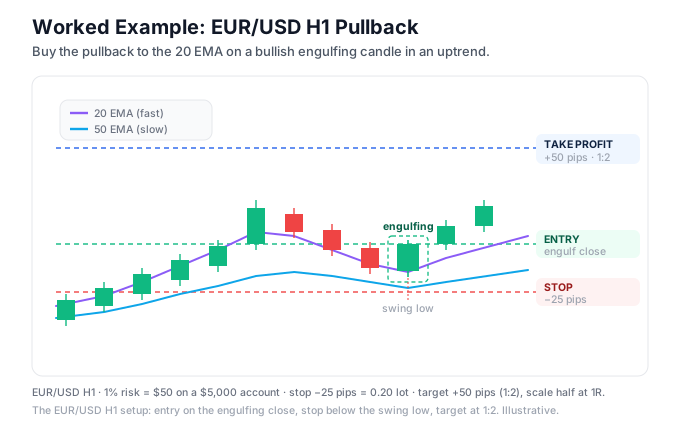
Setup rule (long): on H4, price is above the 50 EMA (uptrend). On H1, price pulls back to the 20 EMA and prints a bullish engulfing candle that closes back above it. All three true, or no trade.
Risk and limit: 1% per trade — $50 on a $5,000 account. Daily loss limit: two losers in a row or −3% ($150), then platform closes.
Entry / stop / target: enter at market on the close of the engulfing candle. Stop goes 5 pips below the pullback swing low; if that distance is 25 pips, the position is 0.20 lot ($50 ÷ 25 pips ÷ $10 per pip). Target is 1:2 — 50 pips — with half closed at 1R and the stop moved to breakeven.
Journaling: screenshot every entry and exit, log the R-multiple, and mark yes/no on “followed all rules.” Weekly review every Sunday grades only rule-following. Test this on a demo first — our demo vs live account guide explains what a demo does and doesn’t prove before you risk real capital.
Gold (XAU/USD) needs its own rules in your plan
A plan tuned to EUR/USD will over-size gold and hand you a stop-out on your first trade. Give XAU/USD its own block with separate rules — do not fold it into your forex settings.
Three gold-specific rules belong in every plan that touches it. Trade micro (0.01) lots only until you have proven the setup on gold. Size stops to gold’s real range — XAU/USD moves roughly $20 to $50 a day, about 2,000 to 5,000 pips at $0.01 per pip, so a forex-sized 25-pip stop is far too tight. And avoid new gold trades around high-impact US data — CPI, NFP, and FOMC can move gold hundreds of pips in seconds.
The pip math is different too: on gold, 1 pip is a $0.01 move and a standard 100-ounce lot is worth $1 per pip, $0.10 per pip on a 0.10 lot, and $0.01 per pip on a 0.01 lot. Size the position to your 1% risk using that math, never the forex table.
Common mistakes that make a trading plan useless
A plan can exist and still fail you. These are the errors that turn a written plan back into guessing.
The plan is too vague to test. “Buy in an uptrend near support” cannot be scored yes or no. Fix: rewrite every setup rule until a stranger would mark the same candles as valid.
No daily loss limit. Without a circuit breaker, one bad morning becomes a revenge-trading spiral that erases a month. Fix: add a hard stop-for-the-day — two losers or −3%, whichever hits first.
Sizing the position before the stop. Traders pick a lot size, then choke the stop to fit their comfort. Fix: place the stop where price proves you wrong, then size the position to make that distance 1% of equity.
Never reviewing the plan. A plan written once and never opened decays as the market changes. Fix: a fixed weekly review that grades rule-following, adjusting one variable at a time.
Grading on profit instead of process. Judging trades by P&L rewards lucky rule-breaks and punishes disciplined losers. Fix: score each trade on “followed the plan,” and let a small sample of results stay noise.
One risk setting for every instrument. Copying EUR/USD stops onto gold or GBP/JPY over-sizes the volatile ones. Fix: give each higher-range instrument its own stop-and-lot block, gold especially.
Writing a plan you won’t follow. A 12-page plan or one you never open is decoration, not a plan. Fix: keep it to one page and read it before every session — a plan you don’t follow protects nothing.
Frequently asked questions
How do I write a simple forex trading plan?
Answer seven questions in writing: which pairs you trade, on what timeframes and sessions, your exact setup rules, your risk per trade (1%), your daily loss limit, your entry-stop-target rules, and your journaling plus weekly review routine. Keep it to one page so you actually read it before each session.
What are the components of a trading plan?
A complete plan has seven blocks: a focused watchlist of 3–6 pairs, defined timeframes and sessions, testable setup rules, fixed risk per trade, a daily loss limit, entry-stop-take-profit rules, and a journaling and review routine. Missing any one leaves a gap where impulse takes over.
How much should I risk per trade?
The standard convention is 1% of account equity per trade — $20 on a $2,000 account, $50 on $5,000. At 1%, a run of ten losers costs about 10% and is fully survivable. Doubling to 2% more than doubles your risk of ruin — often several-fold, not a little — which is why disciplined traders rarely exceed 1%.
What is a daily loss limit and where do I set it?
A daily loss limit is a hard stop that ends your trading for the day once you hit it, protecting you from revenge trading. A common default is two consecutive losers or a 3% account drawdown for the day, whichever comes first. When it triggers, closing the platform is the correct next action.
How is a trading plan for gold different?
Gold (XAU/USD) moves $20–$50 a day — roughly 2,000–5,000 pips at $0.01 per pip — so it needs wider stops, micro (0.01) lots until proven, and no new trades around CPI, NFP, or FOMC. Keep gold’s rules in a separate block; a plan sized for EUR/USD will over-size gold badly.
Can I use one trading plan for a prop firm challenge?
Yes, with tighter risk. Prop firms typically enforce a daily loss limit near 5% and a maximum drawdown near 10%, and profit targets around 8–10% — but terms vary by firm, so verify the current rules before you start. Many traders drop to 0.5% risk per trade to stay clear of the daily limit. See our what is a prop firm guide for how the rules work.
How often should I review my trading plan?
Review the plan weekly against your journal, grading rule-following rather than profit. Do a deeper review every 20–30 trades or once a month, adjusting one variable at a time so you can tell what changed the result. Never rewrite the whole plan mid-drawdown — that is emotion, not analysis.
Do I need a plan for a demo account?
Yes. A demo is where you prove the plan is followable before real money raises the pressure. Trade the demo exactly as you would live — same watchlist, same 1% risk, same journaling — or the results tell you nothing about how you will trade funded.
Risk disclaimer: Forex and CFD trading carries a high level of risk and may not be suitable for all traders. The strategies and indicators described here are educational. Past performance does not guarantee future results. Test on a demo account before risking real capital.
Ready to put this into practice?
Open an account with a regulated broker and apply what you have learned. These are the three brokers we recommend:
Trading forex and CFDs carries a significant risk of loss and is not suitable for everyone. Broker links are affiliate links — we may earn a commission at no cost to you.