

Last updated: July 20, 2026 · By: Tim Morris, founder of ForexMt4Indicators.com
Copy trading links your account to another trader’s so their positions replicate in yours, sized to your balance. It is genuinely hands-off, and that is the problem — you inherit their risk profile, their leverage, and their drawdown. Leaderboard returns are not predictive. Treat it as risk delegation, not a shortcut to skill.
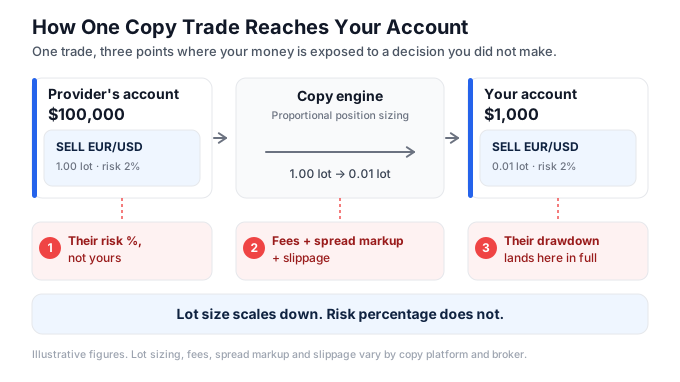
The diagram above traces one trade from the provider’s terminal into your account, and marks the three points where your money is exposed to a decision you did not make. Those three points are where most copy-trading accounts are lost.
Copy trading sits next to two things beginners confuse it with. Our forex signal guide covers the version where you still press the button yourself, and this article covers the version where you do not.
What is copy trading, exactly?
Copy trading is an account-linking arrangement. You choose a trader, allocate an amount, and their entries, exits, and position adjustments are mirrored into your account automatically.
Sizing is proportional. If the provider risks 2% of their balance on a trade, the software opens a position that risks roughly 2% of your allocation — a 1.00 lot trade on a $100,000 account typically arrives as 0.01 lot on a $1,000 allocation.
That proportionality is the feature people hear about. The part they miss is that the risk percentage copies across untouched. You are not copying their profits; you are copying their exposure, and the profits are a byproduct.
You keep custody of your funds. Your money stays in your own trading account, you can stop copying at any time, and open copied positions can normally be closed by you directly.
How is copy trading different from signals, robots, and managed accounts?
These four get used interchangeably in forums and marketing, and the differences decide who is responsible when a trade goes wrong.
Signals are notifications. Someone sends “buy EUR/USD at 1.0850, stop 1.0820” by Telegram, email, or in-platform alert, and you decide whether to place it. You keep the final decision and you absorb the delay.
A robot or expert advisor is code you install on your own terminal. The rules are fixed, they run on your machine or VPS, and you set the lot size and the parameters. Our forex robot vs manual trading comparison covers the trade-offs there in detail.
For one broker’s published offer, the FBS VPS guide separates deposit qualification and renewal conditions from the trading software’s performance.
A managed account hands discretionary control to a third party under a formal arrangement, usually with a fee structure and regulatory paperwork attached. Copy trading is not this, even though it can feel similar.
| Copy trading | Signals | Robot / EA | Trading it yourself | |
|---|---|---|---|---|
| Who decides the trade | Another person | Another person | Fixed code rules | You |
| Who executes | Software, automatically | You, manually | Software on your terminal | You |
| Your control per trade | Low (can close early) | Full | Medium (settings only) | Full |
| Sizing | Proportional to allocation | You choose | You configure | You choose |
| Whose risk profile applies | Theirs | Yours, after filtering | Whatever you set | Yours |
| Main hidden cost | Fees, spread markup, slippage | Delay between alert and fill | Curve-fitted rules failing live | Your own mistakes |
| What you learn | Little, unless you review | Some — you filter setups | A lot about mechanics | Everything, slowly |
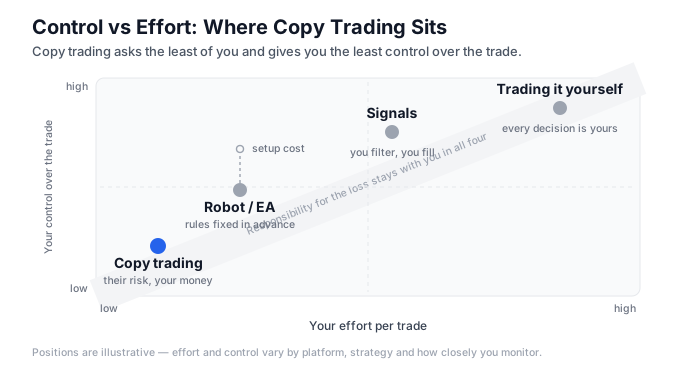
The column that matters is “whose risk profile applies.” With signals you can decline a setup you dislike or halve the size. With copy trading, the provider’s aggression arrives in your account at full proportional strength, every time, including on the day they decide to double down.
What copy trading genuinely gets you
We are sceptical of copy trading, not dismissive of it. Three benefits are real.
It is hands-off. If you work shifts, live in a timezone that puts London open at 3am, or cannot watch charts without interfering with your own trades, automated replication removes the screen-time requirement entirely.
It gives access to a strategy you cannot build yet. A trader with eight years on GBP/JPY has pattern recognition you will not acquire in six months. Copying is one way to have exposure to that while you learn, ideally in parallel with our complete step-by-step guide for beginners.
It can teach you — conditionally. If you open every copied trade, note the pair, the session, the stop distance, and what price did before entry, you build a real study library. That conditional is doing heavy lifting. Copying without reviewing teaches nothing at all, which is the single most common way beginners waste a year.
Where copy trading goes wrong
This is the part the marketing pages skip, and it is the reason this article exists.
You inherit their risk profile, not their returns
Risk and return are the same decision viewed from two ends. A provider posting strong monthly numbers is usually taking correspondingly large risk, and that risk copies into your account at the same percentage.
A trader running 5% risk per trade on their own $200,000 account has made a choice about their finances, their income, and their tolerance for a bad month. Copying them applies that same choice to your $1,000, which you may need for something else.
Drawdown transmits perfectly. If they take a 40% drawdown, your allocation takes roughly 40% too, and it happens on their schedule rather than yours.
Leaderboards select for luck, not skill
Platform rankings usually sort by recent return. Across thousands of providers, the ones sitting at the top in any given month are disproportionately the ones who took the largest risk and happened to be right.
That is survivorship at work. A trader who risks 10% per trade and wins six in a row posts an extraordinary month; the same trader losing six in a row disappears from the leaderboard, so you never see them.
Past return over a short window carries close to no predictive information about the next. A three-month streak is not a track record — it is a sample too small to distinguish skill from variance.
A copied trader can blow up your account as fast as their own
There is no protective layer between their decisions and your balance. If they average down into a losing position, add lots after a loss, or hold through a news release without a stop, that behaviour arrives in your account in full.
Martingale-style recovery — doubling size after each loss — is common among providers with long smooth equity curves, because it hides losses until the one time it does not. When it fails, it fails completely, and it takes your allocation with it.
Requotes and slippage widen the gap further. The copied fill can land at a worse price than the provider’s own, especially around news. Our requote explainer covers why that happens and when it is worst.
Fees and spread markups compound quietly
Copy arrangements are paid for somehow. Typical structures include a performance fee on profits, a fixed monthly subscription, a markup added to your spread, or some combination — figures vary widely between platforms, so read the fee page and verify current terms before allocating anything.
The cost that hurts most is spread markup, because it applies to every trade whether it wins or loses. A provider trading 20 times a month with a 1-pip markup pays that 20 times, out of your account, regardless of outcome.
Performance fees carry a subtler problem: they are usually charged on gains without a symmetric penalty for losses. That asymmetry rewards a provider for taking more risk, not less. Broker and platform costs deserve the same scrutiny you would apply when choosing a forex broker.
It teaches you nothing by default
Watching an equity curve move is not learning. Without reviewing why each trade was taken, you finish the year with the same skill level and a smaller or larger balance, having outsourced the one thing that would have compounded.
The XAU/USD problem
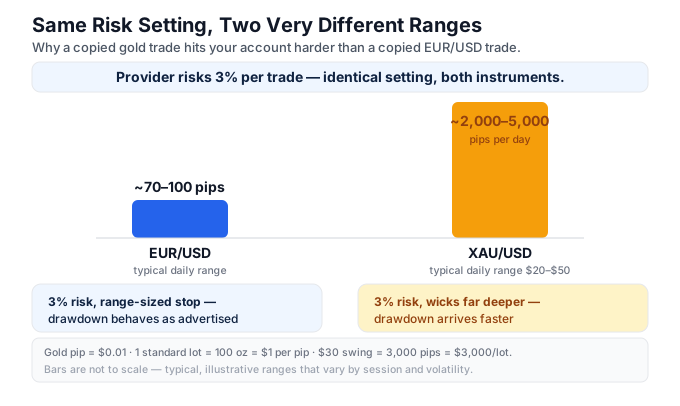
Check what the trader you copy actually trades. A provider running large gold positions transmits gold’s 2,000-5,000-pip ($20-$50) daily swings straight into your account, which can be far more drawdown than the same nominal size on a major pair.
Gold’s pip is a $0.01 move, and a standard XAU/USD lot is 100 ounces — so $1 per pip per standard lot, $0.10 per 0.10 lot, $0.01 per 0.01 lot. A $30 daily swing is 3,000 pips, or $3,000 on a standard lot.
A provider whose numbers were built on EUR/USD and who rotates into gold has changed instrument without changing their advertised profile. Their stated 3% risk now sits on an instrument with wicks several times deeper, and you find out during the drawdown rather than before it.
Check that the service still exists: our FBS CopyTrade status guide explains the closed service and why FBS’s current leaderboard does not enable copying.
How to evaluate a provider if you proceed
If you decide to copy anyway, evaluate on risk first and return last. Work through these in order.
Verified track record through a losing period. Twelve months minimum, and it has to include a stretch where the strategy struggled. A curve that only goes up has not been tested; it has been lucky, or it has been short.
Maximum drawdown, not return. Find the deepest peak-to-trough fall and ask whether you would have kept copying through it. Most people who say yes to a 35% drawdown on paper stop copying at 15% in reality.
Risk per trade and whether it is consistent. Look for stable position sizing. Sudden size increases after losses signal recovery trading; sudden increases after wins signal a trader on a confidence run, and both end the same way.
Consistency versus one lucky month. Strip out the single best month and re-read the record. If the whole edge lived in one month, the record describes an event, not a method.
Instrument and session mix. Gold, exotics, and indices behave differently from majors. A profile built on one and executed on another is a change you are funding.
Total cost, verified today. Add performance fee, subscription, and any spread markup, then compare that against the stated returns. Terms change — check the current page rather than a review from last year.
The controls that stay your job
No provider manages your risk. These four are yours regardless of who you copy.
- Allocate only what you can lose entirely. Never the whole balance, and never money with a purpose attached to it.
- Set an equity stop. Decide in advance the drawdown level at which you stop copying — say 20% of the allocation — and act on it without renegotiating.
- Cap total exposure across providers. Copying three traders who are all long EUR is one position, not three.
- Review every copied trade weekly. This converts a passive cost into an education, and it is the only version of copy trading that leaves you better off as a trader.
Discipline is the binding constraint here, exactly as it is in manual trading. Our guide on how to build discipline in trading covers the habit side of holding an equity stop when the account is red.
Common mistakes traders make with copy trading
Chasing the leaderboard. Selecting whoever ranks highest this month puts you into the highest-risk trader at the peak of their variance. Fix: filter by drawdown and track-record length first, then look at return only among the survivors.
Copying with the whole account. One provider failure becomes a total account loss with no capital left to continue. Fix: allocate a defined slice — treat it as a position size, not a lifestyle change.
Running no equity stop. Without a pre-set exit level, the decision to stop gets made emotionally at the worst point of the drawdown. Fix: write the number down before you allocate and set a calendar check to enforce it.
Judging on return without drawdown. A 60% annual return that included a 50% drawdown is a different product from a 20% return with an 8% drawdown. Fix: read the two numbers together, and always look at the deepest fall first.
Ignoring what they actually trade. A gold-heavy provider transmits far larger swings than the same risk percentage on EUR/USD. Fix: check the instrument mix and recent trade history before allocating, not after.
Never reviewing the copied trades. Passive copying costs you a year and returns no skill. Fix: log every trade weekly — pair, session, stop distance, outcome — and treat it as a study file.
Switching providers after every losing week. Serial switching locks in each drawdown and buys into each new provider at their high point. Fix: decide the evaluation window in advance and hold to it, or stop copying altogether.
Several of these overlap with the broader list in our beginner forex mistakes guide, because copy trading does not remove the standard errors — it automates them.
Does copy trading remove leverage risk?
It does not. Copied positions use the same leverage your account is set to, and a provider trading at high leverage on their side produces a proportionally leveraged position on yours.
Higher leverage means a smaller adverse move triggers a margin call, and margin calls on copied positions close trades at the broker’s discretion, not the provider’s. Our leverage in forex guide explains the margin mechanics behind that.
Reducing your account leverage does not reduce the copied risk percentage — it changes the point at which the broker forces you out. Position sizing, not leverage, is the control that matters.
Frequently asked questions
Is copy trading profitable for beginners?
Some copied accounts gain and many lose, and the outcome depends almost entirely on the provider’s risk management rather than on the beginner’s choices. The structural problem is selection: beginners pick providers from leaderboards, which favour high-risk traders in a good run. Assume no edge unless you can verify a long record through a losing period.
What is the difference between copy trading and signals?
With signals you receive a trade idea and place it yourself, keeping the final decision and the sizing. With copy trading the position opens in your account automatically, sized proportionally to your allocation. Signals leave you in control and add delay; copy trading removes the delay and the control together.
How much money do I need to start copy trading?
Platform minimums vary widely and change, so verify current terms directly. The practical minimum matters more: your allocation must be large enough that proportional sizing produces a valid position, and small enough that losing all of it changes nothing about your finances. If those two conditions conflict, you are not ready to allocate.
Can copy trading lose more than my allocation?
Normally your loss is capped at the allocated amount, since copying stops when the balance is exhausted. Gaps and slippage during major news can push a position past its stop, and negative-balance protection is not universal — it depends on your broker and your jurisdiction. Confirm your account’s protection status before allocating.
Is copy trading better than using a forex robot?
They fail differently. A robot follows fixed rules that can be tested but degrade when market conditions change; a copied human adapts but can also panic, revenge trade, or double down. A robot gives you parameter control and no discretion; copying gives you discretion you do not control.
How do I know if a copy trading provider is legitimate?
Look for a verified, platform-audited history longer than twelve months that includes a losing stretch, stable risk per trade, and a published maximum drawdown. Treat guaranteed returns, screenshots as proof, and pressure to allocate quickly as disqualifying. Regulatory status of the platform is worth checking separately from the provider’s record.
Does copy trading work on MT4 and MT5?
Both platforms support copying through broker-side services and third-party bridge software, and setup varies by broker. The mechanics are the same regardless of platform — the provider’s trade replicates into your terminal, sized to your allocation. Platform choice does not change the risk analysis in this article.
Should I copy a trader who trades gold?
Only with sizing adjusted for gold’s range. XAU/USD moves roughly $20 to $50 per day, which is 2,000 to 5,000 pips at $0.01 per pip, so the same risk percentage produces much larger swings than on a major pair. If you copy a gold-heavy provider, reduce the allocation rather than assuming the percentage keeps you safe.
Risk disclaimer: Forex and CFD trading carries a high level of risk and may not be suitable for all traders. The strategies and indicators described here are educational. Past performance does not guarantee future results. Test on a demo account before risking real capital.
Ready to put this into practice?
Open an account with a regulated broker and apply what you have learned. These are the three brokers we recommend:
Trading forex and CFDs carries a significant risk of loss and is not suitable for everyone. Broker links are affiliate links — we may earn a commission at no cost to you.