Last updated:
Last updated: July 10, 2026 · By: Tim Morris, founder of ForexMt4Indicators.com
A forex robot, or Expert Advisor (EA), is software that auto-executes a fixed rule set on MT4 or MT5 without you clicking. Robots trade consistently and without emotion; manual trading adapts to context a robot cannot read. Neither is inherently better — a robot is only as good as the flawed strategy coded inside it. Before trusting an AI expert advisor, it helps to know what those systems can and cannot actually do.
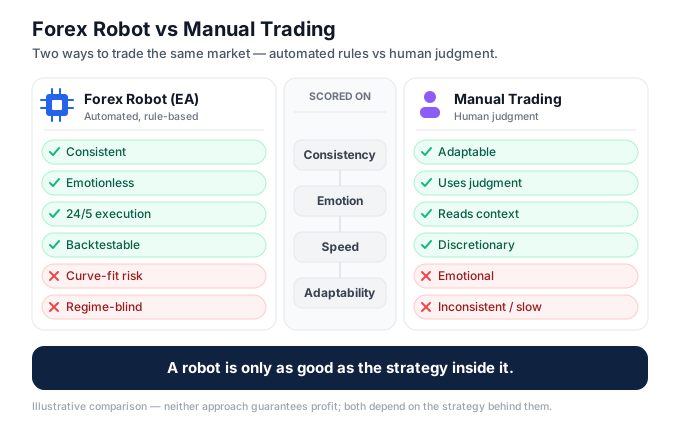
The diagram above lines up an automated system against a manual trader across the things that actually decide results — consistency, emotion, adaptability, and speed. The rest of this guide turns that picture into a decision you can defend.
Before you hand any account to code, the honest starting point is a written edge. Our how to build a trading plan guide covers that framework; a robot is nothing more than a trading plan someone turned into instructions a platform can run automatically.
What is a forex robot (EA)
A forex robot is an Expert Advisor (EA) — a program written in MQL4 or MQL5 that runs on your MetaTrader chart and places, manages, and closes trades according to coded rules. Once attached, it watches price and executes the moment its conditions are met, whether you are at the screen or asleep.
The rules can be simple or layered. A basic EA might buy when a fast moving average crosses a slow one; a complex one stacks a trend filter, a volatility filter, and a news blackout. Complexity is not quality — a tangled EA can hide the same broken idea a one-line EA does.
Most EAs fall into a few archetypes, and the archetype tells you the risk. Trend-following EAs ride moving-average or breakout signals and bleed during range-bound chop. Scalping EAs chase tiny targets and live or die on spread and execution speed.
Two archetypes deserve a specific warning: grid and martingale EAs. They add to losing positions — martingale doubles the size after each loss — so their equity curve looks smooth for months, then a single sustained trend wipes the account in one run. A pretty curve from a martingale is not an edge; it is a delayed loss.
The appeal is obvious. The robot never gets bored, never revenge-trades, never widens a stop out of hope. It does exactly what it was told, 24 hours a day across the five-day forex week.
The catch hides in that same sentence. It does exactly what it was told — including when the market has changed and the instructions are now wrong. A robot has no idea the regime shifted; it keeps firing the old rule into new conditions.
Robots vs manual trading — the honest side-by-side
Most “robot vs manual” articles pick a winner. That is the wrong frame. Each approach trades one weakness for another, and the table below is the trade you are actually making.
| Forex robot (EA) | Manual trading | |
|---|---|---|
| Consistency | Executes the rule identically every time | Varies with mood, fatigue, focus |
| Emotion | None — no fear, greed, or revenge | The main leak for most traders |
| Speed / availability | Reacts in milliseconds, 24/5 | Limited to when you watch |
| Adaptability | Blind to context and regime change | Reads news, tone, and structure |
| Backtestable | Yes — exact rules run on history | Hard to test discretionary judgment |
| Failure mode | Curve-fit; breaks on regime shift | Emotional, inconsistent, slow |
| Only as good as | The strategy coded into it | The trader’s discipline and skill |
Read the table as a mirror. A robot fixes precisely the problems manual traders complain about — the missed entry, the emotional exit, the rule you ignored “this once.” That is real, and for a mechanical edge it matters.
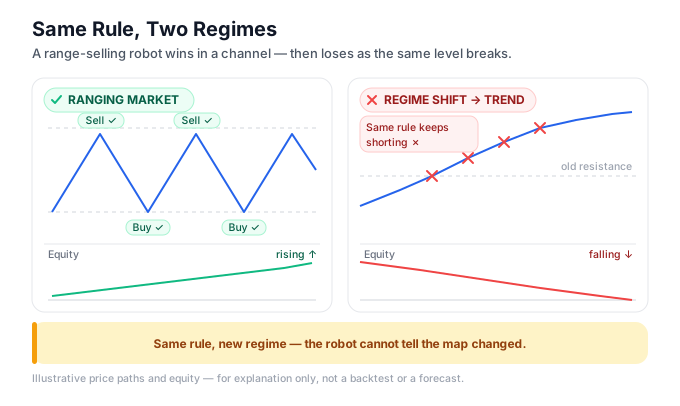
But look at the adaptability row. A human who sees a surprise rate decision can stand aside; a robot tuned to range-bound conditions keeps selling resistance straight into a breakout. The robot’s discipline becomes a liability the moment the assumption behind its rules breaks.
There is a deeper point the table understates. Automation does not create an edge — it enforces one. If the underlying strategy loses, the robot loses faster and more reliably than you would by hand, because it never hesitates to take the bad trade.
What about the EAs sold online
This is where honesty matters most. The largest share of EAs marketed with “never loses,” “98% win rate,” or “set-and-forget passive income” claims are either outright scams or curve-fit junk dressed up with a pretty equity curve.
Curve-fitting is the core trick. Take any price history, add enough parameters, and you can tune a system to look flawless on that exact data — the equivalent of drawing the target after firing the shot. It tells you nothing about tomorrow.
A common tell is a smooth, almost straight equity line with tiny drawdown across years. Real strategies breathe; they have losing streaks and ugly months. A curve that never suffers was fitted, not discovered.
The screenshots make it worse. A profit-factor number and a green backtest report are trivial to generate, and “verified” MyFX-style track records can run on a demo, a cherry-picked window, or an account that hides the losing months. Proof you cannot audit is not proof.
We will not name or endorse any specific robot, and neither should any site — not because good code cannot exist, but because a strategy that genuinely prints money is not sold for $99 on a forum. The incentive math alone should make you skeptical: if it worked as claimed, the seller would trade it, not retail it.
Where automation genuinely helps — and where it fails
Automation earns its place in three situations. First, executing a well-defined mechanical edge you have already validated — the rules are unambiguous, so a machine runs them better than a tired human.
Second, removing execution emotion. If your problem is closing winners early or skipping valid signals, coding the exact entry and exit strips the hesitation out. The EA takes every signal your plan defines, not the ones your nerves allow.
Third, backtesting an idea. Even if you trade by hand, coding a rough version of your rules and running it in the Strategy Tester tells you fast whether the idea has any historical basis before you risk money.
Automation fails in the mirror-image cases. Discretionary setups that depend on context — a news reaction, a session’s tone, the feel of a range — resist clean rules, and a forced rule usually captures the wrong thing.
It also fails at regime shifts. A trend EA bleeds through months of chop; a mean-reversion EA gets run over by a strong trend. Without a filter to detect the change, the robot keeps applying yesterday’s map to today’s terrain.
And no robot removes risk management. Position size, stop discipline, and daily loss limits still decide whether a rough patch is a drawdown or a blown account. Automating entries while ignoring risk — especially with high leverage — is automating the fast way to zero.
The most honest use of automation for most retail traders is hybrid, not full auto. You keep the discretionary decision — is this a market I want to trade today — and let a small EA or a semi-automated tool handle the mechanical part: entering at your level, setting the stop, moving to breakeven, scaling out. That splits the work along the line where each side is actually stronger.
How to evaluate an EA before you trust it live
If you are still tempted by an EA — your own or someone else’s — run it through this gate first. Every item is a reason to walk away if it fails.
Demand a long out-of-sample forward test. A backtest is the sales pitch; a forward test on data the EA was never tuned on is the evidence. Weeks are not enough — insist on months of demo or small-live results.
Get a real drawdown figure. Ask for the worst peak-to-trough equity drop, not the average. If the seller cannot or will not state it, assume it is ugly.
Understand the logic — never run a black box live. If you cannot explain in one sentence why the EA makes money, you cannot know when it will stop. An unexplained system is an unexploded one.
Count the parameters. The more knobs a system has, the easier it was to curve-fit. A handful of sane inputs beats twenty finely-tuned ones.
Test on your own broker and spread. An EA that scalps 3-pip targets dies on a 2-pip spread. Results are meaningless until they include your real costs.
Forward-test on a demo account before a cent of real money. Watch it trade live spread and slippage, and compare the demo record against the backtest — divergence is the truth.
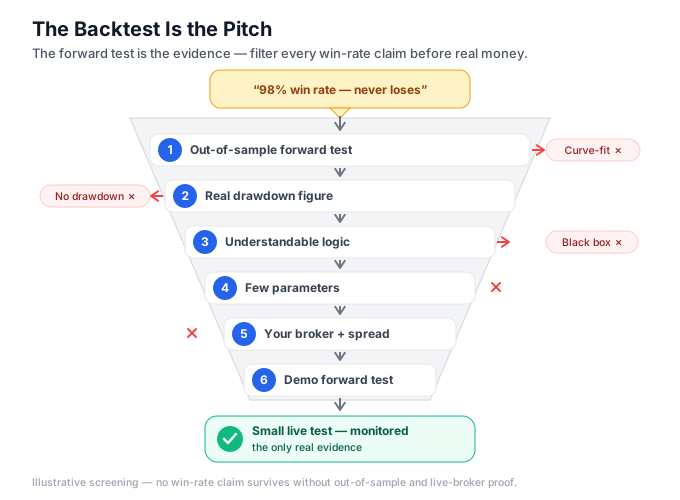
Two green flags are worth as much as the red ones. An honest seller shows you the losing months and explains the conditions where the system struggles; a defensible EA uses a small number of parameters you can reason about. Transparency about weakness is the closest thing to a trust signal in this space.
One rule sits above the list: never attach an EA to a live account you cannot afford to watch fail. “Set and forget” is marketing language, not a risk practice. Log its trades in a trade journal so you can compare its live record against the backtest month by month.
Running a robot on gold (XAU/USD)
Gold breaks naive EAs faster than any forex pair. An EA tuned on EUR/USD assumes EUR/USD’s range — roughly 50 to 90 pips a day — and sizes and spaces its trades to that.
Point that same robot at XAU/USD and the assumptions collapse. Gold routinely moves $20 to $50 a day — about 2,000 to 5,000 pips at $0.01 per pip — so an EA blind to that range will over-trade the noise and over-size every position.
The fix is volatility-aware sizing. Any robot run on gold needs micro lots, range-based stops scaled to gold’s Average True Range rather than a fixed pip number, and ideally an ATR filter so it stops firing during CPI, NFP, and FOMC spikes. Without that, it breaches sane risk within days.
Gold pip math makes the danger concrete. One gold pip is a $0.01 move worth $1 per pip per standard lot (100 oz), so a single $3 wick — 300 pips, ordinary for gold — is a $300 swing per standard lot. Size a gold EA like a EUR/USD EA and one candle can gut the account.
Session behaviour compounds the problem. Gold is quiet in the Asian session (23:00-08:00 GMT), directional through London (08:00-17:00 GMT), and violent around the New York open and US data. An EA with no time filter treats all of those hours as identical, taking the same-sized position into the calm Asian range and the CPI spike alike. On gold, when the robot trades matters as much as what it trades.
Common mistakes traders make with forex robots
These are the errors we see most often — the automation cousins of the classic beginner forex mistakes that sink manual traders too.
Trusting a backtest as proof. A clean backtest is the easiest thing in trading to fake through curve-fitting. Fix: treat the backtest as a hypothesis and the forward test as the evidence; only the forward result counts.
Running a black box live. Buying an EA you cannot explain means you cannot tell a normal losing streak from a broken system. Fix: never automate logic you cannot describe in one plain sentence.
Skipping the demo stage. “It backtested great” is not the same as “it survives live spread and slippage.” Fix: forward-test on demo for months, on your own broker, before any real capital.
Over-optimising parameters. Tuning inputs until the curve looks perfect fits the EA to the past, not the future. Fix: prefer fewer parameters and accept a rougher, more honest equity curve.
Ignoring risk because “the robot handles it.” An EA automates entries, not survival. Fix: cap risk per trade and set a hard daily loss limit the EA cannot override.
Running one EA on every instrument. A system tuned on EUR/USD will over-size and over-trade gold or indices. Fix: validate and re-tune separately per instrument, with volatility-aware sizing.
Believing “set and forget.” Markets shift, and an unattended EA can bleed for weeks before you notice. Fix: monitor equity daily and define in advance the drawdown that switches it off.
Frequently asked questions
Can a forex robot make you consistently profitable
No robot can promise that, and any that claims a fixed win rate or certain profit is a red flag. A robot only runs a strategy — if that strategy has a genuine edge and the market stays within its assumptions, it can perform; when conditions change, it fails like any fixed rule. The edge, not the automation, decides the outcome.
Are the forex robots sold online scams
Many marketed with “never loses” or huge win-rate claims are scams or curve-fit systems that look perfect on past data and fall apart live. That does not mean every EA is fraudulent, but a genuinely profitable system is rarely sold cheaply to strangers. Demand a long forward test and a real drawdown figure before trusting any of them. Our Black Diamond EA review shows how to pressure-test one heavily marketed system.
Is automated or manual trading better for beginners
Manual trading usually teaches more early on, because you learn why setups work and how markets behave. Automation without that understanding hides the lessons. If your written plan already has a clean mechanical edge and your problem is emotional execution, a simple EA can help — but build the judgment first. Our guide to how to start forex trading step by step covers that groundwork, from choosing a regulated broker to sizing your first trade at 1%.
What is the difference between a forex robot and a signal service
A robot executes trades automatically on your platform; a signal service sends you trade ideas to place yourself. Both can be built on weak logic, so the same skepticism applies. Our forex signal guide covers how to evaluate a provider before you follow anyone’s calls with real money.
Can I use an EA to pass a prop firm challenge
Some firms allow EAs and some restrict them, so check the specific rules — many ban certain automated tactics such as latency arbitrage or grid martingale systems. Even where allowed, the challenge’s drawdown and daily-loss limits still apply. See our guide to passing a prop firm challenge for how the rules interact with automation.
Does a forex robot remove the need for risk management
No. An EA automates entries and exits, not survival. Position size, stop discipline, and a daily loss limit still decide whether a losing streak is a drawdown or a blown account.
Many blown EA accounts had a fine entry rule and no sizing discipline. Automate the trade, never the risk.
Why did my profitable EA suddenly start losing
The most common reason is a regime shift — the market moved from ranging to trending, or volatility changed, and the EA’s fixed rules no longer fit. Curve-fit systems fail this way almost on schedule. A resilient EA needs a filter to detect the change; most do not have one, which is why forward-testing and daily monitoring matter.
Risk disclaimer: Forex and CFD trading carries a high level of risk and may not be suitable for all traders. The strategies and indicators described here are educational. Past performance does not guarantee future results. Test on a demo account before risking real capital.
Ready to put this into practice?
Open an account with a regulated broker and apply what you have learned. These are the three brokers we recommend:
Trading forex and CFDs carries a significant risk of loss and is not suitable for everyone. Broker links are affiliate links — we may earn a commission at no cost to you.