Last updated: July 10, 2026 · By: Tim Morris, founder of ForexMt4Indicators.com
Fund a forex account by first confirming the broker is regulated, then completing KYC, choosing one method — bank transfer, card, e-wallet, local payment, or crypto — and making a small first deposit. Test a withdrawal early, before you scale in. Only ever fund money you can afford to lose entirely.
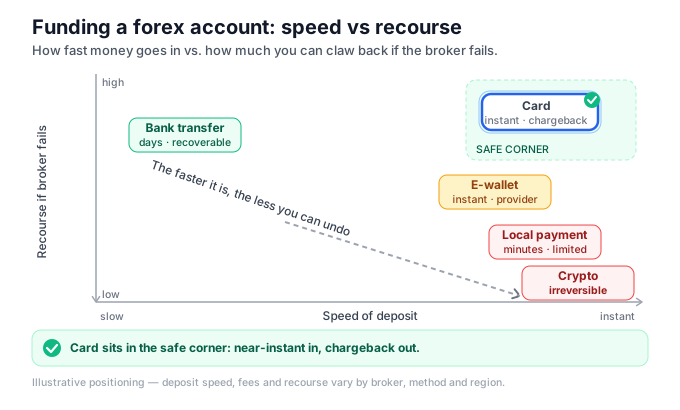
The diagram above ranks the common funding methods by how fast the money lands and how reversible it is if something goes wrong. Speed is the feature every broker advertises; reversibility is the one that actually protects you, and it moves in the opposite direction.
Before any of this, the broker has to be worth funding. Our guide to choosing a regulated forex broker covers the licence checks that come first; this article assumes you have done that and now need to move money in without getting burned.
What does funding an account safely actually mean
Funding is the moment your money leaves your control and enters someone else’s. The method matters, but the destination matters more — a fast, cheap deposit into the wrong broker is the most expensive trade you will ever place.
Three rules sit above every method below, and we repeat them because traders skip them.
Only fund a regulated broker. A licence from a serious regulator means segregated client funds and a complaints process that exists. If you cannot verify the licence number on the regulator’s own website, treat the deposit button as a trap, not a convenience.
Verify a clean withdrawal reputation before you deposit. Deposits always work — that is not the test. Search real user reports for withdrawal delays, sudden document requests, or “bonus” clauses that freeze balances. If withdrawal complaints cluster, no deposit method is safe there.
Only fund money you can afford to lose entirely. This is not a disclaimer line. Retail forex and CFD accounts lose money for most traders, so the deposit should be capital you could write off without touching rent, debt, or food. If losing it would hurt your life, it is too much.
Understanding what your money is actually buying helps here. Our explainer on how forex brokers work covers segregation, spreads, and where broker revenue comes from — context that makes a “too good to be true” bonus easier to spot.
What are the ways to fund a forex account
Most brokers offer four or five of the methods below. They differ on three axes that matter to you: how fast the money lands, what it costs, and how easily it can be reversed if the broker misbehaves.
Bank or wire transfer. The slow, boring, safe option. Transfers usually take 1 to 5 business days, carry a low or flat fee (often $0 to $30 typical, sometimes absorbed by the broker), and support the highest limits. Reversal is hard once sent, but the bank paper trail is the strongest of any method.
Debit or credit card. The default for small accounts. Deposits are near-instant, often free, though some brokers or card issuers add a 1% to 2% processing fee (typical — verify at checkout). The quiet advantage is the chargeback: card networks let you dispute a charge, which is real leverage if a broker refuses a legitimate withdrawal.
E-wallets (Skrill, Neteller, sometimes PayPal). Popular with our readers for good reason. Deposits and withdrawals are usually instant, deposit fees are often waived, and withdrawal fees are small (typical). The catch: e-wallets are a second account to fund and verify, and not every regulated broker supports every wallet.
Local payment methods. In India, Nigeria, Indonesia, the Philippines, and similar markets, brokers often support local bank transfer, UPI, mobile money, or regional processors. These are usually fast and cheap in local currency, which avoids a card FX markup — but they are frequently non-reversible, so the regulated-broker rule matters even more.
Crypto (USDT and similar). Fast and borderless, often landing in minutes to an hour for a network fee only. Two hard warnings: crypto transfers are irreversible — a wrong address or a bad broker means the money is gone — and if you hold a volatile coin between deposit and trade, the coin’s price swing is a second, unwanted position. A dollar-pegged stablecoin reduces that second problem but not the irreversibility.
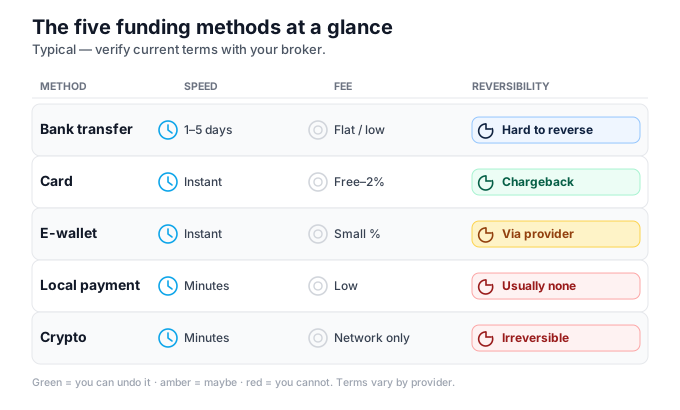
None of these methods is “best” in isolation. The right one is a trade-off between how quickly you need funds, what you are willing to pay, and how much reversal protection you want if the relationship with the broker goes wrong.
Which funding method should you use
Read this table before you pick. Every figure is typical and moves with your country, broker, and card issuer — verify the live terms on the deposit page rather than trusting a number here.
| Method | Typical speed | Typical fee | Typical limits | Reversible if broker fails |
|---|---|---|---|---|
| Bank / wire transfer | 1-5 business days | $0-$30 or flat | Highest | Hard (bank recall only) |
| Debit / credit card | Instant to minutes | Free, sometimes 1-2% | Moderate per transaction | Yes — chargeback possible |
| E-wallet (Skrill/Neteller) | Instant to minutes | Often free in, small out | Moderate | Provider-dependent |
| Local payment method | Minutes to 1 day | Low, often free | Varies by region | Usually no |
| Crypto (stablecoin) | Minutes to ~1 hour | Network fee only | High | No — irreversible |
The honest pattern: speed and reversibility pull against each other. The two fastest methods, local rails and crypto, give you the least recourse if the broker refuses to pay you back. The card is the sweet spot for most small accounts — near-instant in, with a chargeback as your safety net.
For a first live deposit, we favour a card or e-wallet over crypto, specifically because the irreversibility of crypto turns an ordinary “bad broker” mistake into a total, unrecoverable loss.
What is the deposit and withdrawal symmetry rule
Here is the rule that surprises most first-time depositors, and it is not the broker being difficult — it is anti-money-laundering law.
Regulators generally require that you withdraw funds back to the same method you deposited with, up to the amount you deposited. Profit above that deposited amount can usually go to a bank account in your name. This is the deposit/withdrawal symmetry rule, and it exists so trading accounts cannot be used to wash money through a payment method.
A worked example makes it concrete. Say you deposit $500 by card. When you withdraw, the first $500 typically must return to that same card; profit beyond the $500 usually routes to your verified bank account (typical policy — confirm your broker’s exact terms).
Two practical consequences follow. First, keep the card or wallet you deposited with active and valid — an expired card can stall a withdrawal. Second, deposit with the method you actually want your money to come back through, because you are choosing your withdrawal channel at the same time.
This rule also shapes your account currency choice. Pick the currency that matches how you think about risk, because every deposit and withdrawal in a different currency pays an FX conversion twice — once in, once out. A quick check in a live currency converter shows what that spread actually costs before you commit to an account denomination.
XAU/USD note. Funding is instrument-agnostic — the money does not care what you trade. But if you trade gold, which is priced in USD, a USD account keeps your pip and margin math clean and avoids a second currency conversion on every deposit and withdrawal. A USD-denominated account means one gold pip stays a plain $0.01 move ($1 per pip per standard 100-oz lot) instead of a number you have to re-convert each time you fund or cash out. If you plan to size positions and think in dollars, fund in dollars.
How to fund your account step by step
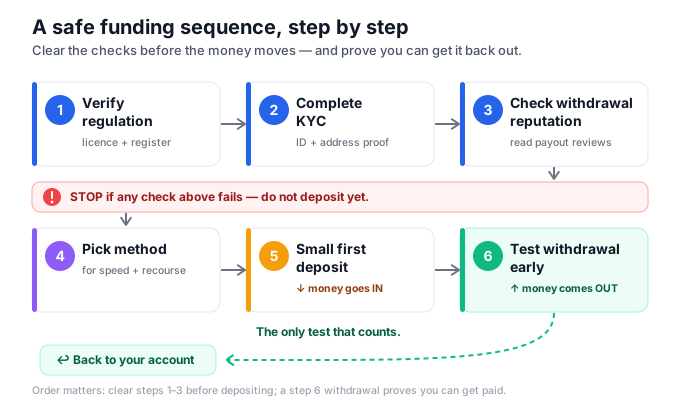
Funding is a sequence, not a single click. Follow it in order — the safety checks up front are what make the deposit at the end low-risk. That sequence sits inside a bigger one — our beginner’s guide covers everything that comes before your first trade, from choosing a regulated broker to sizing a position at 1%.
Verify the regulation. Find the broker’s licence number, then confirm it on the regulator’s own website, not a logo on the broker’s homepage. No verifiable licence means stop here.
Complete KYC before you deposit. Upload ID and proof of address and get the account fully verified first. A broker that lets you deposit but stalls verification when you withdraw is showing you a problem early.
Check the withdrawal reputation. Search recent, specific user reports about getting money out. Weight complaints about delays and moving goalposts far more heavily than complaints about losing trades.
Pick the method that matches your goal. Card or e-wallet for speed plus recourse on a small account; bank transfer for larger amounts; local rails for low local-currency cost; crypto only once you trust the broker and understand it is irreversible.
Make a small first deposit. Fund the minimum that lets you trade your planned position sizes — not your whole planned bankroll. A small first deposit caps the damage if the broker turns out to be the problem.
Test a withdrawal early. Before you scale in, request a small withdrawal and confirm it lands cleanly and on time. This single test tells you more about a broker than any review — a broker that pays a small withdrawal fast has passed the only test that counts.
If you are funding a genuinely small account, our guide on how to start forex with $100 walks through sizing so that a minimum deposit still lets you trade sanely. And if you have not risked real money yet, moving from a demo to a live account deserves its own deliberate step before you fund anything at all.
Do deposit bonuses actually help
Short answer: rarely, and they often cost more than they give. A deposit bonus looks like free capital, but the terms usually turn it into a leash.
Most bonuses lock the funds — sometimes your own deposit alongside the bonus — behind a trading-volume requirement. To “unlock” it you must trade a large multiple of the bonus in lots, which quietly pushes you to over-trade and take setups you would otherwise skip.
The behaviour the bonus encourages, high-frequency volume chasing, is the same behaviour that blows small accounts. The spread cost of hitting the volume target frequently exceeds the bonus itself. Read the volume clause before you accept, and when in doubt, decline the bonus and keep your withdrawal rights clean.
This is not unique to funding — the same “hit a volume or profit target under pressure” trap appears in passing a prop firm challenge, where chasing the target instead of trading your plan is the classic way to fail.
Common mistakes when funding a forex account
We have watched every one of these cost a reader real money. Each is named with the fix.
Funding an unregulated broker because the deposit was easy. A smooth deposit page tells you nothing about whether you can withdraw. Fix: verify the licence number on the regulator’s site before the first cent moves.
Chasing a deposit bonus. The volume requirement locks your funds and pushes over-trading. Fix: decline the bonus unless you have read and accepted the exact volume clause in writing.
Funding money you actually need. Rent, debt, and emergency money on a trading account is a life problem, not a trading problem. Fix: deposit only capital you could lose entirely without changing how you live.
Never testing a withdrawal. Traders deposit big, trade for months, then discover withdrawals are broken. Fix: withdraw a small amount early, before you scale in, and confirm it lands on time.
Using crypto with a broker you have not vetted. Irreversibility turns an ordinary bad-broker mistake into a total loss. Fix: use a card or e-wallet for a first deposit; reserve crypto for brokers you already trust.
Ignoring the symmetry rule and account currency. Depositing through a channel you cannot withdraw to, or in a currency you do not think in, costs you conversions and delays. Fix: deposit with the method and currency you want your money to return through.
Depositing the full bankroll on day one. A single large deposit maximises your exposure to a broker you have not tested. Fix: stage deposits — small first, scale only after a clean withdrawal.
Frequently asked questions
What is the safest way to fund a forex account?
There is no single safest method — safety comes first from funding a regulated broker with a clean withdrawal record. Among methods, a debit or credit card is a strong default for small accounts because deposits are fast and the chargeback gives you recourse if a legitimate withdrawal is refused.
Can I withdraw to a different method than I deposited with?
Usually not for the deposited amount. Anti-money-laundering rules generally require the first withdrawal, up to what you deposited, to return to the same method. Profit above the deposited amount can typically go to a bank account in your name. Confirm your broker’s exact policy before depositing.
How much money should I fund my first forex account with?
Only money you can afford to lose entirely, and for a first live deposit, the minimum that still lets you trade your planned position sizes. Staging matters more than the amount — deposit small, test a withdrawal, and scale in only after the broker has paid you back cleanly once.
Are deposit bonuses worth taking?
Rarely. Most bonuses lock funds behind a trading-volume requirement that pushes over-trading, and the spread cost of hitting that volume often exceeds the bonus. Read the volume clause first, and when unsure, decline the bonus to keep your withdrawal rights unrestricted.
Is it safe to fund a forex account with crypto?
Crypto is fast and cheap but irreversible — a wrong address or a bad broker means the money is gone with no chargeback. If you use it, use a dollar-pegged stablecoin to avoid a price swing between deposit and trade, and only with a broker you have already vetted and successfully withdrawn from.
How long does a forex deposit take to show up?
It depends on the method. Cards, e-wallets, and crypto are usually near-instant to about an hour. Bank and wire transfers typically take 1 to 5 business days. If a deposit has not arrived within the method’s normal window, contact support before sending a second one.
Why does my broker need my ID before I can withdraw?
Because regulated brokers must complete KYC (Know Your Customer) checks under anti-money-laundering law. Ideally you complete verification before depositing. A broker that lets you deposit freely but demands documents only when you try to withdraw is showing a warning sign worth taking seriously.
Risk disclaimer: Forex and CFD trading carries a high level of risk and may not be suitable for all traders. The strategies and indicators described here are educational. Past performance does not guarantee future results. Test on a demo account before risking real capital.
Ready to put this into practice?
Open an account with a regulated broker and apply what you have learned. These are the three brokers we recommend:
Trading forex and CFDs carries a significant risk of loss and is not suitable for everyone. Broker links are affiliate links — we may earn a commission at no cost to you.