

Last updated: July 5, 2026 · By: Tim Morris, founder of ForexMt4Indicators.com
You start forex trading with $100 by treating it as a learning stake, not an income engine. Risk 1% — only $1 — per trade. On a 0.01 micro lot at $0.10 per pip, that $1 is a tight 10-pip stop, so most $100 traders pick a cent account for wider swing-trade stops. Aim for clean execution, not fast profit.
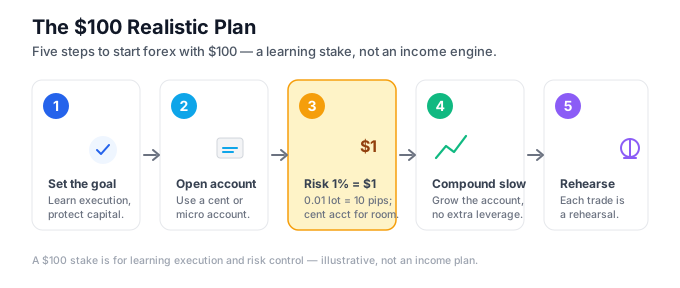
The diagram above lays out the five-step plan the rest of this guide expands: set the right goal, pick the right account, size for a $1 risk, compound slowly, and protect the psychology of a tiny stake.
Before you fund anything, learn how the account mechanics work — our guide to leverage in forex explains why a $100 balance can control far more than $100, and why that is the exact thing you must not abuse when you are starting out.
Can you actually start forex with $100
Yes, you can open and trade a live forex account with $100 at most brokers. What you cannot do is turn $100 into a living. Anyone promising fast riches on a $100 stake is selling you something, and it is not trading.
Here is the honest framing we use with every new trader: $100 is tuition. It is the cheapest way to feel real money on the line — the sweaty-palm difference between a demo click and a live one — without risking capital you cannot lose.
At 1% risk per trade, $100 puts $1 on the line each time. Even a great month of 20% growth is $20. That is not income; it is proof your process works at small size before you scale it.
So the correct question is not “how much can I make from $100?” It is “what can $100 teach me that a demo cannot?” The answer: how you behave when the money is real.
What is the right goal for a $100 account
Set two goals only: protect the capital and rehearse execution. Every trade is a repetition, like a musician running scales. You are not chasing a payday; you are grooving a process you can trust later at larger size.
Profit is a lagging by-product of discipline, not the target. If you aim at profit on $100, you will over-leverage to make the numbers feel worth it — and that is exactly how the $100 dies.
A useful test: at the end of a week, judge yourself on whether you followed your rules, not on whether the balance went up. A losing week where you followed every rule is a win. A winning week where you broke your stop rule is a loss waiting to repeat.
Keep a simple journal — entry reason, stop, result, and one sentence on whether you followed your plan. On a $100 account the journal is worth more than the balance.
Which account type should you open
Open a cent account or a micro account. Both let you trade in tiny sizes so a $100 balance can survive normal losing streaks instead of blowing up in a week.
A cent account displays your balance in cents, so $100 shows as 10,000 cents. It feels bigger, which sounds like a gimmick, but the real benefit is that lot sizes scale down — you can trade positions far smaller than a standard micro lot.
A micro account trades micro lots (0.01), where each pip on a USD-quoted major is worth $0.10. That is the smallest most standard-account brokers allow, and it is the right building block for $100.
Whatever you pick, practise the mechanics on a demo first. Our demo vs live account breakdown covers what a demo teaches well (execution, platform, strategy) and the one thing it cannot teach — the emotion of real money — which is the whole reason the $100 exists.
How much should you risk per trade on $100
Risk 1% of the account per trade. On $100, that is $1 per trade. This single rule is what separates a $100 account that lasts months from one that lasts days.
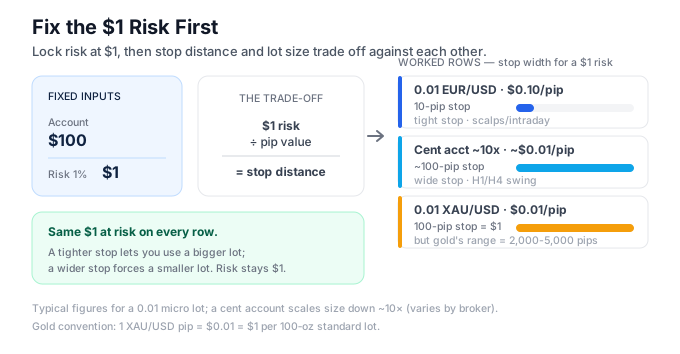
The math is simple once you know your pip value. On a USD-quoted major like EUR/USD, a 0.01 (micro) lot is worth $0.10 per pip. Divide the $1 risk by that pip value and you get a 10-pip stop — $1 ÷ $0.10 = 10 pips.
A 10-pip stop is tight. It works for scalps and intraday setups, but it is too narrow for most H1 or H4 swing trades, which need room to breathe without getting wicked out by noise. That narrow stop is the core constraint of a $100 micro account.
This is exactly why a cent account suits a $100 start. A cent account scales your position size down by roughly 10x — an effective pip value of about $0.01 — so the same $1 risk buys about a 100-pip stop, enough room for an H1 or H4 swing. (Cent mechanics vary by broker, so treat “roughly 10x smaller, about a 100-pip stop” as the shape of it, not an exact figure.) The principle never changes: fix the dollar risk first, then let the stop distance decide the lot.
Here is the relationship laid out. Fix the risk at $1, and stop distance and lot size trade off against each other.
| Account / lot | Pip value | $1 risk allows | Best for |
|---|---|---|---|
| Micro 0.01 (EUR/USD) | $0.10 per pip | 10-pip stop | Tight intraday / scalps |
| Cent acct (~10x smaller) | ~$0.01 per pip | ~100-pip stop | H1/H4 swing on $100 |
| Micro 0.01 (XAU/USD) | $0.01 per pip | 100-pip ($1) stop | Gold — but its range makes even this risky |
Never invert this. Decide the $1 risk and the stop your setup needs; the calculator returns the lot. Our lot size calculator does the arithmetic so you are not guessing under pressure — feed it the balance, the 1% risk, and the stop in pips.
How to pick a broker for a small account
Pick a broker with low or no minimum deposit, micro or cent accounts, and micro (0.01) lot sizing. Those three features decide whether $100 is workable at all.
Check the spread next. A wide spread eats a bigger share of your small stops — a 3-pip spread against a 10-pip stop is 30% of your risk gone before price moves. Favour tight-spread majors while you are learning.
Confirm the broker is regulated by a recognised authority and that withdrawals are clean and documented by real users. On a tiny account the temptation is to chase the biggest deposit bonus; ignore bonuses, because they usually lock your funds behind volume requirements that push you to over-trade.
We keep the deeper checklist — regulation, spreads, execution, funding — in our guide to choosing a forex broker. Read it before you fund; the broker is the one decision you cannot easily undo mid-account.
How do you grow $100 without blowing it
You grow it by compounding slowly and refusing to “speed it up” with more leverage. Leverage does not create edge; it only enlarges the outcome of an edge you may not have yet.
Compounding means your position size grows only as the balance grows. At a fixed 1% risk, a $100 account risks $1; at $120 it risks $1.20. The lot size creeps up on its own — you never manually jump from 0.01 to 0.10 to “make it faster.”
Run the numbers before you fantasise. A compound calculator shows that steady, modest gains take real time to matter on a small base — which is the point. Slow is not a flaw here; slow is the survival mechanism.
The trap is the shortcut. A trader who cranks leverage to turn $100 into $500 in a month is not compounding — they are running a coin-flip with a countdown timer. The blow-up is a matter of when, not if.
The psychology of a tiny account
A $100 account plays a mental trick: the money feels too small to respect, so traders gamble it. Resist that. The habits you build at $100 are the habits you will run at $10,000 — build sloppy ones now and they scale up with your balance.
Treat every trade as a rehearsal. You are practising the exact motions — set the stop, size the position, wait for the setup, walk away after entry — that must be automatic when the stakes are real.
The paradox of the small account is that the less the money matters financially, the more it matters as training. Blowing $100 through discipline failures is expensive in a way the balance does not show: you rehearsed losing.
Understand what leverage does to that psychology, too — a small balance with high leverage can feel like a big account, which invites big-account mistakes on a stake that cannot absorb them. Our what is margin in forex guide explains how much of your $100 a position actually ties up, and how fast a margin call arrives when you over-size.
What about trading gold (XAU/USD) on $100
Gold is tempting because it moves, but $100 cannot safely trade XAU/USD in anything but the smallest micro (0.01) lot. Even then, treat it with caution.
The pip math: at $1 per pip per 100-oz standard lot, a 0.01 gold lot is $0.01 per pip. That sounds tiny — but gold’s daily range routinely runs $20 to $50, which is 2,000 to 5,000 pips at $0.01 per pip.
Do the arithmetic and the danger is clear. A single average-range day of 2,000 pips on a 0.01 gold lot is a $20 swing — 20% of your $100, when your rule says risk 1%. A gold trade can breach a sane risk limit on ordinary volatility, before any news spike.
For most $100 beginners, the answer is simple: skip gold at first. Learn on a low-volatility USD-quoted major like EUR/USD, where a 0.01 lot’s $0.10 pip value keeps your risk controllable, and come back to gold once your sizing is automatic.
A step-by-step $100 starting plan
Follow these steps in order. Each one protects the capital and reinforces the process before you risk a real dollar. They sit inside the wider beginner path we cover in our complete step-by-step guide to starting forex trading.
Learn on a demo first. Run your strategy on a demo until execution is boring and mechanical. Boring is the goal — it means the mechanics no longer cost you attention.
Open a cent or micro account with a low-minimum, micro-lot, tight-spread broker. Fund it with $100 you can afford to lose entirely.
Fix your risk at 1% = $1 per trade. Never change this to chase a bigger number. It is the rule the whole plan rests on.
Size every trade to that $1. Pick your stop from the setup, then let the lot size calculator return the lot. On an EUR/USD micro lot, $1 at $0.10 per pip is a tight 10-pip stop; a cent account gives roughly 10x the room for the same $1.
Trade a low-volatility major, not gold. EUR/USD first. Add volatile instruments only once your sizing and stops are automatic.
Journal every trade and grade the process, not the profit. Did you follow your stop and risk rule? That is the scorecard.
Compound slowly; add zero extra leverage. Let the position size grow with the balance. Resist every urge to “speed it up.”
Common mistakes new $100 traders make
Most $100 accounts do not die from bad analysis. They die from these named behaviours — each with the fix.
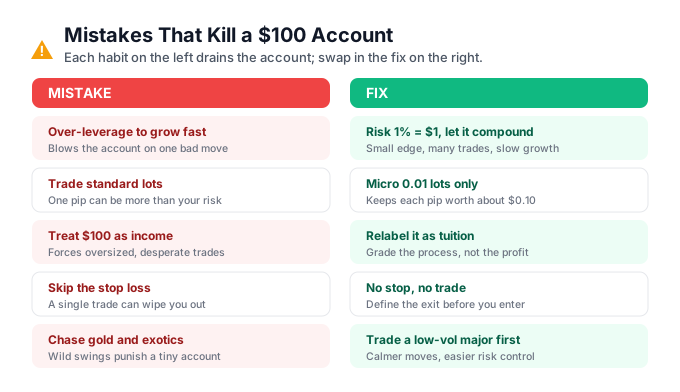
Over-leveraging to grow fast. Cranking leverage to turn $100 into $1,000 quickly is the number-one account killer. Fix: keep risk at 1% ($1) per trade and let compounding, not leverage, do the growing.
Trading standard lots on $100. A single standard lot on EUR/USD is $10 per pip — a 10-pip move is a 10% account swing, a 100-pip move wipes you out. Fix: trade micro (0.01) lots only; verify the lot in a calculator before every entry.
Treating $100 as income. Expecting rent money from a $100 stake forces oversized bets and reckless trades. Fix: relabel the account as tuition; judge it on process followed, not dollars earned.
Skipping the stop loss. On a tiny account a stopless trade that runs against you can erase weeks of discipline in one candle. Fix: set the stop before you enter — no stop, no trade, ever.
Chasing gold or exotics for the big move. Volatile instruments blow a 1% risk limit on ordinary daily range. Fix: trade a low-volatility major first; earn the right to trade gold by being consistent on EUR/USD.
Adding leverage after a loss to “win it back.” Revenge sizing after a losing trade doubles the damage of a bad streak. Fix: keep the same $1 risk win or lose; the size never reacts to the last result.
Ignoring spread on tight stops. A 3-pip spread against a 10-pip stop is 30% of your risk gone at entry. Fix: favour tight-spread majors and widen the stop, or size down, so spread is a small fraction of risk.
Frequently asked questions
Can you actually make money trading forex with $100?
You can make money in percentage terms, but the dollar amounts are small — 10% growth on $100 is $10. The realistic purpose of a $100 account is learning execution and discipline with real money on the line, not generating income. Grow the process first; the capital scales later.
How much can you realistically make with $100 in forex?
At a disciplined 1% risk per trade, gains are measured in single dollars per trade and modest percentages per month. A strong month might grow $100 by 10% to 20%, or $10 to $20. Anyone promising far more is ignoring the risk required to chase it — and that risk usually blows the account.
What lot size should I use with a $100 account?
Use micro (0.01) lots on a micro account, or the small equivalent on a cent account. On a USD-quoted major, a 0.01 lot is $0.10 per pip, so risking $1 (1%) allows only a tight 10-pip stop — fine for scalps, too narrow for most swing setups. A cent account scales size down roughly 10x, so the same $1 buys about a 100-pip stop. Fix your dollar risk first, then let the stop distance set the exact lot.
Should I use high leverage on a small account?
No. High leverage does not create an edge; it only magnifies the result of trades you may not yet be sizing correctly. Keep risk at 1% per trade regardless of the leverage your broker offers. Leverage is the tool most responsible for blowing small accounts fast.
Can I trade gold (XAU/USD) with $100?
Only in the smallest micro (0.01) lot, and even then with caution. At $0.01 per pip on a 0.01 gold lot, gold’s normal $20 to $50 daily range (2,000 to 5,000 pips) can swing more than a 1% risk on $100. Most $100 beginners should trade a low-volatility major first.
Is $100 enough to learn forex trading?
Yes — $100 is enough to learn the one thing a demo cannot teach: how you behave when the money is real. It covers a cent or micro account, micro-lot sizing, and dozens of small live trades. Treat it as tuition, protect it with 1% risk, and it can teach you for months.
What is the best account type for $100 in forex?
A cent account or a micro account. Both allow tiny position sizes so a $100 balance survives normal losing streaks. Cent accounts display the balance in cents and scale sizes down further; micro accounts trade 0.01 lots. Pick a low-minimum, tight-spread, regulated broker for either.
How do I grow a $100 account safely?
Compound slowly at a fixed 1% risk and add no extra leverage. Let position size grow only as the balance grows, trade a low-volatility major, journal every trade, and grade yourself on process, not profit. Safe growth on $100 is slow by design — the slowness is what keeps the account alive.
Risk disclaimer: Forex and CFD trading carries a high level of risk and may not be suitable for all traders. The strategies and indicators described here are educational. Past performance does not guarantee future results. Test on a demo account before risking real capital.
Ready to put this into practice?
Open an account with a regulated broker and apply what you have learned. These are the three brokers we recommend:
Trading forex and CFDs carries a significant risk of loss and is not suitable for everyone. Broker links are affiliate links — we may earn a commission at no cost to you.