Last updated: July 10, 2026 · By: Tim Morris, founder of ForexMt4Indicators.com
Interest rates are the single biggest fundamental driver of a currency’s value. Capital flows toward higher, rising yields, so a currency with higher or climbing rates tends to strengthen and one with falling rates tends to weaken. What a pair prices is the rate differential between its two currencies — but expectations move price more than the current level.
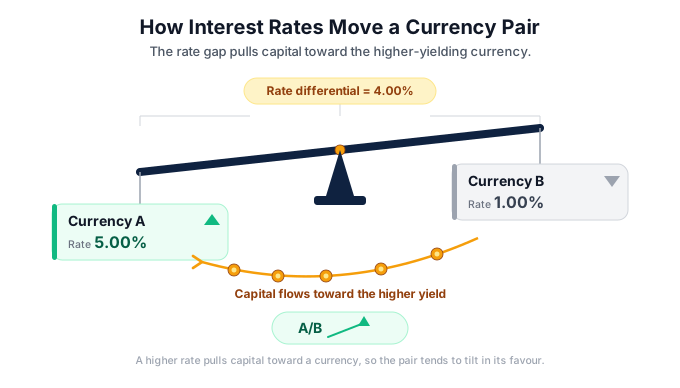
The diagram above shows two central-bank rates feeding a scale, the gap between them tilting a currency pair, and capital flowing toward the higher yield. The rest of this guide turns that picture into a bias you can carry into a trade.
If you want the wider machinery behind these moves, our central bank impact on forex guide covers who sets rates and how policy meetings ripple through the market; this article zooms in on the rates themselves and how a beginner should read them.
Why do interest rates drive a currency’s value
A currency is a claim on an economy, and its interest rate is the yield you earn for holding it. Money is mobile, so it drifts toward wherever it is paid the most to sit.
When a central bank raises its policy rate, holding that currency (in bonds, deposits, or the cash itself) pays more. Global capital rotates toward it, demand rises, and the currency tends to strengthen.
When a central bank cuts, the reverse happens. The yield on that currency falls, capital looks elsewhere for a better return, and the currency tends to weaken.
This is why interest rates sit at the top of fundamental analysis. If you are still deciding how much weight to give the news versus the chart, our fundamental vs technical analysis guide maps out where rates fit alongside price action.
What the rate differential prices in
You never trade one currency in isolation — you trade a pair. So the number that matters is not one country’s rate but the difference between the two rates in the pair.
If the base currency yields 5.00% and the quote currency yields 1.00%, the pair carries a 4.00% rate differential in the base currency’s favour. That gap is the fundamental wind behind the pair, and it shows up in two concrete places on your account.
The overnight swap. Hold a position past the daily rollover and you either earn or pay interest based on that differential. Long the higher-yielding currency, you tend to collect; long the lower-yielding one, you tend to pay. Our swap in forex guide breaks down exactly how brokers calculate it.
The carry trade. Some traders buy the high-rate currency and sell the low-rate currency purely to bank the differential over time. The idea is simple, but the risk is not, as the worked example below shows.
Here is what a differential does across the two sides:
| Rate change | Effect on the currency’s relative yield | Typical currency tendency |
|---|---|---|
| Surprise hike or faster hiking path | Yield rises vs expectations | Strengthens |
| Hike that markets already priced in | No change vs expectations | Little to no move |
| Hold, but signals more hikes (hawkish) | Expected future yield rises | Strengthens |
| Hold, but signals cuts (dovish) | Expected future yield falls | Weakens |
| Surprise cut or faster cutting path | Yield falls vs expectations | Weakens |
| Cut that markets already priced in | No change vs expectations | Little to no move |
Read that table twice. The right-hand column is driven not by whether rates rose or fell, but by whether they moved relative to what the market already expected — the distinction that is the whole game.
A carry-trade worked example
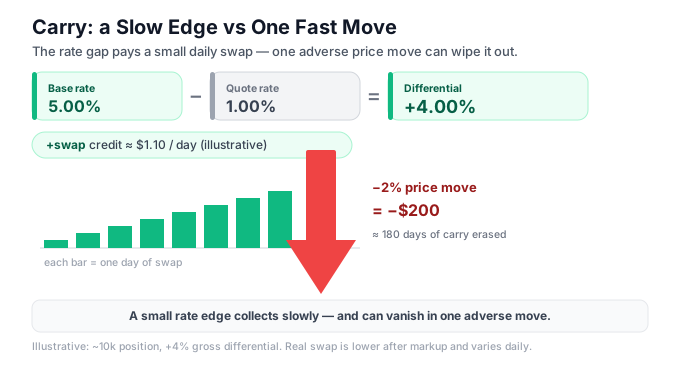
Say a pair carries a 4.00% annual differential in the base currency’s favour, and you go long a 0.10 lot (10,000 units of base, roughly a $10,000 notional). All figures here are illustrative — verify current rates and your broker’s swap terms before trading.
The gross differential is about 4.00% of $10,000 = $400 a year, or roughly $1.10 a day in positive swap. Brokers shave the differential with their own markup, so your real credit is usually smaller — treat any swap figure as typical, not fixed.
Now the catch. If the pair falls 2% in a single week, that is a $200 loss on the notional — wiping out roughly 180 days of that carry in five sessions.
The lesson is blunt. A small rate edge collects slowly and can be erased by one adverse move, so carry is a position-management problem, not a free yield. Never chase the differential without respecting the price risk sitting on top of it.
Why expectations move price more than the rate itself
This is the part most beginners get backwards. Markets are forward-looking, so today’s price already contains what traders expect rates to do next.
When a central bank delivers a hike that everyone saw coming, the pair often barely moves — or even falls, if traders take profit on a “buy the rumour, sell the fact” basis. The hike was already in the price before the announcement.
What moves price is the surprise: a hike when a hold was expected, a cut nobody priced, or a shift in the expected path of future rates. A central bank that holds steady but signals two more hikes can lift a currency more than one that actually hikes but hints it is done.
This is why the meeting statement, the press conference, and the forward guidance often matter more than the rate decision itself. The number is history; the path is the trade.
For a beginner, the practical takeaway is to check what the market expects before a decision, not only the outcome. Reading the forex economic calendar — with its consensus forecast next to each event — tells you what is already priced so you can judge whether a result is a surprise.
Real rates vs nominal rates — which yield actually matters
The rate a central bank announces is the nominal rate. But money cares about what that yield is worth after inflation eats into it — the real rate (nominal rate minus expected inflation).
A currency paying 6% while inflation runs at 5% offers a real yield of about 1%. A currency paying 3% while inflation runs at 1% offers a real yield of about 2% — and is arguably the more attractive hold, despite the lower headline number.
This is why a currency can weaken even as its central bank hikes: if inflation is climbing faster than the rate, the real yield is falling. Traders chase real yield, not the poster number.
As a beginner you do not need to model this precisely. Know that the true fundamental edge between two currencies is the real rate differential, not the nominal one — and that inflation data like CPI moves currencies partly because it shifts that real yield.
How do interest rates affect gold (XAU/USD)
Gold pays no interest. It sits in a vault yielding nothing, so its main competitor is the real yield on cash and bonds — which makes XAU/USD one of the most rate-sensitive instruments a retail trader touches.
When a central bank hikes and real yields rise, holding non-yielding gold costs you the return you gave up elsewhere, and gold tends to fall. When policy eases and real yields drop, that opportunity cost shrinks and gold tends to rise.
The key word is real. Gold does not track the nominal rate cleanly — it tracks the inflation-adjusted yield. Gold can climb during a hiking cycle if inflation is outrunning the rate hikes, because real yields are still falling.
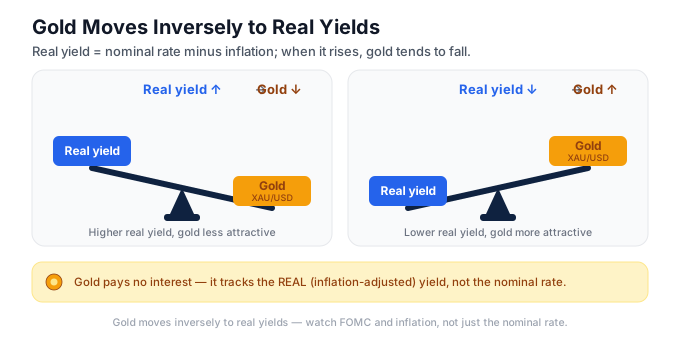
For a gold trader, this means watching Federal Open Market Committee (FOMC) decisions and real-yield shifts as closely as any currency trader watches rate differentials. CPI and FOMC routinely move XAU/USD $20 to $50 in a session — plan for wider stops and smaller lots than on EUR/USD around these events.
How should a beginner use interest rates
Rates are a directional bias, not an entry signal. They tell you which currency has the wind at its back over weeks and months — they do not tell you where to click buy this afternoon. Use them like this.
Rank the currencies by rate and rate direction. Note which currencies are hiking, holding, or cutting, and where each central bank has signalled it is heading. The currency with a high or rising rate has the fundamental wind behind it.
Favour pairs where the two currencies point in opposite directions. A currency that is hiking against one that is cutting has the cleanest differential story. Two currencies both cutting cancel much of the edge.
Check what is already priced before a decision. If a hike is fully expected, do not treat it as fresh fuel — the move may already be done. Look for surprises and changes in the expected path instead.
Let price action time the entry. Rates give you the bias; your chart and setup give you the entry, stop, and target. Trading a rate view without a price trigger is how beginners hold losers for weeks.
Respect the calendar. Rate decisions and inflation releases spike volatility and widen spreads. Know when they land, and decide in advance whether you are trading them or standing aside.
Track the swap on anything you hold overnight. If the differential is against you, swap quietly bleeds a long hold. Check both sides before carrying a position past rollover; an interest rate tracker keeps the current policy rates in one place.
Common mistakes traders make with interest rates
Assuming a hike always lifts a currency. When the hike was priced in, the pair can sit still or fall on the news. Fix: compare the outcome to the consensus forecast — trade the surprise and the forward guidance, not the raw direction.
Chasing carry without respecting price risk. A 4% annual differential feels like free money until a 2% adverse move erases months of it. Fix: size carry positions for the price risk first; treat swap as a bonus, never the trade thesis.
Ignoring the rate calendar. Getting caught in a position through an unexpected decision or a high-impact CPI print turns a clean setup into a coin flip. Fix: mark rate decisions and inflation releases on your calendar and plan around them.
Reading nominal rates and forgetting inflation. A 6% rate with 5% inflation is a worse hold than a 3% rate with 1% inflation. Fix: compare real (inflation-adjusted) yields when you judge which currency is genuinely stronger.
Using rates to time entries. A rate view is a multi-week bias, not a signal to enter at market now. Fix: let your chart trigger the entry and place the stop; use the rate story only to pick a direction.
Trading gold off nominal rates. Expecting gold to fall on every hike ignores that gold tracks real yields, not the headline rate. Fix: watch inflation-adjusted yields and the FOMC’s path, not only whether the Fed moved.
Trusting a signal service to “read the Fed” for you. No service reliably predicts a rate surprise, and any that claims a fixed win rate on news events is selling confidence, not edge. Fix: learn to read the calendar and consensus yourself — see our forex signal guide for what these services can and cannot do.
How interest rates compare to other forex drivers
Rates are the biggest fundamental lever, but they are not the only one. Knowing where they rank keeps you from over-weighting a single meeting.
| Driver | Time horizon | Effect on a currency |
|---|---|---|
| Interest rates and rate expectations | Weeks to months | Primary — sets the directional bias |
| Inflation (CPI) | Weeks to months | Strong — moves the real yield |
| Growth and jobs data (GDP, NFP) | Days to weeks | Strong — shapes rate expectations |
| Risk sentiment (risk-on / risk-off) | Days | Moderate — flows to or from safe havens |
| Price action and positioning | Minutes to days | Times the entry within the bias |
The honest takeaway: rates set the current the boat drifts in, but sentiment and price action decide the chop on any given day. Get the rate bias right and still ignore the chart, and you will be right on direction and wrong on timing.
Frequently asked questions
Do higher interest rates always make a currency stronger
Not always. A rate that is already expected is priced in, so the currency may not move — or may fall on profit-taking. And if inflation is rising faster than the rate, the real yield is falling and the currency can weaken despite the hike. The surprise and the real yield matter more than the headline number.
What is a rate differential in forex
The rate differential is the gap between the interest rates of the two currencies in a pair. If the base yields 5% and the quote yields 1%, the differential is 4% in the base’s favour. That gap is the fundamental bias behind the pair and it also determines the overnight swap you earn or pay.
How do interest rates affect the swap I pay or earn
Swap is charged or credited when you hold a position past the daily rollover, based on the rate differential. Hold the higher-yielding currency long and you tend to earn a credit; hold the lower-yielding one and you tend to pay. Brokers add a markup, so the credit is usually smaller than the raw differential suggests.
Why did the currency drop even though the central bank raised rates
Most likely the hike was already priced in, so traders sold the fact after buying the rumour. It can also happen if the bank hiked but signalled it is finished, lowering the expected future path. And if inflation is outrunning rates, the real yield fell even as the nominal rate rose.
What is a carry trade
A carry trade buys the higher-interest currency and sells the lower-interest one to collect the rate differential over time via positive swap. The differential accrues slowly, though, and a single adverse price move can wipe out months of carry, so it is a position-management strategy, not free income.
How do interest rates affect gold
Gold pays no interest, so it competes with the real (inflation-adjusted) yield on cash and bonds. When real yields rise, non-yielding gold tends to fall; when they drop, gold tends to rise. Gold tracks nominal rates poorly — it follows the real yield, which is why gold can climb during a hiking cycle if inflation is higher still.
How do I know what interest rate move is already priced in
Check the economic calendar’s consensus forecast next to the event, and follow the tone of the central bank’s recent guidance. If the expected outcome matches the forecast, it is largely priced in. The tradeable move comes from a result that misses the forecast or a shift in the expected path of future rates.
Glossary of related terms
- Interest rate (policy rate) — the rate a central bank sets; the yield you earn for holding that currency.
- Rate differential — the gap between the two currencies’ rates in a pair; the fundamental bias behind it.
- Nominal rate — the headline announced rate, before adjusting for inflation.
- Real rate — the nominal rate minus expected inflation; the yield that actually drives capital flows and gold.
- Swap (rollover) — interest earned or paid for holding a position overnight, set by the rate differential.
- Carry trade — buying the high-rate currency and selling the low-rate one to bank the differential.
- Hawkish / dovish — signalling a bias toward higher rates (hawkish) or lower rates (dovish).
- FOMC — the US Federal Reserve’s policy-setting committee; its decisions drive USD and gold.
Related reading
- Central bank impact on forex
- What is swap in forex?
- How to read the forex economic calendar
- How to fund a forex account
Risk disclaimer: Forex and CFD trading carries a high level of risk and may not be suitable for all traders. The strategies and indicators described here are educational. Past performance does not guarantee future results. Test on a demo account before risking real capital.
Ready to put this into practice?
Open an account with a regulated broker and apply what you have learned. These are the three brokers we recommend:
Trading forex and CFDs carries a significant risk of loss and is not suitable for everyone. Broker links are affiliate links — we may earn a commission at no cost to you.