Last updated: July 10, 2026 · By: Tim Morris, founder of ForexMt4Indicators.com
A forex signal is a trade suggestion someone hands you: a currency pair, a direction (buy or sell), an entry price, a stop-loss, and a take-profit, sometimes with the reasoning behind it. Signals come from human analysts or from algorithms, free or paid, and most paid services oversell what they actually deliver.
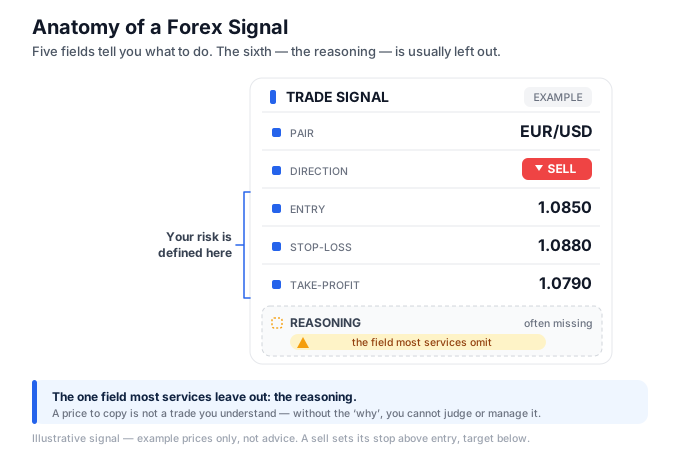
The diagram above breaks a single signal into its parts — the five fields you can act on, plus the one most services leave out. Everything below turns that anatomy into a filter for deciding whether a signal is worth your attention at all.
If you are early in your trading, following signals blind is one of the fastest ways to stall — our rundown of common beginner forex mistakes covers why outsourcing your own decisions rarely ends well. This guide treats signals as a tool to be tested, not a shortcut to be trusted.
What is a forex signal, exactly?
A forex signal is a specific trade instruction. At minimum it names a pair and a direction; a complete signal adds an entry price, a stop-loss (SL), and a take-profit (TP).
The best signals also include the reasoning — a chart, a level, a news catalyst — so you can judge the logic before you risk money. The worst give you a pair and a direction and nothing else, which is another way of telling you to trust the sender blindly.
A typical signal reads like this: “SELL EUR/USD at 1.0850, SL 1.0880, TP 1.0790.” That single line contains a direction, an entry, 30 pips of risk, and 60 pips of reward — a 1:2 risk-to-reward setup you can measure before you commit. A signal that omits the stop or the target is not incomplete by accident; it is hiding the risk from you.
Think of a signal as a second opinion, not an order. It is someone’s read on the market, packaged so you can copy it. Whether that read is any good is a separate question the signal itself never answers.
We treat every signal as a claim to be checked against our own analysis — the same discipline behind fundamental versus technical analysis — never as a command to click buy.
What are the types of forex signals?
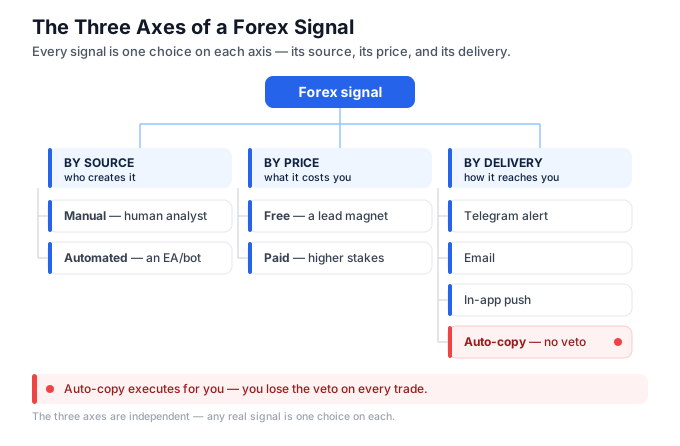
Signals split along three axes: who generates them, whether you pay, and how they reach you. Knowing where a signal sits on each axis tells you most of what you need before you even read the setup.
By source — signals are either manual or automated. Manual signals come from a human analyst reading charts or news. Automated signals come from an algorithm or expert advisor (EA) scanning for a pattern and firing an alert — the same debate we unpack in automated versus manual trading.
By price — free or paid. Free signals are often lead magnets: the sender wants your email, your Telegram follow, or your broker sign-up. Paid signals charge a monthly fee, and that fee does not make them more accurate — it raises the stakes.
By delivery — Telegram groups, email lists, mobile-app push notifications, or auto-copy that mirrors trades straight into your account. Auto-copy is the most dangerous because it removes the one step where you could say no.
| Type | Generated by | Typical cost | Delivered via | Main risk |
|---|---|---|---|---|
| Manual analyst | A human reading charts and news | Free or paid | Telegram, email, app | Bias, no accountability |
| Automated / EA | An algorithm or trading robot | Free or paid | App push, auto-copy | Curve-fit rules that break live |
| Broker in-house | A broker’s analyst desk | Usually free | Platform, email | Nudges you to trade more |
| Marketplace | Ranked third-party providers | Paid / subscription | Copy platform | Cherry-picked track records |
Where do forex signals come from?
Signals reach you from four main places, and each carries its own conflict of interest.
Broker and analyst desks publish signals to keep you trading — more trades mean more spread and commission for them. The analysis can be solid, but the incentive is volume, not your balance.
Telegram and social groups are the largest and least accountable source. Anyone can start one, post screenshots of winners, quietly delete the losers, and charge for “VIP” access.
Signal marketplaces rank providers by published statistics. The numbers look objective, but they are often self-reported or measured on demo accounts, and a provider can bury a blown account by opening a fresh one and starting the stats over.
Copy-trading platforms sit close to marketplaces but automate the whole loop — you pick a “top trader” from a leaderboard and their positions replicate into your account. The leaderboard rewards whoever took the biggest recent risk, so the trader at the top is often the one about to blow up, not the one to follow.
The pattern across all four: the people sending signals rarely lose money when you do. That asymmetry is the first thing to hold in mind.
The honest take on paid signal services
Here is the part most signal reviews skip. We have watched dozens of these services over the years, and the recurring problems are structural, not occasional.
Most paid services overstate their accuracy. A headline “accuracy” figure means nothing without the risk-to-reward attached — you can win most of your trades and still lose money if the few losers are large.
Few publish a verifiable, third-party-audited track record. Screenshots are not proof; a real record is a read-only broker statement or a verified account covering every trade, winners and losers, over months.
Many are marketing funnels in disguise. The “free” signals push you to deposit with one specific broker, because the sender typically earns an affiliate commission — often a share of your spread, and in some arrangements a share of your losses — the moment you fund the account.
And following signals blind teaches you nothing. You outsource the single skill that separates traders who last from those who don’t: deciding for yourself when a setup is worth risking money on.
Red flags: how to tell a scam from a signal worth testing
You will not verify a service’s honesty from its marketing. But you can screen out the obvious traps fast, because green flags and red flags tend to cluster together.
| Green flags (worth a demo test) | Red flags (walk away) |
|---|---|
| Shows a third-party-verified track record | Claims guaranteed or “100%” profits |
| Publishes losers alongside winners | Only ever posts winning screenshots |
| Explains the reasoning behind each call | Gives a pair and direction with no logic |
| Lets you use your own risk and stop | Pressures you to deposit “now” to a set broker |
| Is open about its method and its limits | Keeps the “strategy” a paid secret |
| No pressure, no countdown timers | Urgency, scarcity, and lifetime-deal timers |
No signal service should ask you to abandon your own stop-loss or size a trade to their instruction. The moment a provider treats risk as an afterthought, whatever track record sits behind it is irrelevant.
How to use forex signals responsibly, if at all
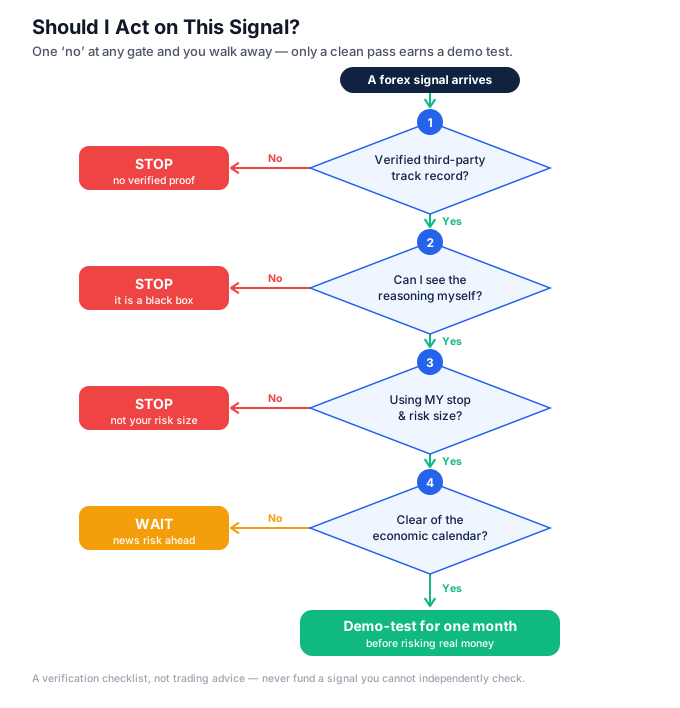
If you use signals, use them as a learning aid or a second opinion — never as autopilot. Here is the framework we would give a newer trader who insists on trying them — ideally one who has already worked through how to start forex trading step by step.
Verify before you value. Ignore the marketing and look for a read-only, third-party-verified record covering months, not a week. No verifiable record, no trust — full stop.
Check every signal against your own analysis. Mark the level, the trend, and the catalyst yourself. If you cannot see why the trade makes sense, skip it — a signal you do not understand is a coin flip with extra steps.
Always use your own risk sizing and stop. Size each trade to a fixed percentage of your account (many traders cap risk near 1% per trade), and place your stop where the chart says it belongs, not where the signal says.
Cross-check the calendar. A signal that ignores a high-impact release is a trap. Our economic calendar shows what is due before you commit to any entry.
Test on demo first. Run any new service on a demo account for a month before a cent of real money touches it. If it cannot survive demo, it will not survive live.
Watch the broker push. If unlocking the signals requires depositing with one named broker, treat the whole thing as an advertisement. Pick your broker on its own merits — our guide to choosing a forex broker covers what actually matters.
XAU/USD note: why gold signals are especially risky
Gold signals deserve their own warning. XAU/USD moves far faster and further than the majors — a routine day covers roughly $20 to $50, and news candles spike much wider.
That volatility breaks the neat fixed stop most signals hand you. A gold signal with a stop only a few dollars from entry — far tighter than gold’s daily range — can be blown through in a single CPI or FOMC candle before the trade ever works, booking your loss even when the direction was right.
If you ever act on a gold signal, size it in micro lots (0.01) and widen the stop to gold’s actual range yourself — never trust the tight stop a signal quotes. For reference, 1 pip on gold is a $0.01 move, worth $0.01 per pip per 0.01 lot, $0.10 per 0.10 lot, and $1 per standard 100 oz lot.
Common mistakes traders make with forex signals
Copying the entry but skipping the stop. Traders take the buy and drop the SL to “give it room.” Fix: never take a signal without a stop; if the signal has no stop, it is a guess, not a signal.
Trusting an accuracy figure with no risk-to-reward. A high hit rate can still lose money if the losers dwarf the winners. Fix: judge every service on net expectancy over months of verified trades, not the share of green trades.
Sizing to the signal, not to your account. Providers post lot sizes for a $50,000 account; you have $800. Fix: recalculate position size to your own balance and a fixed risk percentage, every single time.
Auto-copying without a kill switch. Auto-copy can mirror a blown account straight into yours overnight. Fix: if you auto-copy at all, cap the copied lot size and set a hard daily loss limit on your account.
Paying to escape learning. New traders buy signals to skip the study, then never build a skill of their own. Fix: use signals as flashcards — for every call, write down why it is or is not valid before the result prints.
Chasing gold signals with forex-sized stops. A stop distance that is sane on EUR/USD leaves only a dollar or two of room on gold — far inside XAU/USD’s range and reckless. Fix: widen stops to gold’s range and cut to micro lots before you touch a gold call.
Ignoring the affiliate motive. Free signals tied to one broker are advertisements. Fix: assume any “deposit here to unlock” offer is paid placement and judge the broker separately.
Frequently asked questions
Are forex signals worth paying for?
For most traders, no. Paying does not buy accuracy — it buys someone else’s opinion, often behind an unverified track record. A paid signal can be worth a short demo test if the provider shows a third-party-verified record and explains its reasoning, but treat the fee as tuition for learning to read setups, not a route to profit.
Can forex signals make you profitable?
No signal can make you profitable on its own. Profitability comes from your risk management, position sizing, and consistency — the parts a signal never handles for you. At best a good signal is a second opinion that speeds up your own analysis. Followed blindly, signals only move the decision to someone with no stake in your account.
What is a good win rate for a forex signal service?
Win rate alone tells you almost nothing. A service can win most of its trades and still lose money if its losers are far larger than its winners. What matters is net expectancy — average result per trade across a long, verified sample. Be skeptical of any provider that advertises a headline accuracy number without showing the risk-to-reward behind it.
Are free Telegram forex signals reliable?
Rarely. Free Telegram groups are the least accountable source of signals: anyone can open one, post only the winners, and charge for a “VIP” tier later. Many exist to funnel you to a specific broker for an affiliate commission. If you follow one, verify every call against your own chart and never size a trade to their instruction.
Should I use auto-copy trading signals?
Auto-copy is the riskiest way to use signals because it removes the step where you could refuse a bad trade. A provider’s blown account can replicate straight into yours overnight. If you use it, cap the copied lot size, set a hard daily loss limit, and only mirror an account with a long, verified, third-party track record.
Do forex signals work for gold (XAU/USD)?
Gold signals are especially risky. XAU/USD’s volatility means the tight fixed stop most signals quote can be blown through in a single news spike, even when the direction is right. If you act on a gold call, ignore the quoted stop, widen it to gold’s real range yourself, and cut your position to micro lots.
Can I use signals to pass a prop firm challenge?
Leaning on signals to hit a target fast is a common way to fail. Prop rules punish exactly the behaviour blind copying encourages — oversized trades and stops set by someone else. If you are attempting an evaluation, our guide to passing a prop firm challenge shows why a tested system of your own beats borrowed calls every time.
Risk disclaimer: Forex and CFD trading carries a high level of risk and may not be suitable for all traders. The strategies and indicators described here are educational. Past performance does not guarantee future results. Test on a demo account before risking real capital.
Ready to put this into practice?
Open an account with a regulated broker and apply what you have learned. These are the three brokers we recommend:
Trading forex and CFDs carries a significant risk of loss and is not suitable for everyone. Broker links are affiliate links — we may earn a commission at no cost to you.