Last updated: July 6, 2026 · By: Tim Morris, founder of ForexMt4Indicators.com
Central banks move forex by setting interest rates. Money flows toward currencies with higher, rising rates, so a hawkish (rate-hiking) bank tends to strengthen its currency and a dovish (rate-cutting) one tends to weaken it. The four that matter most are the Fed, ECB, Bank of England, and Bank of Japan.
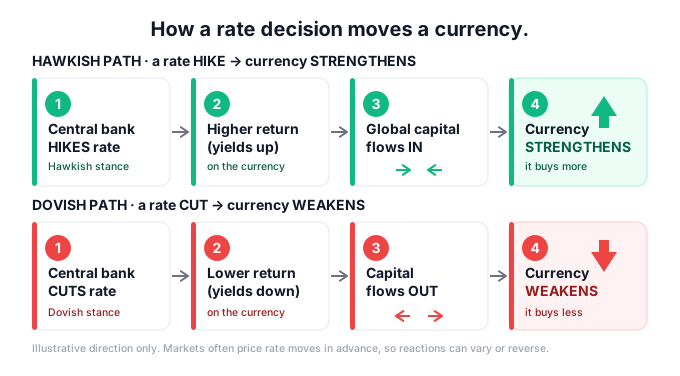
The diagram above traces the single chain that drives most currency moves: a central bank changes its policy rate, capital chases the higher return, and the currency strengthens or weakens as a result. The rest of this guide turns that chain into rules you can trade around.
Interest-rate policy is the heart of the macro side of trading, one layer up from the account setup and first-trade basics in how to start forex trading. If you are still weighing chart-reading against the economic backdrop, our fundamental vs technical analysis guide shows where central-bank policy fits; this article zooms in on the banks themselves.
How do central banks actually move a currency?
A central bank sets the short-term interest rate for its economy. That rate decides what banks earn on safe deposits, which ripples out to bond yields, loan rates, and the return a foreign investor gets for holding that currency.
Money is not loyal. Capital flows toward the currency that pays more for the same safety, so when a central bank raises rates — or signals it soon will — demand for that currency tends to rise and its price climbs.
The reverse works the same way. When a bank cuts rates or signals easier policy, the return on that currency drops, capital rotates elsewhere, and the currency tends to weaken.
What actually gets traded is the gap between two countries’ rates. A pair like EUR/USD reflects the euro’s rate against the dollar’s, so a hawkish Fed can lift the dollar even when the ECB does nothing — the rate gap widened in the dollar’s favour. This is why one bank’s decision moves both sides of a pair.
Two words carry this whole story. A hawkish stance means the bank is leaning toward tighter policy — higher rates to cool inflation. A dovish stance means it is leaning toward easier policy — lower rates to support growth.
Hold onto that hawkish-versus-dovish frame. Almost every forex reaction to a central bank, from a 20-pip drift to a 150-pip spike, is the market repricing how hawkish or dovish that bank turned.
Hawkish vs dovish: which way does the currency go?
Here is the reference to keep on your desk. It maps the bank’s stance to the likely currency direction, all else equal.
| Central bank stance | What it means | Rate direction | Currency tendency |
|---|---|---|---|
| Hawkish | Fighting inflation, tightening | Hikes or signals hikes | Tends to strengthen |
| Dovish | Supporting growth, easing | Cuts or signals cuts | Tends to weaken |
| Neutral / on hold | Waiting for data | No change | Reacts to the guidance tone |
“All else equal” is doing heavy lifting in that table. A hike only lifts a currency if the market was not already expecting it — the reason for that sits in the surprise section below.
Note the neutral row too. A bank can hold rates steady and still move its currency hard, purely through the tone of its statement and press conference. The decision and the message are two separate signals.
Which central banks move forex the most?
Four banks set the tone for the majors. Learn these four and you understand most of what drives EUR/USD, GBP/USD, USD/JPY, and the dollar crosses.
| Central bank | Currency | Rough meeting cadence | What traders watch |
|---|---|---|---|
| Federal Reserve (Fed) | USD | Every 6-8 weeks (~8/year) | Rate decision, projections, Fed chair press conference |
| European Central Bank (ECB) | EUR | Every 6-8 weeks (~8/year) | Rate decision, staff projections, statement tone |
| Bank of England (BoE) | GBP | Roughly every 6 weeks (~8/year) | Committee vote split, inflation outlook |
| Bank of Japan (BoJ) | JPY | Every 6-8 weeks (~8/year) | Policy shifts, yield-curve stance |
The Fed is the heavyweight. Because the US dollar sits on one side of most forex volume, a Federal Reserve decision moves nearly every USD currency pair on your screen at once. When the Fed turns hawkish, the dollar tends to strengthen against everything; when it turns dovish, the dollar tends to fall broadly.
The ECB (European Central Bank) drives the euro and, through EUR/USD, a large share of the market. Its published staff projections often move the euro as much as the headline rate does.
The BoE (Bank of England) moves the pound, and its decisions carry an extra tell: the committee publishes how each member voted. A 5-4 split toward hikes reads as more hawkish than a unanimous hold, even when the rate itself does not change.
The BoJ (Bank of Japan) is the outlier. For years it ran ultra-loose policy while the others tightened, which made the yen react sharply whenever it hinted at any shift. Any BoJ surprise tends to move USD/JPY and the yen crosses fast.
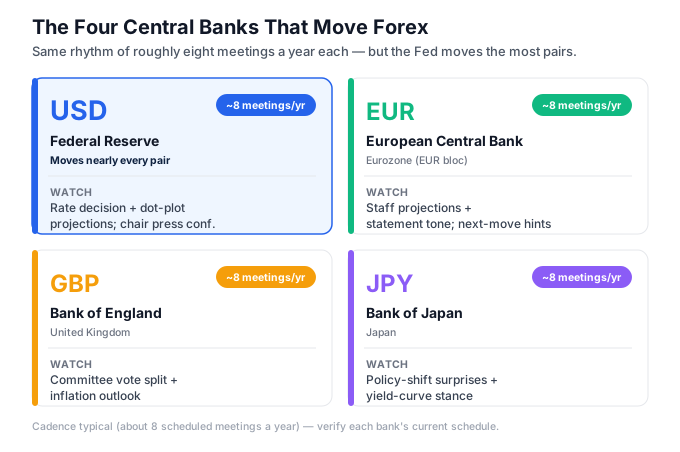
Every figure here — meeting counts and cadence — is typical and changes. Central banks reschedule, add emergency meetings, and revise their own calendars, so verify the next dates on an interest-rate tracker before you plan a trade around them.
Why does the surprise matter more than the decision?
Here is the idea that separates traders who survive rate days from those who get run over. The market prices in the expected decision before it happens, so price moves on the gap between what was expected and what the bank actually delivers.
If every economist expects a hike and the bank hikes, the currency may barely move — or even fall, because the news was already in the price. Traders call this “buy the rumour, sell the fact.”
A rough, illustrative example: if the market has fully priced a 0.25% hike and the bank delivers exactly that, the currency can sit still or drift lower. Deliver 0.50% instead, or hint at more hikes ahead, and the same currency can jump 80-120 pips as traders scramble to reprice.
The violent moves come from surprises. A bank that was expected to hold but hikes, or was expected to cut but pauses, forces the whole market to reprice in seconds. That is where the 100-pip candles come from.
Forward guidance is the other half. This is the language a central bank uses about future policy — the hints in its statement and press conference. A bank can leave rates unchanged and still send its currency up sharply by signaling more hikes ahead.
So you are watching three things on decision day: the rate itself, the guidance about what comes next, and how both compare to what the market already expected. The third one drives the candle.
How should you trade a central bank rate decision?
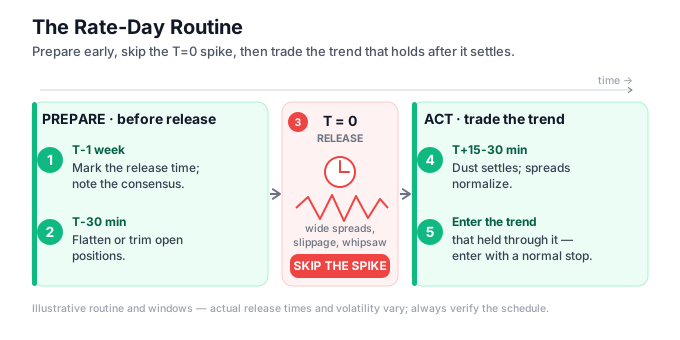
The honest answer for most retail traders: do not trade the spike. The first seconds after a decision bring the widest spreads, the worst slippage, and whipsaws that stop you out in both directions before price settles.
The release is violent by design. Liquidity thins out right before the announcement, so a market order into that window can fill far from your intended price.
A calmer routine works better. Here is the framework we use around any of the four majors.
Mark the decision on your calendar first. Know the exact release time in your own time zone before the week starts. Our how to read a forex economic calendar guide shows how to read impact ratings and consensus numbers so nothing catches you flat.
Know the consensus. Note what the market expects — the consensus rate and the expected tone. Without that number you cannot judge whether the outcome is a surprise. The live economic calendar tool lists consensus and previous figures side by side.
Flatten or reduce before the release. Close or trim open positions on affected pairs 15-30 minutes before the decision, or stand aside entirely. Protecting capital beats guessing direction.
Wait for the dust to settle. Let the first 15-30 minutes pass. The initial spike often reverses; the real move is the trend that forms once the market digests the guidance.
Trade the trend that follows, not the spike. Once a direction holds after the noise, you can enter with a normal stop in the direction the market chose. This is slower and far less glamorous — and it is how most consistent traders handle news.
None of this promises a winning trade. Losing trades around news are normal even with a good process; how you size and recover from them matters more than any single call, and our guide on handling trading losses covers that recovery discipline.
What about gold (XAU/USD)?
Gold is as sensitive to central banks as any currency pair, and it keys off the same driver from a different angle. Gold pays no interest, so its appeal falls when safe, rate-bearing assets pay more.
The specific link is real yields — the interest rate minus expected inflation. When a hawkish Fed pushes real yields up, gold tends to fall, because cash and bonds suddenly out-compete a metal that yields nothing.
When policy eases and real yields drop, gold tends to rise. A gold trader has to watch Fed decisions and real-yield shifts as closely as a EUR/USD trader watches the rate line — arguably closer, because gold’s daily range routinely runs $20 to $50 and its news spikes are brutal.
Practical takeaway: treat FOMC days on XAU/USD with even more caution than on the majors. The same stand-aside-then-trade-the-trend routine applies, with wider stops for gold’s noise.
Gold is a CFD for most retail traders outside the US, the same instrument class as forex. If that distinction is new to you, our what is a CFD explainer covers how these contracts work.
Common mistakes traders make around central bank decisions
Trading the rate-decision spike. The first candle after a decision is close to a coin flip with terrible spreads. Fix: stand aside for 15-30 minutes and trade the trend that forms after the noise.
Ignoring forward guidance. Reading only the rate number and skipping the statement means missing half the signal. Fix: wait for the press conference and read the tone before you judge direction.
Assuming a hike always lifts the currency. When a hike is fully expected, it is already in the price and the currency can fall on the news. Fix: compare the outcome to consensus — trade the surprise, not the decision.
Not knowing the consensus. Without the expected number you cannot tell a surprise from a non-event. Fix: check consensus and previous figures on the economic calendar before the release.
Holding oversized positions into the announcement. A normal position size becomes reckless when the spread widens and price gaps. Fix: flatten or trim exposure on affected pairs before high-impact decisions.
Trading every central bank the same way. A BoJ surprise behaves differently from a routine Fed hold. Fix: learn each bank’s current stance and what the market is primed to react to.
Forgetting the dollar is on both sides of your screen. An FOMC move hits every USD pair at once, so stacked dollar positions all win or lose together. Fix: treat a Fed day as one big dollar bet and size your total exposure accordingly.
Frequently asked questions
Why does a currency go up when interest rates rise?
Higher rates raise the return on holding that currency in safe deposits and bonds. International capital flows toward the better return, which increases demand for the currency. The effect is strongest when the hike is a surprise; a fully expected hike is often already reflected in the price before the announcement.
What does hawkish and dovish mean in forex?
Hawkish means a central bank is leaning toward tighter policy — raising rates to fight inflation — which tends to strengthen its currency. Dovish means leaning toward easier policy — cutting rates to support growth — which tends to weaken it. Markets often react to the tone of the statement as much as to the rate itself.
Which central bank moves forex the most?
The US Federal Reserve, because the dollar sits on one side of most traded pairs. An FOMC decision moves nearly every pair on your screen at once. The ECB, Bank of England, and Bank of Japan drive the euro, pound, and yen respectively, but the Fed has the broadest reach across the market.
How often do central banks meet?
The four major banks — the Fed, ECB, Bank of England, and Bank of Japan — each meet roughly every 6 to 8 weeks, about eight times a year. These are typical cadences that shift year to year, so confirm the exact dates on an interest-rate tracker or economic calendar before planning trades.
Should I trade during a central bank rate decision?
Most retail traders should not trade the moment of release. Spreads widen, slippage spikes, and price often whipsaws in both directions before settling. A safer routine is to stand aside for 15-30 minutes, then trade the trend that forms once the market has digested the decision and its guidance.
Why did the currency fall even though the central bank raised rates?
Because the hike was already expected and priced in. Markets move on the gap between expectation and outcome, so a fully anticipated hike can trigger a “sell the fact” drop — especially if the guidance about future policy sounded softer than traders had hoped.
How do central bank decisions affect gold?
Gold pays no interest, so it competes with rate-bearing assets. A hawkish central bank that pushes real yields (rates minus inflation) higher tends to pull gold down; easier policy and falling real yields tend to lift it. Gold traders watch Fed decisions and real-yield shifts as closely as forex traders do.
Risk disclaimer: Forex and CFD trading carries a high level of risk and may not be suitable for all traders. The strategies and indicators described here are educational. Past performance does not guarantee future results. Test on a demo account before risking real capital.
Ready to put this into practice?
Open an account with a regulated broker and apply what you have learned. These are the three brokers we recommend:
Trading forex and CFDs carries a significant risk of loss and is not suitable for everyone. Broker links are affiliate links — we may earn a commission at no cost to you.