

Last updated:
Last updated: July 20, 2026 · By: Tim Morris, founder of ForexMt4Indicators.com
To withdraw money from a forex broker without problems: complete identity verification before you request funds, withdraw back to the method you deposited with, keep enough free margin for open trades, and avoid deposit bonuses carrying turnover conditions. In practice the most common cause of a delayed withdrawal is an incomplete verification file, not a broker refusing to pay.
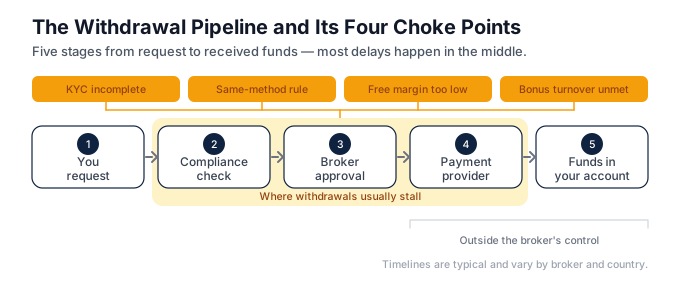
The diagram above traces a withdrawal from request to settled funds, and marks the four checkpoints where requests get stuck. Each of those checkpoints is set long before you click withdraw — most of them on the day you fund your forex account.
That is the part beginners skip. Deposits are designed to be frictionless because the broker wants your money in; withdrawals run through compliance, and compliance has rules. Understanding how forex brokers work on the back end explains why the same transfer feels instant in one direction and slow in the other.
What actually happens when you request a withdrawal
A withdrawal is a queue, not one action: the request hits the broker’s back office, compliance checks your verification status and account activity, the payment is approved, and only then does it enter the payment provider’s settlement timeline.
The broker controls the first three stages. The last one belongs to your bank, card scheme, or e-wallet, and no broker can speed it up.
Brokers also check that the withdrawal leaves the account solvent. If you have open positions, the platform releases only your free margin — the equity not currently tied up as collateral.
Why does verification (KYC) decide how fast you get paid?
Incomplete verification is the most common reason a withdrawal sits unprocessed. Regulated brokers operate under anti-money-laundering rules that require them to confirm who you are before releasing funds, and many will accept a deposit from a partially verified account while blocking the payout.
Complete verification on day one, before you have a balance worth worrying about. Two documents cover most brokers: a government photo ID (passport, national ID, or driving licence) and a proof of address dated within the last three to six months — a utility bill or bank statement showing your name and the address on file.
The mistakes that get documents rejected are boring and repeatable. Cropped corners, glare across the photo page, an expired ID, a mobile phone bill where the broker asked for a utility, or an address that does not match your registration form.
Requirements vary by broker and jurisdiction, so read your broker’s current document list rather than assuming. One rule holds nearly everywhere: the name on the payment method must match the name on the trading account. Third-party payments — a friend’s card, a spouse’s bank account — are rejected by regulated brokers, and getting that money back can take weeks.
What is the same-method rule, and why does it exist?
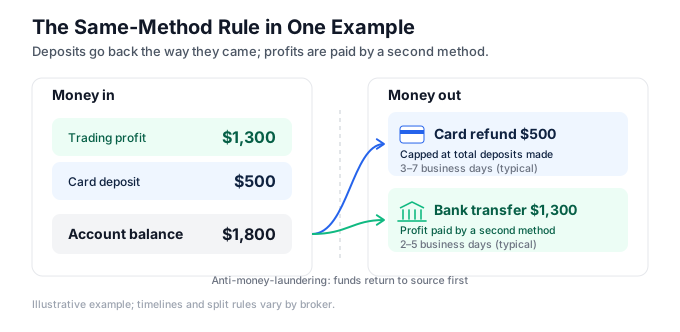
Most regulated brokers return funds to the source they came from. Deposit $500 by card, and the first $500 out typically goes back to that card as a refund, not as a fresh payment.
This is an anti-money-laundering control, not a broker being difficult. Money in by card and out by an unrelated bank account would turn a trading platform into a laundering channel, which is why AML obligations and card-scheme refund rules push brokers to close the loop.
The practical consequence catches people out. Card refunds are typically capped at the total you deposited on that card; profits above that amount are paid by a second method, usually bank transfer or an e-wallet in your name. Card refunds are also time-limited — once the original deposit is beyond the card scheme’s refund window (often around six months), the broker pays the full amount by another method instead.
So a trader who deposited $500 by card and grew the account to $1,800 will often see two transactions: a $500 card refund and a $1,300 bank transfer. Two methods, two timelines, two sets of fees.
How long does a forex withdrawal take?
Broker-side approval is usually the quick part; the payment rail is what sets the clock. The table below shows typical ranges across the retail industry — treat them as illustrative and verify current terms on your own broker’s funding page, because timelines and fees change without much notice.
| Method | Typical broker processing | Typical time to land | Typical fee | Notes |
|---|---|---|---|---|
| E-wallet (Skrill, Neteller, local wallets) | Same business day | Minutes to 24 hours | Often free from broker; wallet may charge | Fastest route; wallet must be in your name |
| Debit / credit card | Same to next business day | 3-7 business days | Usually free | Processed as a refund, capped at deposits |
| Bank / wire transfer | 1-2 business days | 2-5 business days, longer cross-border | $0-$30 typical, plus correspondent fees | Slowest; watch intermediary bank charges |
| Local payment / instant bank rails | Same business day | Minutes to 48 hours | Varies by country | Availability depends on your region |
| Crypto (where offered) | Same business day | Under an hour once sent | Network fee | Not offered by every regulated broker |
Two timing details do the damage. Broker back offices work business days, so a Friday evening request in your time zone may not be looked at until Monday — and weekend requests behind a public holiday stretch further.
Cut-off times are usually quoted in the broker’s local time, which shifts against your clock twice a year when that country moves on or off daylight saving. A 16:00 UK cut-off lands at 21:30 IST in winter and 20:30 IST in summer.
What fees and minimums should you expect?
Most brokers advertise free withdrawals, and for e-wallets and cards that is often accurate. The surprises sit elsewhere.
Bank wires carry correspondent charges the broker never sees, and they stack on top of anything the broker charges. Broker fee $0-$30, plus $15-$40 of correspondent-bank deductions on international wires — budget for both, which is why small bank withdrawals are inefficient.
Currency conversion is the quieter cost. If your account is in USD and your bank account is in INR, ZAR, or PHP, the rate applied is rarely the mid-market rate. Check the mid-market number in a currency converter before accepting a quoted amount.
Minimums are common too — many brokers set a floor around $10-$50 per withdrawal, or allow a few free requests per month and bill the rest. Fee schedules are one of the sharper differences between firms, so compare them before you open an account rather than after. Our guide on how to choose a forex broker covers what to check alongside regulation and spreads.
Why are deposit bonuses the classic withdrawal trap?
A deposit bonus is not free money — it is credit attached to conditions. The standard structure requires you to trade a set volume before the bonus, and sometimes the profit made with it, becomes withdrawable.
Those conditions are expressed in lots. A common shape is one standard lot traded per $2-$5 of bonus, which turns a $200 bonus into 40 to 100 standard lots of required turnover — far more than a small account will trade responsibly.
Some bonus schemes go further and treat the bonus as part of your usable margin. Withdraw while it is still active and the bonus is removed, which shrinks your equity and can trigger a margin call on positions that looked comfortable an hour earlier.
Read the bonus terms before accepting, not after. If you cannot state the turnover requirement in lots and the forfeiture rule in one sentence, decline it — a clean balance you can withdraw beats a padded one you cannot.
For an XM account, use the XM withdrawal guide for the request and status sequence. If promotional credit is involved, read the XM bonus review alongside your own offer terms; do not assume the examples above describe every XM promotion.
The step-by-step withdrawal checklist
Run this sequence the first time you take money out of any broker. Steps 1-5 take about 15 minutes at your desk; steps 6-8 play out over the following days as the test payment settles.
Verify the account fully before you need the money. Upload ID and proof of address in week one, and confirm the dashboard shows verification complete rather than pending.
Check your open positions and free margin. Withdraw only from free margin, and confirm the remaining margin level leaves your trades room to breathe.
Confirm which method the same-method rule forces. Look at your deposit history: the first tranche out usually follows the money in, in the order it arrived, unless the original deposit sits outside the card refund window.
Read the current fee and minimum for that method. Broker terms change; the page you read six months ago may not be the page that applies today.
Check any active bonus. If a bonus is attached, confirm whether withdrawing forfeits it and whether the turnover condition is met.
Run a small test withdrawal. Request $20-$50 early, while your balance is small and the stakes are low. This proves the route works and surfaces every document problem before it matters.
Record the request. Save the ticket number, timestamp, method, and amount. If you have to escalate, that record is your case.
Confirm arrival and note the elapsed time. Now you know your broker’s real timeline rather than the marketing one, and you can plan around it.
Step 6 is the highest-value habit here. Discovering a rejected proof of address on a $30 request is an annoyance; discovering it on a $3,000 request while you need the money is not.
What to do when a withdrawal is delayed
For an existing XM balance, our guides for India, the Philippines and Pakistan add local context to the payment-record and support checks. They cover unresolved requests without treating a withdrawal question as permission to make a new deposit.
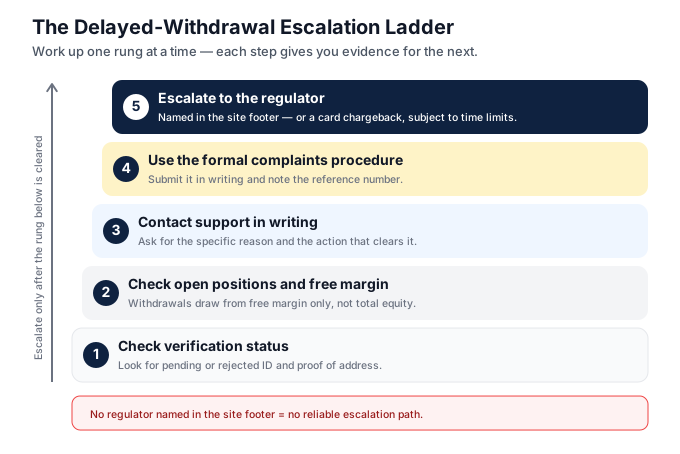
Delays feel like theft and are usually paperwork. Work the ladder in order rather than jumping to public accusations, which slow everything down.
First, check verification status. Log in and look for a pending document, an expired ID, or a new request the broker emailed to a spam folder. This resolves a large share of stuck withdrawals on its own.
Second, check positions and margin. If your free margin is below the requested amount, the platform will hold or reduce the withdrawal. Closing or trimming a position releases the collateral.
Third, contact support in writing. Use email or the ticket system rather than live chat alone, ask for the specific reason for the hold, and ask what document or action clears it. Written records survive; chat transcripts often do not.
Fourth, escalate internally. Most regulated brokers have a formal complaints procedure with a defined response window. Request it by name and keep the reference number.
Fifth, escalate to the regulator. A regulated broker’s licence number and authority sit in the website footer, and that authority accepts client complaints. Card deposits also have a chargeback route through your bank, subject to time limits.
One caveat worth stating plainly: a delayed withdrawal from an offshore, unregulated firm has no escalation path that reliably works. That protection is chosen at account-opening time, not at withdrawal time. If you are still at that stage, our seven-step guide to how beginners should start trading forex covers picking a regulated broker, leverage and margin, demo practice and your first trade.
XAU/USD (gold): withdraw with margin in mind
Gold is where withdrawal timing quietly becomes a risk-management problem. Keep enough free margin when you withdraw — pulling funds while a leveraged gold position is open can push your margin level toward a stop-out.
The numbers explain why. XAU/USD swings $20-$50 in an ordinary day, and with 1 pip = $0.01 and a standard lot of 100 ounces at $1 per pip, that is $2,000-$5,000 of equity movement per standard lot per day.
Withdraw $500 from an account carrying a 1.00 lot gold position and an ordinary day’s range can erase the cushion before the funds even leave the broker.
The rule: close or reduce gold exposure before a large withdrawal, then request the funds. If you must hold the position, withdraw a fraction and recheck your margin level — our guide to margin in forex explains where the stop-out sits.
Common mistakes when withdrawing from a forex broker
Leaving verification until you need the money. The document review runs on the broker’s schedule, not yours, and a rejected upload restarts the clock. Fix: verify in week one, and re-check whenever your ID or address changes.
Expecting the full balance back on the deposit card. Card refunds are typically capped at what you deposited, so profit arrives separately and later. Fix: set up and verify a second method — a bank account or e-wallet in your own name — before you have profits to move.
Using someone else’s payment method. A third-party card or account will be rejected by regulated brokers and can freeze the whole withdrawal for review. Fix: deposit and withdraw only through accounts registered in your own name.
Accepting a deposit bonus without reading the turnover terms. The bonus becomes a lock on your funds or vanishes on withdrawal, sometimes taking your margin cushion with it. Fix: decline bonuses unless you can state the lot requirement and forfeiture rule in one sentence.
Withdrawing while leveraged positions are open. Removing free margin raises your effective leverage on trades already running, especially on gold. Fix: check the margin level after a hypothetical withdrawal, and close or reduce exposure first.
Testing the withdrawal route with a large amount. The first withdrawal is where every document and name-match problem appears. Fix: send $20-$50 early as a deliberate test, and treat it as part of setting up the account.
Chasing support by chat only. Verbal assurances leave no record, which weakens any later complaint. Fix: put every request in writing, keep ticket numbers, and note dates and times.
These share one habit: know what your account is doing before you touch it. The discipline that stops you trading through a requote storm stops you withdrawing into a margin call.
Frequently asked questions
Why is my forex withdrawal taking so long?
The most common cause is incomplete verification — a missing or rejected ID or proof of address. Other causes are insufficient free margin against open positions, an active bonus with turnover conditions, a weekend or public holiday in the broker’s country, or normal bank settlement time. Check verification status first, then contact support in writing.
Can I withdraw to a different bank account than the one I deposited from?
Usually not for the deposited amount. Regulated brokers apply a same-method rule that returns funds to the original source, and the payment name must match your account name. Profits above your total deposits can often be paid to a different method in your own name — confirm your broker’s current policy before you rely on it.
How long does a forex broker take to process a withdrawal?
Broker-side approval is typically same day to two business days. After that, e-wallets usually land within 24 hours, card refunds in about 3-7 business days, and bank transfers in 2-5 business days or longer cross-border. These ranges are illustrative; check your broker’s stated processing times and cut-off hours.
Do forex brokers charge withdrawal fees?
Many advertise free withdrawals, and card and e-wallet payouts are often genuinely free. Bank wires are the exception: correspondent banks alone can take $15-$40 on top of any broker fee, and currency conversion adds a hidden spread. Minimums of roughly $10-$50 per request are common. Fee schedules change, so verify current terms.
Can I withdraw money while I have open trades?
Yes, but only up to your free margin — the equity not held as collateral. Removing free margin raises your effective leverage and moves you closer to a stop-out, which matters most on volatile instruments like XAU/USD. Check your margin level after the withdrawal, and reduce exposure first if it looks tight.
What happens to my deposit bonus if I withdraw?
It depends on the terms you accepted. Many brokers remove the bonus, and sometimes bonus-derived profit, if you withdraw before meeting the trading-volume requirement — and losing the bonus can reduce your usable margin. Read the bonus conditions before accepting, and check whether the turnover target has been met.
What can I do if a broker refuses to pay me?
Escalate in order: confirm verification and margin, then request the specific reason in writing, then use the broker’s formal complaints procedure. If the broker is regulated, file with the authority named on its website. Card deposits may also support a bank chargeback, subject to time limits.
Does copy trading change how withdrawals work?
The withdrawal mechanics are the same, but the margin arithmetic is harder because positions open without your input. If you follow strategies through copy trading, check open exposure before requesting funds, since a withdrawal can leave copied trades under-collateralised, and remember you inherit the provider’s drawdown as well as their entries — leaderboard results are past performance and do not carry forward.
Risk disclaimer: Forex and CFD trading carries a high level of risk and may not be suitable for all traders. The strategies and indicators described here are educational. Past performance does not guarantee future results. Test on a demo account before risking real capital.
Ready to put this into practice?
Open an account with a regulated broker and apply what you have learned. These are the three brokers we recommend:
Trading forex and CFDs carries a significant risk of loss and is not suitable for everyone. Broker links are affiliate links — we may earn a commission at no cost to you.