
Before trading gold at XM, check the exact symbol’s contract size, minimum volume, price units, margin method, financing and sessions in your account. A gold CFD gives price exposure without owning physical gold. The worked figures below assume a 100-ounce contract and are examples, not a verified specification for every XM account.
Find the exact gold instrument available to your account
XM’s public precious-metals page presents metals trading and directs readers to account login for trading hours. The checked Global page includes account/product categories, but its public presentation does not establish every symbol’s full specification for every reader.
Start with the instrument in the account you intend to use. Record its full name and suffix rather than typing a remembered symbol from another broker. XAU/USD describes gold priced in US dollars, but a platform’s trading symbol may use a different label or suffix. A cash-style derivative and a dated futures-based product also need different checks.
Use our XM account-types guide to understand account choice. For this task, the important question is which exact contract your chosen account makes available, not which gold name appears most often in online articles.
Know what the contract gives you
With a CFD, you are taking exposure to a price change under the broker’s contract. You are not buying a gold bar for delivery or acquiring an ownership certificate simply by opening a platform position. The settlement, financing and closing rules are contractual.
That distinction affects your planning. A position can require margin, incur financing and be closed under the account’s risk rules. It should not be evaluated like a fully paid physical holding. Gold can also experience sharp moves and gaps, so its reputation as a store of value does not make a leveraged position low risk.
If your purpose is to learn contract arithmetic, begin with a demo account exercise. A demo can help you understand order fields, but it does not prove how a live order will execute or what its future return will be.
Build a symbol-specification card
| Field | Why it matters | Record it as |
|---|---|---|
| Contract size | Converts lots into ounces | Ounces per lot |
| Minimum volume and step | Controls permitted order sizes | Lots, using the platform’s increment |
| Tick size/value | Defines the minimum price change and its money value | Price units and currency |
| Margin calculation | Determines required collateral | Ratio, percentage or stated method |
| Long/short financing | Affects overnight holding | Rate, units and multiplier |
| Sessions and expiry | Determines when trading is available | Server timezone, dates and breaks |
On MetaTrader 5 desktop, use the exact symbol’s Specification from Market Watch. The official platform documentation explains the information available there. For other interfaces, find the equivalent instrument-details screen or request its location from support.
Capture the account context and date alongside the values. A contract-size screenshot without a symbol or server is weak evidence. If fields are absent or ambiguous, ask for the applicable instrument schedule rather than borrowing another account’s values.
Convert lot size into ounces before calculating risk
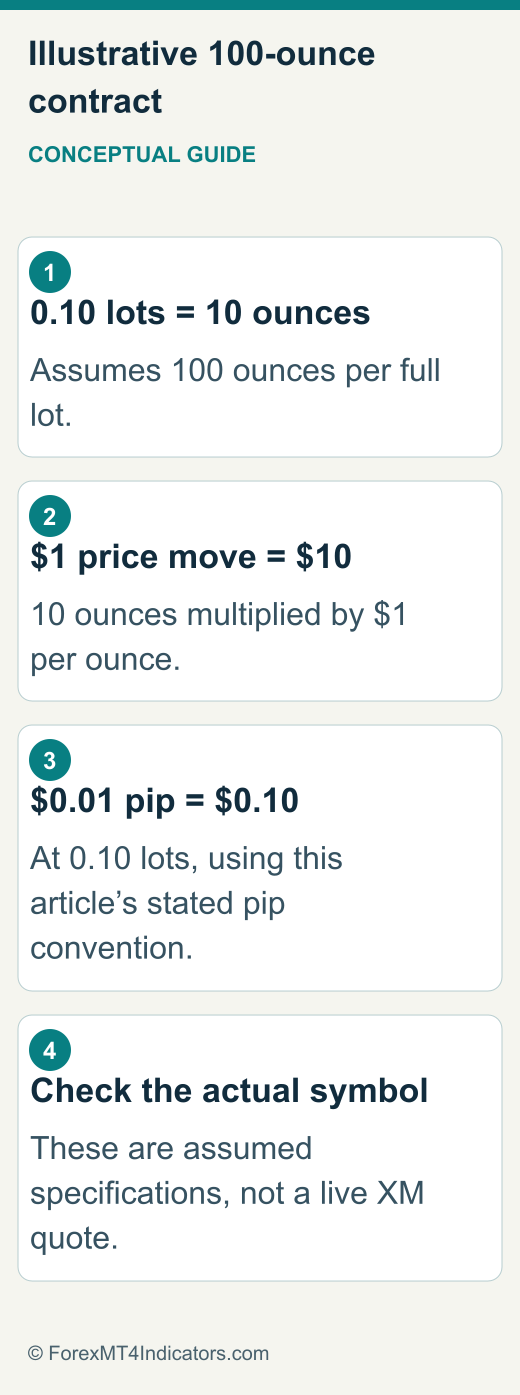
Assume, for illustration, that one lot represents 100 troy ounces and your position is 0.10 lots. The exposure is 10 ounces: 100 multiplied by 0.10. A $1 change per ounce then changes the position’s value by $10 before costs.
For that same assumed contract, 0.01 lots represents one ounce, so a $1 price change means $1. One full lot represents 100 ounces, making the same price movement worth $100. These relationships are simple once the contract size is explicit.
Do not confuse order volume with the amount of margin deposited. A small margin requirement can support a much larger ounce exposure. The XM leverage guide explains why financing capacity does not determine the money lost from a fixed price movement.
Use one clear pip convention and check tick size separately
In this site’s gold examples, one XAU/USD pip means a $0.01 price change per ounce. Under the assumed 100-ounce standard lot, that is $1 per pip. At 0.10 lots it is $0.10 per pip, and at 0.01 lots it is $0.01 per pip.
Other materials may use “pip” or “point” differently. Avoid comparing a broker’s spread figure until you know its price increment. A displayed price with two or three decimal places does not by itself establish the convention used in a third-party article.
The robust calculation is price change in dollars per ounce multiplied by ounces. For a $2.50 move and 10-ounce exposure, the result is $25. You can also express that as 250 pips under the stated $0.01 convention, multiplied by $0.10 per pip. Both routes agree because the units are consistent.
Calculate a position from a planned adverse move
Suppose a fictional plan allows a $50 price-risk budget and uses a $5-per-ounce distance from entry to the planned stop. Divide $50 by $5 to obtain 10 ounces. With the assumed 100-ounce contract, that corresponds to 0.10 lots, before costs and execution differences.
The arithmetic is not a recommendation to risk $50 or use a $5 stop. The distance should come from the trading method and market context; the budget should come from an appropriate personal risk decision. Round down to a permitted volume when necessary rather than exceeding the budget to match an order increment.
Add a separate allowance for trading costs. A stop order can fill beyond its requested level, so the calculated stop-distance loss is not a guaranteed maximum. If minimum order size exceeds the budget under your chosen distance, the practical answer may be to skip the trade rather than force a narrower stop.
Estimate spread and margin without mixing them
For a fictional quote of 2500.00 bid and 2500.30 ask, the spread is $0.30 per ounce. At 10 ounces, that difference is $3.00. These are illustrative prices, not a current gold quote or measured XM spread. The XM fees guide explains how to avoid adding a theoretical spread twice when reconciling actual executions.
At an illustrative reference price of $2,500, 10 ounces has a $25,000 notional value. If this hypothetical instrument used a simple 100:1 margin calculation, required margin would be $250. A different instrument margin method changes that estimate.
Margin and spread answer different questions. Margin concerns collateral required to support exposure. Spread concerns the difference between bid and ask. Neither replaces the calculation of how much the position loses if gold moves against it.
Check sessions, rollover and holidays in server time
Do not rely on a generic “gold opens at” answer without its timezone and applicable date. Record the server timezone shown by your platform, the symbol’s daily breaks and the current holiday notice. Your phone’s local clock and the platform’s trading schedule may use different time references.
For a purely hypothetical session time of 23:00 in UTC+2, the corresponding UTC time is 21:00. In a UTC+8 location it is 05:00 the next calendar day. If the source offset changes, that conversion changes too. This example illustrates date rollover; it is not an XM gold session.
Before holding through a break, inspect financing and any relevant expiry or adjustment terms. A closed market can prevent a planned exit while prices change elsewhere. A chart remaining visible does not prove the symbol is currently accepting orders.
Use an order rehearsal to catch specification errors
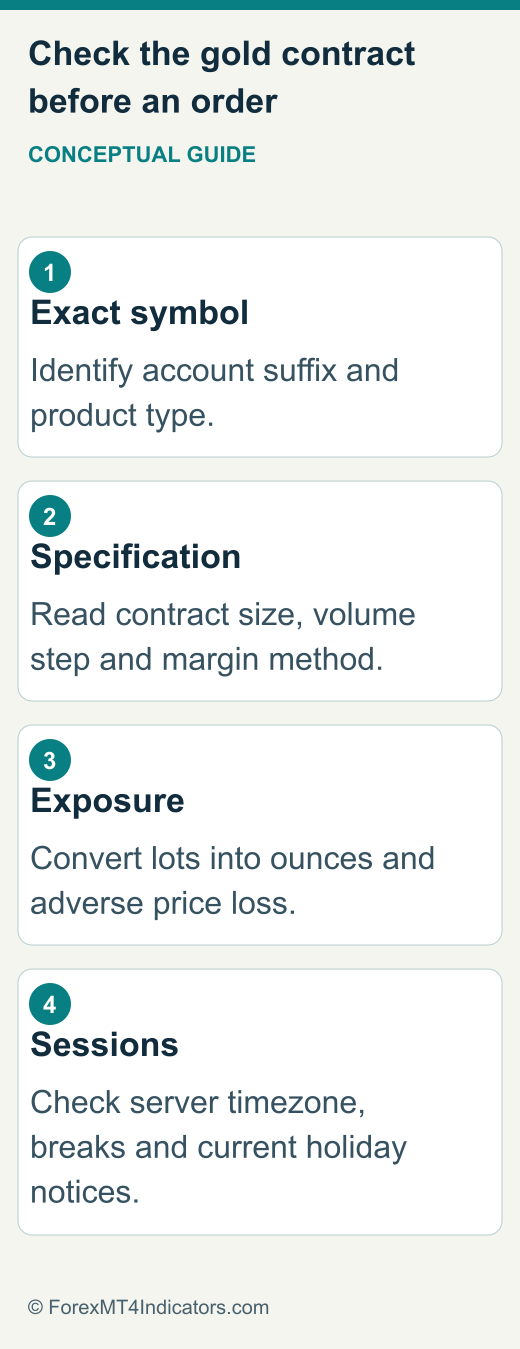
A useful rehearsal records the symbol, intended direction, volume, estimated ounce exposure, adverse price distance, spread and margin. Read the order type and selected account again before any demo submission you choose to make. If the platform reports a size or margin error, investigate it instead of increasing available funds immediately.
Compare the resulting demo position’s price-movement value with your estimate. Use a small identifiable price change and keep the calculation currency consistent. Where values differ, check contract size, volume and account-currency conversion first.
The XM MT5 guide helps verify the terminal and server. A correct rehearsal supports understanding of the fields; it does not validate a profitable gold strategy, execution speed or live slippage assumptions.
Frequently asked questions
What is the gold symbol on XM?
Use the exact gold instrument listed on your own account, including its suffix and product type. Do not assume a generic XAUUSD label maps to every XM contract.
How much is one gold pip worth?
Under this article’s $0.01-per-ounce pip convention and assumed 100-ounce lot, one pip is $1 for a full lot. Multiply by the lot fraction, and verify your actual contract before applying it.
Why does gold show different hours on different websites?
The sources may use different timezones, dates, product types or server schedules. The account’s current symbol specification and holiday notices are the practical reference.
Is the smallest gold trade always affordable?
No. Minimum volume, stop distance, costs and possible slippage determine the money at risk. A low margin requirement alone does not make the smallest available position suitable.
Sources and review scope
Expansion content reviewed 9 September 2026. Source-specific dates and scopes appear below. No personal account or execution test.
- XM precious metals · 2026-09-09 · XM Global public page directs trading hours to account login
- MetaTrader 5 symbol specification · 2026-09-09 · Official platform documentation; general desktop workflow
- XM stable leverage · 2026-09-09 · XM Global public maximum advertisement, not account-specific quote