


Last updated: July 5, 2026 · By: Tim Morris, founder of ForexMt4Indicators.com
The forex day splits into four sessions that hand liquidity around the clock: Sydney and Tokyo (the Asian session, 23:00–08:00 GMT), London (08:00–17:00 GMT), and New York (13:00–22:00 GMT). The best time to trade is the London/New York overlap, 13:00–17:00 GMT, when both centres are open, volume peaks, and spreads on the majors are tightest.
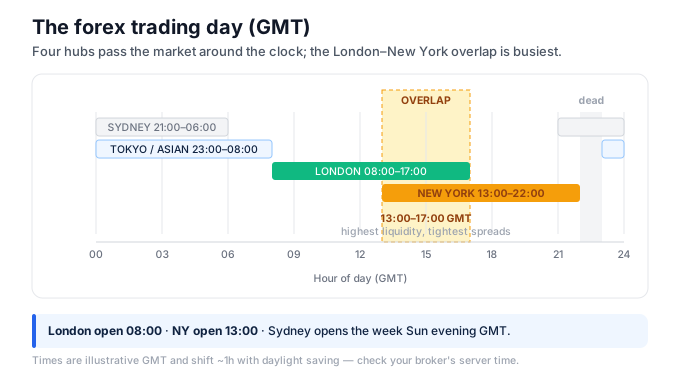
The diagram above lays the four sessions across a 24-hour GMT bar so you can see where they open, where they overlap, and where the market goes quiet. The rest of this guide turns that timeline into rules for which pair to trade and when.
If you are still learning how the market runs 24 hours a day without a central exchange, our forex trading guide covers the structure; this article zooms in on the sessions themselves and the hours that actually move price.
Why does forex trade in sessions?
Forex has no single exchange. It runs on a network of banks sitting in three financial centres across three time zones: Asia, Europe, and North America. As one region opens for business, its banks flood the market with orders; as it closes, that flow fades and passes to the next.
The result is a rolling 24-hour market from Sunday evening to Friday evening GMT — but the activity is not spread evenly. Volume clusters around each region’s working hours and thins in the gaps between.
That unevenness is the whole point of session trading. A pair’s volatility, spread, and reliability change depending on whether its home market is awake or asleep. Trade EUR/USD at the London open and you get clean, liquid moves; trade it at 03:00 GMT and you get a thin, choppy drift that eats your stop.
What are the four forex trading sessions?
Traders talk about four sessions, though Sydney and Tokyo are usually grouped together as the Asian session. Here are the standard GMT hours we use across the site.
| Session | GMT hours | Home currencies | Character |
|---|---|---|---|
| Sydney | 21:00–06:00 | AUD, NZD | Thin, slow — opens the trading week |
| Tokyo (Asian) | 23:00–08:00 | JPY, AUD, NZD | Ranging, lower volatility |
| London | 08:00–17:00 | EUR, GBP, CHF | Highest single-session volume |
| New York | 13:00–22:00 | USD, CAD | Volatile, news-driven |
Sydney opens the week on Sunday evening GMT and hands over to Tokyo a few hours later, so most traders fold the two into one “Asian session” running roughly 23:00–08:00 GMT.
London is the heavyweight. It sits between Asia and the Americas and overlaps both, which is why it carries the largest share of daily forex volume of any single session.
New York opens while London is still trading and stays open into the evening GMT, driven by US data releases and the dollar’s dominance in global settlement.
When is the London/New York overlap?
The London/New York overlap runs 13:00–17:00 GMT — the four hours when Europe and the US are both open. In the US summer, daylight saving shifts the window about an hour earlier, to roughly 12:00–16:00 GMT. This is the single highest-liquidity window of the trading day.
Two of the world’s three largest financial centres are active at once, so order flow is deepest here. On the majors, that depth shows up as the tightest spreads of the day and the cleanest fills — your entry and stop land close to where you clicked.
It is also the most volatile window, and the two facts are linked. Deep liquidity absorbs large orders without gapping, but the sheer volume plus scheduled US data (CPI and NFP near 12:30 GMT, FOMC near 18:00 GMT) produces the day’s biggest directional moves.
For most retail strategies on the majors, this overlap is where the edge lives. If you can only trade a few hours a day, trade these four.
Which pairs are most active in each session?
A pair moves best when at least one of its home markets is open. Match the pair to the session and you trade liquidity; ignore the match and you trade noise.
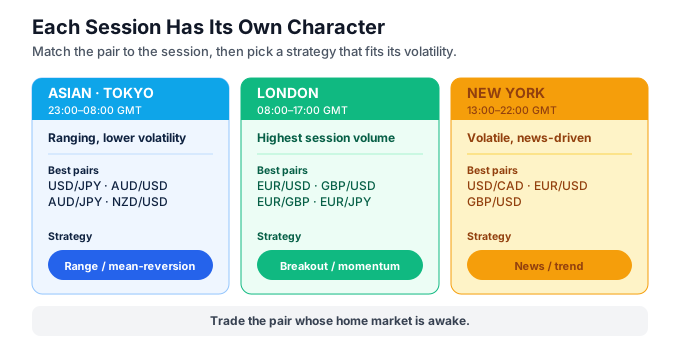
Asian session (23:00–08:00 GMT). The JPY, AUD, and NZD pairs lead. USD/JPY, AUD/USD, AUD/JPY, and NZD/USD are the pairs with local participants awake and news flowing. Ranges are typically narrower than in London, which suits mean-reversion and range strategies.
London session (08:00–17:00 GMT). The EUR and GBP pairs come alive. EUR/USD, GBP/USD, EUR/GBP, and EUR/JPY see their sharpest moves here, and the London open (08:00 GMT) often sets the day’s directional bias.
New York session (13:00–22:00 GMT). The USD pairs dominate, since US data and the dollar drive the flow. USD/CAD, EUR/USD, and GBP/USD stay active during the overlap; after London closes at 17:00 GMT, liquidity thins and the afternoon drifts.
Trading a pair while both its home markets sleep is the most common self-inflicted wound in session trading. GBP/USD at 02:00 GMT — London and New York both closed — is a thin, spread-heavy chart with no reason to trend.
How do spread and volatility change by session?
Spread and volatility both track liquidity, and liquidity tracks the clock. Understanding the shape of the day stops you paying peak spread in the deadest hours.
Spreads are tightest during the London/New York overlap, when depth is greatest, and widest in the low-liquidity gaps — the late New York afternoon and the early Asian session before Tokyo warms up. On an exotic or a cross, an off-hours spread can be several times its overlap value.
Volatility follows a similar curve but peaks at session opens. The London open (08:00 GMT) and the New York open (13:00 GMT) are the two most explosive minutes of the day, as fresh order flow hits the market at once. Our session clock tool shows which sessions are live right now in your local time.
The dead zones matter as much as the peaks. The gap between the New York close (22:00 GMT) and the Tokyo pickup is the thinnest, choppiest stretch of the day — wide spreads, no follow-through, stop-hunting on low volume. A volatility heatmap shows, hour by hour, which pairs are actually moving before you commit.
What is the best time to trade forex?
There is no single “best time” — there is a best time for your pair, your strategy, and your own clock. But three windows do most of the work for most traders.
The London/New York overlap (13:00–17:00 GMT) is the default answer for anyone trading the majors. Tight spreads, deep liquidity, and the day’s cleanest directional moves. If you can trade only one window, trade this one.
The London open (08:00 GMT) suits breakout and momentum traders. The first hour often sets the day’s range and direction, and the Asian-session range frequently breaks here.
The Asian session (23:00–08:00 GMT) suits range and mean-reversion traders on the JPY, AUD, and NZD pairs, where quieter conditions keep price inside a channel.
For readers in Asia and Africa, translate GMT to your own clock and the picture gets practical. In India (IST, GMT+5:30) the overlap runs 18:30–22:30 — an evening window. In Indonesia (WIB, GMT+7) it is 20:00–00:00, and in South Africa (SAST, GMT+2) it is 15:00–19:00. You do not need to be awake at 3 AM to trade well; you need to be awake for the overlap.
How do you match a session to a pair and a strategy?
Use this framework before you open a chart. Three questions decide whether the hour is worth trading. If you have not opened an account yet, our beginner’s guide to forex trading covers the broker, demo and position-sizing steps that come first.
Which pair am I trading, and is one of its home markets open? Trade EUR and GBP pairs in London, JPY/AUD/NZD pairs in Asia, and USD pairs during the New York overlap. If both home markets are asleep, wait.
What does my strategy need — volatility or range? Breakout and momentum strategies need the London and New York opens and the overlap. Range and mean-reversion strategies need the quieter Asian session. Matching the two is half the battle.
Is the spread acceptable right now? Check the live spread before you commit. If it is a large fraction of your stop — common in off-hours and on crosses/exotics — the setup is not worth taking, however clean the chart looks.
The framework is simple on purpose. Most losing session decisions come from trading the right pair at the wrong hour, or the right strategy in the wrong volatility regime.
Does session timing apply to gold (XAU/USD)?
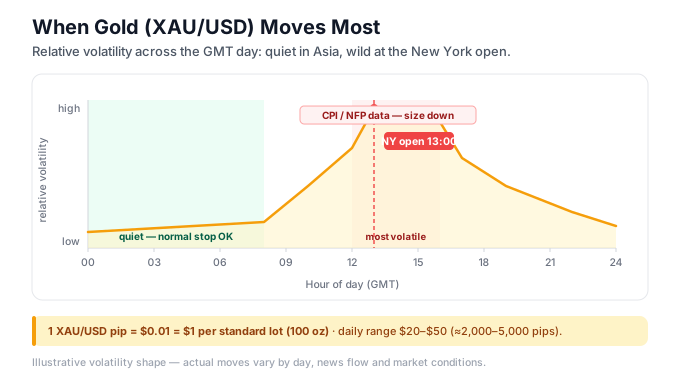
Gold follows the session rhythm as clearly as any major, and treating it like a 24-hour flat market is how traders get caught. XAU/USD is quiet in the Asian session, gets directional through London, and is most volatile at the New York open and around scheduled US data.
The New York session is where gold does its damage. The NY open (13:00 GMT) and the big US releases — CPI and NFP near 12:30 GMT and FOMC near 18:00–19:00 GMT — routinely produce fast, wide moves with long wicks on XAU/USD.
Size down and widen stops for New York gold. Gold’s pip is a $0.01 move and a standard lot is 100 ounces, so 1 pip = $1 per standard lot. Its daily range routinely runs $20–$50 (roughly 2,000–5,000 pips), and the overlap and news windows are where the biggest of those ranges print.
The practical takeaway: an Asian-session gold trade can use a normal stop, but a New York gold trade around a data release needs a wider stop and a smaller lot for the same dollar risk. Never carry the same size across both.
Common mistakes traders make with forex sessions
Scalping the dead New York-to-Tokyo gap. The stretch after the New York close (22:00 GMT) before Tokyo warms up is the thinnest, choppiest window of the day. Fix: avoid scalping between 22:00 and 23:00 GMT; wait for Tokyo or the London open for follow-through.
Trading a pair while its home market sleeps. GBP/USD at 03:00 GMT has neither London nor New York open — thin volume, wide spread, no trend. Fix: match the pair to a live session, or switch to a JPY/AUD/NZD pair during Asian hours.
Ignoring the Friday close and Sunday open. Liquidity drains into the Friday New York close and the Sunday-evening reopen often gaps on weekend news. Fix: close or reduce positions before the Friday close; never place tight stops into the thin Sunday open.
Holding a scalp across a session handover. A clean London trend can stall the moment London closes at 17:00 GMT and New York momentum fades. Fix: know when your session ends and take profit or tighten stops before the handover, not after.
Trading the news minute on gold without adjusting size. CPI, NFP, and FOMC turn XAU/USD into a spike machine at the New York open. Fix: size down and widen stops for gold around scheduled releases, or stand aside for the first five minutes.
Assuming your local “market hours” match GMT. Traders in IST, WIB, or SAST who assume London opens at their 8 AM miss the whole overlap. Fix: convert every session time to your own zone once, and check a bank holiday calendar — a London or US holiday thins liquidity even inside normal hours.
Forex sessions vs a fixed stock-market schedule
Traders coming from equities expect one opening bell and one closing bell. Forex works differently, and the difference is worth settling early.
| Forex sessions | Stock exchange | |
|---|---|---|
| Trading hours | ~24 hours, Sunday–Friday GMT | Fixed daily hours (e.g. 09:30–16:00 local) |
| Structure | Rolling handover across 3 centres | Single exchange, single time zone |
| Best liquidity | London/New York overlap (13:00–17:00 GMT) | The exchange’s own open and close |
| Gaps | Mainly at the Sunday open | Every overnight and weekend |
| What moves it | Whichever region is awake | The exchange’s listed companies |
The rolling structure is the key mental shift. In stocks, “the market is closed” is a single fact; in forex, some market is almost always open, but the useful market — the one with liquidity for your pair — is open only for part of your day. If you want the fuller contrast, our forex vs stocks guide breaks down the trade-offs.
That relativity is also why spread is not a fixed number. A pair’s spread depends on which session is live and how deep its liquidity is — which is why the same EUR/USD costs less to trade at 14:00 GMT than at 03:00 GMT.
Frequently asked questions
What are the four forex trading sessions and their GMT hours?
The four sessions are Sydney (21:00–06:00 GMT), Tokyo (23:00–08:00 GMT), London (08:00–17:00 GMT), and New York (13:00–22:00 GMT). Sydney and Tokyo are usually grouped as the Asian session, running roughly 23:00–08:00 GMT. London and New York overlap from 13:00 to 17:00 GMT (about 12:00–16:00 GMT in the US summer), the highest-liquidity window of the day.
What is the best time of day to trade forex?
For the major pairs, the London/New York overlap, 13:00–17:00 GMT, is the best window — tightest spreads, deepest liquidity, and the cleanest directional moves. Breakout traders also favour the London open at 08:00 GMT. Range traders prefer the quieter Asian session. The best window depends on your pair and strategy, not a universal clock.
Why should I avoid trading a pair when its home market is closed?
When both of a pair’s home markets are asleep, liquidity dries up. Spreads widen, moves become thin and choppy, and price drifts without follow-through. GBP/USD at 03:00 GMT, with London and New York both closed, is a classic trap. Trade the pair whose session is live, or switch to a JPY, AUD, or NZD pair during Asian hours.
Which currency pairs are best for the Asian session?
The JPY, AUD, and NZD pairs — USD/JPY, AUD/USD, AUD/JPY, and NZD/USD — are most active during the Asian session because their home markets are open. Ranges are typically narrower than in London, which suits range and mean-reversion strategies rather than breakout trading.
What time is the London/New York overlap in my local time zone?
The overlap runs 13:00–17:00 GMT (roughly 12:00–16:00 GMT in the US summer). Convert to your zone: 18:30–22:30 IST (India), 20:00–00:00 WIB (Indonesia), and 15:00–19:00 SAST (South Africa). This evening window for many Asian and African readers is the highest-liquidity stretch of the day and the easiest time to trade the majors well.
When is gold (XAU/USD) most volatile during the day?
Gold is quiet in the Asian session, turns directional through London, and is most volatile at the New York open (13:00 GMT) and around scheduled US data — CPI and NFP near 12:30 GMT and FOMC near 18:00–19:00 GMT. Size down and widen stops for New York gold; its daily range of $20–$50 concentrates in these windows.
Is it safe to hold trades over the weekend in forex?
Forex closes at the Friday New York close (22:00 GMT) and reopens Sunday evening GMT. Weekend news can gap the Sunday open past your stop, since no trading happens in between. Reduce or close positions before the Friday close, and avoid tight stops into the thin Sunday reopen unless your strategy accounts for gap risk.
Why do spreads widen at certain times of day?
Spreads track liquidity. During the London/New York overlap, deep order flow keeps spreads tight; in the low-liquidity gaps — the late New York afternoon and the early Asian session before Tokyo warms up — fewer participants mean wider spreads. On crosses and exotics, the off-hours spread can run several times its overlap value.
Glossary of related terms
- Asian session — Tokyo-centred hours, roughly 23:00–08:00 GMT; lower volatility, JPY/AUD/NZD pairs most active.
- London session — European hours, 08:00–17:00 GMT; the highest single-session volume, EUR/GBP pairs most active.
- New York session — US hours, 13:00–22:00 GMT; volatile and news-driven, USD pairs most active.
- Overlap — the 13:00–17:00 GMT window when London and New York are both open; the day’s deepest liquidity and tightest spreads.
- Spread — the gap between bid and ask; widens in low-liquidity sessions and tightens during the overlap.
- Killzone — a narrower high-activity window inside a session (London 08:00–11:00 GMT, New York 12:30–15:00 GMT).
- Session handover — the transition when one region closes and the next takes over the order flow.
- Liquidity — the depth of available orders; deepest during the overlap, thinnest in the New York-to-Tokyo gap.
Related reading
Risk disclaimer: Forex and CFD trading carries a high level of risk and may not be suitable for all traders. The strategies and indicators described here are educational. Past performance does not guarantee future results. Test on a demo account before risking real capital.
Ready to put this into practice?
Open an account with a regulated broker and apply what you have learned. These are the three brokers we recommend:
Trading forex and CFDs carries a significant risk of loss and is not suitable for everyone. Broker links are affiliate links — we may earn a commission at no cost to you.