
XM Copy Trading lets eligible investors allocate funds to a strategy whose trades are copied automatically. A strategy’s past return is not a forecast, and copied results can differ. Before subscribing, check the account terms, manager fee, allocation method, open-position exposure and what the pause and exit controls actually do.
Understand what you are authorising
The important moment is accepting a copying relationship, not choosing a colourful performance card. Copying can cause orders to open and close without your approval for each individual trade. You need to understand the strategy and the permitted actions before a live subscription begins.
XM’s public copy-trading page describes the service and provides investor and manager tutorials. Its Global presentation does not establish availability for every resident or account. Start with the legal company on your agreement and confirm that the product is offered in your account. The XM review explains the broader broker checks.
The practical guidance below is a decision process based on public information, not a report of an account we funded or a strategy we tested. Where the exact private interface differs, ask XM to identify the applicable control before making a commitment.
Separate the investor role from the manager role
An investor chooses subscriptions and allocated amounts. A strategy manager supplies a strategy other users may choose to copy. A person being listed as a manager should not be treated as a personally vetted adviser, and popularity alone is not evidence of a dependable trading method.
For an investor, the useful questions concern money at risk, execution differences, fees and control over the subscription. For a prospective manager, the agreement includes a different set of responsibilities. This guide focuses on the investor decision; it does not promise earnings from attracting followers.
Do not confuse social information with the investment decision. Comments, profile descriptions and impressive charts can help you find questions to investigate, but they are not substitutes for a readable trading history and the applicable fee terms.
Read strategy statistics in context
| Statistic or feature | What to investigate | What it cannot prove |
|---|---|---|
| Return | Period, calculation method and treatment of funding | Your future return |
| Drawdown | Equity or balance basis, dates and recovery | A maximum future loss |
| History length | Different conditions represented in the sample | That a method survives every market |
| Open positions | Floating loss and concentrated exposure | That closed-trade profit tells the whole story |
| Trading style | Holding time, position growth and correlated symbols | That a risk label remains accurate |
A smooth balance curve can coexist with large floating losses if losing positions remain open. Check equity-based information where available and ask how the displayed drawdown is calculated. A high percentage over a short period can also reflect unusually concentrated risk rather than a repeatable advantage.
Look at changes in behaviour, not just the final number. Did the manager increase size after losses? Did most gains come from one instrument or one news event? If the information needed to answer is absent, treat that absence as uncertainty rather than filling it with confidence.
Compare costs before calling the service free
A platform may advertise free access while managers still charge fees and underlying trades incur costs. Separate the platform-access price, strategy fee and trading costs. The XM fees guide explains spreads, commission and financing without assuming one schedule applies to every account.
The currently linked Belize agreement makes acceptance of the manager’s fee part of subscription and allows fee collection at intervals or at trade closure. It also addresses outstanding fees. Read chapter F of the XM Global agreement, together with the actual strategy’s displayed terms.
Before subscribing, ask whether a fee is based on realised profit, another calculation or multiple components; whether previous losses affect future fee calculations; and what happens on partial withdrawal or exit. Do not infer a high-water-mark policy, a charging interval or a percentage from another manager’s profile.
Work through a downside example first
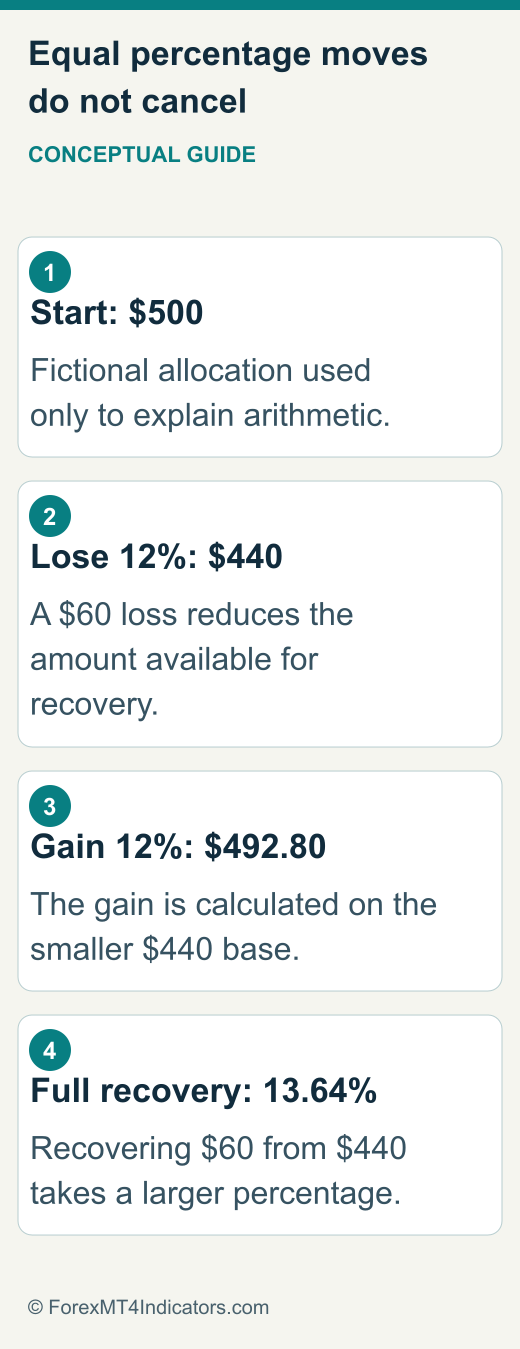
Suppose an illustrative allocation of $500 loses 12%. That is $60, leaving $440 before any additional costs or adjustments. A subsequent 12% gain on $440 produces $52.80, taking it to $492.80. Equal percentage moves down and up do not return the allocation to its starting value.
Recovering the full $60 from $440 requires a gain of about 13.64%. This is arithmetic, not a forecast of any XM strategy. It helps explain why a return figure without drawdown context can mislead. A larger allocation simply scales the dollar consequences of the same percentage movement.
For a separate fictional fee example, suppose a contract charges 20% of $50 of qualifying profit. The fee would be $10 and $40 would remain from that profit before any other applicable cost. The rate and definition are invented only to illustrate a calculation, not to describe an XM manager’s actual price.
Decide the allocation and combined exposure
Do not choose an allocation solely because it meets a displayed minimum. Decide how much of your total speculative capital you can afford to lose, then consider other positions and subscriptions. Money reserved for bills or emergencies should not become an allocation merely because a strategy has recently performed well.
The XM Global Limited Belize agreement does not treat the copy allocation as a guaranteed loss cap: section 56.1 says losses can exceed the amount used to copy a strategy. Section 53.1(f) also permits outstanding manager fees to be collected from another XM account. Read these provisions in the Belize agreement and confirm how they apply before subscribing.
Several managers trading the same currency or gold direction may create one large underlying bet. Counting manager names does not measure diversification. Compare instruments, direction, timing and how their losses coincide. If the available detail is insufficient, avoid claiming the portfolio is diversified.
The Belize copy terms describe proportional copying and possible differences from manager results, including minimum-volume effects. That means a small allocation may not reproduce every trade in exactly the advertised proportions. Confirm the minimum allocation and how rounding or unfilled copies are handled for your subscription.
Use a pre-subscription review sequence
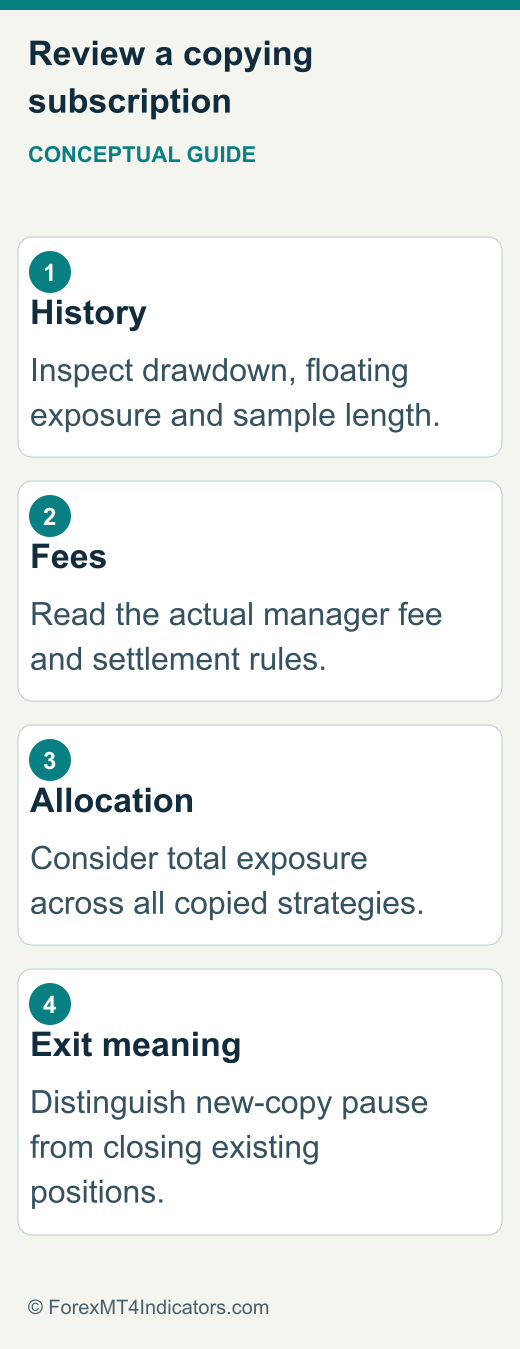
- Enter through the official XM product route and confirm the trading account and entity.
- Open the candidate strategy’s history, fee and risk information before allocating funds.
- Identify whether existing manager positions can be copied when the subscription starts.
- Read the allocation amount, fee acceptance and any investment restrictions on the confirmation screen.
- Locate the instructions for pausing, closing copied positions and ending the subscription before accepting it.
If one of those actions is unclear, send a precise question through the official Help Center: “For this account and strategy, does this control stop only new copies, close existing positions, or end the subscription and settle fees?” A written answer is more useful than assuming an icon’s meaning.
Use the XM app guide for product navigation and the login guide if profile access fails. App access is not evidence that all copy features are available on every device.
Pause, close and exit are separate decisions
A pause can mean stopping future copying while existing positions remain exposed. Closing positions changes market exposure and may realise losses. Ending a subscription can have additional fee-settlement or allocation consequences. Treat these as distinct concepts until the current interface explicitly tells you which operations a control performs.
Before acting, review copied open positions, pending actions, available funds and outstanding charges. Read the confirmation text rather than relying on a tutorial recorded under an earlier interface. After an action you choose, check the subscription state and actual positions separately. A status label alone does not prove exposure is gone.
If an exit request is pending or a position remains open unexpectedly, preserve the request time, strategy identifier and relevant status messages for private support. Avoid repeated clicks that create uncertainty about which request was accepted. Never send a password, verification code or full account screenshot to a social-media manager.
Keep a review journal that can change your decision
Set a review schedule before joining. Record why you selected the strategy, the maximum allocation you intended, which behaviour would cause you to reassess, and the exit procedure you verified. Review after meaningful changes in exposure or fees as well as on your regular schedule.
A journal should include rejected strategies and reasons, not just successful examples. Otherwise it becomes easy to rewrite your original decision after seeing the result. Changing managers repeatedly after a short loss can add costs without improving the selection process.
The XM demo guide can help with general order and margin practice. Do not assume a demo account reproduces the complete live copy service or its fee mechanics. Keep platform practice separate from evidence about a specific manager’s performance.
Frequently asked questions
Is XM Copy Trading guaranteed income?
No. Copied trades can lose money, and past results or a risk score cannot guarantee future results. Allocation and exit settings do not remove market or execution risk.
Will I get the manager’s exact return?
Not necessarily. Timing, costs, allocation ratios, minimum volumes and account conditions can produce differences. Use the applicable terms and your own statement to judge actual outcomes.
Does stop copying close every trade?
Do not assume it does. Read the exact confirmation and check whether it pauses future copies, closes existing positions, ends the subscription or combines these actions.
Is Japan covered by this Global guide?
XMTrading has a separate product and terms. Use the Japanese copy-trading guide and Japan overview for that route rather than transferring Global eligibility or menu instructions.
Sources and review scope
Expansion content reviewed 9 September 2026. Source-specific dates and scopes appear below. No personal account or execution test.
- XM Copy Trading · 2026-09-09 · XM Global public product and tutorials
- XM Global client agreement · 2026-09-09 · XM Global Limited Belize; linked from legal page on 2026-09-09
- XM app · 2026-09-09 · XM Global public feature page; account compatibility not tested
- XM Help Center · 2026-09-09 · Official linked help route; client-rendered content not extracted