

Last updated:
Last updated: July 5, 2026 · By: Tim Morris, founder of ForexMt4Indicators.com
Most blown forex accounts die from the same seven mistakes: over-leveraging, no stop-loss, risking too much per trade, revenge trading, widening a stop, ignoring spread and swap, and no plan or journal. The single biggest killer is position size — one 1.00 lot trade on a $500 account can be wiped by a 50-pip move.
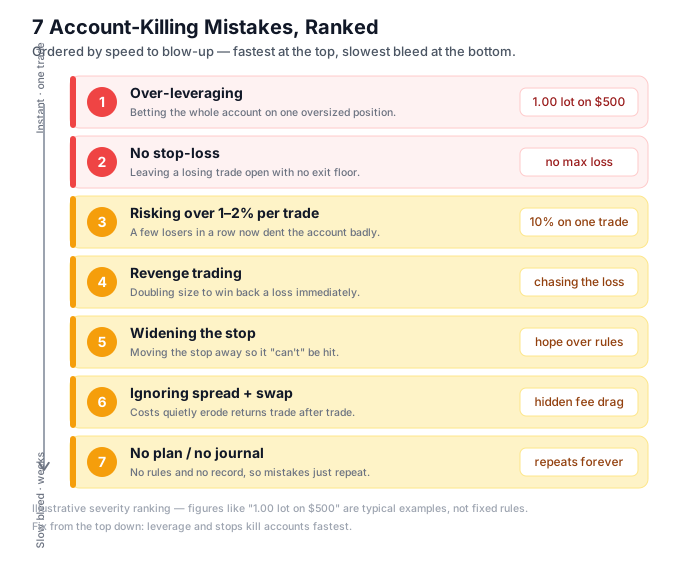
The diagram above ranks the seven account-killers by how fast they empty a small account, from the instant blow-up of over-leverage down to the slow bleed of no journal. The rest of this guide takes each one in turn: what it looks like, why it kills, and the exact fix.
If you are still learning position sizing, our guide to leverage in forex explains why a big lot on a small account is the fastest way to zero; this article turns that warning into seven concrete habits.
Mistake 1: Over-leveraging — trading a lot size too big for the account
This is the number-one account killer, and it hides behind the word “leverage.” A trader opens a $500 account, sees 1:500 leverage, and thinks that means they can safely trade a 1.00 standard lot. They cannot.
A 1.00 lot on EUR/USD is worth $10 per pip. On a $500 account, a 50-pip move against you — an ordinary daily wiggle — is a $500 loss. The account is gone in one trade.
Leverage does not increase your edge; it increases how fast your account reacts to every pip. High leverage is only a problem when it tempts you into an oversized position, which it almost always does for beginners.
The fix: size the position to your account, not to what leverage allows. On a $500 account you should be trading 0.01 lots (micro), where EUR/USD moves $0.10 per pip and a 50-pip loss costs $5, not $500. Our lot size calculator does this math for you before every trade.
Mistake 2: Trading with no stop-loss
A trade without a stop-loss (SL) — an order that closes a losing position at a set price — has no defined maximum loss. That single fact is why no-stop trading blows accounts.
The pattern is always the same. A trade goes against the beginner, they refuse to close it because “it will come back,” and they watch a 20-pip loss become a 200-pip loss, then a margin call. One trade without a stop can erase weeks of gains.
Some traders skip the stop because they got stopped out moments before price reversed, and concluded stops are the problem. The stop was not the problem — the stop was in the wrong place, too tight for the pair’s normal range.
The fix: every trade gets a stop-loss set at entry, before you are emotionally attached to the position. Place it at a level that invalidates your idea — beyond a swing high or low — not at a random pip count. No stop, no trade.
Mistake 3: Risking more than 1-2% per trade
Even with a stop in place, beginners routinely risk 10%, 20%, or half the account on a single “high-conviction” trade. The math of losing streaks is what kills them. Five losers in a row at 20% each and the account is more than halved.
The convention that keeps traders alive is the 1% rule: risk no more than 1% of account equity on any single trade. At 1% risk, it takes a run of dozens of consecutive losses to do serious damage — and if you are losing that often, the strategy is broken, not the account size.
Here is the 1% math on a small account, worked all the way through:
- Account: $500. Risk per trade at 1% = $5.
- Trade: EUR/USD with a 50-pip stop-loss.
- Position size that risks exactly $5 over 50 pips = 0.01 lot (at $0.10 per pip, 50 pips = $5).
That is the whole discipline in one line: a $5 risk on a 50-pip stop is a 0.01 lot. Widen the stop and the lot shrinks; tighten it and the lot grows — but the dollar risk stays fixed at $5.
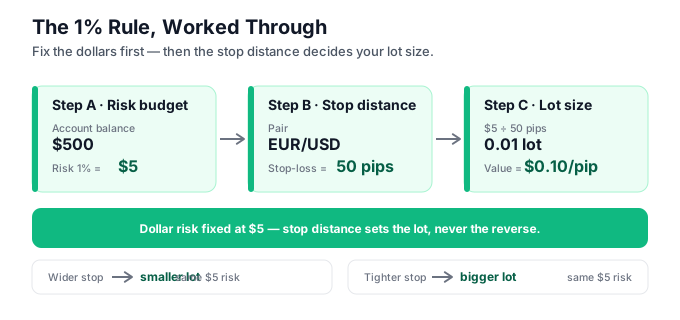
The fix: decide your dollar risk first (1% of equity), then let the stop distance dictate the lot size — never the other way around. To see how risk-per-trade and win rate combine into your odds of eventually going broke, run the numbers through our risk of ruin calculator.
Mistake 4: Revenge trading and over-trading after a loss
Revenge trading is opening a new position purely to win back what you lost on the last one. It is an emotional reaction, not a setup, and it is how a single bad trade becomes a bad day becomes a blown account.
The sequence is predictable. A trader takes a loss, feels the sting, doubles the lot size to “make it back fast,” ignores their own rules, and loses again — bigger. Each loss raises the emotional temperature and lowers the quality of the next decision.
Over-trading is the same disease without the trigger: taking trade after trade out of boredom or the need to feel active. More trades on a small account mean more spread paid and more chances to break your own rules.
The fix: set a daily loss limit — two losing trades, or 3% of the account, whichever comes first — and stop for the day when you hit it. Close the platform. The market is open tomorrow; a revenge trade tonight might mean there is no account tomorrow.
Mistake 5: Moving or widening a stop as price approaches it
This mistake feels like patience and is actually panic. Price drifts toward your stop, you convince yourself the level “only needs more room,” you drag the stop further away — and you have quietly turned a 1% risk into a 3% or 5% risk.
The reason it blows accounts is that it removes the one number you committed to. The stop was your maximum acceptable loss. Moving it means you no longer have a maximum acceptable loss; you have a hope.
Widening a stop almost never saves a trade. If price is pushing through the level that invalidated your idea, the idea was wrong — dragging the stop only makes being wrong more expensive.
The fix: treat the stop as a fixed contract with yourself. You may move a stop toward profit (to breakeven or into a trailing stop), never away from it. If you keep getting stopped out by noise, the fix is a wider stop set correctly at entry — with a smaller lot to match — not a stop you move mid-trade.
Mistake 6: Ignoring the real cost of spread and swap
Beginners think about entry and exit and forget the two costs that run in the background: the spread (the gap between bid and ask you pay to enter) and the swap (the interest charged or paid for holding a position overnight). On small accounts and frequent trades, these costs quietly compound.
Spread hurts scalpers most. If you scalp for a 5-pip target on a pair with a 1.5-pip spread, you are paying 30% of your target in cost on every trade before price moves. On an exotic pair with a 40-pip spread, a scalp is mathematically hopeless.
Swap hurts overnight and swing holds. Holding a negative-swap position for a week can cost more than the spread did, and holding over a Wednesday triple-swap rollover multiplies that overnight charge.
The fix: check the spread and swap on your pair before you trade it, the same way you check the chart. Favour tight-spread majors when you are starting, keep scalp targets well above the spread cost, and know the swap on any position you plan to hold overnight.
Mistake 7: Trading with no plan and no journal
The final mistake is the one that hides all the others: trading without a written plan and without a journal. With no plan, every trade is improvised; with no journal, you never find out which improvisations are losing you money.
A plan does not need to be complex. It states which pairs you trade, on which timeframes, what a valid setup looks like, your risk per trade, and your daily loss limit. Five lines beat none.
A journal is where mistakes 1 through 6 become visible. When you log every trade — entry, stop, size, result, and why — the pattern of over-leveraged revenge trades on Fridays stops being invisible and starts being fixable.
The fix: write a one-page plan before you place another live trade, and log every trade in a simple spreadsheet. Review the journal weekly. Practise the whole loop on a demo account first, so your plan meets real price action before real money does.
The disciplined trader vs the account-blower — side by side
The difference between a trader who survives and one who blows up is rarely the strategy. It is the seven habits below. Read this table as a checklist for your own trading.
| Situation | The mistake (blows accounts) | The disciplined habit (survives) |
|---|---|---|
| Position size | 1.00 lot on a $500 account | 0.01 lot sized to 1% risk |
| Stop-loss | No stop, “it will come back” | Stop set at entry, at an invalidation level |
| Risk per trade | 10-50% on one “sure” trade | 1-2% fixed, dollar risk decided first |
| After a loss | Double up to win it back | Stop at the daily loss limit |
| Stop under pressure | Drag it wider to avoid the loss | Never widen; only move toward profit |
| Costs | Ignore spread and swap | Check both before entering |
| Process | No plan, no record | One-page plan + a trade journal |
The left column is a fast account death; the right column is a slow, survivable learning curve. Nobody starts perfect — the goal is to move one row at a time from left to right.
These mistakes are worse on gold (XAU/USD)
Over-leverage and no-stop trading are amplified on gold, and beginners feel it hardest here. XAU/USD moves roughly $20 to $50 per day — about 2,000 to 5,000 pips at $0.01 per pip — so price swings that would be a quiet day on EUR/USD are violent on gold.
The pip value makes this concrete. Gold runs $0.10 per pip per 0.10 lot and $1 per pip per standard lot, and its daily range is 2,000 to 5,000 pips — so a full 1.00 lot swings thousands of dollars in an ordinary session. A no-stop gold trade on a small account can be a margin call inside an hour.
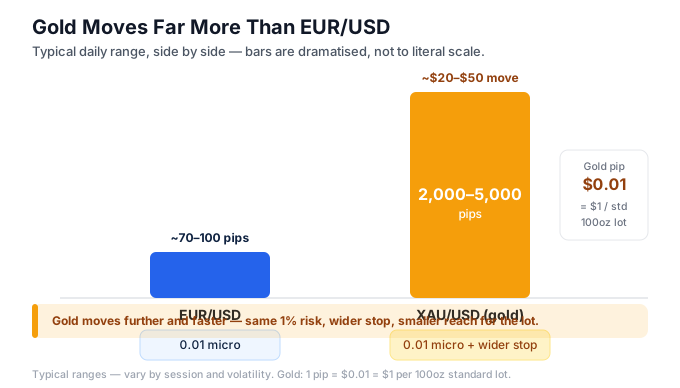
The fix on gold: trade micro (0.01) lots only when you are starting, and size the stop to gold’s range, not to a forex habit. A 20-pip stop that is sane on EUR/USD is far too tight on gold — plan for a wider stop, then let the smaller lot keep your dollar risk at 1%.
How to build the habit
Discipline is not willpower — it is a checklist you run every time until it becomes automatic. Before every trade, answer four questions in order.
- What is my risk in dollars? 1% of the account. On $500, that is $5. Decide this before anything else.
- Where is my stop? At the level that proves the trade wrong, not a round pip number. If there is no logical stop, there is no trade.
- What lot size makes that stop equal my dollar risk? Let the calculator answer — never eyeball it.
- Have I already hit my daily loss limit? If yes, the platform closes. Tomorrow exists.
Run those four questions on demo until they are boring, then carry them to a live micro account. The traders who last are not the ones with the best indicator — they are the ones who never skipped this checklist.
Frequently asked questions
What is the biggest mistake beginner forex traders make?
The biggest one is over-leveraging — trading a lot size far too large for the account. A single 1.00 standard lot on a $500 account can be wiped by an ordinary 50-pip move, because that lot is worth $10 per pip. Sizing every trade to risk 1% of the account is the fix.
How much should a beginner risk per trade in forex?
No more than 1% of account equity per trade, 2% at the absolute most. On a $500 account, 1% is $5 per trade. Risking small keeps a normal losing streak survivable; risking 10% or more means a handful of losers can halve the account.
Why do most beginner forex traders blow their accounts?
They combine oversized positions with no stop-loss, then revenge trade after a loss. Any one of those can be recovered from; together they compound fast. Add ignored spread and swap costs and no trading plan, and the account bleeds out from several directions at once.
Should I always use a stop-loss when trading forex?
Yes. Every trade should have a stop-loss set at entry, before you are emotionally attached to the position. A trade without a stop has no defined maximum loss, which is how a small loss becomes a margin call. Place the stop at a level that invalidates your trade idea.
Is it okay to move my stop-loss during a trade?
Only toward profit — to breakeven or as a trailing stop. Never widen a stop to avoid taking a loss. Moving a stop away from price removes the maximum loss you committed to and turns a 1% risk into a much larger one. If your stops keep getting hit by noise, set them wider at entry with a smaller lot.
How does trading gold (XAU/USD) change these mistakes?
Gold amplifies over-leverage and no-stop errors because it moves $20 to $50 a day, roughly 2,000 to 5,000 pips at $0.01 per pip. At $1 per pip per standard lot, a full lot swings thousands of dollars fast. Beginners should trade gold in 0.01 micro lots only, with a stop sized wide to its range, not a tight forex-style stop.
Do I actually need a trading journal as a beginner?
Yes — the journal is where your repeated mistakes become visible and fixable. Logging entry, stop, size, result, and reason for every trade reveals patterns you cannot see in the moment, like revenge trades after losses. A simple spreadsheet reviewed weekly is enough to start.
How can I avoid revenge trading after a loss?
Set a hard daily loss limit before you start — two losers or 3% of the account, whichever comes first — and close the platform when you hit it. Revenge trading is an emotional reaction, not a setup. Walking away for the day breaks the cycle before one bad trade becomes a bad week.
Risk disclaimer: Forex and CFD trading carries a high level of risk and may not be suitable for all traders. The strategies and indicators described here are educational. Past performance does not guarantee future results. Test on a demo account before risking real capital.
Related reading
- What is leverage in forex?
- What is margin in forex?
- Demo vs live account
- How to start forex trading with $100
- How to choose a forex broker
- How to read a forex economic calendar
Ready to put this into practice?
Open an account with a regulated broker and apply what you have learned. These are the three brokers we recommend:
Trading forex and CFDs carries a significant risk of loss and is not suitable for everyone. Broker links are affiliate links — we may earn a commission at no cost to you.