

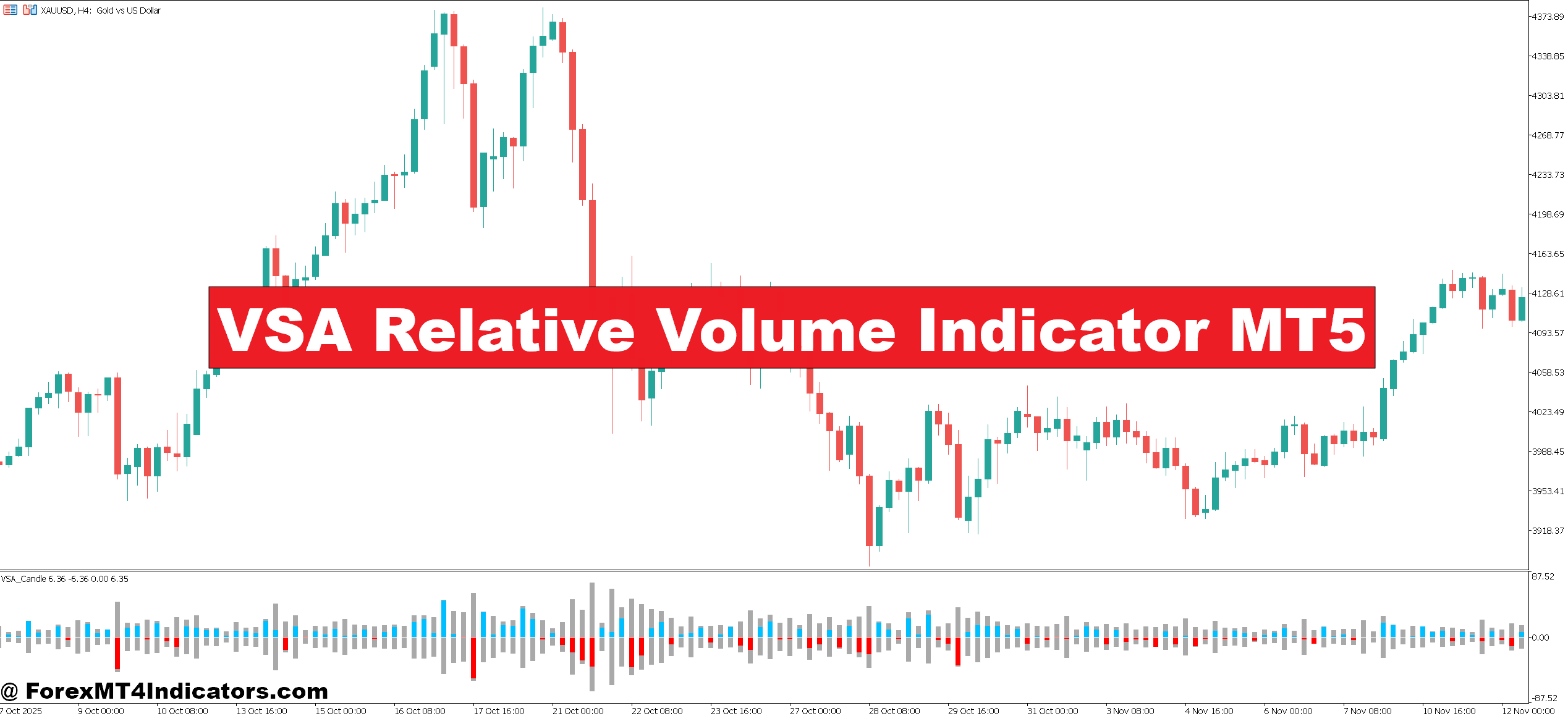
The VSA Relative Volume Indicator MT5 is a technical analysis tool built on the principles of Volume Spread Analysis (VSA). VSA studies the relationship between price movement, volume, and candle spread to determine whether professional money is entering or leaving the market.
Instead of showing raw tick volume, this indicator measures relative volume. In simple terms, it compares the current candle’s volume to the average volume over a selected number of past bars.
If the current volume is significantly higher than normal, the indicator highlights it. This signals increased market participation, which often appears during:
- Breakouts
- Trend accelerations
- Reversals driven by large traders
For example, a trader observing GBP/USD on the 1-hour chart might see the indicator spike when price breaks above a consolidation zone. That spike suggests strong participation rather than a weak retail-driven move.
Many traders pair this tool with price action methods such as support and resistance zones, breakout trading, or supply and demand analysis.
How the Indicator Works
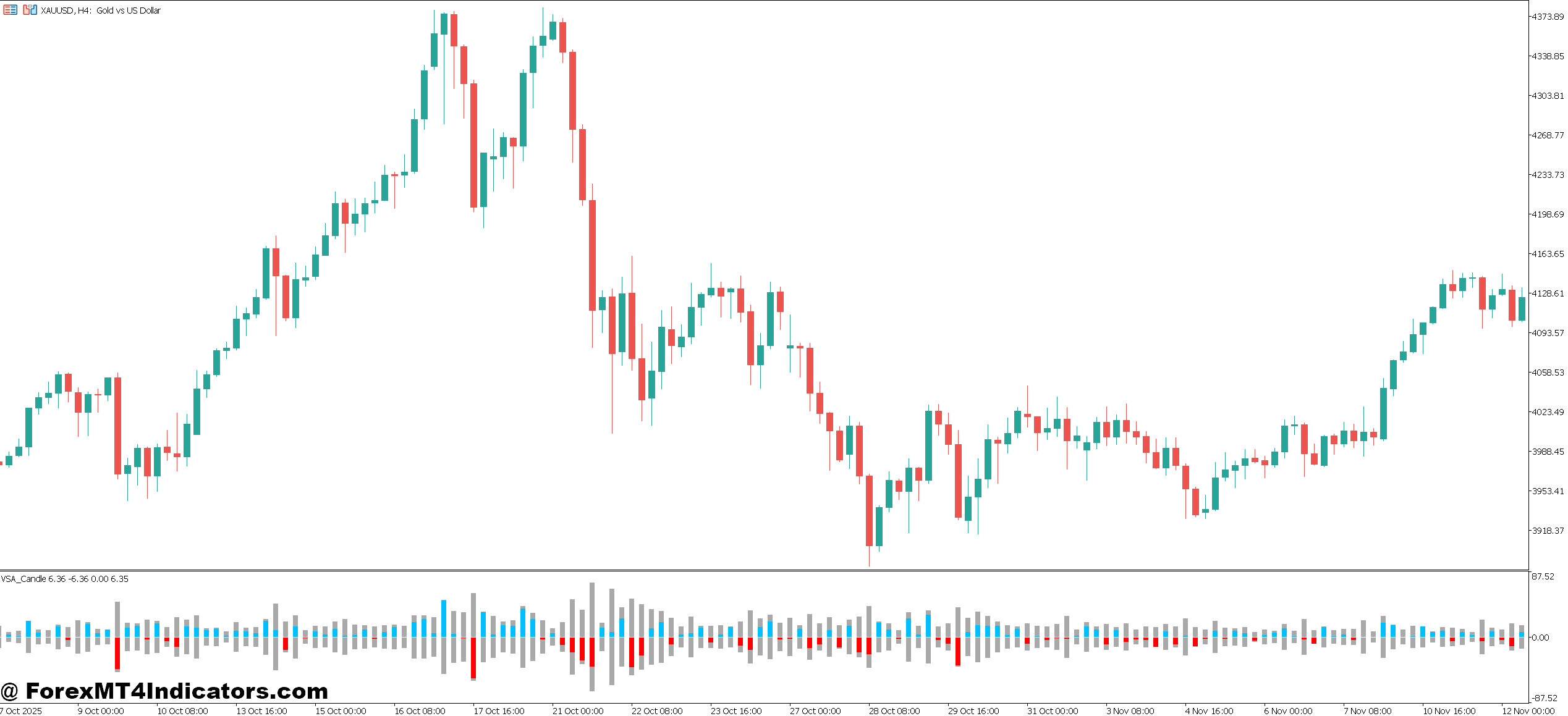
The logic behind the VSA Relative Volume Indicator is straightforward but powerful. It calculates the average tick volume over a defined period and compares it with the current candle’s volume.
A simplified formula looks like this:
Relative Volume = Current Volume ÷ Average Volume (N periods)
Where N is usually set between 20 and 50 candles.
If the result is:
- 1.0 → Current volume equals the average
- Above 1.5 → Strong participation
- Above 2.0 → Extremely high activity
High relative volume often signals that large traders are active. But volume alone doesn’t determine direction. The trader must also analyze price spread and candle behavior.
Example scenario:
A trader studies USD/JPY on the 30-minute chart.
- Price approaches a resistance level around 150.20.
- A bullish candle closes above resistance.
- The relative volume reading jumps to 2.3.
This combination suggests the breakout may have real strength behind it.
But here’s the catch: high volume during a long upper wick could signal distribution instead of continuation. That’s why experienced traders always combine volume signals with price structure.
Practical Trading Applications
The VSA Relative Volume Indicator shines when traders want confirmation behind price movement. Here are a few practical ways traders apply it.
Breakout Confirmation
Breakouts without strong volume often fail.
Suppose EUR/USD on the 1-hour chart breaks above 1.0950 resistance. If the breakout candle shows relative volume above 1.8, it suggests stronger participation. Traders may then consider entering a long position with a stop below the breakout level.
Without that volume spike, many experienced traders wait.
Identifying Reversal Pressure
High volume can appear near turning points.
During testing on volatile Non-Farm Payroll (NFP) days, traders sometimes see large volume spikes after extended trends. If price forms a pin bar or engulfing candle with high relative volume, it may indicate professional traders closing positions.
This doesn’t guarantee a reversal. But it warns traders to reduce risk or tighten stops.
Detecting Weak Moves
Low relative volume often signals weak momentum.
For instance, if AUD/USD on the 15-minute chart slowly drifts upward while relative volume stays around 0.6, the move may lack commitment from larger market participants.
Such conditions often lead to sideways price action or sudden pullbacks.
VSA Relative Volume Indicator MT5 Settings and Customization
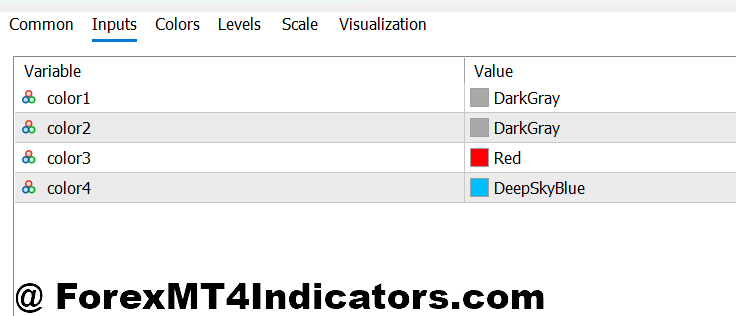
Most versions of the VSA Relative Volume Indicator MT5 allow traders to adjust a few key parameters.
Volume Lookback Period
The most important setting is the average calculation period.
Common values include:
- 20 periods – more sensitive, good for scalping
- 30–40 periods – balanced setting for intraday trading
- 50+ periods – smoother signals for swing trading
Shorter periods respond quickly but may produce more noise.
Threshold Levels
Some traders set visual alerts for specific volume levels.
Example structure:
- 1.2 – Moderate volume
- 1.5 – Strong volume
- 2.0 – Extreme volume
This helps identify unusual market activity quickly.
Timeframe Considerations
Relative volume behaves differently depending on timeframe.
- Scalpers often use: M5 or M15 charts
- Day traders prefer: M30 or H1 charts
- Swing traders sometimes analyze: H4 or Daily charts
Testing the indicator across several timeframes usually provides better context.
Advantages and Limitations
No indicator works perfectly in every market condition. Understanding both strengths and weaknesses helps traders use the tool wisely.
Advantages
First, the indicator highlights institutional participation. Many traders struggle to distinguish real breakouts from weak ones. Relative volume helps filter those situations.
Second, it works well with price action strategies. When traders combine it with support/resistance or market structure, signals often become clearer.
Third, it adapts to different trading styles. Scalpers, intraday traders, and swing traders can all adjust the settings.
Limitations
But there are limitations.
Forex markets don’t provide centralized volume data. MT5 indicators rely on tick volume, which reflects price changes rather than actual traded contracts.
While tick volume often correlates with real volume, it isn’t perfect.
Another limitation appears during news releases. Volume spikes during economic events like CPI or NFP may create extreme readings that distort normal market behavior.
And finally, the indicator does not predict direction. It only shows participation.
Traders still need price action, structure, and risk management to make informed decisions.
Comparison With Similar Volume Indicators
Several MT5 tools attempt to measure market activity. The VSA Relative Volume Indicator stands out because it focuses on relative comparison rather than raw volume numbers.
For example:
Standard Volume Indicator
- Shows tick volume per candle
- Harder to identify abnormal activity
On-Balance Volume (OBV)
- Tracks cumulative buying and selling pressure
- Useful for trend analysis but slower to react
Volume Oscillator
- Compares short-term and long-term averages
- Often used for momentum signals
The VSA Relative Volume Indicator MT5 simplifies the process by immediately showing when volume exceeds its normal range. That quick comparison helps traders detect potential breakouts, climaxes, or exhaustion.
How to Trade with VSA Relative Volume Indicator MT5
Buy Entry
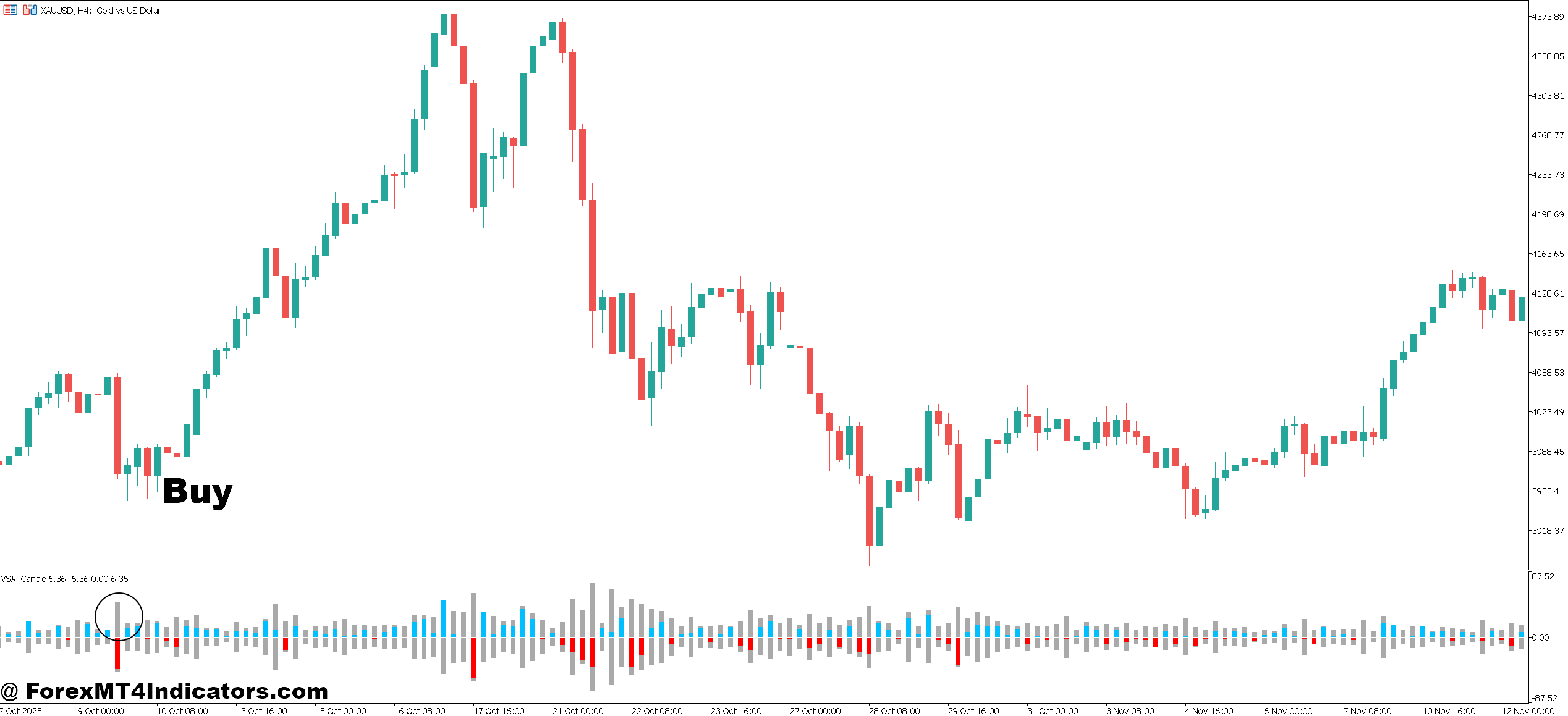
- Buy after high-volume breakout – Enter a buy trade when price breaks a strong resistance level with relative volume above 1.5 on the EUR/USD 1-hour chart. This indicates strong market participation. Place a stop loss 20–30 pips below the breakout level to manage risk.
- Buy during pullback with rising volume – If GBP/USD on the 4-hour chart pulls back to a support zone and the indicator shows increasing volume (above 1.3 relative volume), it often signals buyers returning. Target 40–70 pips while keeping risk below 2% of account balance.
- Buy after bullish engulfing candle with volume spike – When a bullish engulfing candle forms with relative volume above 2.0 on EUR/USD 1-hour timeframe, it can indicate institutional buying pressure. Traders often set a 25–35 pip stop loss below the candle low.
- Buy when consolidation breaks with strong volume – If price moves sideways for 10–20 candles and then breaks upward with volume above 1.8, it may signal a strong continuation move. This setup works well on GBP/USD 30-minute charts.
- Buy near support with abnormal volume activity – When EUR/USD touches a daily support level and the indicator suddenly spikes above 1.6, it may show accumulation. Traders sometimes enter with 30–50 pip targets depending on volatility.
- Buy after trend continuation signal – During a clear uptrend on the 4-hour chart, look for a bullish candle with volume 40–50% higher than average. This often confirms trend continuation. Avoid risking more than 1–2% per trade.
- Buy after false downside breakout with strong recovery volume – If price briefly breaks support but quickly returns above it with relative volume above 1.7, it may trap sellers. This setup appears frequently on EUR/USD 1-hour charts.
- Avoid buying during low-volume rallies – If price rises but the indicator shows relative volume below 0.8, the move may lack real momentum. Low participation often leads to fake breakouts or sideways chop.
Sell Entry
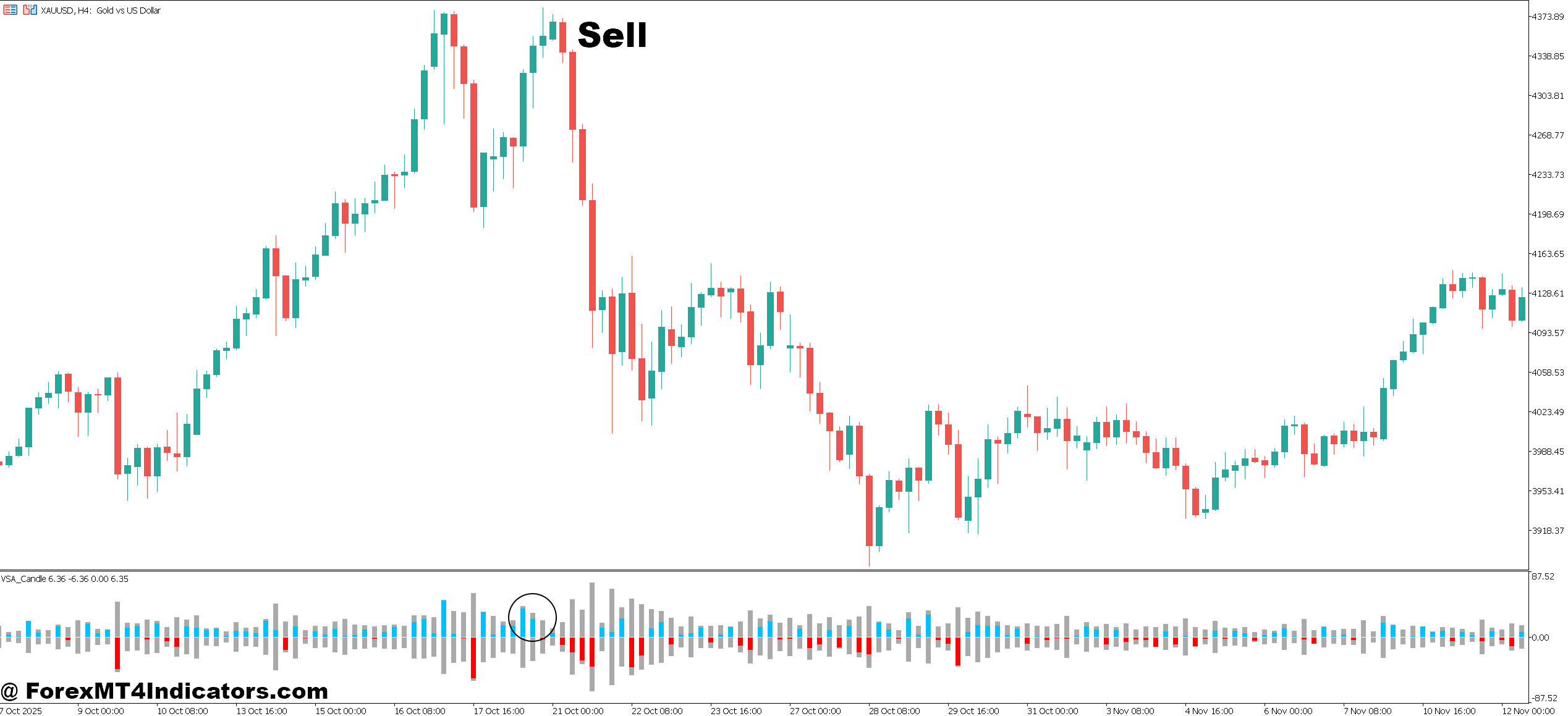
- Sell after high-volume resistance rejection – If GBP/USD on the 1-hour chart touches resistance and forms a bearish candle with relative volume above 1.6, it often indicates strong selling pressure. A 20–30 pip stop loss above the high helps control risk.
- Sell during breakdown with strong volume expansion – When price breaks a support level and volume rises above 1.8, traders often consider short positions. This setup works well on EUR/USD 4-hour charts with 40–80 pip downside targets.
- Sell after bearish engulfing with extreme volume – If a bearish engulfing candle forms with volume above 2.0, it may signal institutional selling. Traders usually place stops 25–35 pips above the candle high.
- Sell when trend continuation appears with high volume – In a clear downtrend on EUR/USD daily chart, look for pullbacks followed by bearish candles with volume 30–50% above average. This often confirms sellers remain in control.
- Sell after failed breakout above resistance – When price briefly breaks resistance but quickly drops back with relative volume above 1.7, it may signal a bull trap. Short entries sometimes target 50+ pips depending on volatility.
- Sell during distribution near major resistance – If GBP/USD on the 4-hour chart forms several small candles near resistance while volume spikes repeatedly, large traders may be distributing positions. Conservative traders often use 30–60 pip targets.
- Sell after strong bearish momentum candle – When a large bearish candle closes with relative volume above 2.2, it often indicates aggressive selling. Entering after a small pullback can improve the risk-to-reward ratio.
- Avoid selling during low-volume declines – If the market drops slowly but the indicator shows volume below 0.9, the move may lack commitment. Weak selling pressure often leads to sudden reversals or ranging markets.
Conclusion
The VSA Relative Volume Indicator MT5 offers traders a practical way to evaluate the strength behind price movement. Instead of relying solely on chart patterns, it highlights when market participation increases or fades.
Key takeaways include: traders often use the indicator to confirm breakouts, spot potential reversal pressure, and identify weak price moves that lack strong volume support. It works best when combined with price action tools such as support and resistance levels or trend analysis. Adjusting the lookback period allows the tool to fit different trading styles and timeframes.
Still, traders should remember one important fact: Trading forex carries substantial risk. No indicator guarantees profits.
Used carefully, the VSA Relative Volume Indicator MT5 can add valuable insight into market behavior. Testing it in a demo account and observing how volume interacts with price structure is often the best first step.
Level up your trading Learn to read the chart — not just the indicator eBook · Instant PDF Video Course · 12 modules Trading forex and CFDs carries a significant risk of loss and is not suitable for everyone. Broker links are affiliate links — we may earn a commission at no cost to you.Recommended MT4/MT5 Brokers
Free MT4 Indicator Download

Enter Your Email Address below, download link will be sent to you.