

Last updated:
A Fair Value Gap (FVG) is a three-candle price imbalance. On a bullish FVG it is the untraded space between the high of the first candle and the low of the third, left behind because the middle candle moved so fast the outer wicks never overlapped. Price often, but not always, returns to fill it.
That single idea sits at the heart of Smart Money Concepts (SMC) trading. It is one of the most searched, most misunderstood terms in retail forex, partly because a lot of online content oversells it. This guide keeps the mechanics precise and stays honest about what an FVG can and cannot tell you.
What a fair value gap actually is
A fair value gap marks a moment where price moved in one direction so aggressively that it left a portion of the chart with little or no two-sided trading. In SMC language this is called an imbalance or an inefficiency. Supply and demand met unevenly, and the market skipped past a price band instead of trading through it cleanly.
You measure an FVG across three consecutive candles, not one. The gap is defined by the outer two candles; the middle candle is the one that did the fast move. This is why an FVG is not the same thing as a weekend gap, where the whole market simply reopens at a different price. An FVG can form in the middle of an active, continuously trading session.
For a bullish FVG, the imbalance is the range between the high of candle one and the low of candle three, and it only exists if candle one’s high is below candle three’s low. That non-overlap is the whole point. The wicks of the first and third candles do not cover the same prices, so a band in between was never properly auctioned.
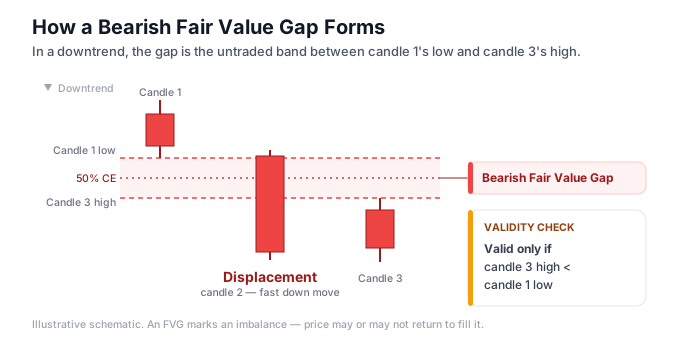
A bearish FVG is the exact mirror. It is the range between the low of candle one and the high of candle three, and it only exists when candle one’s low is above candle three’s high.
The theory is that markets dislike leaving inefficiencies untouched, so price tends to drift back to “rebalance” the gap before continuing. Traders treat the gap as a potential area where price may react. Notice the hedging language: tends to, potential, may. That caution is deliberate and it matters for your money.
An FVG is a close cousin of the order block and often forms right alongside one during the same impulsive move. It is also frequently the reason a move looks so one-sided: strong displacement leaves gaps behind it. Understanding both, plus how they relate to smart money concepts as a whole, is what turns a single pattern into a framework.
How to spot a fair value gap
Spotting an FVG by eye comes down to one question: do the wicks of candle one and candle three overlap, or is there clear air between them?
Walk through it on a bullish example. Take three candles in an uptrend. Candle one is an ordinary bar. Candle two is a large bullish candle that rips higher. Candle three opens and trades up too. Now look only at candle one’s high and candle three’s low. If candle three’s low sits above candle one’s high, the space between those two levels is your bullish FVG.
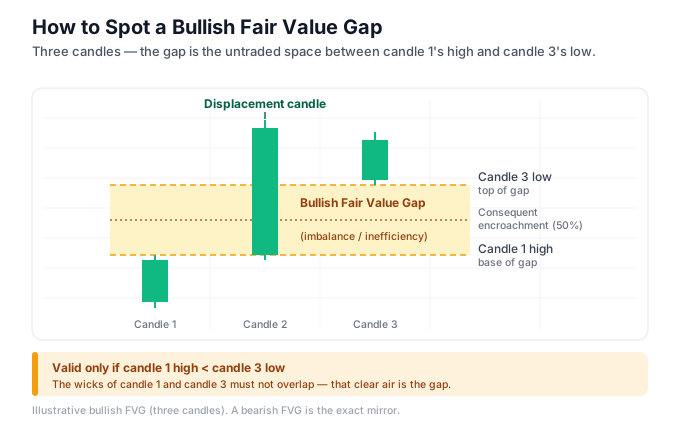
The band you have just shaded was skipped. During candle two’s rush higher, price never came back down to trade through that zone, so on the outer candles it appears as a hole. That hole is the gap.
For a bearish FVG you flip everything. In a downtrend, candle two is a large bearish candle. You compare candle one’s low against candle three’s high. If candle one’s low sits above candle three’s high, the space in between is the bearish FVG.
A few practical checks separate a meaningful gap from noise:
- Size relative to the pair and timeframe. A two-pip gap on a one-minute EUR/USD chart is usually noise. The same gap size means more on a higher timeframe. Judge gaps in context, not absolute pips.
- Was there real displacement? A genuine FVG comes from a decisive candle two, not a lazy drift. Weak, overlapping candles rarely leave gaps worth trading.
- Direction of the trend. Gaps that form in the direction of the prevailing move, ideally after a clean break of structure, tend to be treated as higher quality than gaps that form against it. A break of structure versus a change of character tells you which regime you are in.
Be warned that timeframes disagree. A gap that is glaring on the 15-minute chart may vanish on the 1-hour, because the higher timeframe candle absorbs the imbalance. Always know which timeframe you are trading and stick to it.
How to trade a fair value gap
The standard SMC approach treats an FVG as an area of interest, not a signal on its own. You wait for price to return toward the gap and look for a reaction there, rather than chasing the impulsive candle that created it.
Here is a concrete, deliberately conservative worked example on EUR/USD, 1-hour chart. Treat the numbers as illustration, not a recommendation.
Suppose price is in a clear uptrend and has just broken above a prior swing high, confirming a bullish break of structure. On the pullback you find a bullish FVG:
- Candle one high: 1.0840
- Candle three low: 1.0865
That 25-pip band, 1.0840 to 1.0865, is the gap. Its midpoint, sometimes called the consequent encroachment, is 1.08525.
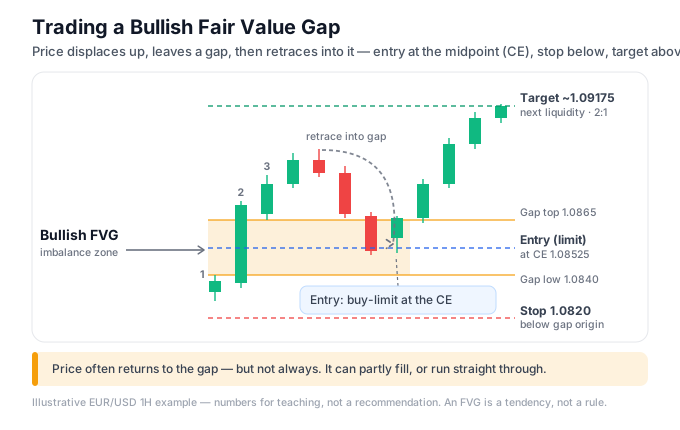
A patient plan might look like this. You place a buy limit order inside the gap rather than at market, because you want price to come to you. Some traders use the far edge (1.0840), some the midpoint (1.08525); the far edge fills less often but offers a tighter stop. Say you choose the midpoint.
Your protective stop sits below the gap and below the swing low that anchored the move, giving the idea room to breathe, perhaps at 1.0820. That is a 32.5-pip stop from a 1.08525 entry. You size the position so that if the stop is hit you lose only a small, pre-decided fraction of your account, commonly no more than 1 to 2 percent. A position size and risk calculator does this arithmetic for you and removes a common source of costly mistakes.
Your target is defined before you enter, not invented afterward. A reasonable objective is the recent high the impulse came from, or a level that gives you a favourable reward-to-risk ratio such as 2:1. If your risk is 32.5 pips, a 2:1 target sits roughly 65 pips above entry, near 1.09175.
Then you do the hardest part: nothing. Price either trades back into the gap and reacts, in which case your limit fills and your stop and target are already set, or it does not, in which case you have risked zero. Deciding whether to go long or short is settled by the structure before the trade, not by emotion during it.
Two honest caveats. First, gaps get partially filled all the time, tagging the near edge and reversing before reaching the midpoint, which is why your entry choice changes your fill rate. Second, gaps also get blown straight through with no reaction whatsoever, and a gap that price closes clean through can flip into an inverse fair value gap. There is no rule of the market that forces price back to an FVG. The pattern describes a tendency, and tendencies fail.
Common mistakes traders make with FVGs
Most FVG errors are the same errors that sink new traders generally, dressed in SMC vocabulary. A quick scan of beginner forex mistakes will feel familiar.
Trading every gap. Charts are full of small imbalances. Trading all of them is overtrading. Filter hard by timeframe, displacement quality, and trend alignment, and ignore the rest.
Confusing an FVG with a weekend gap. They are different animals. A weekend gap is a break between sessions; an FVG is an intrabar imbalance defined by three candles. Do not apply “gaps always fill” folklore from weekend gaps to FVGs.
Ignoring the higher-timeframe picture. A pristine 5-minute bullish FVG means little if the 4-hour chart is in a strong downtrend. Context beats the pattern. Trade gaps that agree with the larger structure.
Entering at market instead of waiting. The edge in this method comes from patience: letting price return to the gap on your terms. Chasing the displacement candle throws that edge away and usually hands you a terrible stop distance.
No stop, or a stop that is too tight. Placing a stop just outside a gap invites a normal wick to knock you out before the idea plays out. Anchor the stop to structure, then size the trade to the stop, never the other way round.
Treating FVGs as certainty. This is the big one. SMC is a discretionary framework built on tendencies, not a mechanical system with a fixed edge. It is not proprietary knowledge about where “the banks” will push price, and no honest source can promise otherwise.
It bears repeating plainly: most retail traders lose money. An FVG is a lens for reading order flow, not a shortcut around risk management, discipline, or the base rates of this business.
How indicators automate fair value gap detection
Marking gaps by hand is slow and easy to get wrong when you are watching several pairs. This is where an indicator earns its place. The fair value gap indicator for MT5 scans your chart candle by candle, checks the non-overlap condition automatically, and shades every valid bullish and bearish gap as a coloured box, so you spot imbalances at a glance instead of measuring wicks manually.
MetaTrader 4 users are covered too; the fair value gap indicator for MT4 does the same job on the older platform. Most versions let you tune minimum gap size, restrict detection to a chosen timeframe, and optionally hide gaps once they have been filled, which keeps the chart clean.
Because FVGs rarely trade in isolation, many traders run them next to related SMC tools. A broader smart money concepts indicator for MT5 can plot structure, order blocks, and gaps together, while a dedicated liquidity indicator highlights the pools of stops that a liquidity sweep often targets just before price reverses into a gap. The two ideas frequently pair up: a sweep grabs liquidity, then price displaces and leaves an FVG behind on the way back.
One firm caution about automation. An indicator marks gaps; it does not decide whether a gap is worth trading, and it cannot manage your risk. It removes the tedious measuring, not the judgement. Treat what it draws as a starting point for your own analysis, verify anything that looks off against the raw candles, and keep every trade inside a written trading plan.
FVGs also overlap conceptually with classic support and resistance. A gap that lines up with an established level is often stronger than one floating in open space, because two independent reasons point at the same zone.
Frequently asked questions
What is a fair value gap in simple terms?
It is a three-candle pattern showing a spot on the chart where price moved so fast it skipped a small range, leaving an imbalance. On a bullish gap it is the space between the first candle’s high and the third candle’s low. Traders watch it because price often returns to that area before continuing.
Do fair value gaps always get filled?
No. Price frequently returns to fill or partially fill a gap, but there is no guarantee. Gaps can be tagged and reversed, filled completely, or ignored entirely while price runs away. Trading an FVG as if a fill is certain is a common and expensive mistake.
What is the difference between a fair value gap and an order block?
An FVG is an imbalance, the untraded space left by a fast move across three candles. An order block is the specific candle, usually the last opposing candle before that move, thought to hold resting institutional orders. They often appear together in the same impulse, but they describe different things: a gap is empty space, an order block is a candle.
What timeframe is best for trading fair value gaps?
There is no single best timeframe. Higher timeframes such as the 1-hour, 4-hour, and daily tend to produce fewer but more reliable gaps and are friendlier for beginners. Lower timeframes give more signals but far more noise. Pick a timeframe that matches your available screen time and always check that the gap agrees with the higher-timeframe trend.
Is a fair value gap the same as a weekend gap?
No. A weekend gap is the price difference between Friday’s close and Sunday’s reopen, caused by the market being shut. A fair value gap forms during live trading and is defined by three candles with non-overlapping wicks. The “gaps always fill” saying comes from weekend gaps and should not be applied blindly to FVGs.
Can I trade fair value gaps as a beginner?
You can study and practise them, but tread carefully. FVGs sit inside the discretionary SMC framework, which rewards experience with structure and risk management. Most retail traders lose money regardless of method. Learn the mechanics on a demo account, keep risk per trade small, and treat every gap as a probability, not a promise.
Trading forex and CFDs carries a high level of risk and is not suitable for everyone. Most retail traders lose money. Nothing here is financial advice; it is educational content only. Always do your own analysis and never risk money you cannot afford to lose.
Ready to put this into practice?
Open an account with a regulated broker and apply what you have learned. These are the three brokers we recommend:
Trading forex and CFDs carries a significant risk of loss and is not suitable for everyone. Broker links are affiliate links — we may earn a commission at no cost to you.