

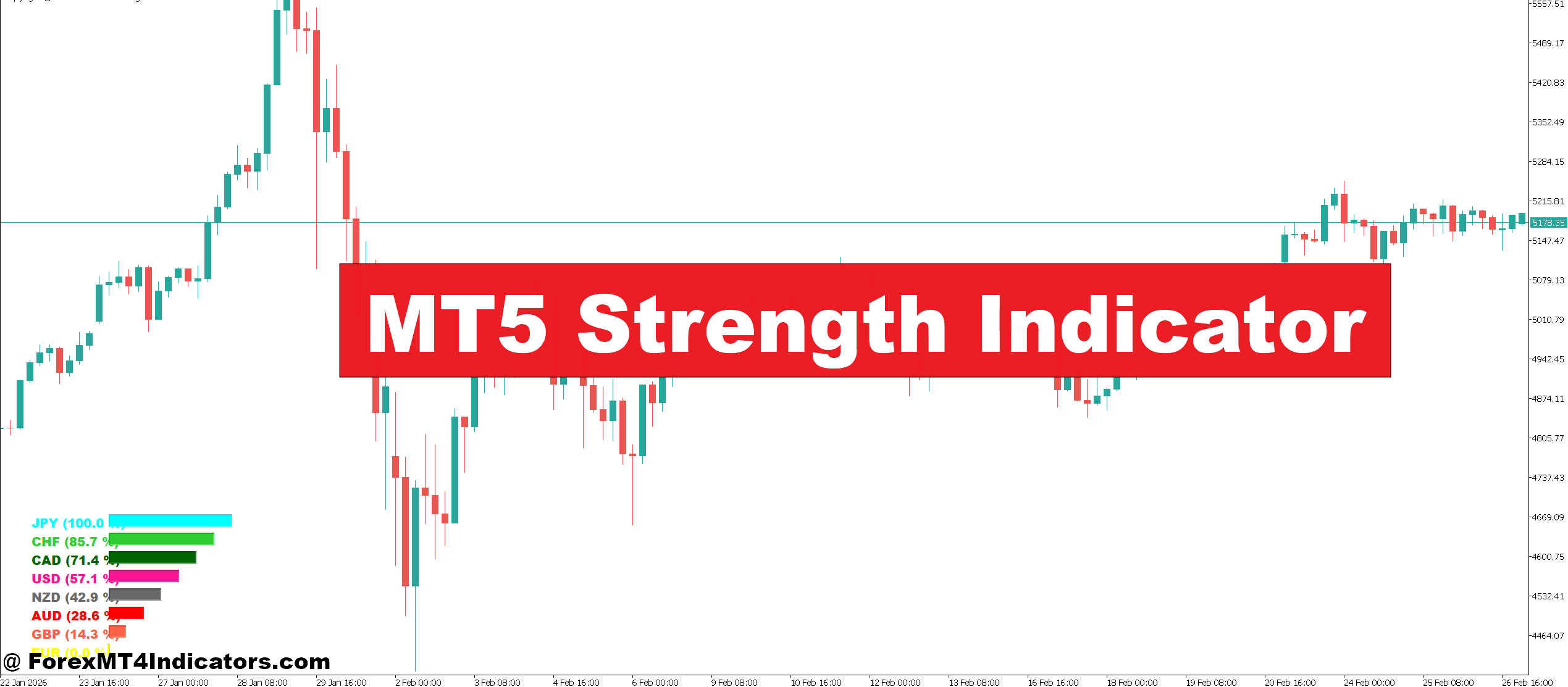
The MT5 Strength Indicator is a technical tool designed for the MetaTrader 5 platform. It measures and compares the strength of different currencies in real time. Instead of focusing on a single pair, it evaluates multiple currencies and displays their relative performance.
In simple terms, it answers a key question: which currency is gaining strength and which one is losing it?
Most versions display this data as lines or bars. For example, if the USD line is rising while the EUR line is falling, it signals potential bearish pressure on EUR/USD. That’s a stronger insight than relying on price action alone.
Unlike traditional indicators like RSI or MACD, this tool doesn’t just track momentum—it tracks market relationships. That gives traders an edge, especially in trending markets.
How the Indicator Works Behind the Scene
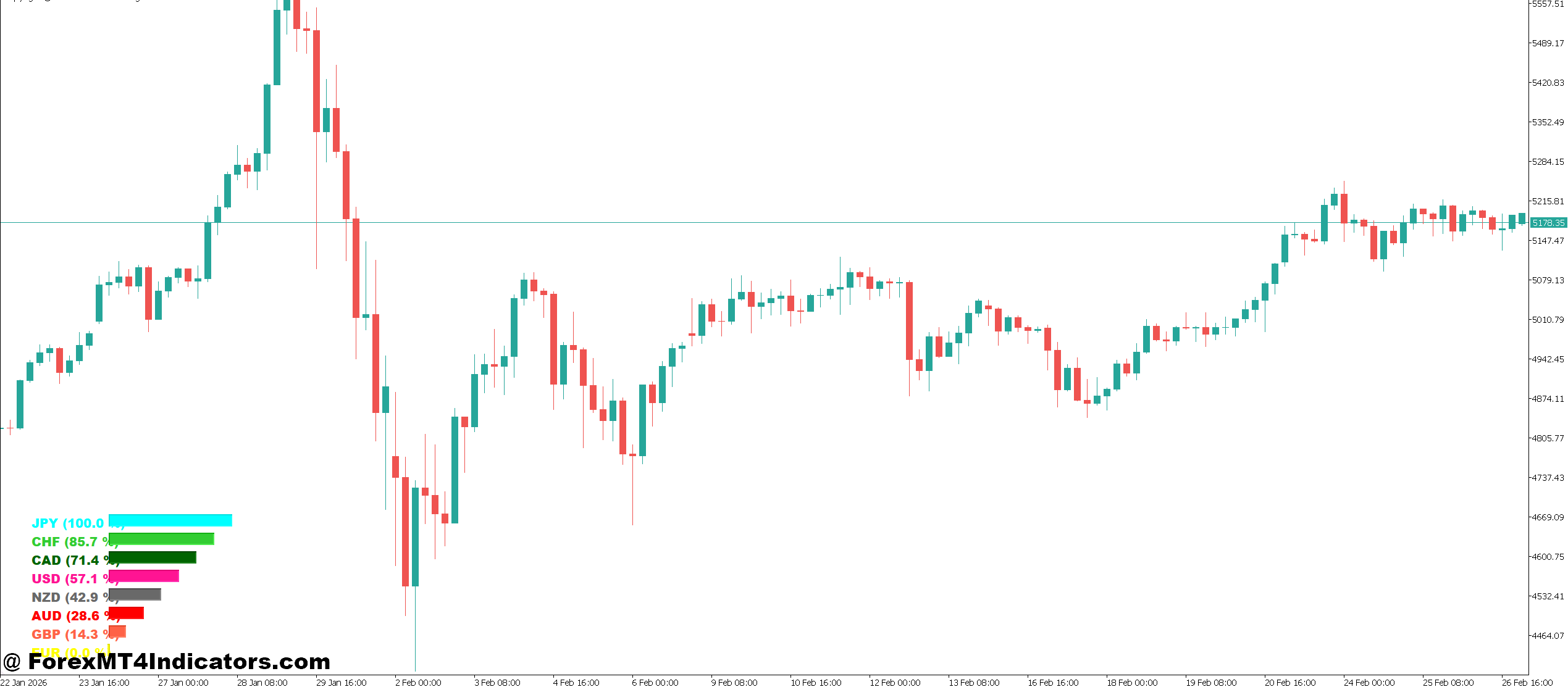
The logic behind the MT5 Strength Indicator is based on comparing multiple currency pairs. It calculates the strength of each currency by analyzing its performance across different pairs.
For example:
- USD strength may be derived from pairs like EUR/USD, GBP/USD, USD/JPY, and USD/CHF
- EUR strength may come from EUR/USD, EUR/JPY, EUR/GBP, and so on
The indicator aggregates these movements and assigns a value or line to each currency. When a currency consistently gains across several pairs, its strength increases.
Some advanced versions also apply smoothing methods like moving averages to reduce noise. This helps avoid reacting to small fluctuations or market “chop.”
Here’s a practical scenario:
On a 1-hour chart, if GBP shows strong upward momentum across multiple pairs while JPY is dropping, GBP/JPY becomes a high-probability setup. The indicator doesn’t just show direction—it confirms underlying strength.
Practical Trading Applications
Using the MT5 Strength Indicator becomes powerful when combined with price action. It’s not meant to replace chart analysis, but to support it.
Trend Confirmation
When trading trends, alignment is key. Suppose EUR/USD is forming higher highs on the H1 chart. If the indicator shows EUR gaining strength and USD weakening, that trend has solid backing.
A trader might enter after a pullback, targeting 30–50 pips with confidence that the move has momentum behind it.
Breakout Validation
Breakouts often fail due to lack of real strength. But if a breakout happens while one currency is clearly dominant, the odds improve.
Example:
- GBP/USD breaks resistance at 1.2700
- GBP strength line is rising sharply
- USD strength line is declining
That’s not just a breakout—it’s a supported move.
Avoiding Bad Trades
This might be the most underrated benefit. The indicator helps filter out weak setups.
Let’s say AUD/USD shows a bullish signal, but both AUD and USD are flat on the strength meter. That suggests no clear advantage. Skipping trades like this can protect capital.
Intraday Scalping
On lower timeframes like M15, the indicator can help scalpers pick quick moves. For instance, during the London session, if EUR spikes in strength while CHF drops, EUR/CHF may offer a fast 10–20 pip opportunity.
MT5 Strength Indicator Settings and Customization
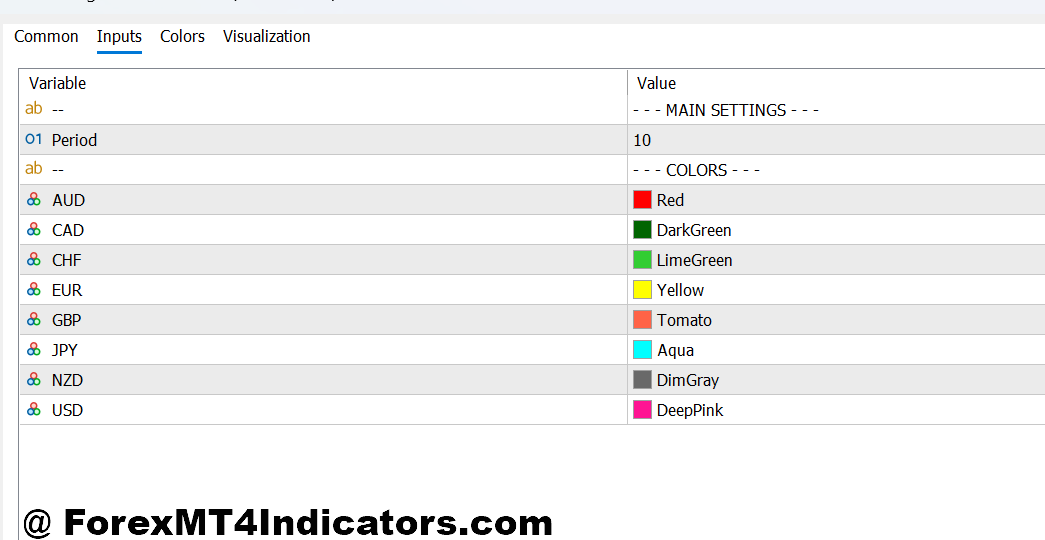
Most MT5 Strength Indicators come with adjustable parameters. Fine-tuning these can make a big difference depending on trading style.
Common Settings
- Timeframe sensitivity – Lower settings react faster but may produce noise
- Smoothing period – Higher values reduce false signals but add lag
- Currency selection – Some traders focus only on major currencies
Suggested Configurations
- Scalping (M5–M15): Use lower smoothing (5–10) for faster signals
- Intraday (M30–H1): Medium smoothing (10–20) balances speed and accuracy
- Swing trading (H4–D1): Higher smoothing (20–30) filters noise
A trader testing this on EUR/USD during the New York session might notice that a smoothing value of 14 provides stable signals without too much lag.
But here’s the thing—no setting is perfect. Markets change, and traders should adjust based on volatility and session behavior.
Advantages and Limitations
Advantages
The biggest strength of this tool is clarity. It simplifies complex market relationships into easy-to-read signals.
It also helps with pair selection. Instead of randomly choosing trades, a trader can focus on the strongest vs. weakest currencies. This alone can improve consistency.
Another benefit is versatility. It works across all timeframes and pairs, making it suitable for scalpers and swing traders alike.
Limitations
No indicator is flawless. The MT5 Strength Indicator can lag during sudden news events. For example, during NFP releases, currency strength can shift rapidly, making signals unreliable.
It also doesn’t replace price action. Relying on it alone can lead to late entries or missed context, especially around key support and resistance levels.
And in ranging markets, the lines may cross frequently, causing confusion or whipsaws.
Comparison With Similar Indicators
Traders often compare this tool with standard indicators like RSI or MACD. But the approach is different.
- RSI measures overbought and oversold conditions
- MACD focuses on momentum and trend direction
- MT5 Strength Indicator tracks relative currency performance
That distinction matters. While RSI might show EUR/USD as overbought, the strength indicator could reveal that EUR is still dominant. In such cases, a pullback may be more likely than a full reversal.
Some traders also use currency strength meters on dashboards. These are similar but often less dynamic than MT5-based indicators, which update directly with chart data.
How to Trade with MT5 Strength Indicator
Buy Entry
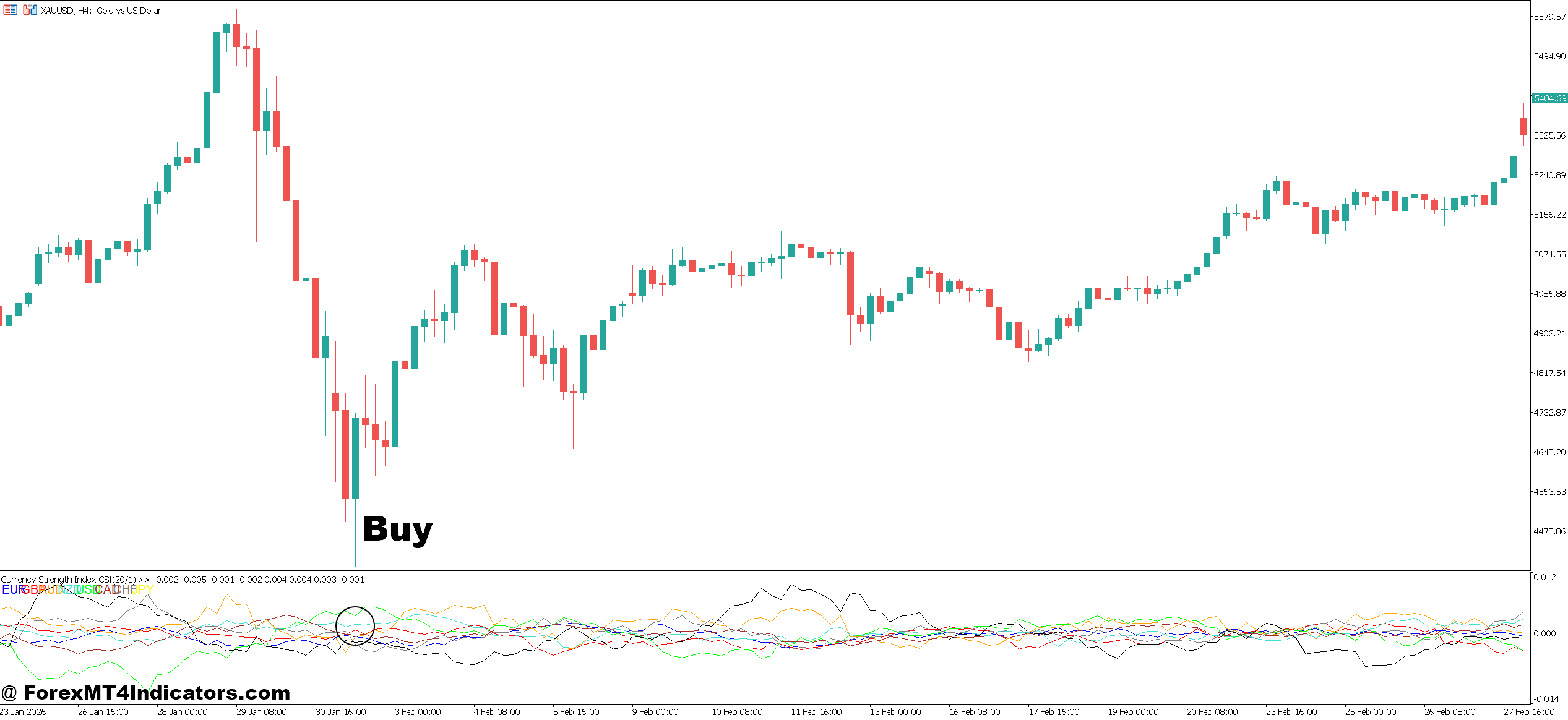
- Strong vs Weak Currency Setup – Enter a buy when one currency (e.g., EUR) shows clear strength above 70% while the other (USD) drops below 30% on the 1-hour chart, confirming directional bias.
- Pullback in Uptrend – Wait for EUR/USD to retrace 20–30 pips to a support level on H1, while EUR strength remains high, then enter for continuation.
- Breakout With Strength Confirmation – Buy when price breaks resistance (e.g., 1.1000 on EUR/USD) and the strength line shows a sharp upward slope, targeting 30–50 pips.
- Multi-Timeframe Alignment – Take buy trades only when both H1 and H4 show the same currency strength direction, reducing false signals.
- London Session Momentum Entry – During London open, if GBP strength spikes and USD weakens, buy GBP/USD for quick 20–40 pip intraday moves.
- Avoid Flat Strength Lines – Do not enter if both currencies are moving sideways within 40–60% range; this often leads to choppy price action.
- Support Zone Confirmation – Enter buy near strong support zones when strength remains bullish, placing stop loss 15–25 pips below the level.
- Risk Control Entry – Risk only 1–2% per trade and aim for at least 1:2 risk-to-reward ratio (e.g., 20 pip SL, 40 pip TP).
Sell Entry
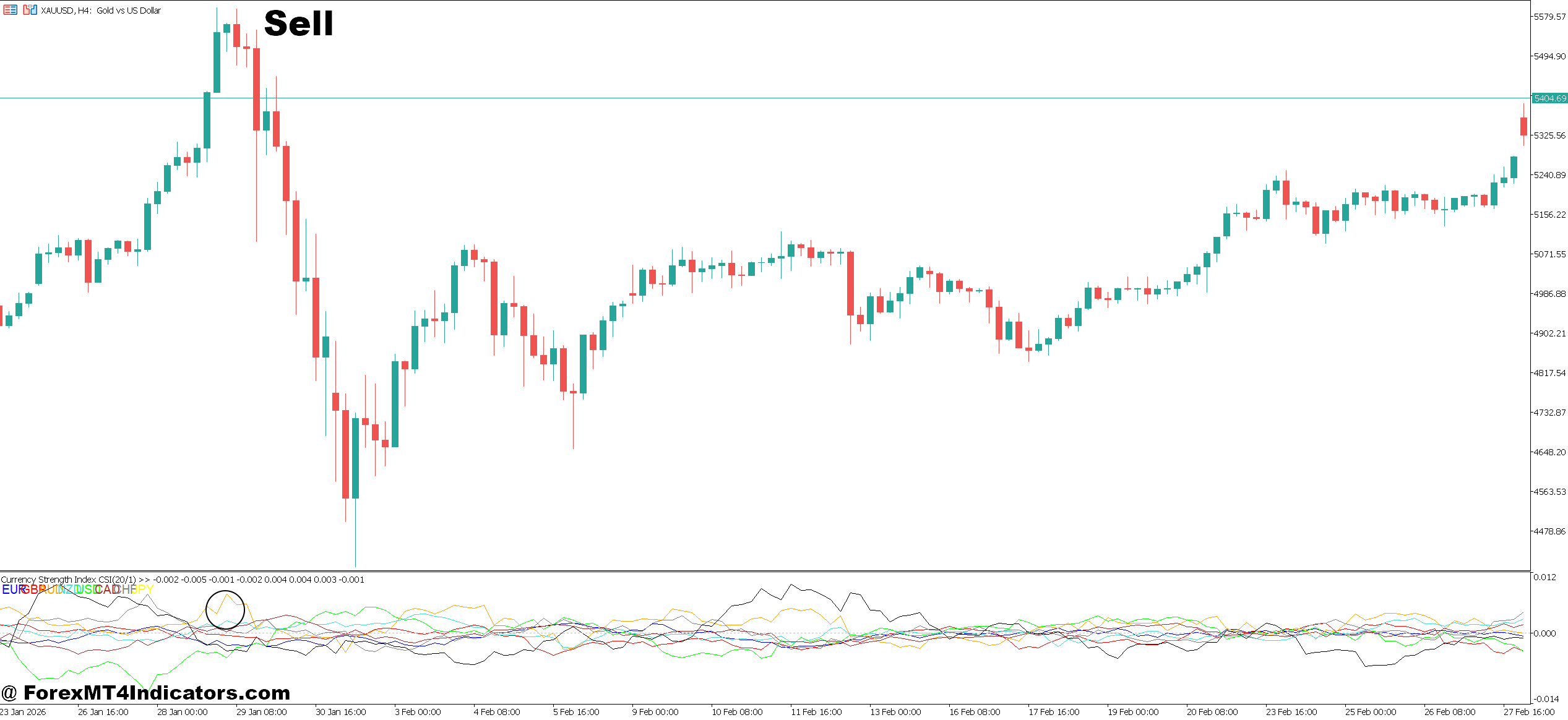
- Weak vs Strong Currency Setup – Enter a sell when base currency (e.g., EUR) drops below 30% strength and quote currency (USD) rises above 70% on H1.
- Pullback in Downtrend – Wait for price to retrace 20–30 pips upward on GBP/USD while GBP remains weak, then sell for continuation.
- Breakdown With Strength Confirmation – Sell when price breaks support (e.g., 1.2700 on GBP/USD) with increasing bearish strength, targeting 30–60 pips.
- H4 Trend Confirmation – Only take sell trades when H4 confirms the same bearish strength direction to avoid counter-trend trades.
- New York Session Volatility – Look for USD strength surges during NY session and sell pairs like EUR/USD for fast 25–50 pip moves.
- Avoid News Volatility – Do not enter trades during major news events (like NFP), as strength readings can flip quickly and cause fake-outs.
- Resistance Rejection Entry – Sell near resistance zones when strength shows clear bearish dominance, placing stop loss 20–30 pips above.
- Proper Risk Management – Keep risk per trade under 2% and target at least double reward (e.g., 25 pip SL, 50 pip TP) to stay consistent.
Conclusion
The MT5 Strength Indicator gives traders a broader view of the forex market by highlighting which currencies are leading and which are lagging. That insight can improve trade selection and timing when used correctly.
Key takeaways include: focusing on strong vs. weak currency pairs for better setups, combining the indicator with price action for confirmation, adjusting settings based on timeframe and volatility, and staying aware of its limitations during news or ranging markets. It’s a helpful tool, but not a standalone system.
Trading forex carries substantial risk. No indicator guarantees profits. The smart approach is to test the MT5 Strength Indicator on a demo account, observe how it behaves in real conditions, and then decide how it fits into a broader trading strategy.
Level up your trading Learn to read the chart — not just the indicator eBook · Instant PDF Video Course · 12 modules Trading forex and CFDs carries a significant risk of loss and is not suitable for everyone. Broker links are affiliate links — we may earn a commission at no cost to you.Recommended MT4/MT5 Brokers
Free MT4 Indicator Download

Enter Your Email Address below, download link will be sent to you.