Last updated:
Forex day trading means opening and closing all your trades within the same day, so no position is held overnight. For a complete beginner, the safest way to start is one simple strategy — a trend-following pullback on the H1 chart, traded only during the London/New York overlap — while risking no more than 1% of your account per trade.
Key takeaways
- Forex day trading is intraday trading: every position is opened and closed the same day, before the daily rollover, so you never pay overnight swap or wake up to a gap.
- The best window for beginners is the London/New York overlap, roughly 08:00–12:00 EST (13:00–17:00 GMT) — the most liquid, most directional hours of the day.
- Stick to the majors — EUR/USD, GBP/USD, and USD/JPY — where spreads are tightest and moves are cleanest.
- You do not need five strategies. Learn one — a trend-following pullback — until it is automatic, then add a second only if you need it.
- The math that keeps you in the game is the 1% rule: risk no more than 1% of your account on any single trade, sized with a stop, not a hunch.
- Day trading is not harder than swing trading in skill — it is harder in pace. It demands screen time and fast decisions; swing trading suits people who can only check charts once a day.
What is forex day trading?
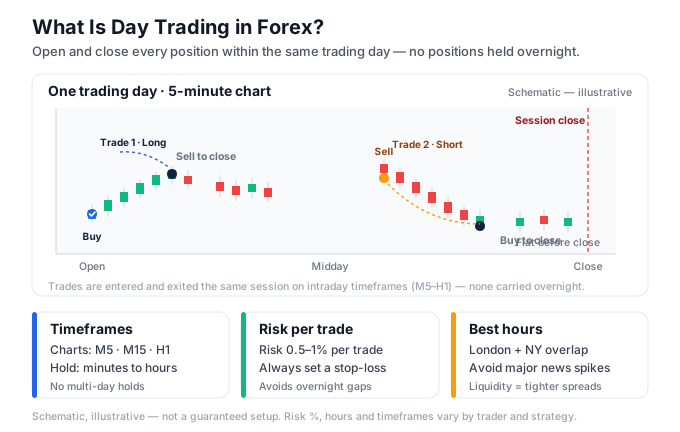
Forex day trading is a style where you open and close every position within the same trading day. You are trading the intraday move — the swing that happens between the morning and the evening — and you flatten everything before the day ends. Nothing is left running overnight.
The practical reason this matters is rollover. Brokers charge or pay swap on positions held past the daily rollover (usually 22:00 GMT / 17:00 EST). Day traders close before that, so they avoid swap costs entirely and never face a weekend gap against an open position.
Day trading sits between two other styles. Scalpers hold for seconds to minutes and take dozens of trades a day; swing traders hold for days to weeks. Day trading is the middle ground — a handful of trades per session, each lasting minutes to a few hours, all closed by day’s end. Scalping and swing trading are separate disciplines; this guide is only about day trading.
Be honest about capital. You can open an account for $100 at many brokers, but a realistic starting balance for most beginners is $500 to $2,000. Small accounts are fine to learn on — they absorb smaller dollar swings, so the 1% rule matters even more. If you are new to the market, start with our guide on how to start forex trading before placing a live trade.
Best time and pairs to day trade as a beginner
Day trading works when the market is moving and liquid. That narrows when and what you should trade to a short list.
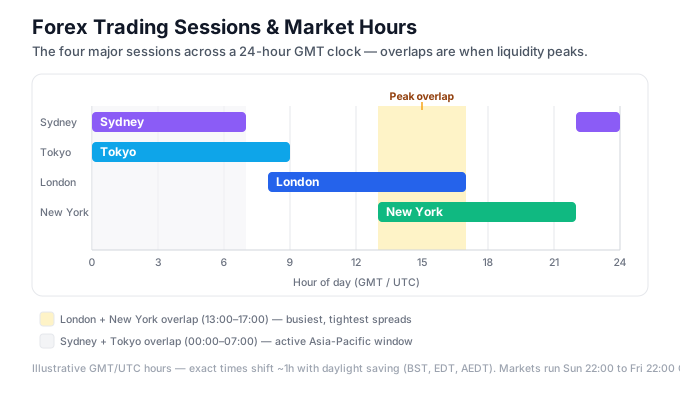
The best window is the London/New York overlap. London runs 08:00–17:00 GMT and New York runs 13:00–22:00 GMT; where they overlap — 13:00–17:00 GMT (08:00–12:00 EST) — you get the highest volume and cleanest directional moves of the whole day. For other zones that is roughly 18:30–22:30 IST, 20:00–24:00 WIB, and 15:00–19:00 SAST.
Avoid the dead hours. The late Asian session (after roughly 04:00 GMT) is often slow and range-bound on the majors, so breakout and trend strategies stall. Trading fewer hours in the right window beats sitting at the screen all day.
Stick to the majors: EUR/USD, GBP/USD, and USD/JPY — the tightest spreads, deepest liquidity, and most predictable session behaviour. EUR/USD is the calmest and the best first pair. Avoid exotics (USD/ZAR, USD/TRY) while learning; their wide spreads eat intraday moves alive.
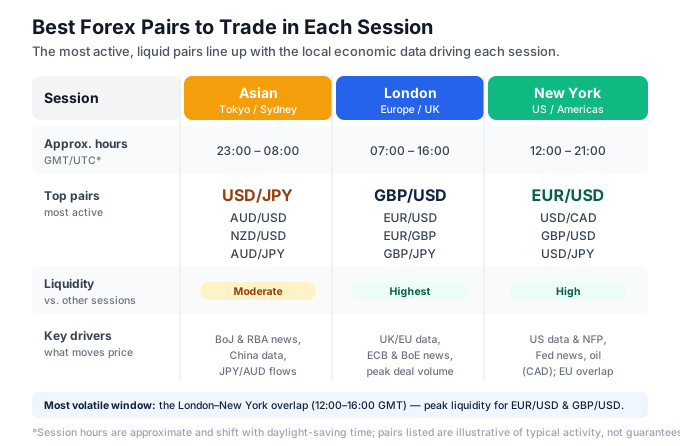
If you trade XAU/USD (gold), the same overlap applies, but respect gold’s character: it moves $20–$50 in a normal day and spikes hard around the New York open and news. Gold needs wider stops than EUR/USD — roughly 1.5 times the distance — because its normal wicks would sweep a forex-sized stop.
5 beginner day trading strategies
You do not need all five. Learn the first one until it is boring, then reach for the others only when you understand why it works. Each of these is a genuine intraday strategy — none is scalping and none is swing trading.
1. Trend-following pullback (EMA)
The one strategy to master first. In an intraday trend, price rarely moves in a straight line — it pushes, pulls back, then pushes again. You buy the pullback in an uptrend, or sell it in a downtrend, trading with the dominant force at a discount rather than chasing an extended move.
- Timeframe: H1 for the trend, M15 for the entry.
- Indicator: a 20 EMA (Exponential Moving Average) and a 50 EMA on the H1.
- Rules: go long only when the 20 EMA is above the 50 EMA and price is above both. Wait for a pullback toward the 20 EMA, then enter when a candle closes back in the trend direction off that level. Stop below the recent swing low; target the prior high or a 1:2 reward.
2. Breakout (London-open / session-range)
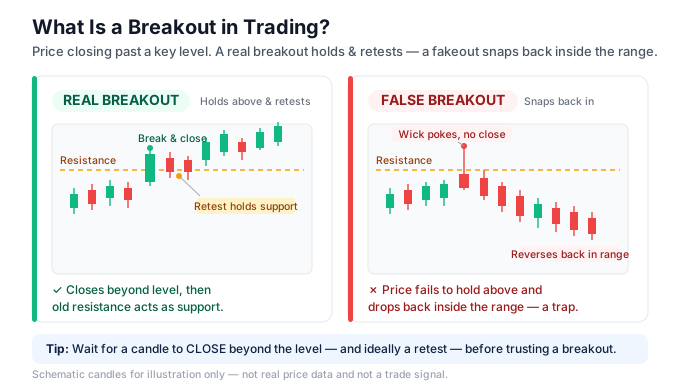
Markets often coil quietly during the Asian session, then break when London arrives. This strategy trades that release of energy.
- Timeframe: M15.
- Tool: horizontal lines marking the Asian session high and low (roughly 23:00–07:00 GMT).
- Rules: mark the range. When London opens (08:00 GMT) and a candle closes beyond the range, enter in the breakout direction. Stop on the opposite side of the range; target a multiple of the range height. Wait for the close — chasing the wick is how beginners get faked out.
3. Support and resistance bounce
Price respects levels where it has reversed before. This strategy fades those levels — but only with confirmation.
- Timeframe: H1 to find levels, M15 to enter.
- Rules: mark two or three clear levels where price has reacted before. When price returns to a level, wait for a rejection candle (a long wick or an engulfing candle) at the level, then enter toward the middle of the range. Stop a few pips beyond the level; target the next level. A bounce without a rejection candle is not a signal — it is hope.
4. Momentum (MACD / RSI)
Momentum strategies enter in the direction of a strong, accelerating move rather than fading it.
- Timeframe: M15 or H1.
- Indicator: MACD (12, 26, 9) or RSI (14).
- Rules: in an established H1 trend, use the MACD line crossing its signal line in the trend direction as your trigger, or RSI crossing back above 50 (for longs) after a pullback. Momentum tools are confirmation, not standalone signals — take the cross only when it agrees with the higher-timeframe trend.
5. News reaction (advanced — trade with caution)
High-impact releases — NFP, CPI, FOMC — move the majors fast. Some day traders trade the reaction; beginners should mostly avoid trading the news itself. Spreads widen violently, slippage is real, and the first move often reverses before the “real” direction appears.
The safer beginner approach: don’t trade in the first minutes after a release. Wait for the dust to settle, let a clear direction form on the M15, then apply the trend-following pullback above. Check the economic calendar (forexfactory.com) each morning so you know when the red-folder events hit.
If you want fully worked, ready-to-trade setups once you have the basics down, our roundup of advanced day trading setups breaks down five more detailed systems. This page is the beginner starting point; that one is the next step.
A worked example — one full day trade
Rules are abstract until you see the numbers. Here is one complete trend-following pullback trade, start to finish, with the math shown.
The setup:
- Account balance: $2,000
- Risk per trade: 1% = $20
- Pair: EUR/USD, London/NY overlap
- Context: on the H1, the 20 EMA is above the 50 EMA and price is above both — a clean uptrend.
- Signal: price pulls back to the 20 EMA on the M15 and prints a bullish candle that closes back up off the level.
- Entry: 1.0850
- Stop-loss: 1.0830 — a few pips below the pullback swing low = 20 pips
- Take-profit: 1.0890 — the prior intraday high = 40 pips away (a 1:2 risk-reward)
Step 1 — confirm the pip value. On EUR/USD, one pip is 0.0001. On a full standard lot (100,000 units) of a USD-quoted pair, one pip is worth $10. Pip value scales down proportionally with lot size.
Step 2 — calculate the position size. The formula:
Lot size = risk in dollars ÷ (stop in pips × pip value per standard lot)
Plugging in:
Lot size = $20 ÷ (20 × $10) = $20 ÷ $200 = 0.10 lot
Step 3 — verify the risk. A 0.10 lot is worth $1 per pip (0.10 × $10). A 20-pip stop-out costs 20 × $1 = $20 — exactly your 1% limit. The math holds.
Step 4 — check the reward. The 40-pip take-profit at $1 per pip returns 40 × $1 = $40, or 2R. Win the trade and you make $40; lose it and you lose $20.
Run this before every trade. Our position size calculator does the arithmetic instantly if you would rather not do it by hand. The discipline of sizing to a fixed risk — not the strategy itself — is what separates traders who survive from those who blow up.
Risk management for day traders
A day trader takes more trades than a swing trader, which means more chances to lose, so it is worth weighing whether day trading is worth it before you commit. Risk management is not the boring part of the job — it is the job.
The core rule is the 1% rule: never risk more than 1% of your account equity on a single trade. On the $2,000 account above, that is $20 per trade. Risk 1% and it takes a long, unlikely losing streak to do serious damage; risk 10% and three bad trades in a row can cripple the account.
Every trade needs a stop-loss placed before you enter, at a level the chart justifies — beyond a swing low, beyond a level, beyond the range. Then you size the position so that stop distance equals your 1% risk. Stop first, size second. Never widen a stop to “give the trade room” once it is live.
Cap your day. Many day traders set a daily loss limit — for example, stop trading after two or three losing trades, or after losing 2–3% of the account in a session. This stops a bad morning from becoming a blown account. Revenge trading after a loss is the single most common way beginners destroy accounts.
Day trading vs swing trading — which suits you?
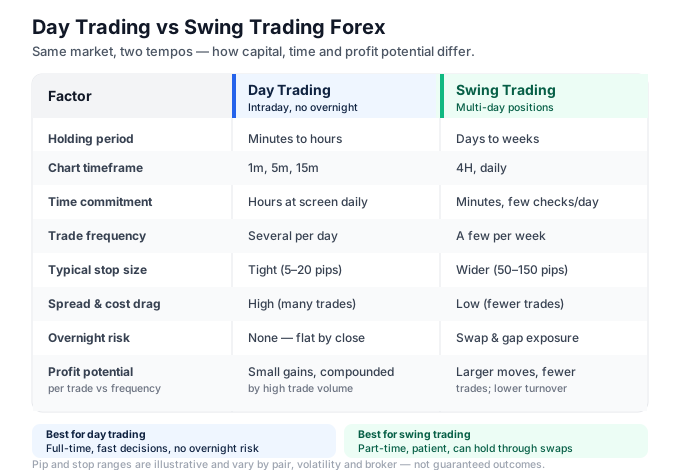
The most useful decision a beginner can make is not which strategy but which style fits their life. Day trading and swing trading demand different things.
| Factor | Day trading | Swing trading |
|---|---|---|
| Trade duration | Minutes to hours (same day) | Days to weeks |
| Screen time | High — active during your session | Low — check once or twice a day |
| Timeframes | M15, H1 | H4, D1 |
| Overnight risk | None (closed daily) | Yes (gaps, weekend risk) |
| Number of trades | Several per session | A few per week |
| Best for | People with focused screen time | People with a day job |
| Main challenge | Pace, discipline, spread cost | Patience, wider stops, gap risk |
Day trading is not more skilful than swing trading — the analysis is largely the same technical reading; it is more demanding of your time and nerves. If you can dedicate a focused block during the London/NY overlap, day trading fits. If you can only glance at charts after work, swing trading is the honest choice. Both rest on the same foundation of technical analysis.
Common day trading mistakes to avoid
These are the errors that quietly drain beginner day-trading accounts. Each has a specific fix.
- Overtrading. Taking a trade every time the screen twitches. Fix: trade only your one strategy, only in your window, only when the setup is textbook. A no-trade day is a valid outcome.
- Trading outside the overlap. Forcing breakouts during the dead Asian hours. Fix: trade the 13:00–17:00 GMT window where moves are real.
- Skipping the stop. “I’ll close it manually if it goes wrong.” You won’t, and it will gap. Fix: set the stop before you enter, every time.
- Risking too much per trade. 5% or 10% “to make the day worth it.” Fix: 1% per trade, no exceptions.
- Revenge trading. Doubling size to win back a loss. Fix: a hard daily loss limit — walk away after it hits.
- Trading the news blind. Buying into an NFP spike with a tight stop. Fix: wait for the dust to settle, then trade the clean move that follows.
Frequently asked questions
How much money do you need to start day trading forex?
Many brokers let you open a day trading account for $100 or less, but a realistic starting balance for most beginners is $500 to $2,000. Small accounts are fine to learn on — they can’t absorb large dollar swings, so the 1% risk rule matters even more. Start on a demo account first, then trade small live.
What’s the best day trading strategy for a complete beginner?
The trend-following pullback is the best first strategy. Trade only in the direction of the H1 trend (20 EMA above 50 EMA for longs), wait for price to pull back to the 20 EMA, then enter when a candle closes back in the trend direction. It keeps you trading with the market rather than guessing tops and bottoms.
What’s the best timeframe for day trading — M5, M15, or H1?
For beginners, use H1 to read the trend and M15 to time entries. M5 fires far more false signals because spread and noise dominate small candles, and it demands faster decisions than most beginners can make well. Learn on M15/H1 first; only drop to M5 once you are consistently profitable and understand your spread cost.
How many pips a day is realistic for a beginner?
There is no fixed number, and chasing a daily pip target causes overtrading. A realistic goal is one or two clean setups per session at a 1:2 risk-reward — some days that is 40 pips, many days it is zero. Consistency and risk control matter far more than a pip count.
Can you day trade forex part-time?
Yes. Day trading only requires you to be present during your chosen window — for most beginners, the London/NY overlap (13:00–17:00 GMT). If those hours don’t fit, trade the London open instead, or accept that swing trading suits your life better. What doesn’t work is glancing at charts randomly between other tasks; a position needs focused attention while it is open.
Which currency pairs are best for day trading?
Stick to the majors: EUR/USD, GBP/USD, and USD/JPY. They have the tightest spreads, the deepest liquidity, and the cleanest intraday moves. EUR/USD is the calmest and the best first pair. Avoid exotic pairs (USD/ZAR, USD/TRY) while learning — their wide spreads eat intraday profits, and their thin liquidity produces erratic moves.
Is day trading harder than swing trading?
Not in skill — the technical analysis is largely the same. Day trading is harder in pace: it demands focused screen time, faster decisions, and tighter discipline, and spread cost bites more when trades are short. Swing trading is slower and suits a day job, but carries overnight gap risk. Choose the one that fits your available time, not the one that sounds more exciting.
Do you need indicators to day trade forex?
No — many traders day trade on price action alone using support, resistance, and candlestick signals. But beginners usually benefit from one or two simple tools: a moving average for trend direction and, optionally, MACD or RSI for momentum confirmation. The goal is to keep the chart clean. Two indicators used with rules beat ten indicators contradicting each other.
Forex and CFD trading carries a high level of risk and may not be suitable for all traders. The strategies described in this article are educational. Past performance does not guarantee future results. Always test on a demo account before risking real capital.
Forex day trading is simple to define and hard to master: open and close within the day, trade the London/NY overlap, stick to the majors, and learn one strategy — the trend-following pullback — before anything else. Size every trade to 1% with a stop you set in advance, cap your losses for the day, and let the discipline compound. Master the beginner setup here, then move on to more advanced day trading setups when the basics are automatic.
Related: Forex Chart Reading for Beginners