


Last updated:
The best forex currency pairs to trade are the ones that match your session, your style, and your budget — not a fixed “top 10” list. For most traders, that means picking 1 to 3 pairs and learning them deeply. Beginners should start with EUR/USD: it has the highest liquidity and the lowest spread of any pair.
Key takeaways
- There is no single “best” pair. The best pair for you is the one whose active hours match when you trade and whose volatility suits your style.
- Trade 1 to 3 pairs, not fifteen. Depth beats breadth — you learn a pair’s rhythm, its typical range, and how it behaves at news.
- Beginners start with EUR/USD: deepest liquidity, tightest spread (often around 0.1–1.0 pip), and the cleanest, least erratic moves.
- Judge a pair on five factors: liquidity and spread, volatility, session timing, correlation, and holding cost (swap).
- Avoid exotics (USD/ZAR, USD/TRY, USD/MXN) while learning — wide spreads and thin liquidity eat your edge.
- Correlated pairs double your risk. Long EUR/USD and short USD/CHF is close to one big bet, not two separate ones.
The three types of currency pairs
Before you choose, you need the map. Every forex pair falls into one of three buckets, and the bucket largely decides its spread, liquidity, and volatility. If you want the full breakdown, read our guide to the different types of currency pairs in forex — this section is the short version.
Majors pair the US dollar with another major economy’s currency: EUR/USD, GBP/USD, USD/JPY, USD/CHF, USD/CAD, AUD/USD, and NZD/USD. These carry the deepest liquidity and the tightest spreads on the market. EUR/USD alone is the single most-traded pair in the world.
Minors (also called crosses) are pairs that leave out the US dollar but still involve major currencies — EUR/GBP, EUR/JPY, GBP/JPY, AUD/JPY. Spreads are wider than majors and moves can be larger, but liquidity is still solid. GBP/JPY is a well-known example of a volatile cross.
Exotics pair a major currency with an emerging-market currency: USD/ZAR (South African rand), USD/TRY (Turkish lira), USD/MXN (Mexican peso), USD/THB. They have the widest spreads, the thinnest liquidity, and the sharpest, most news-driven moves. They are not a good place to learn.
The 5 factors that make a pair “good” for you
A pair is not good or bad in the abstract. It is good or bad for a specific trader trading at a specific time in a specific style. Score any pair against these five factors.
Liquidity and spread
Liquidity is how easily a pair can be bought or sold without moving the price. Spread is the gap between the buy and sell price — your main cost on every trade. The two go together: high liquidity means a tight spread, low liquidity means a wide one.
Majors have the tightest spreads. EUR/USD typically trades around 0.1–1.0 pip on a standard retail account; GBP/USD and USD/JPY sit slightly higher. Exotics can run 15, 30, or 50+ pips wide. That spread is a cost you pay the moment you enter, so it matters far more to a scalper taking ten trades a day than to a swing trader holding for a week.
Compare live spreads across pairs before you commit to one — our spread comparison tool shows the difference at a glance.
Volatility
Volatility is how much a pair moves in a typical day. More movement means more profit potential and more risk — the two are inseparable. EUR/USD is relatively calm. GBP/JPY and XAU/USD (gold) move much more.
Match volatility to your style and your nerves. A beginner learning position sizing is better off on a calmer pair like EUR/USD, where a normal day won’t blow through a sensibly placed stop. High-volatility pairs demand wider stops, smaller position sizes, and more experience.
The volatility heatmap shows which pairs are moving most right now, so you can size and select accordingly.
Session timing
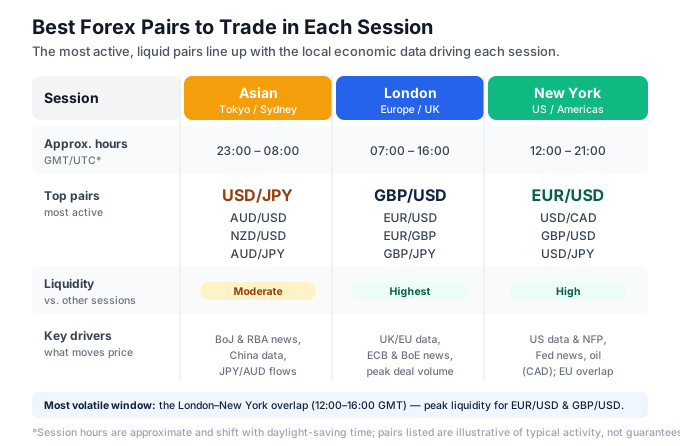
A pair is only worth trading when its market is awake. Each pair is most active — tightest spread, cleanest moves — during its home session.
- EUR/USD, GBP/USD, USD/CHF, EUR/GBP — most active during the London session (08:00–17:00 GMT) and the London/New York overlap (13:00–17:00 GMT).
- USD/JPY, AUD/USD, NZD/USD — most active during the Asian session (23:00–08:00 GMT) and into the London open.
- USD/CAD and USD-quoted pairs — cleanest during the New York session (13:00–22:00 GMT).
If you can only trade after work in the evening (say, in the WIB or IST time zone), you should pick pairs that are liquid in your window, not pairs that only move while you are asleep. Trading a pair during its dead hours means wider spreads and choppy, range-bound price.
Correlation
Correlation measures how two pairs move relative to each other. Positively correlated pairs (EUR/USD and GBP/USD) tend to move the same direction; negatively correlated pairs (EUR/USD and USD/CHF) tend to move opposite.
This matters for risk. If you go long EUR/USD and long GBP/USD, you have not diversified — you have doubled down on a weak-dollar bet. If both go against you, you lose on both at once. Beginners often think they are spreading risk across two trades when they are actually placing one big correlated bet.
Check how your pairs move together before you stack positions — the correlation matrix shows the relationships clearly.
Cost (swap)
Swap (or rollover) is the interest you pay or receive for holding a position past the daily rollover, usually 22:00 GMT. It comes from the interest-rate difference between the two currencies in the pair.
For a day trader who closes before rollover, swap is irrelevant. For a swing or position trader holding for days or weeks, swap can quietly eat profits — or, occasionally, add to them. Pairs with a large interest-rate gap (some involving JPY or exotics) carry the biggest swap charges. If you hold trades overnight, check the swap on your broker before you choose the pair.
Best pairs by trading style
Your style narrows the field more than anything else. A scalper and a position trader should not be trading the same shortlist.
Scalping and day trading
Short holds mean spread is your biggest enemy — you pay it on every one of many trades. Stick to the tightest-spread majors: EUR/USD, USD/JPY, GBP/USD. Trade them during the London/New York overlap when spreads are tightest and moves are cleanest. Our guide to day trading strategies for beginners covers the setups that suit these pairs.
Swing trading
Holding for days means spread matters less and the daily range matters more. You can widen the net to include liquid crosses like EUR/JPY or GBP/JPY alongside the majors, because a few extra pips of spread is trivial against a 200-pip swing. Account for swap on multi-day holds. See our swing trading strategies for forex traders for the full approach.
Position trading
Holding for weeks or months, you are trading the macro trend and the interest-rate story more than the chart. Major pairs with clear central-bank divergence work best — EUR/USD, USD/JPY, AUD/USD. Swap becomes a real factor over long holds, and it can work for or against you depending on direction.
Best currency pairs for beginners
If you are starting out, ignore the crosses and exotics entirely. Learn on the four most liquid, best-behaved majors. Here is how they compare.
| Pair | Nickname | Typical spread | Character | Best session |
|---|---|---|---|---|
| EUR/USD | “Fiber” | ~0.1–1.0 pip | Calmest, most liquid, cleanest moves — the best first pair | London / NY overlap |
| USD/JPY | “Ninja” / “Gopher” | ~0.5–1.5 pips | Smooth trends; JPY pip = 0.01, not 0.0001 | Asian / London |
| GBP/USD | “Cable” | ~0.6–1.5 pips | More volatile than EUR/USD; bigger daily range | London |
| USD/CHF | “Swissy” | ~0.8–1.8 pips | Safe-haven flows; inversely tracks EUR/USD | London / NY |
Start with EUR/USD. It is the most forgiving pair to learn position sizing, stop placement, and strategy execution on, because its moves are orderly and its spread is the lowest you will find. Add a second pair only once the first feels automatic.
A note on XAU/USD (gold): many beginners are drawn to it, and it is popular for good reason. But gold moves $20–$50 in a normal day and spikes hard around the New York open and news releases. Its spread is far wider than EUR/USD (often 15–35 pips), and it needs roughly 1.5 times wider stops. Treat gold as a step up, not a starting point.
How many pairs should you trade?
Trade 1 to 3 pairs. That is the whole rule.
Each pair has its own rhythm — its typical daily range, how it behaves at the London open, how it reacts to its home country’s news. You cannot learn that for fifteen pairs at once. Traders who watch too many pairs end up knowing none of them well and force marginal trades to stay busy.
Start with one pair — EUR/USD — until its behaviour is familiar. Add a second only when you can trade the first without hesitation, and make it one that trades in a different session or has low correlation to the first, so you always have a live opportunity without doubling your risk. Three well-understood pairs is plenty for a full-time trader.
More pairs is not more opportunity. It is more noise, more screen time, and more chances to break your own rules.
Tools to compare pairs
You do not have to guess at any of the five factors. These free tools give you the live data:
- Correlation matrix — see which pairs move together before you stack two correlated positions.
- Currency strength meter — spot which currencies are strong and weak right now, so you pair strength against weakness.
- Volatility heatmap — check which pairs are moving most today, to match volatility to your style.
- Spread comparison — compare live spreads across pairs so you know your entry cost before you trade.
Used together, these turn “which pair should I trade?” from a guess into a decision based on live numbers.
Compare top forex brokers
The pair you choose only matters if the spread you pay on it is fair. Your broker sets that spread, so broker choice and pair choice are linked. The three brokers below are widely used by retail traders for accessible accounts and competitive spreads on the majors. This is general information, not personalised advice — regulation and account terms vary by country and change over time, so do your own checks first.
- XM — open an XM account. XM is a long-established broker popular with beginners for low entry requirements, free demo accounts, and competitive spreads on the major pairs. Account options scale from small starting balances upward. Suitability and available account types depend on your region.
- FBS — open an FBS account. FBS offers beginner-friendly account types and a strong focus on educational content, with demo accounts so you can practise pair selection before trading live. As with any broker, the products and protections you get depend on where you live.
- FXOpen — open an FXOpen account. FXOpen is an established broker offering a range of account types and the widely used MetaTrader platforms, with raw-spread options that matter if you scalp the majors. It supports demo trading for risk-free practice. Available features and regulation differ by jurisdiction.
Disclaimer: Always verify each broker’s current regulation, spreads, and account terms on the regulator’s official register and the broker’s own site before depositing any money. If you are still choosing a broker, read our full guide to choosing the right forex broker for beginners first.
Frequently asked questions
What is the best forex pair to trade for beginners?
EUR/USD is the best pair for beginners. It has the highest liquidity and the tightest spread of any pair (often around 0.1–1.0 pip), and its moves are calmer and cleaner than volatile pairs like GBP/JPY or gold. That makes it the most forgiving pair to learn stop placement, position sizing, and strategy execution on.
How many currency pairs should I trade at once?
Trade 1 to 3 pairs. Each pair has its own rhythm — daily range, session behaviour, news reactions — and you cannot learn that for many pairs at once. Start with one (EUR/USD), add a second only when the first is automatic, and choose pairs in different sessions or with low correlation so you don’t double your risk.
What are the most liquid forex pairs?
The majors are the most liquid: EUR/USD, USD/JPY, GBP/USD, USD/CHF, USD/CAD, AUD/USD, and NZD/USD. EUR/USD is the most liquid pair in the world. High liquidity means tighter spreads and cleaner price action, which is why majors are the standard choice for both beginners and professionals.
Should I trade major or exotic currency pairs?
Trade majors, especially while learning. Majors have the tightest spreads and deepest liquidity. Exotics (USD/ZAR, USD/TRY, USD/MXN) have spreads of 15–50+ pips, thin liquidity, and sharp news-driven moves that make them expensive and erratic. The wide spread alone can erase a beginner’s edge before the trade even moves.
Why does the currency pair I choose depend on my time zone?
Because each pair is only active during its home session. EUR/USD and GBP/USD move most during London hours (08:00–17:00 GMT); USD/JPY and AUD/USD are most active in the Asian session (23:00–08:00 GMT). Trading a pair during its dead hours means wider spreads and choppy, range-bound price. Pick pairs that are liquid when you actually trade.
Are correlated currency pairs bad to trade together?
They are risky if you don’t account for the correlation. Going long EUR/USD and long GBP/USD isn’t two diversified trades — both are weak-dollar bets, so you lose on both at once if the dollar strengthens. Check a correlation matrix before stacking positions, and avoid holding two highly correlated pairs in the same direction.
What is the best currency pair for day trading?
EUR/USD, USD/JPY, and GBP/USD are best for day trading. Because you pay the spread on every one of many trades, tight-spread majors keep your costs down. Trade them during the London/New York overlap (13:00–17:00 GMT), when spreads are tightest and directional moves are cleanest.
Is trading gold (XAU/USD) good for beginners?
Gold is popular but not a beginner starting point. It moves $20–$50 a day, spikes hard at the New York open and news, and its spread (often 15–35 pips) is far wider than EUR/USD. It needs roughly 1.5 times wider stops and more experience to size correctly. Learn on EUR/USD first, then step up to gold.