


Last updated:
The best MT4 indicators are the Moving Average, MACD, RSI, Stochastic, Bollinger Bands, ADX, Parabolic SAR, Fibonacci retracement, the Money Flow Index (MFI), and the Ichimoku Cloud. Each answers a different question — trend, momentum, or volatility — and the real edge comes from combining two or three. Here’s how to read and combine them.
Key takeaways
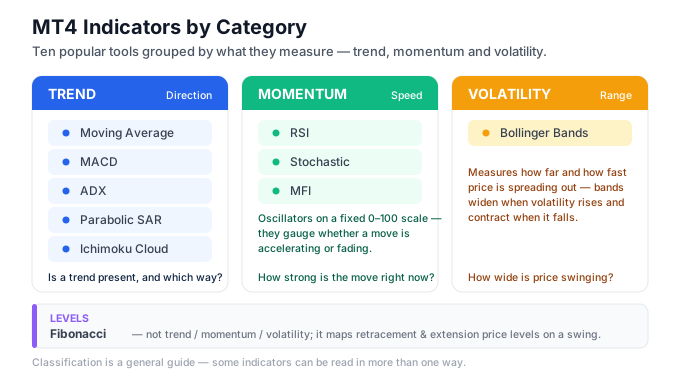
- The top 10 split into three jobs: trend (Moving Average, MACD, ADX, Parabolic SAR, Ichimoku), momentum (RSI, Stochastic, MFI), and volatility (Bollinger Bands) — plus Fibonacci for mapping levels.
- No single indicator is “the best.” The best one is whichever answers the question your setup needs — direction, timing, or volatility context.
- Combine across categories, not within. One trend tool plus one momentum tool confirms from independent angles; two momentum tools only agree with each other.
- Two or three indicators is the working cap. Beyond that they contradict each other and cause hesitation, not confidence.
- All ten ship free with MT4. They are built into the platform’s Insert → Indicators menu — you do not need to download or pay for any of them.
- Standard settings are standard for a reason. RSI 14, MACD 12/26/9, Stochastic 14/3/3, ADX 14 — start there before you optimise.
What makes an MT4 indicator “good”?
A “good” MT4 indicator is not the one with the most arrows or the flashiest colours. It is one that answers a specific question clearly and does not pretend to answer questions it can’t. Every indicator on this list is a formula applied to price — it organises what already happened so you can read it faster.
The ten below earn their place because they cover the three questions that matter, and because they are built into MT4 so every trader can test them. Knowing which category an indicator belongs to tells you what it is for — and stops you stacking three tools that all say the same thing.
Trend indicators tell you direction and strength: which way is price moving, and is the move real? Moving Average, MACD, ADX, Parabolic SAR, and the Ichimoku Cloud live here. They work best in trending markets and mislead you in ranges.
Momentum indicators (oscillators) tell you whether a move is accelerating or fading, usually on a fixed 0-100 scale. RSI, Stochastic, and MFI are the momentum tools here. They shine in ranging markets and for timing pullbacks; they fail when used to fade a strong trend.
Volatility indicators tell you how wide price is swinging. Bollinger Bands are the classic volatility measure — the bands expand when price moves and squeeze when it goes quiet. Fibonacci sits slightly apart: it is a levelling tool that maps likely support and resistance from a prior swing.
The point of categories is simple. A strong setup has agreement across categories — a trend indicator and a momentum indicator pointing the same way. That is worth far more than five indicators from the same box all nodding along. Our full guide to how to combine indicators builds systems from exactly this idea.
The top 10 MT4 indicators
1. Moving Average
What it does: smooths price into a single line so you can see the underlying trend without the candle-to-candle noise. The Simple Moving Average (SMA) weights all periods equally; the Exponential Moving Average (EMA) weights recent prices more, so it reacts faster.
Best for: trend direction and dynamic support/resistance. The 50 EMA and 200 SMA are the two most-watched.
How to read it: price above a rising moving average is an uptrend; price below a falling one is a downtrend. When a faster MA crosses above a slower one, momentum is turning up — the classic version, the 50-day crossing above the 200-day, is the “golden cross.” It lags by design — it confirms trends rather than predicting them.
2. MACD
What it does: the MACD (Moving Average Convergence Divergence) measures the relationship between two EMAs, plotting a MACD line, a signal line, and a histogram. Default settings are 12, 26, 9.
Best for: confirming trend momentum and spotting divergence.
How to read it: when the MACD line crosses above the signal line, momentum is shifting up; below, down. The histogram shows the gap between the two lines — growing bars mean momentum is building. The higher-probability use is divergence: price makes a new high but MACD doesn’t, warning the trend is tiring.
3. RSI
What it does: the RSI (Relative Strength Index) is a momentum oscillator that measures the speed of recent price changes on a 0-100 scale. Default: 14-period, with 70/30 thresholds.
Best for: spotting overbought/oversold conditions and divergence in ranging markets. Our RSI analysis guide goes deeper on reading it.
How to read it: above 70 is traditionally overbought, below 30 oversold — but in a strong trend RSI can sit above 70 for many candles, so those levels are not automatic sell signals. Use RSI to time pullbacks with the trend, or to catch divergence, rather than to fade a trend outright.
4. Stochastic Oscillator
What it does: compares the closing price to the high-low range over a set period, plotting two lines (%K and %D) on a 0-100 scale. Default settings: 14, 3, 3.
Best for: timing entries in ranging markets and confirming pullbacks.
How to read it: above 80 is overbought, below 20 oversold. A %K/%D crossover coming out of an extreme is the classic signal. Stochastic fires more signals than RSI, which makes it useful in ranges but noisy in trends — most traders pair it with a trend filter.
5. Bollinger Bands
What it does: plots a moving average (usually 20-period) with two bands set two standard deviations above and below it. The bands are a volatility measure — they widen when price moves and squeeze when it goes quiet.
Best for: reading volatility and identifying squeezes before expansion.
How to read it: a “squeeze” (narrow bands) signals low volatility that often precedes a breakout — common in the hours before high-impact news. Price tagging a band is not an automatic reversal: in a strong trend price rides the upper band for a long time. Our guide to trading with Bollinger Bands shows how to pair them with momentum.
6. ADX
What it does: the ADX (Average Directional Index) measures trend strength — not direction — on a 0-100 scale. Default period: 14.
Best for: filtering out ranging markets before you apply a trend strategy.
How to read it: above 25 means a real trend is present and trend tools are worth trusting; below 20 means the market is ranging and trend signals will fail. ADX is a gatekeeper, not an entry trigger. It tells you which mode the market is in so you pick the right tool.
7. Parabolic SAR
What it does: the Parabolic SAR (Stop and Reverse) plots dots above or below price. Dots below price signal an uptrend; dots above signal a downtrend, and they flip sides when the trend changes.
Best for: trailing stops and confirming trend direction.
How to read it: hold long while dots sit below price; the dot level is a ready-made trailing stop that ratchets in your favour. It works well in strong trends and whipsaws badly in ranges — which is exactly why traders pair it with ADX to confirm a trend exists first.
8. Fibonacci Retracement
What it does: maps horizontal levels (23.6%, 38.2%, 50%, 61.8%, 78.6%) between a swing high and swing low, marking where a pullback might find support or resistance.
Best for: finding entry zones within a trend and setting logical targets.
How to read it: in an uptrend, draw from swing low to swing high; the 38.2%-61.8% zone is where pullbacks often stabilise before the trend resumes. The 61.8% level (“the golden ratio”) is the most-watched. Fibonacci is a mapping tool — it marks where, not when, so combine it with a momentum signal for timing.
9. Money Flow Index (MFI)
What it does: the MFI is a momentum oscillator that adds volume to the RSI concept — it measures buying and selling pressure on a 0-100 scale using price and volume. Often called “volume-weighted RSI.”
Best for: confirming momentum with a volume dimension, and spotting divergence.
How to read it: above 80 is overbought, below 20 oversold. Because MFI factors in volume, a divergence between price and MFI can be a stronger warning than RSI divergence alone. Note that forex volume in MT4 is tick volume, not true traded volume — treat MFI readings as relative pressure, not an exact volume figure.
10. Ichimoku Cloud
What it does: the Ichimoku Cloud (Ichimoku Kinko Hyo) packs trend direction, momentum, and support/resistance into one view using five lines — Tenkan-sen, Kijun-sen, Chikou Span, and the two Senkou lines that form the “cloud” (Kumo).
Best for: an all-in-one trend and support/resistance read, especially on H4 and D1.
How to read it: price above the cloud is bullish, below is bearish, inside is a no-trade zone. A thick cloud signals strong support/resistance; a thin one signals a weak zone prone to breaking. Ichimoku looks intimidating but it is one indicator doing the work of three — which is why it stays popular decades after Goichi Hosoda published it.
Best MT4 indicator combinations
No indicator works alone. The strongest setups pair tools from different categories so each confirms from an independent angle. These three combinations cover most of what trading actually requires.
Moving Average + RSI (the beginner workhorse). The moving average sets direction; RSI times the pullback entry. In an uptrend — price above the 50 EMA — you ignore RSI overbought readings and wait for RSI to dip toward 40-50 and turn back up. The MA keeps you on the right side; RSI times the entry.
MACD + Bollinger Bands (momentum meets volatility). When the Bollinger Bands squeeze, the market is coiling. When price breaks out and MACD confirms with a crossover in the same direction, you have volatility and momentum agreeing — a stronger case than either alone.
EMA + ADX + Parabolic SAR (a stricter trend system). ADX is the gatekeeper: only trade the trend when ADX reads above 25. The EMA gives direction, and Parabolic SAR trails the stop as the move runs. This is the rare case where three indicators earn their place because each does a genuinely different job. For the full method, see our guide on how to combine indicators for analysis.
How many indicators should you use?
Two or three. That is the working cap, and it holds for almost every trader.
The temptation is to add a fourth and fifth indicator for “more confirmation.” It backfires. Add RSI, Stochastic, and MFI to one chart and you have three momentum tools that nearly always agree — that is one signal wearing three hats, not three confirmations. Worse, on any given candle at least one of five indicators will disagree with the others, so you either freeze or override your own rules.
The fix is category discipline: one trend indicator, one momentum indicator, and optionally one volatility tool for context. If you want to add a new indicator, remove one first. A chart you can read in three seconds produces cleaner decisions than a dashboard you have to interpret.
On XAU/USD (gold), the same combinations apply but the settings need loosening. Gold’s higher volatility keeps RSI and Stochastic overbought or oversold for longer stretches than EUR/USD, so RSI 14 fires more false signals — many gold traders use RSI 21 instead and give ADX more room before trusting a trend. Gold’s wider daily range means an oscillator screaming “overbought” can stay that way through an entire trending session.
How to install MT4 indicators
Every indicator on this list is already built into MT4 — you do not need to download anything. To add one to a chart:
- Open the Insert menu. Click Insert → Indicators in the top MT4 menu bar.
- Pick the category. Choose Trend, Oscillators, Volumes, or Bill Williams, then select the indicator (e.g. Moving Average, RSI, Bollinger Bands).
- Set the parameters. In the pop-up, set the period and levels — leave them at default (RSI 14, MACD 12/26/9) until you have a reason to change them.
- Click OK. The indicator applies to the active chart.
For a custom indicator you downloaded (an .ex4 or .mq4 file), the process differs: go to File → Open Data Folder → MQL4 → Indicators, paste the file there, restart MT4, and it appears in the Navigator panel under Indicators. Our roundup of 5 MT4 indicators that improve win rate covers a few custom picks worth adding beyond the built-ins.
Frequently asked questions
What is the best MT4 indicator overall?
There is no single best MT4 indicator — it depends on what your setup needs. For trend direction, the Moving Average and MACD are the most widely used; for timing entries, RSI; for trend strength, ADX. Most experienced traders combine a trend indicator with a momentum one rather than relying on any single tool.
What is the most accurate MT4 indicator?
No indicator is “accurate” in the sense of predicting price — every one is a formula applied to past price. Be skeptical of any “100% accurate” or “non-repainting” claim; those are marketing, not results. The most reliable tools are lagging trend indicators like moving averages, because they confirm moves that have already started instead of guessing.
What is the best MT4 indicator for beginners?
The Moving Average paired with RSI (14, 70/30) on the H1 chart. It uses standard settings, combines a trend tool with a momentum tool, and enforces the key beginner habit: trade with the trend and use the oscillator only to time pullbacks. Master this two-indicator combination before adding anything else.
What is the best MT4 indicator combination?
For most traders, a Moving Average plus RSI — one sets trend direction, the other times pullback entries. For a stricter trend system, add ADX as a strength filter and Parabolic SAR to trail the stop. The rule is to combine indicators from different categories (trend, momentum, volatility) so they confirm from independent angles.
Are MT4 indicators free?
Yes. All ten indicators on this list are built into MT4 for free, under the Insert → Indicators menu. You never need to pay for the standard built-ins. Paid or “custom” indicators exist, but a beginner can build a complete strategy using only the free built-in tools.
What is the best non-repainting MT4 indicator?
The built-in classics — Moving Average, MACD, RSI, ADX, Bollinger Bands — do not repaint, because they calculate on closed candles. Be cautious with third-party “no-repaint” arrow indicators; many recalculate signals after the fact. If an indicator is built into MT4 and reads from closed prices, repainting is not a concern.
How many MT4 indicators should I use at once?
Two or three, each from a different category — one trend, one momentum, optionally one volatility. Beyond three, indicators start contradicting one another and cause hesitation. If you want to add one, remove one first. A clean two-indicator chart produces better decisions than a crowded six-indicator one.
Do professional traders use MT4 indicators?
Some do, many don’t rely on them heavily. Professionals tend to use indicators as confirmation for a decision made from price structure and context, not as standalone signals. The common thread is restraint — a couple of well-understood indicators used consistently, rather than a screen full of tools fighting each other.
The top 10 MT4 indicators are not a ranked ladder where one wins — they are ten tools covering three jobs. Moving Average, MACD, ADX, Parabolic SAR, and Ichimoku read the trend; RSI, Stochastic, and MFI read momentum; Bollinger Bands read volatility; and Fibonacci maps the levels. Pick two or three that answer different questions, start with the standard settings, and add strict risk control. That is a real system — not a cluttered chart.
Forex and CFD trading carries a high level of risk and may not be suitable for all traders. The strategies and indicators described in this article are educational. Past performance does not guarantee future results. Always test on a demo account before risking real capital.
Ready to put this into practice?
Open an account with a regulated broker and apply what you have learned. These are the three brokers we recommend:
Trading forex and CFDs carries a significant risk of loss and is not suitable for everyone. Broker links are affiliate links — we may earn a commission at no cost to you.